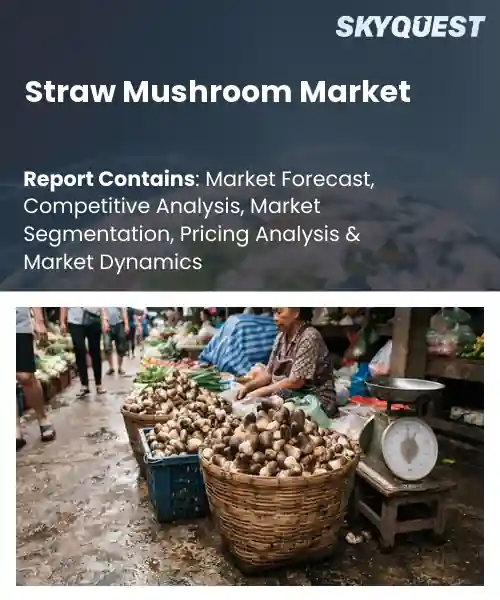
Straw Mushroom Market
Report ID: SQMIG30H2566
Report ID: SQMIG30H2566
[email protected]
USA +1 351-333-4748
Report ID:
SQMIG30H2566 |
Region:
Global |
Published Date: August, 2026
Pages:
157
|Tables:
118
|Figures:
77


Global Straw Mushroom Market size was valued at USD 0.5 Billion in 2024 and is poised to grow from USD 0.54 Billion in 2025 to USD 1.05 Billion by 2033, growing at a CAGR of 8.5% during the forecast period (2026-2033).
Growing demand for fresh produce has propelled the global straw mushroom market, which covers cultivation, distribution, and processing of Volvariella volvacea. Valued for its delicate texture and rapid growth, the fungus supplies millions in Southeast Asian dishes and is entering Western ready‑meal kits. Historically, smallholder farms in Thailand and Vietnam led supply, yet the decade saw mechanised farms cut harvest time from ten to six days, lifting output from 1.2 million tons in 2010 to over 2.1 million in 2023. This rise mirrors expanding consumer appetite for plant‑based protein and the mushroom’s price advantage over meat, positioning it as a food‑security asset.The surge in urban middle‑class populations across Asia and Europe acts as the main catalyst for the straw mushroom market, because higher disposable income fuels demand for convenient, nutritious ingredients that cut cooking time. This shift prompts retailers to stock pre‑sliced or vacuum‑packed mushrooms; Singapore supermarkets, for example, saw a 35 % sales jump after adding ready‑to‑cook packs. Producers respond by building climate‑controlled houses that raise yield per hectare by up to 40 %, creating export surplus for the Middle East. The resulting opportunity invites agritech firms with IoT monitoring and food‑service operators to replace meat with mushrooms, boosting margins and sustainability.
How is AI-driven automation influencing production efficiency in the straw mushroom
AI-driven automation is reshaping straw mushroom farms by linking sensors, vision systems and robotic harvesters to the biological rhythm of the crop. Smart climate controllers adjust temperature and humidity in real time, while machine‑learning models predict optimal harvest windows based on growth patterns. Data from these devices guides precise substrate preparation, reducing waste and improving yield consistency. Farmers are seeing smoother workflows as manual labor shifts toward monitoring and decision support, creating a more resilient production line that can scale with market demand. The technology also helps maintain quality by catching defects early, reinforcing confidence in supply chains.China Mushroom Days, April 2026, introduced an AI‑enabled sorting platform that accelerates grading and packaging, boosting overall farm efficiency and supporting the market’s upward trajectory.
Market snapshot - (2026-2033)
Global Market Size
USD 0.5 Billion
Largest Segment
Fresh Straw Mushroom
Fastest Growth
Processed & Preserved Straw Mushroom
Growth Rate
8.5% CAGR
To get more insights on this market click here to Request a Free Sample Report
Global straw mushroom market is segmented by product type, cultivation method, end use, distribution channel and region. Based on product type, the market is segmented into Fresh Straw Mushrooms, Canned Straw Mushrooms, Dried Straw Mushrooms and Frozen Straw Mushrooms. Based on cultivation method, the market is segmented into Indoor Cultivation and Outdoor Cultivation. Based on end use, the market is segmented into Foodservice, Household Consumption and Food Processing. Based on distribution channel, the market is segmented into Supermarkets & Hypermarkets, Specialty Food Stores, Wholesale Markets and Online Retail. Based on region, the market is segmented into North America, Europe, Asia Pacific, Latin America and Middle East & Africa.
Fresh Straw Mushrooms segment dominates because buyers prioritize natural texture, immediate flavor, and the premium perception associated with uncooked produce. Supply chains that handle minimal processing benefit from reduced logistics complexity, allowing quick turnarounds to retail shelves and foodservice kitchens. Consumers seeking authentic culinary experiences reinforce demand, prompting growers to allocate larger cultivation areas to fresh harvests. Retail operators also favor this product because it drives higher basket value and supports menu differentiation.
However, Dried Straw Mushrooms emerges as the most rapidly expanding area because its long shelf life meets the needs of inventory conscious retailers and consumers seeking convenience. Innovations in dehydration technology are lowering cost and preserving flavor, encouraging restaurants and snack producers to integrate dried forms into new product lines.
Indoor Cultivation segment dominates because controlled environment eliminates seasonal variability, allowing producers to deliver uniform size, texture, and appearance. Precise regulation of temperature, humidity, and light reduces disease incidence, which improves yield reliability and lowers waste throughout the supply chain. Culinary operators value this predictability when planning menus, and distributors appreciate the steadier flow that minimizes stockouts. Consequently, growers invest heavily in climate managed facilities to capture premium pricing.
Meanwhile, Outdoor Cultivation is witnessing the strongest growth momentum because consumer interest in sustainably sourced, terroir specific mushrooms is rising. Natural conditions impart distinctive flavor that appeals to gourmet chefs and health focused buyers, prompting growers to add acreage in suitable regions. This expansion creates new sourcing opportunities that can differentiate brands.
To get detailed segments analysis, Request a Free Sample Report
North America leads the global straw mushroom landscape through a combination of advanced cultivation techniques, well‑developed supply chains, and strong culinary traditions that embrace mushroom ingredients. Producers in the United States and Canada benefit from extensive research institutions that continuously refine substrate formulations and climate‑controlled growing environments, delivering consistent quality and product variety. Retail networks, ranging from specialty grocers to large‑scale supermarkets, provide broad market access, while consumer awareness of health benefits fuels steady demand. Export capabilities are reinforced by stringent food safety standards that meet international requirements, allowing North American growers to supply distant markets with confidence. Together, these factors create a resilient ecosystem that sustains the region’s dominant position. The collaborative ecosystem also encourages small‑scale farms to integrate into larger distribution channels, further strengthening market depth.
United States Straw Mushroom Market
Straw Mushroom Market activity in the United States reflects a mature infrastructure that blends large‑scale commercial producers with innovative boutique farms. Consumer appetite for plant‑based protein drives product diversification, encouraging growers to experiment with organic certifications and value‑added offerings such as pre‑sliced packages. Distribution channels benefit from well‑established logistics networks, while culinary education programs promote incorporation of straw mushrooms into mainstream recipes, expanding both home‑cooking and food‑service demand nationally significantly.
Canada Straw Mushroom Market
Straw Mushroom Market development in Canada benefits from a climate that naturally supports fungal cultivation, especially in provinces with cooler, humid conditions. Government‑backed research initiatives foster collaboration between universities and private growers, leading to advances in substrate efficiency and disease management. Consumer preferences for sustainable foods encourage retailers to allocate shelf space to Canadian straw mushrooms, while culinary festivals showcase versatility, reinforcing demand across ethnic and mainstream dining segments globally.
Europe’s straw mushroom sector is experiencing swift expansion as culinary trends shift toward plant‑based, nutrient‑dense foods and consumers seek novel textures for gourmet preparations. Robust research networks across the continent foster continuous improvement in strain selection and low‑impact cultivation methods, aligning with stringent sustainability standards that European buyers prioritize. Retail ecosystems ranging from high‑end specialty stores to expansive supermarket chains provide ample shelf visibility, while the rise of online grocery platforms accelerates market reach. Moreover, cross‑border trade agreements simplify movement of fresh and processed products, encouraging producers to serve multiple markets from centralized hubs. This confluence of health‑focused demand, regulatory support, and efficient distribution channels propels Europe’s rapid growth trajectory. Culinary schools across major cities incorporate straw mushrooms into curricula, creating a pipeline of chefs who champion the ingredient in fine dining and casual concepts alike.
Germany Straw Mushroom Market
Straw Mushroom Market in Germany is anchored by strong agricultural cooperatives that integrate advanced substrate technology with precision climate control. Consumers value the mushroom’s nutritional profile, prompting supermarkets to allocate dedicated shelf space and encouraging foodservice operators to feature it in health‑focused menus. Government incentives for sustainable farming reinforce adoption of low‑waste production methods, while culinary festivals highlight regional recipes that showcase the mushroom’s delicate texture and distinct umami depth.
United Kingdom Straw Mushroom Market
United Kingdom Straw Mushroom Market is propelled by a fast‑growing appetite for innovative, plant‑centric cuisine among urban diners. Boutique growers capitalize on niche market segments by offering organic and locally sourced varieties that align with consumer expectations for traceability. Retail chains respond with prominent in‑store displays, while chefs in gastropubs and upscale restaurants experiment with native British flavor pairings, elevating the mushroom’s profile within the broader culinary scene today continually.
France Straw Mushroom Market
France Straw Mushroom Market remains in an emerging phase, driven by growing curiosity among consumers for exotic ingredients that enhance classic French dishes. Small‑scale farms experiment with terroir‑specific strains, creating flavor profiles that complement regional cheeses and sauces. Gourmet retailers and high‑end butcher shops introduce the mushroom as a seasonal delicacy, while culinary schools integrate it into training modules that emphasize balance and refined palate development for modern gastronomy worldwide.
Asia Pacific is consolidating its influence in the straw mushroom arena through a blend of traditional cultivation expertise and rapid adoption of smart‑farming technologies. Long‑standing mushroom‑growing regions leverage generational knowledge of substrate composition while integrating IoT sensors and data analytics to optimize yield and resource efficiency. Growing consumer awareness of functional foods in Japan and South Korea fuels demand for high‑quality, traceable products, prompting producers to attain rigorous safety certifications. Collaborative research programs between universities and private enterprises accelerate strain development tailored to local taste preferences. Additionally, expanding e‑commerce platforms and modern logistics networks reduce time to market, enhancing competitiveness against established Western suppliers. This synergistic progression positions Asia Pacific as a dynamic hub of innovation and supply reliability global.
Japan Straw Mushroom Market
Straw Mushroom Market in Japan thrives on a cultural appreciation for seasonal produce, where mushrooms are celebrated for both flavor and health virtues. Advanced indoor farms combine precise humidity control with renewable energy sources, reducing environmental impact while maintaining quality. Retailers showcase the mushroom in dedicated sections, and chefs integrate it into traditional kaiseki as well as contemporary fusion dishes, reinforcing its status as a versatile ingredient across dining experiences.
South Korea Straw Mushroom Market
South Korea Straw Mushroom Market is propelled by a burgeoning interest in functional foods that support immunity and wellness. High‑tech farms employ vertical stacking and AI‑driven climate algorithms to maximize productivity on limited urban land. Supermarkets position the mushroom alongside other health‑focused products, while fast‑casual chains experiment with mushroom‑based broths and toppings, appealing to younger consumers seeking nutritious yet flavorful options. Boosting global appeal and opening new significant market avenues.
To know more about the market opportunities by region and country, click here to
Buy The Complete Report
Rising Health Consciousness
Expanding Export Opportunities
Limited Cold Chain Infrastructure
Stringent Food Safety Regulations
Request Free Customization of this report to help us to meet your business objectives.
The global straw mushroom market is shaped by intense competition among spawn producers, substrate suppliers, and growers, driving consolidation and innovation. Companies are pursuing M&A to broaden geographic reach, forming partnerships to secure premium raw material supplies, and investing in biotech to enhance yield and reduce cultivation cycles, intensifying market dynamics.
Top Player’s Company Profile
Recent Developments
SkyQuest’s ABIRAW (Advanced Business Intelligence, Research & Analysis Wing) is our Business Information Services team that Collects, Collates, Correlates, and Analyses the Data collected by means of Primary Exploratory Research backed by robust Secondary Desk research. As per SkyQuest analysis, the global straw mushroom market is propelled primarily by rising health consciousness, with consumers seeking nutrient‑dense, plant‑based proteins that boost demand for fresh, organic varieties, while expanding export opportunities further accelerate growth by opening new trade corridors and encouraging producers to adopt advanced, shelf‑stable processing. The fresh straw mushrooms segment dominates because buyers value its natural texture and immediate flavor, and North America leads the market thanks to sophisticated cultivation techniques, robust supply chains and strong consumer awareness. However, limited cold‑chain infrastructure in emerging regions restrains broader adoption, as inadequate refrigeration hampers freshness and raises spoilage risks, curbing potential market expansion.
| Report Metric | Details |
|---|---|
| Market size value in 2024 | USD 0.5 Billion |
| Market size value in 2033 | USD 1.05 Billion |
| Growth Rate | 8.5% |
| Base year | 2024 |
| Forecast period | (2026-2033) |
| Forecast Unit (Value) | USD Billion |
| Segments covered |
|
| Regions covered | North America (US, Canada), Europe (Germany, France, United Kingdom, Italy, Spain, Rest of Europe), Asia Pacific (China, India, Japan, Rest of Asia-Pacific), Latin America (Brazil, Rest of Latin America), Middle East & Africa (South Africa, GCC Countries, Rest of MEA) |
| Companies covered |
|
| Customization scope | Free report customization with purchase. Customization includes:-
|
To get a free trial access to our platform which is a one stop solution for all your data requirements for quicker decision making. This platform allows you to compare markets, competitors who are prominent in the market, and mega trends that are influencing the dynamics in the market. Also, get access to detailed SkyQuest exclusive matrix.
Table Of Content
Executive Summary
Market overview
Parent Market Analysis
Market overview
Market size
KEY MARKET INSIGHTS
COVID IMPACT
MARKET DYNAMICS & OUTLOOK
Market Size by Region
KEY COMPANY PROFILES
Methodology
For the Straw Mushroom Market, our research methodology involved a mixture of primary and secondary data sources. Key steps involved in the research process are listed below:
1. Information Procurement: This stage involved the procurement of Market data or related information via primary and secondary sources. The various secondary sources used included various company websites, annual reports, trade databases, and paid databases such as Hoover's, Bloomberg Business, Factiva, and Avention. Our team did 45 primary interactions Globally which included several stakeholders such as manufacturers, customers, key opinion leaders, etc. Overall, information procurement was one of the most extensive stages in our research process.
2. Information Analysis: This step involved triangulation of data through bottom-up and top-down approaches to estimate and validate the total size and future estimate of the Straw Mushroom Market.
3. Report Formulation: The final step entailed the placement of data points in appropriate Market spaces in an attempt to deduce viable conclusions.
4. Validation & Publishing: Validation is the most important step in the process. Validation & re-validation via an intricately designed process helped us finalize data points to be used for final calculations. The final Market estimates and forecasts were then aligned and sent to our panel of industry experts for validation of data. Once the validation was done the report was sent to our Quality Assurance team to ensure adherence to style guides, consistency & design.
Analyst Support
Customization Options
With the given market data, our dedicated team of analysts can offer you the following customization options are available for the Straw Mushroom Market:
Product Analysis: Product matrix, which offers a detailed comparison of the product portfolio of companies.
Regional Analysis: Further analysis of the Straw Mushroom Market for additional countries.
Competitive Analysis: Detailed analysis and profiling of additional Market players & comparative analysis of competitive products.
Go to Market Strategy: Find the high-growth channels to invest your marketing efforts and increase your customer base.
Innovation Mapping: Identify racial solutions and innovation, connected to deep ecosystems of innovators, start-ups, academics, and strategic partners.
Category Intelligence: Customized intelligence that is relevant to their supply Markets will enable them to make smarter sourcing decisions and improve their category management.
Public Company Transcript Analysis: To improve the investment performance by generating new alpha and making better-informed decisions.
Social Media Listening: To analyze the conversations and trends happening not just around your brand, but around your industry as a whole, and use those insights to make better Marketing decisions.
REQUEST FOR SAMPLE
 REQUEST FREE CUSTOMIZATION


Want to customize this report? This report can be personalized according to your needs. Our analysts and industry experts will work directly with you to understand your requirements and provide you with customized data in a short amount of time. We offer $1000 worth of FREE customization at the time of purchase.
Feedback From Our Clients


 USA (+1) 351-333-4748

