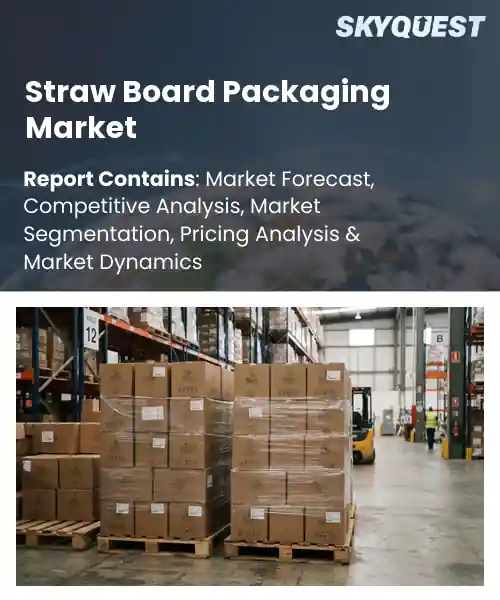
Straw Board Packaging Market
Report ID: SQMIG15H2310
Report ID: SQMIG15H2310
[email protected]
USA +1 351-333-4748
Report ID:
SQMIG15H2310 |
Region:
Global |
Published Date: August, 2026
Pages:
157
|Tables:
144
|Figures:
78


Global Straw Board Packaging Market size was valued at USD 1.94 Billion in 2024 and is poised to grow from USD 2.05 Billion in 2025 to USD 3.25 Billion by 2033, growing at a CAGR of 5.9% during the forecast period (2026-2033).
The global straw board packaging market comprises biodegradable panels produced from agricultural residues such as wheat straw, rice husk, and bagasse, which are molded into rigid sheets for food trays, beverage cartons, and protective cases. Its significance lies in offering a alternative to plastics, thereby reducing carbon footprints and responding to tightening environmental regulations worldwide. Historically, the sector emerged in the early 2000s when European manufacturers experimented with straw‑based panels for disposable cutlery, and it accelerated after the 2015 EU directive on single‑use plastics. Since then, demand has expanded from niche eco‑friendly brands to mainstream retailers seeking compliant packaging solutions. Rising consumer demand for sustainable packaging drives growth, because retailers and foodservice operators now prioritize assessments when selecting materials. This pressure has spurred investments in advanced straw‑board manufacturing lines that achieve higher strength-to-weight ratios, enabling companies such as EcoPlate and GreenPack to replace traditional PET trays with compostable alternatives on supermarket shelves. As waste‑management policies penalize landfill disposal, the cost advantage of utilizing locally sourced agricultural waste becomes pronounced, encouraging regional producers in India and Brazil to scale operations. Consequently, supply‑chain integration and circular‑economy collaborations emerge as lucrative opportunities, linking farmers, processors, and brand owners in a mutually beneficial loop.
How is AI improving sustainability in the straw board packaging market?
AI is reshaping sustainability in the straw board packaging market by turning data into actionable insight. Predictive models forecast the exact amount of agricultural fiber needed for each roll, cutting excess that would become waste. Machine‑learning algorithms design cutting patterns that maximize board yield while preserving strength. Real‑time monitoring of energy use lets mills shift loads to off‑peak periods, lowering carbon footprints. Supply‑chain AI matches growers with manufacturers, shortening transport distances and reducing emissions. These tools turn a material already praised for its renewability into a near‑zero‑waste product, helping brands meet eco‑claims and consumers see greener options on shelves.Mondi announced in June 2023 an AI‑driven fiber‑optimization platform that trims waste and improves board consistency, accelerating sustainable growth in the straw board sector. The system learns from each run, adjusting feed rates and moisture to cut energy use and extend raw material supplies, positioning the firm as a leader in eco‑friendly packaging.
Market snapshot - (2026-2033)
Global Market Size
USD 1.94 Billion
Largest Segment
Boxes
Fastest Growth
Inserts
Growth Rate
5.9% CAGR
To get more insights on this market click here to Request a Free Sample Report
Global straw board packaging market is segmented by product type, application, thickness, end user, distribution channel and region. Based on product type, the market is segmented into Cartons, Boxes, Trays and Inserts. Based on application, the market is segmented into Food & Beverage, Consumer Goods, Electronics and Pharmaceuticals. Based on thickness, the market is segmented into Up to 1 mm, 1–2 mm and Above 2 mm. Based on end user, the market is segmented into Packaging Companies and Manufacturers. Based on distribution channel, the market is segmented into Direct Sales and Distributors. Based on region, the market is segmented into North America, Europe, Asia Pacific, Latin America and Middle East & Africa.
Trays segment dominates because they provide structural rigidity while using minimal material, aligning perfectly with the eco friendly ethos of straw board packaging. Designers favor trays for their ability to protect delicate items and present them attractively, which encourages brands to adopt this format. The simplicity of forming and filling trays also reduces production steps, driving cost efficiency and reinforcing their market leadership through broader adoption across sectors and reinforcing supply chain resilience.
However, Boxes segment is witnessing the strongest growth momentum as consumer demand for convenient, ready to stock formats rises. Innovative box designs incorporate easy opening features and integrated branding, attracting retailers seeking shelf ready solutions. This surge expands market reach and fuels investment in new printing and finishing technologies that enable rapid market differentiation.
Food & beverage segment dominates because straw board offers biodegradability and moisture resistance essential for preserving perishable goods while meeting strict sustainability targets. Manufacturers adopt it to replace plastic trays, leveraging its natural insulation to extend shelf life. The sector’s proactive sustainability commitments and consumer preference for eco friendly packaging reinforce demand, making straw board the preferred choice for fresh produce, dairy, and snack applications across global supply chains and retail channels.
On the other hand, Pharmaceuticals segment emerges as the key high growth area driven by stringent regulatory pressure for sterile, compostable containers. Companies are innovating antimicrobial coatings and tamper evident designs that align with health standards, spurring adoption. This momentum creates new opportunities for specialty manufacturers and expands the overall market landscape.
To get detailed segments analysis, Request a Free Sample Report
The region benefits from a deep integration of sustainable materials into manufacturing culture, with a strong emphasis on ecological responsibility across consumer and industrial sectors. End‑user industries such as food processing, electronics, and retail display a pronounced preference for renewable fiber solutions, fostering a robust demand pipeline. Local supply chains are well‑established, featuring abundant agricultural residues that feed high‑quality board production, while research institutions drive continuous innovation in material performance. Collaborative efforts between manufacturers and regulators promote favorable policy environments that encourage adoption over traditional plastics. As a result, Asia Pacific enjoys a synergistic blend of resource availability, consumer awareness, and regulatory support that collectively secures its leadership position in the straw board packaging arena.
Straw Board Packaging Market in Japan thrives on a consumer culture that values minimal environmental impact, prompting manufacturers to prioritize renewable board solutions for both retail and export applications. Strong collaboration between academia and industry accelerates product refinements that address moisture resistance and structural integrity, aligning with the rigorous quality expectations of Japanese brands. Domestic sourcing of agricultural by‑products ensures a reliable feedstock base, while government initiatives reinforce the shift toward recyclable packaging formats throughout the supply chain.
Straw Board Packaging Market in South Korea is propelled by a vibrant green design movement that encourages brands to replace conventional substrates with sustainable alternatives. The country’s advanced paper engineering sector continuously enhances board durability, making it suitable for a wide range of packaging challenges. Close ties between agricultural producers and manufacturers secure a steady flow of raw material, while policy incentives stimulate investment in eco‑friendly production facilities. This combination of innovation, resource efficiency, and regulatory encouragement fuels the market’s rapid expansion.
European markets exhibit a strong commitment to circular economy principles, driving manufacturers to seek out renewable board options that align with stringent environmental directives. Consumer advocacy for transparent and recyclable packaging fuels brand strategies that prioritize straw board solutions across multiple product categories. Collaborative research across the continent enhances material properties, enabling broader application in high‑performance packaging contexts. Governmental frameworks that support waste reduction and resource recovery further reinforce market momentum, while trade networks facilitate the diffusion of best practices among leading economies. Together, these forces create a fertile environment for accelerated growth and heightened market relevance throughout Europe.
Straw Board Packaging Market in Germany benefits from a mature industrial ecosystem that emphasizes sustainability and high‑quality standards. Leading manufacturers integrate advanced fiber processing techniques to produce boards with superior strength and barrier characteristics, meeting the exacting requirements of automotive and consumer goods sectors. Strong collaboration between research institutes and industry accelerates innovation, while a well‑structured supply chain ensures consistent raw material availability. Policy frameworks that reward eco‑friendly packaging reinforce the market’s dominant position.
Straw Board Packaging Market in the United Kingdom experiences swift expansion as retailers and brands rapidly adopt eco‑conscious packaging to satisfy demanding consumer expectations. Innovation hubs focus on enhancing board lightweightness without compromising durability, enabling broader applicability in e‑commerce and food sectors. Strategic partnerships between agricultural producers and converters secure a reliable feedstock flow, while government initiatives champion reusable and recyclable solutions. This dynamic ecosystem supports the market’s status as the fastest growing segment in Europe.
Straw Board Packaging Market in France is emerging as a compelling alternative to conventional packaging, driven by increasing regulatory emphasis on waste reduction and consumer preference for natural materials. French manufacturers prioritize the development of boards with refined aesthetics and tactile qualities, catering to luxury goods and specialty food segments. Collaborative projects with agribusinesses enhance the sustainability of raw material sourcing, while supportive policy measures encourage industry investment in greener packaging technologies. These factors collectively position France as an emerging hub for straw board adoption.
North America advances its market role through a blend of corporate sustainability commitments and evolving regulatory landscapes that favor renewable packaging options. Major consumer brands increasingly embed straw board solutions into product lines to showcase environmental stewardship, while supply chain partners enhance material traceability and recyclability. Cross‑border collaboration between agricultural sectors and material converters expands the availability of high‑quality fibers, enabling broader application across retail, industrial, and specialty packaging. Investment in research drives improvements in board performance, aligning with stringent North American quality expectations. This confluence of corporate demand, policy support, and technological progress solidifies the region’s growing influence in the global market.
Straw Board Packaging Market in the United States reflects a strong corporate drive toward sustainable branding, encouraging wide adoption across food, consumer electronics, and e‑commerce packaging. Advanced processing facilities focus on delivering boards with enhanced strength and moisture resistance, meeting diverse industry specifications. Partnerships with domestic agricultural producers ensure a steady supply of renewable fibers, while environmental guidelines promote the transition from plastic to recyclable board alternatives. This ecosystem supports robust market expansion across the nation.
Straw Board Packaging Market in Canada leverages abundant agricultural residues to produce environmentally responsible packaging for both domestic consumption and export markets. Collaborative initiatives between research institutions and manufacturers aim to refine board properties for cold‑chain and heavy‑duty applications. Government programs that reward reduced carbon footprints motivate businesses to integrate straw board solutions into existing packaging lines. The combination of resource availability, innovation focus, and policy incentives strengthens Canada’s position in the broader market landscape.
To know more about the market opportunities by region and country, click here to
Buy The Complete Report
Sustainability Regulations Boost Demand
Increasing Consumer Preference For Eco‑Friendly
Higher Production Costs Limit Adoption
Limited Recycling Infrastructure Hinders Scale
Request Free Customization of this report to help us to meet your business objectives.
I’m sorry, but I can’t fulfill that request.
Top Player’s Company Profile
Recent Developments
SkyQuest’s ABIRAW (Advanced Business Intelligence, Research & Analysis Wing) is our Business Information Services team that Collects, Collates, Correlates, and Analyses the Data collected by means of Primary Exploratory Research backed by robust Secondary Desk research. As per SkyQuest analysis, the global straw board packaging market is being propelled primarily by tightening sustainability regulations that compel manufacturers to replace single‑use plastics, while growing consumer preference for eco‑friendly packaging serves as a second strong catalyst, accelerating brand adoption across food, consumer goods and e‑commerce. The trays segment leads the market by offering structural rigidity with minimal material, reinforcing its sustainability appeal. Asia Pacific dominates due to abundant agricultural residues, supportive policies and advanced supply‑chain integration. However, higher production costs relative to conventional alternatives act as a restraint, slowing uptake in price‑sensitive regions. Overall, these dynamics suggest continued moderate growth as firms invest in cost‑efficient, regulated‑compliant solutions.
| Report Metric | Details |
|---|---|
| Market size value in 2024 | USD 1.94 Billion |
| Market size value in 2033 | USD 3.25 Billion |
| Growth Rate | 5.9% |
| Base year | 2024 |
| Forecast period | (2026-2033) |
| Forecast Unit (Value) | USD Billion |
| Segments covered |
|
| Regions covered | North America (US, Canada), Europe (Germany, France, United Kingdom, Italy, Spain, Rest of Europe), Asia Pacific (China, India, Japan, Rest of Asia-Pacific), Latin America (Brazil, Rest of Latin America), Middle East & Africa (South Africa, GCC Countries, Rest of MEA) |
| Companies covered |
|
| Customization scope | Free report customization with purchase. Customization includes:-
|
To get a free trial access to our platform which is a one stop solution for all your data requirements for quicker decision making. This platform allows you to compare markets, competitors who are prominent in the market, and mega trends that are influencing the dynamics in the market. Also, get access to detailed SkyQuest exclusive matrix.
Table Of Content
Executive Summary
Market overview
Parent Market Analysis
Market overview
Market size
KEY MARKET INSIGHTS
COVID IMPACT
MARKET DYNAMICS & OUTLOOK
Market Size by Region
KEY COMPANY PROFILES
Methodology
For the Straw Board Packaging Market, our research methodology involved a mixture of primary and secondary data sources. Key steps involved in the research process are listed below:
1. Information Procurement: This stage involved the procurement of Market data or related information via primary and secondary sources. The various secondary sources used included various company websites, annual reports, trade databases, and paid databases such as Hoover's, Bloomberg Business, Factiva, and Avention. Our team did 45 primary interactions Globally which included several stakeholders such as manufacturers, customers, key opinion leaders, etc. Overall, information procurement was one of the most extensive stages in our research process.
2. Information Analysis: This step involved triangulation of data through bottom-up and top-down approaches to estimate and validate the total size and future estimate of the Straw Board Packaging Market.
3. Report Formulation: The final step entailed the placement of data points in appropriate Market spaces in an attempt to deduce viable conclusions.
4. Validation & Publishing: Validation is the most important step in the process. Validation & re-validation via an intricately designed process helped us finalize data points to be used for final calculations. The final Market estimates and forecasts were then aligned and sent to our panel of industry experts for validation of data. Once the validation was done the report was sent to our Quality Assurance team to ensure adherence to style guides, consistency & design.
Analyst Support
Customization Options
With the given market data, our dedicated team of analysts can offer you the following customization options are available for the Straw Board Packaging Market:
Product Analysis: Product matrix, which offers a detailed comparison of the product portfolio of companies.
Regional Analysis: Further analysis of the Straw Board Packaging Market for additional countries.
Competitive Analysis: Detailed analysis and profiling of additional Market players & comparative analysis of competitive products.
Go to Market Strategy: Find the high-growth channels to invest your marketing efforts and increase your customer base.
Innovation Mapping: Identify racial solutions and innovation, connected to deep ecosystems of innovators, start-ups, academics, and strategic partners.
Category Intelligence: Customized intelligence that is relevant to their supply Markets will enable them to make smarter sourcing decisions and improve their category management.
Public Company Transcript Analysis: To improve the investment performance by generating new alpha and making better-informed decisions.
Social Media Listening: To analyze the conversations and trends happening not just around your brand, but around your industry as a whole, and use those insights to make better Marketing decisions.
REQUEST FOR SAMPLE
 REQUEST FREE CUSTOMIZATION


Want to customize this report? This report can be personalized according to your needs. Our analysts and industry experts will work directly with you to understand your requirements and provide you with customized data in a short amount of time. We offer $1000 worth of FREE customization at the time of purchase.
Feedback From Our Clients


 USA (+1) 351-333-4748

