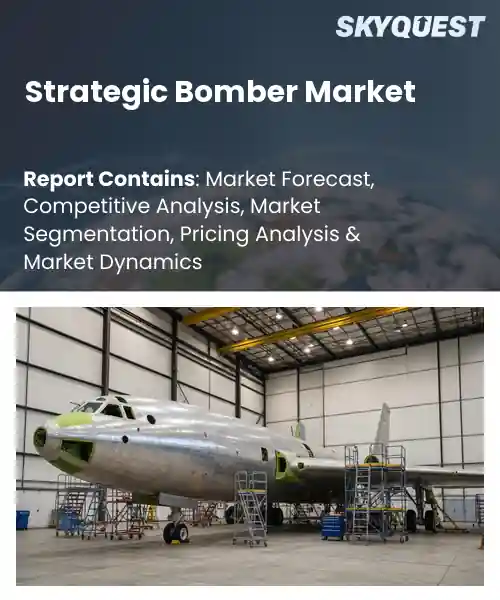
Strategic Bomber Market
Report ID: SQMIG20A2690
Report ID: SQMIG20A2690
[email protected]
USA +1 351-333-4748
Report ID:
SQMIG20A2690 |
Region:
Global |
Published Date: June, 2026
Pages:
157
|Tables:
115
|Figures:
77


Global Strategic Bomber Market size was valued at USD 7.51 Billion in 2024 and is poised to grow from USD 7.73 Billion in 2025 to USD 9.79 Billion by 2033, growing at a CAGR of 2.99% during the forecast period (2026-2033).
The combination of digital and hypersonic technologies that increase mission flexibility and the credibility of deterrence is driving the bomber market. Countries want fewer signatures and a quicker delivery. Manufacturers are developing autonomous navigation, networked avionics and engines capable of Mach 5 for defended targets requiring penetrative strikes. The U.S. is upgrading its B-21 Raider with AI-enabled sensor suites that point to reducing operating costs and increasing sortie rates, prompting allies such as Australia to consider buying it. This drives demand for retrofit programmes and export variants, creating lucrative business opportunities for aerospace companies, and compels policymakers to rethink force structures in the face of hypersonic threats.
How is AI influencing next‑generation strategic bomber design and mission automation?
AI is designing the architecture of next generation strategic bombers by embedding intelligence into every layer of the platform. These sensor streams are processed in real time by machine learning algorithms allowing the aircraft to autonomously navigate through contested airspace and select targets dynamically without overloading the pilot. Digital twins allow designers to test aerodynamic and stealth characteristics, and AI can optimise structural layouts for weight and range. Predictive maintenance models forecast component wear to lower downtime and to improve sortie rates. “The market is witnessing a shift to aircraft that deliver high speed along with self directed mission execution making them more adaptable to evolving threat environments driven by robust demand from North America and Asia Pacific.
In January 2026, Tupolev delivered an AI based flight control suite that automated low observable maneuvers and real time threat assessment, reducing crew workload and speeding up mission planning. This capability is a case in point of how AI is enhancing operational efficiency and sustaining market momentum for advanced strategic bombers.
Market snapshot - (2026-2033)
Global Market Size
USD 7.51 Billion
Largest Segment
Turbofan Powered Strike Aircraft
Fastest Growth
Turboprop Powered Strike Aircraft
Growth Rate
2.99% CAGR
To get more insights on this market click here to Request a Free Sample Report
Global strategic bomber market is segmented by engine propulsion subtype, stealth profile design, flight operational mission application, procurement acquisition supply channel and region. Based on engine propulsion subtype, the market is segmented into Turbofan Powered Strike Aircraft, Turbojet Powered Strike Aircraft and Turboprop Powered Strike Aircraft. Based on stealth profile design, the market is segmented into Low Observable Stealth Strategic Bombers and Conventional Non Stealth Strategic Bombers. Based on flight operational mission application, the market is segmented into Active Military Strike Operations, Military Force Flight Training and Others. Based on procurement acquisition supply channel, the market is segmented into Original Equipment Manufacturer Production Linefit and Systems Integration Aftermarket Upgrade Retrofit. Based on region, the market is segmented into North America, Europe, Asia Pacific, Latin America and Middle East & Africa.
The Turbofan Powered Strike Aircraft segment accounts for the major share owing to high thrust to weight ratio and fuel efficiency that enables extended range penetrations with payload flexibility. The engines provide better cruise performance, which allows bombers to operate from dispersed bases and loiter over contested areas. Modern turbofans are reliable and reduce maintenance down time which results in higher sortie generation rates. Hence the love of turbofan platforms by air forces for decisive strike reach and operational endurance.
However, the Turbojet Powered Strike Aircraft is seeing the strongest growth momentum as advances in materials and afterburner efficiency are re-igniting interest in supersonic dash capabilities. So, there is new investment in turbojet upgrades. Operators need to get in and out quickly for time critical missions. This boom opens market opportunities for niche high speed bomber concepts and propulsion specialists.
Original Equipment Manufacturer (OEM) Production Linefit leads the OEM market by integrating the newest avionics, propulsion and airframe components directly from the factory, providing baseline performance conformity and reducing integration risk. Manufacturers are on the ball with supply chains and testing protocols to provide turn-key platforms that meet demanding military specs. This more lean approach cuts delivery times, reduces total cost of ownership and builds confidence with procurement officials, making OEM line-fit the preferred path for new strategic bomber programs.
Meanwhile the fastest growing segment is the Systems Integration Aftermarket Upgrade Retrofit as legacy bombers get cockpit swap-outs, adaptive engine modules and stealth kit add-ons. The demand for integration services is driven by operators extending the life of their platforms and adapting to evolving threat environments. This retrofit boom creates a secondary market that helps to expand the strategic bomber ecosystem as a whole.
To get detailed segments analysis, Request a Free Sample Report
North America remains the dominant force in the strategic bomber space, with its deep technological expertise, large aerospace infrastructure and continued defence investment. The United States has a mature fleet, a robust supply chain, ongoing modernization programs and a culture of innovation that enables incremental capability improvements over a long period of time. Canada brings a complementary suite of capabilities such as joint development programs, advanced training ecosystems, and a strategic partnership that exploits shared logistics and interoperability. The region benefits from a strong government commitment, a protected intellectual property environment, and a network of skilled engineering talent to fuel research, testing and sustainment activities. This entire ecosystem is creating a very solid market base, which attracts global partners, and keeps the strategic bomber platforms relevant over time.
The United States Strategic Bomber Market is driven by a legacy of firsts, and the ongoing process of improving capabilities. The national industry has a deep engineering bench and broad testing facilities that enable quick incorporation of new stealth, avionics and long-range strike technologies. And collaborative defence programs foster strong government-prime contractor relationships and keep operational concepts current as the threat environment evolves. The robust logistics network also allows for high levels of readiness across widely dispersed bases.
The Canadian Strategic Bomber Market activity is driven by a close integration with North American defense frameworks and a focus on interoperability. U.S. aerospace companies deliver niche components and sustainment services to support allied platforms.” The government’s policy also calls for joint training exercises and collaborative research to create a pipeline of talent skilled in advanced bomber systems. This collaborative approach helps to align Canadian capabilities with broader strategic goals on the continent.
Countries across the Asia-Pacific are responding to shifting security dynamics and aspirations for greater strategic autonomy with an increasing rate of growth in strategic bomber capabilities. Regional defence agendas are focused on modernising legacy fleets and investment in indigenous design programmes with stealth, network-centric warfare and long range precision-strike characteristics. Strong government commitment to research and development and strong industrial bases can facilitate rapid assimilation of technology and domestic production. We work with our current global partners through exercises and sharing of technology to improve our operations and reduce barriers to entry. These factors combine to provide fertile ground for market growth leading to both local initiatives and strategic imports which align with broader geopolitical aspirations.
The Japanese strategic bomber market is abuzz with a deliberate move toward self-reliant deterrence and greater airpower projection. Indigenous aerospace companies are working in joint ventures that marry sophisticated sensor suites with advanced stealth shaping. The government’s policy highlights the integration of bomber concepts into a layered defense architecture, supported by substantial simulation and test capabilities. The technological sophistication of Japan is a major piece of regional strategic stability.
The South Korean strategic bomber market is growing as the knowledge from advanced fighter aircraft is being applied to dedicated long-range strike platforms. Home builders join forces with allied partners to combine stealth shaping, integrated avionics and autonomous targeting capabilities. Rapid response and power projection in contested maritime corridors are key to the national defense strategy. Investment in cutting-edge test ranges and digital engineering hubs is speeding up the development of prototypes, highlighting South Korea’s ambitions to field a sovereign strategic bomber capability.
For Europe, the strategic bomber capability is being enhanced by upgrades to current assets and multinational cooperative development programs. Critical defense partnerships build interoperability, joint training and shared procurement structures that reduce duplication and improve collective strike credibility Countries fight sophisticated threats with upgrades such as advanced avionics, stealth retrofits and network-centric command structures to keep existing platforms relevant. Joint research projects of aerospace clusters open the door for innovations in materials, propulsion and autonomous mission planning. “Europe’s capacity to provide a single market environment for the continued development of capabilities and be a credible partner for global strategic deterrence will depend on how well national priorities align with broader NATO objectives.
Another opportunity in the German strategic-bomber market is the potential to extend the service lives of existing bomber variants through extensive retrofit programmes. German aerospace companies know how to integrate next-generation sensor suites and electronic warfare modules to enhance survivability and accuracy. “We can train together, we can improve our tactical doctrine by using European defence networks. The emphasis on upgrade paths allows Germany to maintain a credible strategic strike capability and to offer expertise to multinational bomber missions.
The UK Strategic Bomber Market is moving to develop next generation strike capabilities through a mixture of indigenous development and strategic partnerships. British industry, with a legacy in airframe engineering and advanced propulsion expertise, provides platforms with longer ranges and more flexible payload options. Training with allied forces sharpens operational concepts and eases the transition to joint command structures. This current approach strengthens the UK’s role as a major contributor to collective European strategic deterrence.
French strategic bomber market is to modernize legacy bomber fleets into high performance assets through advanced avionics upgrade and stealth enhancement programs. French aerospace companies are leveraging their expertise in aerodynamics and cutting-edge digital engineering to improve the flexibility of range and payload. In a European defence coalition it is possible to plan missions together and to share logistics, to increase the operational reach. This strategic importance makes France a key node in the continent's collective strategic bombing capability.
To know more about the market opportunities by region and country, click here to
Buy The Complete Report
Advanced Stealth Technology is
Multi‑Domain Operations are
High Development Costs are
Geopolitical Uncertainty Can
Request Free Customization of this report to help us to meet your business objectives.
The competitive landscape is dominated by legacy aerospace giants that are accelerating M&A to consolidate stealth airframe expertise, forging partnerships with AI‑driven analytics firms to enhance mission planning, and investing in next‑generation propulsion and low‑observable materials. Recent examples include a major defense contractor’s acquisition of a hypersonic engine specialist and a joint venture between an established bomber manufacturer and a robotics startup to field autonomous payload integration. These moves intensify rivalry as firms race to deliver longer‑range, higher‑payload, and more survivable strategic bombers.
SkyQuest’s ABIRAW (Advanced Business Intelligence, Research & Analysis Wing) is our Business Information Services team that Collects, Collates, Correlates, and Analyses the Data collected by means of Primary Exploratory Research backed by robust Secondary Desk research. As per SkyQuest analysis, the global strategic bomber market is being propelled primarily by advanced stealth technology that lets aircraft penetrate defended airspace with minimal detection, while a second catalyst comes from the rise of multi‑domain operations that demand network‑centric, cross‑service strike capabilities. The market is constrained by the high development costs associated with next‑generation airframes, propulsion and weapons integration, which can delay new programs. North America remains the dominant region thanks to deep aerospace expertise, robust supply chains and sustained defense investment. Within the segment landscape, turbofan‑powered strike aircraft lead due to their superior thrust‑to‑weight ratio, fuel efficiency and extended range, supporting both stealth and conventional missions.
| Report Metric | Details |
|---|---|
| Market size value in 2024 | USD 7.51 Billion |
| Market size value in 2033 | USD 9.79 Billion |
| Growth Rate | 2.99% |
| Base year | 2024 |
| Forecast period | (2026-2033) |
| Forecast Unit (Value) | USD Billion |
| Segments covered |
|
| Regions covered | North America (US, Canada), Europe (Germany, France, United Kingdom, Italy, Spain, Rest of Europe), Asia Pacific (China, India, Japan, Rest of Asia-Pacific), Latin America (Brazil, Rest of Latin America), Middle East & Africa (South Africa, GCC Countries, Rest of MEA) |
| Companies covered |
|
| Customization scope | Free report customization with purchase. Customization includes:-
|
To get a free trial access to our platform which is a one stop solution for all your data requirements for quicker decision making. This platform allows you to compare markets, competitors who are prominent in the market, and mega trends that are influencing the dynamics in the market. Also, get access to detailed SkyQuest exclusive matrix.
Table Of Content
Executive Summary
Market overview
Parent Market Analysis
Market overview
Market size
KEY MARKET INSIGHTS
COVID IMPACT
MARKET DYNAMICS & OUTLOOK
Market Size by Region
KEY COMPANY PROFILES
Methodology
For the Strategic Bomber Market, our research methodology involved a mixture of primary and secondary data sources. Key steps involved in the research process are listed below:
1. Information Procurement: This stage involved the procurement of Market data or related information via primary and secondary sources. The various secondary sources used included various company websites, annual reports, trade databases, and paid databases such as Hoover's, Bloomberg Business, Factiva, and Avention. Our team did 45 primary interactions Globally which included several stakeholders such as manufacturers, customers, key opinion leaders, etc. Overall, information procurement was one of the most extensive stages in our research process.
2. Information Analysis: This step involved triangulation of data through bottom-up and top-down approaches to estimate and validate the total size and future estimate of the Strategic Bomber Market.
3. Report Formulation: The final step entailed the placement of data points in appropriate Market spaces in an attempt to deduce viable conclusions.
4. Validation & Publishing: Validation is the most important step in the process. Validation & re-validation via an intricately designed process helped us finalize data points to be used for final calculations. The final Market estimates and forecasts were then aligned and sent to our panel of industry experts for validation of data. Once the validation was done the report was sent to our Quality Assurance team to ensure adherence to style guides, consistency & design.
Analyst Support
Customization Options
With the given market data, our dedicated team of analysts can offer you the following customization options are available for the Strategic Bomber Market:
Product Analysis: Product matrix, which offers a detailed comparison of the product portfolio of companies.
Regional Analysis: Further analysis of the Strategic Bomber Market for additional countries.
Competitive Analysis: Detailed analysis and profiling of additional Market players & comparative analysis of competitive products.
Go to Market Strategy: Find the high-growth channels to invest your marketing efforts and increase your customer base.
Innovation Mapping: Identify racial solutions and innovation, connected to deep ecosystems of innovators, start-ups, academics, and strategic partners.
Category Intelligence: Customized intelligence that is relevant to their supply Markets will enable them to make smarter sourcing decisions and improve their category management.
Public Company Transcript Analysis: To improve the investment performance by generating new alpha and making better-informed decisions.
Social Media Listening: To analyze the conversations and trends happening not just around your brand, but around your industry as a whole, and use those insights to make better Marketing decisions.
REQUEST FOR SAMPLE
 REQUEST FREE CUSTOMIZATION
Global Strategic Bomber Market size was valued at USD 7.51 Billion in 2024 and is poised to grow from USD 7.73 Billion in 2025 to USD 9.79 Billion by 2033, growing at a CAGR of 2.99% during the forecast period (2026-2033).
The competitive landscape is dominated by legacy aerospace giants that are accelerating M&A to consolidate stealth airframe expertise, forging partnerships with AI‑driven analytics firms to enhance mission planning, and investing in next‑generation propulsion and low‑observable materials. Recent examples include a major defense contractor’s acquisition of a hypersonic engine specialist and a joint venture between an established bomber manufacturer and a robotics startup to field autonomous payload integration. These moves intensify rivalry as firms race to deliver longer‑range, higher‑payload, and more survivable strategic bombers. 'Northrop Grumman Corporation', 'The Boeing Company', 'Tupolev PJSC', 'Xi'an Aircraft Industrial Corporation', 'Lockheed Martin Corporation', 'United Aircraft Corporation', 'Rostec', 'Aviation Industry Corporation of China', 'BAE Systems plc', 'Rockwell International', 'General Dynamics Corporation', 'Convair Aviation', 'Myasishchev Design Bureau', 'Avro Aircraft', 'Vickers-Armstrongs', 'Handley Page Limited', 'Dassault Aviation', 'Sukhoi Company', 'Shenyang Aircraft Corporation', 'Chengdu Aircraft Industry Group'
Advanced stealth capabilities enable strategic bombers to penetrate defended airspace with reduced detection risk, thereby enhancing mission success rates and survivability. This capability directly addresses defense priorities for deep‑strike operations, prompting air forces to invest in next‑generation platforms that incorporate low observable designs, radar‑absorbent materials, and integrated electronic warfare suites. As nations seek to maintain credible deterrence while minimizing collateral exposure, the demand for aircraft that can operate undetected in contested environments continues to rise, driving sustained growth in the strategic bomber market.
Stealth Technology Evolution: Modern air forces are prioritizing next‑generation stealth capabilities to maintain survivability in contested airspaces. Advances in radar‑absorbent materials, low‑observable shaping, and integrated sensor fusion are reshaping bomber design philosophies. Operators seek platforms that can penetrate sophisticated defenses while delivering precision payloads across extended ranges. This shift drives manufacturers to embed adaptive camouflage, modular weapon bays, and autonomous mission management, fostering a new class of versatile, low‑signature bombers that align with evolving strategic doctrines and emerging threat environments, for future operational flexibility.
Why does North America Dominate the Global Strategic Bomber Market? |@12


Want to customize this report? This report can be personalized according to your needs. Our analysts and industry experts will work directly with you to understand your requirements and provide you with customized data in a short amount of time. We offer $1000 worth of FREE customization at the time of purchase.
Feedback From Our Clients


 USA (+1) 351-333-4748

