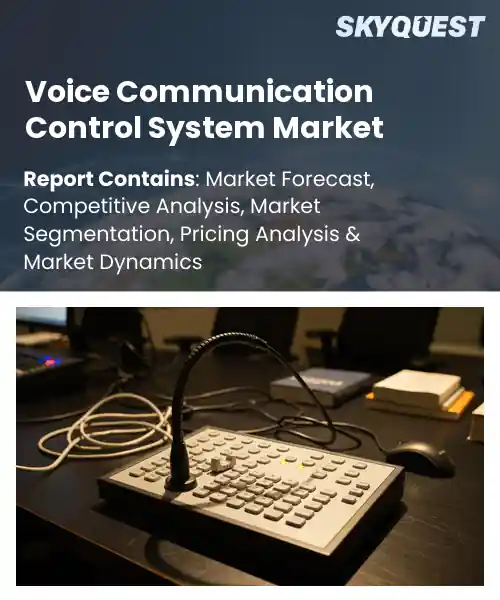
Voice Communication Control System Market
Report ID: SQMIG45H2207
Report ID: SQMIG45H2207
[email protected]
USA +1 351-333-4748
Report ID:
SQMIG45H2207 |
Region:
Global |
Published Date: June, 2026
Pages:
157
|Tables:
148
|Figures:
78


Global Voice Communication Control System Market size was valued at USD 185.93 Million in 2024 and is poised to grow from USD 200.23 Million in 2025 to USD 362.18 Million by 2033, growing at a CAGR of 7.69% during the forecast period (2026-2033).
The primary driver of the voice communication control system market is the accelerating shift from fragmented legacy voice networks to integrated software defined communication platforms that prioritize security and scalability. The market includes hardware and session border controllers, call routing engines and cloud control planes, and matters because organizations rely on voice for contact centers and emergency services. Over time the sector evolved from analog PBX installations through PBX to VoIP migrations and into unified communications with AI assisted call orchestration, illustrated when banks replaced on premise switches with cloud SBCs to meet compliance and remote work needs across industries.
Building on that migration, the key growth factor is widespread cloud adoption coupled with regulatory pressure for secure, auditable voice flows, which create opportunities. As enterprises move control planes into cloud regions, providers can offer elastic licensing and centralized policy enforcement, so vendors scale across geographies while buyers reduce CAPEX. For example hospitals deploy cloud controlled call routing to ensure rapid telemedicine handoffs, and utilities use authenticated voice channels to coordinate field crews, resulting in measurable uptime and safety gains. Consequently demand for managed session border controllers, NFV orchestration and integration with AI driven analytics rises, driving recurring revenue models.
How is AI enhancing reliability in the voice communication control system market?
AI is improving reliability in voice communication control systems by cleaning audio, spotting faults, and supporting faster decisions. Key aspects are speech enhancement for clearer pilot controller exchanges, continuous monitoring that detects anomalies before they affect service, and intelligent call routing that preserves connectivity during equipment failures. The market is shifting from hardware centric radio panels to software based platforms that embed AI in recording, logging, and operator assist tools. Vendors now combine AI driven preprocessing with ongoing model training from live traffic. Real world examples include AI audio enhancement in modern VCS and speech recognition tied to automation to reduce controller workload and human error.
Nexera May 2026, launched VocentraAI, an AI powered real time decision support platform for voice communications that automates event detection and improves situational awareness, supporting market efficiency and faster deployment of reliable VCCS solutions. It helps operators prioritize critical calls, reduce manual review, and shorten incident response cycles, encouraging broader adoption in safety critical sectors.
Market snapshot - (2026-2033)
Global Market Size
USD 185.93 Million
Largest Segment
Hardware
Fastest Growth
Software
Growth Rate
7.69% CAGR
To get more insights on this market click here to Request a Free Sample Report
Global voice communication control system market is segmented by component, platform focus, application area, end-use sector, sales channel and region. Based on component, the market is segmented into Hardware, Software, Services and Others. Based on platform focus, the market is segmented into Air, Ground, Maritime and Others. Based on application area, the market is segmented into Air Traffic Control, Vessel Traffic Control, Disaster Management, Emergency Management and Others. Based on end-use sector, the market is segmented into Commercial, Defense and Others. Based on sales channel, the market is segmented into Direct Government Tenders, Defense Systems Integrators and Others. Based on region, the market is segmented into North America, Europe, Asia Pacific, Latin America and Middle East & Africa.
Software segment dominates because it provides the adaptive backbone that enables modern voice communication control systems to integrate diverse protocols, virtualize voice channels, and deliver advanced routing logic. Vendors focus on software to add analytics, automated voice management, and secure IP transport, which lowers deployment friction for operators. This drives preference for software-centric architectures that accelerate interoperability, reduce time to capability, and allow rapid feature evolution in response to operational demands.
However, Services segment is the most rapidly expanding area in voice communication control systems as demand rises for managed deployments, lifecycle support, and integration services. Service providers are extending value through cloud migration, round-the-clock support, and customized training, enabling operators to adopt complex solutions quickly and unlocking new recurring-revenue opportunities.
Air Traffic Control segment dominates because it represents the most demanding operational environment requiring persistent, secure, and legally certified voice coordination across multiple stakeholders. System architects prioritize features that assure continuity, low-latency links, and rigorous redundancy, prompting suppliers to design robust control consoles and proven voice routing frameworks. This focus drives procurement toward proven solutions, shaping vendor roadmaps and ensuring that platform capabilities align with enduring safety and regulatory imperatives.
Meanwhile, Disaster Management segment is witnessing the strongest growth momentum as agencies require resilient, interoperable voice control for emergency response. Advances in mobile integration, temporary network bridging, and interoperable gateways broaden applications outside fixed control centers. This rising operational demand spurs vendor research and development and service offerings, creating fresh implementation and revenue opportunities.
To get detailed segments analysis, Request a Free Sample Report
North America dominance is driven by large enterprise demand, mature telecom infrastructure, strong vendor presence, advanced research and development in voice technologies, security and compliance frameworks, early cloud adoption, skilled workforce, defense and public safety spending, integration with contact centers, partnerships and acquisitions, robust funding environment for startups, interoperability standards, and an ecosystem of system integrators and channel partners. Presence of major service providers enables effective deployment and customization for verticals such as finance, healthcare, and government, while proactive procurement practices by large organizations facilitate broad adoption. Academic collaboration and innovation clusters concentrate expertise and accelerate commercialization of advanced call routing, voice biometrics, and AI driven control capabilities, while a diverse vendor landscape and mature support services help large buyers adopt complex solutions with confidence.
Voice Communication Control System Market in United States reflects a concentration of enterprise buyers, advanced carrier networks, and R&D activity. Large vendors and specialist startups coexist, creating a competitive environment for innovation in voice routing, security, and analytics. Public safety and corporate contact centers drive sophisticated deployments while system integrators and service providers offer broad implementation expertise. Procurement sophistication and integration with IT stacks reinforce preference for customizable, scalable solutions.
Voice Communication Control System Market in Canada is characterized by coordinated public sector procurement, strong telecom infrastructure, and a focus on interoperability and compliance. Integrators and managed service providers support deployments across healthcare, utilities, and emergency services. Bilingual requirements and regional customization drive demand for localized solutions. Collaboration with international vendors and a pragmatic approach to cloud and on-prem implementations foster refinement of capabilities and integration with broader communication ecosystems.
Europe expansion is propelled by coordinated digital transformation across industries, strong regulatory emphasis on data protection and sovereignty, and a push for interoperable standards that lower integration barriers. Enterprises and public institutions are modernizing contact centers, emergency communication, and enterprise voice infrastructures, while vendors tailor solutions for multilingual and cross-border operations. Collaboration between telco operators, system integrators, and European research institutions accelerates applied innovation in voice analytics and security. Market dynamics also reflect consolidation and strategic partnerships that bring global technology to local contexts. Targeted initiatives in sectors such as automotive, finance, and healthcare drive bespoke integrations, while adoption of cloud native architectures and service models reduces deployment complexity. Procurement frameworks and standardized contracting further encourage consistent approaches and vendor responsibility, creating an environment where innovative control capabilities can scale across borders.
Voice Communication Control System Market in Germany is shaped by deep integration with industrial automation and manufacturing communication requirements. Large enterprises and telecommunication operators prioritize reliability, standards compliance, and tailored solutions that support complex operational environments. Domestic vendors play a pivotal role in system design and deployment. Emphasis on security, interoperability with manufacturing systems and collaboration between industry and research institutions underpin Germany position as a leading market in Europe.
Voice Communication Control System Market in United Kingdom is driven by rapid modernization across financial services, media, and contact center operations. Cloud migration, a vibrant startup ecosystem, and managed service providers accelerate deployment of innovative routing, analytics, and security features. Demand for flexible, cloud native solutions and professional services is strong, while integrators focus on rapid implementation and customer experience improvement. Regional procurement and industry partnerships support sustained momentum overall.
Voice Communication Control System Market in France shows emerging momentum driven by public sector modernization, healthcare digitization, and local vendor innovation. Language localization and regulatory emphasis shape solution design, while partnerships between carriers and system integrators enable tailored deployments. Demand from municipal smart city projects and regulated industries fosters implementations. A services ecosystem supports integration and customization, positioning France as an attractive market for domestic and international technology providers.
Asia Pacific is strengthening its market position through rapid adoption of advanced network architectures, strong mobile and broadband penetration, and a dynamic technology manufacturing base that supports end to end integration. Regional telecom operators and cloud providers invest in platform capabilities while enterprises across manufacturing, finance, and service sectors pursue voice enabled automation. Local vendors innovate in language and dialect handling and integrate AI driven analytics and security into control systems. Government initiatives to modernize communications and public safety, coupled with international partnerships and cross border deployments, foster an ecosystem where scalable, localized, and high performance voice control solutions can be developed and deployed at scale. Research centers and industry consortia establish interoperability testing and certification that accelerate enterprise confidence. Integration with IoT ecosystems and consumer electronics creates new use cases while a deep talent pool and competitive cost structures encourage both local innovation and global vendor investment.
Voice Communication Control System Market in Japan emphasizes reliability, precision engineering, and deep systems integration with manufacturing and enterprise networks. Domestic vendors and established carriers collaborate to deliver solutions tailored to demanding operational environments and multilingual user needs. Enterprises prioritize robust security, maintenance, and support, while research institutions contribute advanced voice recognition and biometric capabilities. This combination of engineering rigor and close vendor client relationships fosters adoption and refined implementations.
Voice Communication Control System Market in South Korea benefits from advanced broadband networks, a strong consumer electronics ecosystem, and close collaboration between carriers and technology manufacturers. Local vendors exploit deep expertise in latency sensitive applications and embed voice control within smartphones and smart devices. Enterprises and service providers favor innovative, cloud enabled architectures and tight integration with analytics and AI capabilities. This environment supports rapid prototyping, commercialization, and competitive differentiation.
To know more about the market opportunities by region and country, click here to
Buy The Complete Report
Increasing Demand For Secure Communication
Integration With Unified Communication Platforms
Complex Regulatory Compliance Requirements
High Implementation and Maintenance Costs
Request Free Customization of this report to help us to meet your business objectives.
Competitive landscape in the global voice communication control system market is defined by incumbent consolidations and cloud native entrants competing on AI and cloud integration. Strategic moves include acquisitions like Microsoft acquiring Nuance and Metaswitch to embed speech AI and carrier voice stacks, and partnerships such as Ribbon with AWS to offer pay as you go session border controller services, driving differentiation through technology integration and route to cloud agreements.
SkyQuest’s ABIRAW (Advanced Business Intelligence, Research & Analysis Wing) is our Business Information Services team that Collects, Collates, Correlates, and Analyses the Data collected by means of Primary Exploratory Research backed by robust Secondary Desk research.
As per SkyQuest analysis, the global voice communication control system market is set for steady expansion with cloud adoption and regulatory pressure for secure, auditable voice flows as a key driver and complex regulatory compliance requirements acting as a restraint. North America is the dominating region due to advanced infrastructure, defense spending and vendor presence, while the software component is the dominating segment because it enables interoperability, virtualization and rapid feature evolution. A second driver is the rise of AI for audio enhancement, anomaly detection and intelligent routing, which improves reliability and operational efficiency and encourages managed and cloud delivery models across safety critical and commercial deployments.
| Report Metric | Details |
|---|---|
| Market size value in 2024 | USD 185.93 Million |
| Market size value in 2033 | USD 362.18 Million |
| Growth Rate | 7.69% |
| Base year | 2024 |
| Forecast period | (2026-2033) |
| Forecast Unit (Value) | USD Million |
| Segments covered |
|
| Regions covered | North America (US, Canada), Europe (Germany, France, United Kingdom, Italy, Spain, Rest of Europe), Asia Pacific (China, India, Japan, Rest of Asia-Pacific), Latin America (Brazil, Rest of Latin America), Middle East & Africa (South Africa, GCC Countries, Rest of MEA) |
| Companies covered |
|
| Customization scope | Free report customization with purchase. Customization includes:-
|
To get a free trial access to our platform which is a one stop solution for all your data requirements for quicker decision making. This platform allows you to compare markets, competitors who are prominent in the market, and mega trends that are influencing the dynamics in the market. Also, get access to detailed SkyQuest exclusive matrix.
Table Of Content
Executive Summary
Market overview
Parent Market Analysis
Market overview
Market size
KEY MARKET INSIGHTS
COVID IMPACT
MARKET DYNAMICS & OUTLOOK
Market Size by Region
KEY COMPANY PROFILES
Methodology
For the Voice Communication Control System Market, our research methodology involved a mixture of primary and secondary data sources. Key steps involved in the research process are listed below:
1. Information Procurement: This stage involved the procurement of Market data or related information via primary and secondary sources. The various secondary sources used included various company websites, annual reports, trade databases, and paid databases such as Hoover's, Bloomberg Business, Factiva, and Avention. Our team did 45 primary interactions Globally which included several stakeholders such as manufacturers, customers, key opinion leaders, etc. Overall, information procurement was one of the most extensive stages in our research process.
2. Information Analysis: This step involved triangulation of data through bottom-up and top-down approaches to estimate and validate the total size and future estimate of the Voice Communication Control System Market.
3. Report Formulation: The final step entailed the placement of data points in appropriate Market spaces in an attempt to deduce viable conclusions.
4. Validation & Publishing: Validation is the most important step in the process. Validation & re-validation via an intricately designed process helped us finalize data points to be used for final calculations. The final Market estimates and forecasts were then aligned and sent to our panel of industry experts for validation of data. Once the validation was done the report was sent to our Quality Assurance team to ensure adherence to style guides, consistency & design.
Analyst Support
Customization Options
With the given market data, our dedicated team of analysts can offer you the following customization options are available for the Voice Communication Control System Market:
Product Analysis: Product matrix, which offers a detailed comparison of the product portfolio of companies.
Regional Analysis: Further analysis of the Voice Communication Control System Market for additional countries.
Competitive Analysis: Detailed analysis and profiling of additional Market players & comparative analysis of competitive products.
Go to Market Strategy: Find the high-growth channels to invest your marketing efforts and increase your customer base.
Innovation Mapping: Identify racial solutions and innovation, connected to deep ecosystems of innovators, start-ups, academics, and strategic partners.
Category Intelligence: Customized intelligence that is relevant to their supply Markets will enable them to make smarter sourcing decisions and improve their category management.
Public Company Transcript Analysis: To improve the investment performance by generating new alpha and making better-informed decisions.
Social Media Listening: To analyze the conversations and trends happening not just around your brand, but around your industry as a whole, and use those insights to make better Marketing decisions.
REQUEST FOR SAMPLE
 REQUEST FREE CUSTOMIZATION
Global Voice Communication Control System Market size was valued at USD 185.93 Million in 2024 and is poised to grow from USD 200.23 Million in 2025 to USD 362.18 Million by 2033, growing at a CAGR of 7.69% during the forecast period (2026-2033).
Competitive landscape in the global voice communication control system market is defined by incumbent consolidations and cloud native entrants competing on AI and cloud integration. Strategic moves include acquisitions like Microsoft acquiring Nuance and Metaswitch to embed speech AI and carrier voice stacks, and partnerships such as Ribbon with AWS to offer pay as you go session border controller services, driving differentiation through technology integration and route to cloud agreements. 'SITA', 'Frequentis', 'Indra Sistemas', 'Rohde & Schwarz', 'Thales Group', 'L3Harris Technologies', 'Northrop Grumman', 'Saab', 'Sitti', 'Leonardo', 'Frequentis Orthogon', 'Morcom International', 'Copperchase', 'Becker Avionics', 'Copperchase', 'Gables Engineering', 'Orbit Communication Systems', 'Systems Interface', 'Telephonics', 'Zenitel'
Organizations across industries prioritize protecting voice channels against interception and unauthorized access, which increases demand for comprehensive voice communication control systems. These solutions provide centralized policy enforcement, access controls, call recording governance, and controlled routing that align with regulatory and corporate security objectives. The need to safeguard sensitive conversations during remote collaboration and mission critical operations encourages enterprises to invest in systems that integrate with existing infrastructure, reducing operational risk and enhancing trust among stakeholders, thereby driving adoption and vendor innovation.
Ai Driven Conversational Intelligence: Voice systems increasingly leverage contextual machine learning to interpret intent, personalize responses, and enable natural interactions across channels. Vendors emphasize improving accuracy, reducing friction, and supporting multilingual environments to drive adoption in customer service and operations. This shift prioritizes continuous learning, privacy aware model training, and integration of domain knowledge to deliver more human like exchanges. Enterprises focus on vendor collaboration, modular architectures, and scalable pipelines that allow rapid feature deployment while maintaining conversational consistency and satisfaction across touchpoints globally.
Why does North America Dominate the Global Voice Communication Control System Market? |@12


Want to customize this report? This report can be personalized according to your needs. Our analysts and industry experts will work directly with you to understand your requirements and provide you with customized data in a short amount of time. We offer $1000 worth of FREE customization at the time of purchase.
Feedback From Our Clients


 USA (+1) 351-333-4748

