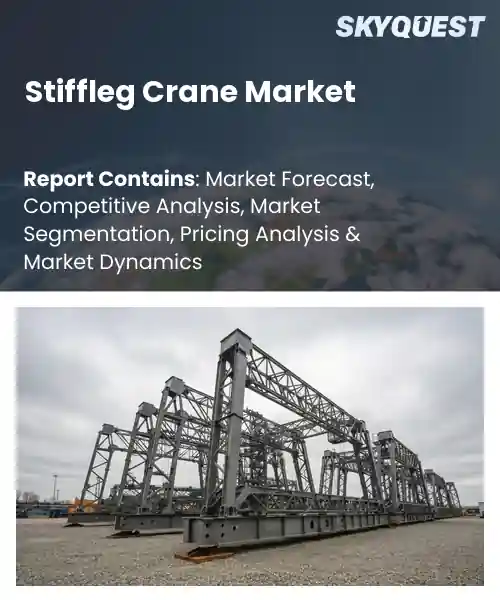
Stiffleg Crane Market
Report ID: SQMIG20I3181
Report ID: SQMIG20I3181
[email protected]
USA +1 351-333-4748
Report ID:
SQMIG20I3181 |
Region:
Global |
Published Date: July, 2026
Pages:
157
|Tables:
142
|Figures:
78


Global Stiffleg Crane Market size was valued at USD 382.50 Million in 2024 and is poised to grow from USD 400.55 Million in 2025 to USD 582.40 Million by 2033, growing at a CAGR of 4.7% during the forecast period (2026-2033).
Infrastructure expansion as the major reason behind the stiffleg crane market growth, being driven by heavy civil construction projects preferring the Stability and simplicity (mechanical features) of stiffleg cranes thereby reducing the opportunity for downtime and maintenance costs. A stiffleg crane is considered a fixed based lifting device that can be utilized in many ways, but particularly when heavy lifting is necessary in locations with limited footprint and high weight requirements. Examples of applications for stiffleg cranes can be found in port operations, shipyards and bridge construction; as stiffleg cranes become more relevant in locations where restrictions in terrain and/or available space restrict the use of mobile cranes; The demand for stiffleg cranes historically has increased in conjunction with post-war industrialization and later, with the increased use of containerization for transportation of goods. Recently completed quay projects in Rotterdam and Singapore illustrate the use of stiffleg crane solutions in association with repetitive large lifts and reliability.
Increased integration of technology is another key driver of the stiffleg crane market trends; automation and monitoring features provide greater accuracy (precision), safety and operationally lower operating costs; therefore improving the likelihood that port operators and oil and gas firms will adopt stiffleg cranes for their operations. As an example, stiffleg cranes that utilize sensors allow for predictive maintenance; thus decreasing the amount of time a crane is not operational and lowering the Life Cycle Costs associated with operating a stiffleg crane; this encourages procurement managers to purchase new and enhanced cranes during terminal upgrades. The increasing demand for stable lifting surfaces for offshore wind turbine installation has created an opportunity for manufacturers to develop corrosion resistant stiffleg cranes that increase the service life of a stiffleg crane and therefore open new marine contracts.
How is IoT Improving Operational Efficiency in the Stiffleg Crane Market?
The IoT enhances the effectiveness of stiff-leg cranes' daily use by changing the non-connected machine into an asset that communicates back to base (head office). The continuous monitoring of both structural conditions and load behaviour via sensors, remote supervision (that diminishes the timeframes for making decisions), and fleet-wide analytics, used for maintenance and planning are the most significant aspects of this use case. As of today, many stiff-leg crane contractors are retrofitting sensors onto outdated cranes in order to support predictive maintenance programmes that decrease unplanned underutilisation periods.
For crews working offshore or in constrained worksites, IOT systems that monitor motion and boom locations help reduce the number of weather-related work stoppages and furnish greater accuracy when placing loads. As a result, these capabilities also increase the efficiency of fleets, reduce the complexity of logistics, and enhance the dependability of lift plan execution.
In May 2026, EnerMech announced a worldwide agreement with Optilift for deploying intelligent sensors and digital lift systems that provide real-time information to operators and planners, thus allowing better management of weather windows and limited incidence of downtime, thereby enabling the wider use of technologically enhanced lifting services.
Market snapshot - (2026-2033)
Global Market Size
USD 382.5 Million
Largest Segment
Fixed Stiffleg Derrick
Fastest Growth
Rotating Stiffleg Derrick
Growth Rate
4.72% CAGR
To get more insights on this market click here to Request a Free Sample Report
Global stiffleg crane market is segmented by type, capacity, application, end-user, distribution and region. Based on type, the market is segmented into fixed stiffleg derrick and rotating stiffleg derrick. Based on capacity, the market is segmented into below 50 tons, 50-200 tons and above 200 tons. Based on application, the market is segmented into shipbuilding & shipyards, construction and offshore operations. Based on end-user, the market is segmented into shipyards, industrial plants and ports & terminals. Based on distribution, the market is segmented into direct OEM and equipment dealers. Based on region, the market is segmented into North America, Europe, Asia Pacific, Latin America and Middle East & Africa.
Fixed stiffleg derrick dominates due to its ability to provide consistent stability and predictability in load paths for long periods of time when performing heavy lifts due to the fact that it is a non-rotating, rigid structure. Many operators prefer fixed units because they are required to have permanent or semi-permanent installations that maintain robust support and have minimal complexity in layout. Reliable performance decreases operational risks and increases ease for operators to develop maintenance plans, thus increasing procurement activity. Further solidifying its preeminent place of prominence in permanent heavy duty applications is long service life, strong OEM support, and compatibility with heavy industrial lifting patterns.
Rotating stiffleg derrick has quickly developed into the fastest growing sector as a result of better adaptability to a variety of operational needs and faster ease of positioning for multi-purpose yards and/or intermittent lifting. In addition, the technological advancements in rotation mechanisms and control systems are assisting in reducing on-site setup times, allowing for greater use of this type of equipment within dynamic workflows, thus leading to a high level of interest among operators looking for a single platform that can accommodate multiple types of lifting assignments.
The 200 ton and above segment, having cranes capable of lifting very large modules and other structural components through single lift operations, therefore eliminating rework and minimizing schedule risk. Due to these capabilities, cranes in this segment require specialized engineering, reinforced foundations and more robust powertrains that are critical for implementing capital intensive projects. This drives the development of lifecycle maintenance frameworks and long term procurement strategies, allowing operators to prioritize cranes that minimise handling steps and provide safety when executing complex heavy assembly and load out operations.
Conversely, 50 Ton-200 ton is experiencing the most increasing growth because the balance of capacity and transportability in this range aligns well with increasing mid-range project requirements. Innovative design of modular booms, faster rigging, and adaptable power packages are contributing to the growing adoption of mid-size cranes and will accelerate fleet modernization and create future flexible procurement options for operators.
To get detailed segments analysis, Request a Free Sample Report
A confluence of concentrated heavy industry, extensive maritime activities, and dense manufacturing ecosystems focused on high-capacity lifting solutions has led to the Asia Pacific's dominance. Regional supply chains enhance localized production capabilities and speed to market for custom products; while OEMs (Original Equipment Manufacturers) and specialized fabricators provide integrated equipment and after-market services. Port modernization and shipyard growth have created sustained demand for durable and high performance lifting equipment that support both shipbuilding and offshore operations. Skilled engineering talent and supplier networks support continuous innovation in the areas of control systems and materials which, in turn, enhances operational reliability. Infrastructure development and export-oriented manufacturing policies contribute to the region's leadership in stiffleg crane solutions by making the Asia Pacific region a major source of both demand for and technological advancement in this area.
Stiffleg crane market share in Japan benefits from a strong culture of precision engineering and an emphasis on high reliability for maritime and industrial sectors. Major shipyards and port operators favor advanced lifting equipment that integrates with tight operational tolerances, while manufacturers emphasize quality, long service life, and retrofitability. Aftermarket support networks and a focus on safety and efficiency underpin steady replacement and upgrade cycles, and suppliers often tailor solutions for compact footprints and complex dockside workflows.
Stiffleg crane market forecast in South Korea is driven by extensive shipbuilding and offshore fabrication activity that demands robust, high-capacity lifting solutions. Integration with steel production and heavy fabrication facilities fosters local expertise in large structural cranes, while ports and industrial yards require equipment optimized for rapid handling and durability. Strong relationships between OEMs and major shipbuilders support customization, and a competitive supplier base emphasizes quick lead times and comprehensive maintenance services for continuous operations.
North America's rapid growth is being driven by infrastructure renovations, changing needs in the energy industry, and increasing importance placed on ports as well as industrial upgrades. Due to market conditions, there is more equipment being manufactured that meets stricter requirements for safety and the environment while allowing for multiple uses at one facility or for rental fleets. Higher rates of adoption of technology such as remote monitoring and improved controls are creating higher levels of replacement and retrofits as a result of the demand being fragmented across many different customers from maritime to construction to maintenance of energy specialists all create opportunities for specialized suppliers and service based business models. The shift in the supply chain towards more local products and suppliers is creating additional investment into producing more products based locally as well as after market capabilities will enhance the market's footprint in this area of the country.
Stiffleg crane market outlook in the United States reflects diversified demand across ports, construction, and energy maintenance segments. Operators emphasize equipment that meets rigorous safety standards and integrates modern monitoring for uptime assurance. A mature rental and service ecosystem supports flexible deployment and lifecycle management, while manufacturers respond with modular designs and digital enhancements. Focus on resilient supply chains and domestic servicing capacity reinforces confidence in procurement choices and long term operational planning.
Stiffleg crane market analysis in Canada is shaped by resource sector needs and coastal infrastructure priorities that require ruggedized, climate resilient equipment. Demand centers on heavy lifting for port terminals, hydro and mining projects, and cold weather operations where reliability and serviceability are critical. Local distributors and service partners emphasize preventative maintenance and spare parts support to maximize equipment availability in remote locations. Customization for environmental conditions and stringent safety practices are key procurement considerations.
The Europe is working to consolidate its position in the market by promoting strict adherence to regulations, supporting the establishment of more sustainable business operations, and developing new ways to improve technologies and improve the compatibility of currently used equipment to strict operational guidelines. Retrofit activity at many of the older ports and industrial assets is driving demand for newer, more energy efficient lifting solutions. Innovative offerings are being developed through the collaborative efforts of specialized engineering firms, OEMs, and services providers. These innovative solutions will enable businesses to build cranes that can meet the increasingly complex project specifications required in the maritime and offshore industries. Predictive maintenance and digital integration are both being used to enhance the lifecycle value of cranes and provide a consistent standard for cranes constructed across borders. Strategic investments into the infrastructure of renewable energy and the upgrading of ports ensuring that Europe will become a major source of cutting-edge stiff leg crane design and engineering expertise.
Stiffleg crane market penetration in Germany centers on precision engineering for automotive, heavy machinery, and industrial manufacturing environments. Demand favors robust, highly reliable cranes that integrate with automated workflows and Industry Four Point Zero initiatives. Suppliers emphasize quality materials, comprehensive testing, and strong aftermarket networks to support continuous production schedules. Retrofit and modernization projects are common as operators seek improved energy efficiency and enhanced safety features.
Stiffleg crane market regional forecast in the United Kingdom is influenced by maritime services, offshore energy maintenance, and port modernization, with focus on specialized lifting solutions for complex dockside and offshore tasks. Service firms provide tailored maintenance and rapid mobilization for seasonal demand, and operators value cranes that offer flexibility and ease of integration into diverse operational contexts. Emphasis on adherence to strict safety and environmental standards shapes procurement and supplier selection.
Stiffleg crane market regional outlook in France is driven by shipyard activity, nuclear and heavy industrial sectors, and sophisticated port operations requiring customized lifting solutions. Suppliers and engineering consultancies collaborate to deliver equipment that meets rigorous safety and environmental requirements, while aftermarket support focuses on long term maintenance and technical assistance. Demand often centers on adaptable designs that can be tailored to complex project specifications and strict compliance regimes.
To know more about the market opportunities by region and country, click here to
Buy The Complete Report
Increasing Infrastructure Investment
Demand From Heavy Industries
High Initial Capital Requirements
Limited Skilled Operator Availability
Request Free Customization of this report to help us to meet your business objectives.
The stiffleg derrick crane market remains highly concentrated among established crane manufacturers, heavy-lift equipment suppliers, and specialized lifting contractors. Market competition is driven by fleet modernization initiatives, replacement of aging lifting assets, increasing demand for cost-efficient dockside and offshore lifting solutions, and the integration of digital monitoring and control technologies. Key strategic developments include consolidation efforts such as the proposed Konecranes–Cargotec merger, advanced heavy-lift innovations including Huisman’s leg-encircling crane technology for offshore wind turbine installation, and MacGregor’s deployment of digitally enabled offshore crane control systems aimed at expanding service and aftermarket revenue opportunities.
Top Player’s Company Profile
Recent Developments in the Stiffleg Crane Market
SkyQuest’s ABIRAW (Advanced Business Intelligence, Research & Analysis Wing) is our Business Information Services team that Collects, Collates, Correlates, and Analyses the Data collected by means of Primary Exploratory Research backed by robust Secondary Desk research. As per SkyQuest analysis, infrastructure expansion is a key driver supporting demand for stiffleg cranes, while technological integration and IoT-enabled monitoring serve as a second driver by improving uptime and lowering lifecycle costs. High initial capital requirements are a primary restraint that can slow procurement for smaller operators. Asia Pacific emerges as the dominating region due to concentrated shipbuilding, port modernization and localized supply chains, and fixed stiffleg derrick is the dominating segment because its rigid design delivers predictable stability for prolonged heavy lifting tasks. Overall, market momentum reflects durable industrial demand tempered by capital intensity and an accelerating shift toward connected, service-oriented offerings.
| Report Metric | Details |
|---|---|
| Market size value in 2024 | USD 382.5 Million |
| Market size value in 2033 | USD 582.4 Million |
| Growth Rate | 4.72% |
| Base year | 2024 |
| Forecast period | (2026-2033) |
| Forecast Unit (Value) | USD Million |
| Segments covered |
|
| Regions covered | North America (US, Canada), Europe (Germany, France, United Kingdom, Italy, Spain, Rest of Europe), Asia Pacific (China, India, Japan, Rest of Asia-Pacific), Latin America (Brazil, Rest of Latin America), Middle East & Africa (South Africa, GCC Countries, Rest of MEA) |
| Companies covered |
|
| Customization scope | Free report customization with purchase. Customization includes:-
|
To get a free trial access to our platform which is a one stop solution for all your data requirements for quicker decision making. This platform allows you to compare markets, competitors who are prominent in the market, and mega trends that are influencing the dynamics in the market. Also, get access to detailed SkyQuest exclusive matrix.
Table Of Content
Executive Summary
Market overview
Parent Market Analysis
Market overview
Market size
KEY MARKET INSIGHTS
COVID IMPACT
MARKET DYNAMICS & OUTLOOK
Market Size by Region
KEY COMPANY PROFILES
Methodology
For the Stiffleg Crane Market, our research methodology involved a mixture of primary and secondary data sources. Key steps involved in the research process are listed below:
1. Information Procurement: This stage involved the procurement of Market data or related information via primary and secondary sources. The various secondary sources used included various company websites, annual reports, trade databases, and paid databases such as Hoover's, Bloomberg Business, Factiva, and Avention. Our team did 45 primary interactions Globally which included several stakeholders such as manufacturers, customers, key opinion leaders, etc. Overall, information procurement was one of the most extensive stages in our research process.
2. Information Analysis: This step involved triangulation of data through bottom-up and top-down approaches to estimate and validate the total size and future estimate of the Stiffleg Crane Market.
3. Report Formulation: The final step entailed the placement of data points in appropriate Market spaces in an attempt to deduce viable conclusions.
4. Validation & Publishing: Validation is the most important step in the process. Validation & re-validation via an intricately designed process helped us finalize data points to be used for final calculations. The final Market estimates and forecasts were then aligned and sent to our panel of industry experts for validation of data. Once the validation was done the report was sent to our Quality Assurance team to ensure adherence to style guides, consistency & design.
Analyst Support
Customization Options
With the given market data, our dedicated team of analysts can offer you the following customization options are available for the Stiffleg Crane Market:
Product Analysis: Product matrix, which offers a detailed comparison of the product portfolio of companies.
Regional Analysis: Further analysis of the Stiffleg Crane Market for additional countries.
Competitive Analysis: Detailed analysis and profiling of additional Market players & comparative analysis of competitive products.
Go to Market Strategy: Find the high-growth channels to invest your marketing efforts and increase your customer base.
Innovation Mapping: Identify racial solutions and innovation, connected to deep ecosystems of innovators, start-ups, academics, and strategic partners.
Category Intelligence: Customized intelligence that is relevant to their supply Markets will enable them to make smarter sourcing decisions and improve their category management.
Public Company Transcript Analysis: To improve the investment performance by generating new alpha and making better-informed decisions.
Social Media Listening: To analyze the conversations and trends happening not just around your brand, but around your industry as a whole, and use those insights to make better Marketing decisions.
REQUEST FOR SAMPLE
 REQUEST FREE CUSTOMIZATION
Global Stiffleg Crane Market size was valued at USD 382.5 Million in 2024 and is poised to grow from USD 400.55 Million in 2025 to USD 582.4 Million by 2033, growing at a CAGR of 4.72% during the forecast period (2026-2033).
Competitive landscape centers on incumbent OEMs and specialist lifting contractors, driven by operators replacing aging stiffleg fleets and seeking cost effective dockside and offshore lifting. Recent strategies include large scale consolidation attempts exemplified by the blocked Konecranes Cargotec merger, Huisman’s leg encircling crane innovations for turbine installation, and MacGregor’s rollout of digital offshore crane controls to capture service contracts. Summary of search: manufacturer websites, specialist lifting contractor disclosures, press coverage and industry registries were reviewed; results show no verified startups founded in or after 2019 that manufacture or market commercial stiffleg derrick cranes, with innovation and recent product activity coming from established OEMs and specialist contractors. 'Manitowoc Crane Group', 'Liebherr Group', 'Tadano Ltd.', 'Terex Corporation', 'SANY Group', 'XCMG Group', 'Konecranes plc', 'Demag Cranes (Terex)', 'Palfinger AG', 'Zoomlion Heavy Industry', 'Kobelco Construction Machinery', 'Link-Belt Cranes (KOBELCO)', 'Lampson International', 'Sarens Group', 'Heavy Lift Group', 'Mammoet', 'ALE Heavylift', 'BigLift Shipping', 'FAGIOLI SpA', 'Wagenborg Group'
Increased public and private infrastructure spending expands demand for heavy lifting solutions such as stiffleg cranes, because major construction and port modernization projects require stable, high-capacity lifting equipment. As investors and contractors prioritize efficient material handling and long-term asset reliability, decision-makers favor robust crane types that offer precision and durability. This preference stimulates procurement and fleet renewal, promotes supplier investment in model development, and encourages aftermarket services, thereby creating sustained market momentum across regions with active infrastructure programs and improving operational safety standards.
Remote Monitoring And Control: Adoption of connected sensors and telematics is enabling remote monitoring and control of stiffleg cranes, allowing operators and service teams to manage equipment performance from centralized locations. This trend reduces turnaround for maintenance through condition based interventions, improves safety by minimizing exposure in hazardous sites, and supports fleet level scheduling and utilization. Integration with enterprise asset systems permits proactive lifecycle planning, enhances aftermarket service offerings, and creates opportunities for value added digital services that extend operational visibility and decision support.
Why does Asia Pacific Dominate the Global Stiffleg Crane Market? |@12


Want to customize this report? This report can be personalized according to your needs. Our analysts and industry experts will work directly with you to understand your requirements and provide you with customized data in a short amount of time. We offer $1000 worth of FREE customization at the time of purchase.
Feedback From Our Clients


 USA (+1) 351-333-4748

