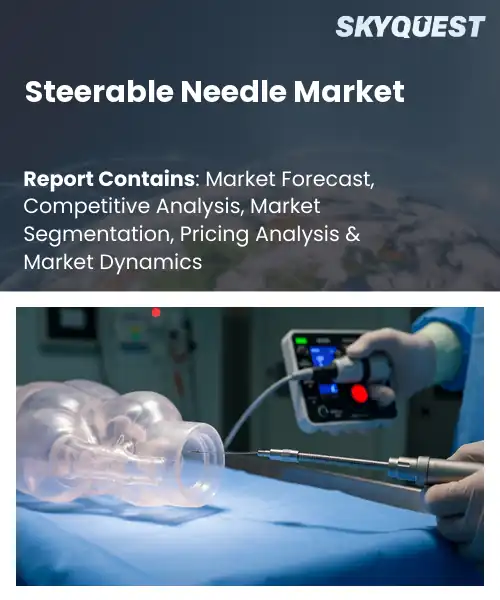
Steerable Needle Market
Report ID: SQMIG20I2859
Report ID: SQMIG20I2859
[email protected]
USA +1 351-333-4748
Report ID:
SQMIG20I2859 |
Region:
Global |
Published Date: April, 2026
Pages:
157
|Tables:
115
|Figures:
77


Global Steerable Needle Market size was valued at USD 1.76 Billion in 2024 and is poised to grow from USD 1.93 Billion in 2025 to USD 1.7 Billion by 2033, growing at a CAGR of 9.7% during the forecast period (2026-2033).
The primary driver of the steerable needle market is the clinical demand for greater targeting accuracy in minimally invasive procedures, which reduces complications and shortens overall patient recovery. This market encompasses flexible, controllable needle devices and the software and imaging systems that guide them, and it matters because clinicians increasingly treat small, hard-to-reach lesions with percutaneous techniques rather than open surgery. Over the last decade the field evolved from simple curved cannulas to integrated steerable systems with real-time imaging and robotic assistance, enabling applications such as MRI-guided prostate biopsies and percutaneous ablation of lung nodules, expanding clinical indications and adoption.A central factor driving global growth is the tighter integration of real-time imaging and robotic control with steerable needle platforms, because improved guidance fidelity directly increases diagnostic yield and reduces repeat procedures. As clinicians observe higher first-pass biopsy accuracy in lung and prostate cases, hospitals gain confidence to invest in combined systems, which in turn expands procurement and vendor R&D into disposable steerable tips and compatible navigation software. This cascade creates opportunities in oncology ablation, targeted intratumoral drug delivery, and outpatient interventional suites where lower complication rates enable faster turnover, and payers respond by updating reimbursement codes that accelerate adoption.
How is AI enhancing precision and adoption in the steerable needle market?
Steerable needle systems bring together flexible needle mechanics imaging modalities and clinician control to reach targets that are hard to access. AI enhances precision by analysing images in real time predicting safer trajectories and offering guidance that reduces variability between operators. The current market is moving toward closer integration of AI with robotic manipulators and advanced imaging which makes procedures more predictable and easier to plan. This shift increases clinician confidence and broadens clinical use cases from niche interventions to more routine procedures. Examples of AI driven imaging platforms and consortium led trials are helping validate these benefits in practice.Bendit Technologies December 2025, received US FDA clearance for the Bendit17 steerable microcatheter which underscores regulatory momentum. When paired with AI enabled imaging and trajectory planning this kind of device availability supports faster adoption by improving targeting consistency shortening procedure time and boosting clinician confidence.
Market snapshot - (2026-2033)
Global Market Size
USD 1.76 Billion
Largest Segment
Robotic/Computer-Assisted Steerable Needles
Fastest Growth
Robotic/Computer-Assisted Steerable Needles
Growth Rate
9.7% CAGR
To get more insights on this market click here to Request a Free Sample Report
Global steerable needle market is segmented by control mechanism, clinical application (strategic drivers), imaging guidance compatibility, end-user and region. Based on control mechanism, the market is segmented into Tip-steerable Needles (Manual Control), Robotic/Computer-Assisted Steerable Needles and Shape-Memory Alloy (SMA) Driven Needles. Based on clinical application (strategic drivers), the market is segmented into Oncology (Biopsy & Tumor Ablation), Pain Management & Regional Anesthesia and Neurosurgery & Cardiovascular Interventions. Based on imaging guidance compatibility, the market is segmented into MRI-Compatible Steerable Needles and Ultrasound/CT-Guided Systems. Based on end-user, the market is segmented into Specialized Surgery Centers & Trauma Hospitals and Academic & Medical Research Institutes. Based on region, the market is segmented into North America, Europe, Asia Pacific, Latin America and Middle East & Africa.
Robotic/Computer-Assisted Steerable Needles segment leads because advanced actuation and closed loop control enable highly repeatable curved trajectories that correct for tissue deformation and clinician variability, improving targeting reliability. Integration with real time imaging and planning software permits complex paths around critical anatomy, driving adoption in complex interventions. The technology reduces procedure time variability and supports reproducible outcomes, which encourages hospital investment and clinical protocol development.
However, Tip-steerable Needles (Manual Control) are emerging as the most rapidly expanding area because their low complexity and familiarity accelerate clinician adoption in routine procedures. Simpler device design and immediate tactile feedback shorten training curves, while lower acquisition barriers expand use across outpatient suites, creating near term growth and broadening application areas.
MRI-Compatible Steerable Needles segment stands out because unparalleled soft tissue contrast and real time imaging feedback allow operators to steer around critical structures during delicate interventions, increasing confidence in lesion targeting. Non metallic construction and compatibility with advanced sequences reduce procedural uncertainty and expand applications in neuro and deep tissue therapies, prompting device refinement and clinical protocol integration that accelerates institutional uptake.
However, Ultrasound/CT-guided Systems are witnessing the strongest growth momentum because their widespread imaging availability and real time visualization meet clinician demand for cost effective, workflow friendly options. Advances in image fusion and portable ultrasound improve path planning and in procedure adjustments, enabling broader procedural adoption and creating commercial opportunities across diverse clinical settings.
To get detailed segments analysis, Request a Free Sample Report
North America dominates the global steerable needle market due to a concentrated convergence of advanced clinical infrastructure, industry leadership, and an enabling innovation environment. Major medical device companies and specialized startups maintain close partnerships with academic medical centers to accelerate device design and clinical validation. Widespread clinician familiarity with minimally invasive interventions, established reimbursement practices, and relatively streamlined regulatory pathways support timely adoption. Dense networks of tertiary hospitals and specialty centers facilitate accumulation of clinical evidence and practitioner expertise, while active investment channels and robust distribution systems enable rapid commercialization and ongoing product refinement across the region.
Steerable Needle Market in United States is led by a concentration of device innovators, academic medical centers, and clinical specialists who collaborate to refine device ergonomics and procedural techniques. Comprehensive training programs and integrated hospital pathways support early clinical adoption, while established distribution channels and reimbursement familiarity enable efficient scaling. Strategic partnerships, targeted acquisition activity, and strong industry investment foster continuous product development and practical deployment across diverse care settings.
Steerable Needle Market in Canada benefits from concentrated adoption within tertiary care centers and collaborative research networks that bridge clinical needs and device innovation. Provincial procurement practices emphasize demonstrated clinical value and workflow integration, encouraging vendors to develop robust training services. Proximity to larger industry hubs supports cross-border partnerships and implementations, while clinical leadership and emphasis on cost effectiveness guide adoption and refinement of steerable needle techniques across healthcare institutions.
Europe is experiencing rapid expansion in the steerable needle market driven by an ecosystem that combines clinical excellence, strong industrial capabilities, and coordinated regulatory frameworks. Robust hospital networks and specialty centers foster multidisciplinary adoption of advanced interventional techniques, while established medtech manufacturers and agile innovators collaborate closely with clinicians to refine device functionality for diverse procedures. Cross-border partnerships and public procurement strategies encourage pilot deployments and clinical evidence generation. Growing emphasis on minimally invasive diagnostics and therapeutics across European healthcare systems, together with evolving reimbursement pathways and clinician demand for procedural precision, is accelerating integration of steerable needle technologies into routine clinical workflows.
Steerable Needle Market in Germany is characterized by a deep industrial base and strong clinical engagement. Robust networks of university hospitals and specialty centers provide settings for device validation and clinician training, while established medtech manufacturers drive engineering improvements. Integrated procurement processes and a focus on clinical outcomes encourage adoption in complex interventional procedures. Collaborative research initiatives between industry and academic centers strengthen deployment and product refinement across clinical settings.
Steerable Needle Market in United Kingdom is propelled by a vibrant innovation ecosystem and focused clinical leadership that accelerates pilot deployments and broader adoption. Strong collaboration between startups, academic centers, and healthcare providers supports rapid iteration of device designs and procedural workflows. National evaluation pathways and focused procurement initiatives encourage real world testing, while clinician champions and targeted training programs help embed technologies into interventional practice across hospital networks nationwide.
Steerable Needle Market in France is emerging through coordinated efforts among academic research centers, specialty hospitals, and innovative medical technology firms. National healthcare structures enable organized pilot programs and evidence generation that inform procurement decisions. A growing community of clinician innovators and supportive incubators helps translate prototypes into relevant devices. Emphasis on procedural precision in oncology and interventional specialties, combined with training initiatives, promotes adoption and refinement across healthcare networks.
Asia Pacific is strengthening its position in the steerable needle market through coordinated investments in clinical infrastructure, domestic manufacturing, and targeted innovation. Advanced healthcare systems in key markets support adoption of precision interventional tools, while local device developers and international firms form partnerships to adapt technologies to regional procedural needs. Regulatory modernization and streamlined approval pathways in several jurisdictions facilitate clinical evaluation and market entry. Focused R&D efforts integrating imaging, robotics, and navigation capabilities enhance device performance for complex procedures. Public and private funding initiatives and partnerships with international research centers support evidence generation and adoption, and regional centers of excellence facilitate clinician training and cross-border knowledge exchange.
Steerable Needle Market in Japan benefits from advanced clinical infrastructure and strong domestic engineering expertise that support quality device development and integration with imaging and robotic systems. Close collaboration between medtech firms and university hospitals enables rigorous clinical evaluation and iterative product enhancement, and continuous clinician training supports broader clinical use across care settings. Strategic partnerships with international companies and supportive regulatory frameworks further enable market expansion and export opportunities.
Steerable Needle Market in South Korea is benefiting from a dynamic medtech ecosystem that blends nimble device manufacturers with advanced hospitals. Emphasis on integrating navigation and robotic assistance enhances device appeal for precise interventions. Proactive collaboration between industry, research institutes, and government innovation programs supports prototyping and clinical evaluation. Strong export focus and partnerships with firms amplify commercialization pathways, while targeted clinician training helps embed steerable needle techniques into practice.
To know more about the market opportunities by region and country, click here to
Buy The Complete Report
Increasing Demand For Precision
Technological Advancements In Design
High Procedural Training Requirements
Regulatory and Reimbursement Uncertainty
Request Free Customization of this report to help us to meet your business objectives.
Competition in the global steerable needle market is driven by clinical demand for earlier, accurate lung diagnostics and device differentiation through regulatory clearances, strategic M&A, and imaging partnerships. Maverix Medical acquired Cirrus Bio to assemble an integrated lung diagnostic and device platform. Serpex Medical secured 510k clearances and demonstrated a first lung nodule biopsy with Body Vision, accelerating commercial adoption.
Top Player’s Company Profile
Recent Developments
SkyQuest’s ABIRAW (Advanced Business Intelligence, Research & Analysis Wing) is our Business Information Services team that Collects, Collates, Correlates, and Analyses the Data collected by means of Primary Exploratory Research backed by robust Secondary Desk research. As per SkyQuest analysis, the global steerable needle market is driven primarily by increasing clinical demand for greater targeting accuracy in minimally invasive procedures, which reduces complications and speeds recovery. A second driver is tighter integration of real time imaging, AI and robotic control that improves guidance fidelity and first-pass diagnostic yield. A restraint is the high procedural training requirements that slow broader adoption and raise institutional procurement barriers. North America remains the dominating region due to concentrated clinical infrastructure, regulatory support and active industry–academic collaborations. The dominating segment is Robotic/Computer-Assisted Steerable Needles which lead because closed loop actuation and imaging integration enable repeatable curved trajectories and reproducible outcomes.
| Report Metric | Details |
|---|---|
| Market size value in 2024 | USD 1.76 Billion |
| Market size value in 2033 | USD 1.7 Billion |
| Growth Rate | 9.7% |
| Base year | 2024 |
| Forecast period | (2026-2033) |
| Forecast Unit (Value) | USD Billion |
| Segments covered |
|
| Regions covered | North America (US, Canada), Europe (Germany, France, United Kingdom, Italy, Spain, Rest of Europe), Asia Pacific (China, India, Japan, Rest of Asia-Pacific), Latin America (Brazil, Rest of Latin America), Middle East & Africa (South Africa, GCC Countries, Rest of MEA) |
| Companies covered |
|
| Customization scope | Free report customization with purchase. Customization includes:-
|
To get a free trial access to our platform which is a one stop solution for all your data requirements for quicker decision making. This platform allows you to compare markets, competitors who are prominent in the market, and mega trends that are influencing the dynamics in the market. Also, get access to detailed SkyQuest exclusive matrix.
Table Of Content
Executive Summary
Market overview
Parent Market Analysis
Market overview
Market size
KEY MARKET INSIGHTS
COVID IMPACT
MARKET DYNAMICS & OUTLOOK
Market Size by Region
KEY COMPANY PROFILES
Methodology
For the Steerable Needle Market, our research methodology involved a mixture of primary and secondary data sources. Key steps involved in the research process are listed below:
1. Information Procurement: This stage involved the procurement of Market data or related information via primary and secondary sources. The various secondary sources used included various company websites, annual reports, trade databases, and paid databases such as Hoover's, Bloomberg Business, Factiva, and Avention. Our team did 45 primary interactions Globally which included several stakeholders such as manufacturers, customers, key opinion leaders, etc. Overall, information procurement was one of the most extensive stages in our research process.
2. Information Analysis: This step involved triangulation of data through bottom-up and top-down approaches to estimate and validate the total size and future estimate of the Steerable Needle Market.
3. Report Formulation: The final step entailed the placement of data points in appropriate Market spaces in an attempt to deduce viable conclusions.
4. Validation & Publishing: Validation is the most important step in the process. Validation & re-validation via an intricately designed process helped us finalize data points to be used for final calculations. The final Market estimates and forecasts were then aligned and sent to our panel of industry experts for validation of data. Once the validation was done the report was sent to our Quality Assurance team to ensure adherence to style guides, consistency & design.
Analyst Support
Customization Options
With the given market data, our dedicated team of analysts can offer you the following customization options are available for the Steerable Needle Market:
Product Analysis: Product matrix, which offers a detailed comparison of the product portfolio of companies.
Regional Analysis: Further analysis of the Steerable Needle Market for additional countries.
Competitive Analysis: Detailed analysis and profiling of additional Market players & comparative analysis of competitive products.
Go to Market Strategy: Find the high-growth channels to invest your marketing efforts and increase your customer base.
Innovation Mapping: Identify racial solutions and innovation, connected to deep ecosystems of innovators, start-ups, academics, and strategic partners.
Category Intelligence: Customized intelligence that is relevant to their supply Markets will enable them to make smarter sourcing decisions and improve their category management.
Public Company Transcript Analysis: To improve the investment performance by generating new alpha and making better-informed decisions.
Social Media Listening: To analyze the conversations and trends happening not just around your brand, but around your industry as a whole, and use those insights to make better Marketing decisions.
REQUEST FOR SAMPLE
 REQUEST FREE CUSTOMIZATION


Want to customize this report? This report can be personalized according to your needs. Our analysts and industry experts will work directly with you to understand your requirements and provide you with customized data in a short amount of time. We offer $1000 worth of FREE customization at the time of purchase.
Feedback From Our Clients


 USA (+1) 351-333-4748

