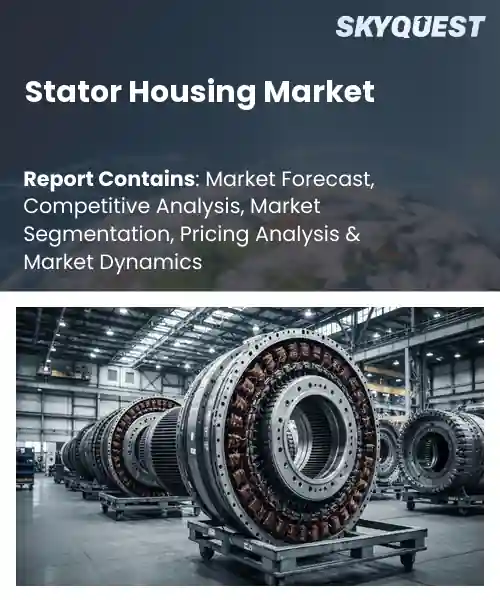
Stator Housing Market
Report ID: SQMIG20D2573
Report ID: SQMIG20D2573
[email protected]
USA +1 351-333-4748
Report ID:
SQMIG20D2573 |
Region:
Global |
Published Date: March, 2026
Pages:
157
|Tables:
146
|Figures:
78


Global Stator Housing Market size was valued at USD 5.2 Billion in 2024 and is poised to grow from USD 5.58 Billion in 2025 to USD 9.89 Billion by 2033, growing at a CAGR of 7.4% during the forecast period (2026-2033).
Key Takeaways : Market Trends & Insights
Engineered enclosures for electric motors and generators drive the market for stator housing, focusing on the global transition to electrification across all industries. They directly affect the operation of the stator and its electromagnetic behavior (the way in which it produces and/or transmits electricity), which contributes to the efficiency of the motor, and thus, affects the overall life expectancy of a machine used to run a factory, car, or wind turbine. During the last decade, the stator housing market has moved from cast iron to lightweight, largely due to the adoption of electric vehicles (EV's), with increasing capacity for wind turbines, resulting in increased tooling capacity, testing, and requirements for suppliers.
The changes seen in the materials and manufacturing processes have had a significant impact on the global stator housing market. Suppliers' investments in die casting and CNC machining have been accelerated due to the increased efficiency of the motors resulting from the use of more thermally conductive, lighter-weight materials. Consequently, many suppliers have invested heavily in the new technologies used for the manufacture of stator housing, including additive manufacturing.
How is AI Enhancing Quality Control in the Stator Housing Market?
AI is revolutionizing the field of quality control for stator housings through the use of machine vision, sensor fusion, computed tomography, and pattern recognition. AI enables manufacturers to use 3D scans to compare structures in a CAD file to detect minute defects, such as porosity, misalignment, and welding inconsistencies.
As electric motor production continues to increase and the demand for tighter tolerances grow, it is increasingly important that production processes are inspected consistently. Machine manufacturers are integrating AI into end of line machine systems to track quality and give feedback to machining and assembly so that escapes can be reduced. For example, some companies are using automated CT evaluations to eliminate time-consuming checks by operators and give more accurate information regarding the history and quality of parts.
Market snapshot - 2026-2033
Global Market Size
USD 5.2 Billion
Largest Segment
Gray/Nodular Cast Iron (Industrial-duty)
Fastest Growth
Magnesium Alloys (Lightweighting focus)
Growth Rate
7.4% CAGR
To get more insights on this market click here to Request a Free Sample Report
Global stator housing market is segmented into material chemistry, manufacturing technology, cooling/thermal management, stator diameter/size, end-use application and region. Based on material chemistry, the market is segmented into die-cast aluminum alloys (AlSi10Mg/AlSi12), magnesium alloys (lightweighting focus) and gray/nodular cast iron (industrial-duty). Based on manufacturing technology, the market is segmented into high-pressure die casting (HPDC), low-pressure die casting (LPDC), gravity/sand casting and CNC precision machined housings. Based on cooling/thermal management, the market is segmented into water-jacketed cooling (liquid-cooled), air-cooled (finned design) and phase-change material (PCM) integrated. Based on stator diameter/size, the market is segmented into small (below 150mm), medium (150mm - 300mm) and large (above 300mm). Based on end-use application, the market is segmented into EV/HEV powertrains (traction motors), industrial automation & robotics, aerospace propulsion systems and home appliances/consumer electronics. Based on region, the market is segmented into North America, Europe, Asia Pacific, Latin America and Middle East & Africa.
The largest stator housing market share is for the die cast aluminium alloys, as die-cast aluminium offers an excellent combination of lightweight properties; sufficient strength; and thermal conductivity, which meet the requirements of the core stator housing. This reduced complexity of manufacturing per part and machining downstream reduces costs to manufacture, increases dimensional consistency, and facilitates the use of these materials in traction and consumer electric motor applications.
Magnesium alloys have the greatest rate of expansion, due to aggressive lightweighting initiatives in electrification, which is driving designers to explore alternative materials with lower weights. Developments in the protective coatings and alloy formulations of these materials have helped to overcome historical limitations related to corrosion and castability, which allows for the use of magnesium in compact and high-efficiency electric motors.
The high pressure die casting (HPDC) segment dominates the market segment because it allows for quick cycles of production for complex thin wall designs with consistency, requiring little to no secondary machining, while ensuring that stator housings are manufactured within very tight tolerances. The popularity of HPDC is due in part to the fact that it can process all common aluminum alloy chemistries, along with having developed tooling factory systems. Thus, creating large volume output, excellent efficiency, and consistent production quality makes the HPDC process an attractive supply option for OEMs looking for many motor program solutions and cost-effective manufacturing.
The CNC precision machined housings segment has become most rapidly expanding as precision critical applications require custom geometries and surface finishes not possible using casting at low to medium volume. With the additional increase in demand from aerospace, robotics, and/or higher end industrial drives for delivering greater dimensional accuracy, tighter tolerances, and/or functional features integrated directly into machined components are causing a transition away from casting to machining thus creating additionalsupplier market opportunities with higher profit potential.
To get detailed segments analysis, Request a Free Sample Report
Asia Pacific's leadership in the stator housing market is influenced by three factors concentrated manufacturing, integrated supply chains, and strong demand for key end uses. The region's leadership is supported by the ability to produce advanced electric motors and by local suppliers of components and materials, which enables high levels of efficiency and cost savings when scaling up production. The close distances between major original equipment manufacturers (OEMs) promote collaboration on product design and testing. Investments in automation and quality control help improve competitive positions and accelerate the introduction of new technologies in global markets.
The stator housing market in Japan is focused on precision engineering, optimizing the use of materials, and integrating components into efficient motor systems. Design engineers work closely with production teams, continually refine products, and ensure their designs and processes adhere to demanding quality standards. The testing and metallurgical processing capabilities of Japanese manufacturers contribute to ensuring the durability and performance of the products manufactured in Japan. The culture of continuous improvement in Japan encourages the introduction of new products and innovative manufacturing processes, which enhance the competitiveness of both domestic and export-oriented supply chains supporting the development of advanced mobile applications.
As per stator housing industry analysis, South Korea is supported by strong integration of electronics in motor systems, by a rapid acceptance of automation, and by close relationships with many leading motor and vehicle OEMs. Manufacturers leverage compact design capabilities and employ innovative surface coating processes to satisfy their customers' product performance requirements. Collaborative clusters of material suppliers and research institutions facilitate rapid prototyping and refinement of products.
The stator housing industry in Europe is quickly growing because of advanced automotive technology, high-end vehicle manufacturers, and the need for electric vehicles and efficient use of power as required by governments. Suppliers are investing in lightweight materials, new ways to make things, and tooling with very high precision so they can produce their products to meet the very high performance and safety requirements. As there are a high number of suppliers working together in close proximity to major original equipment manufacturers, they may quickly design and test new products for production. In addition, because there are testing facilities available in most parts of Europe and the emphasis on recycling of materials, there is a growing demand for stator housing products from all industries and markets for these products throughout Europe.
The stator housing industry in Germany focuses on producing precision manufactured stator housings that are integrated into the entire automotive and industrial equipment supply chain. In addition, companies in Germany use robust testing methods as well as materials expertise and modular construction to assist assembly and servicing of stator housing products through close relationship/networking with OEM design groups. The extensive network of specialized sub-contractors and engineering consulting firms aid in qualifying and customizing individual components of stator housings. This strong infrastructure, as well as close working relationships with OEM design teams, has established Germany as a significant location for high quality and reliable stator housing solutions.
The stator housing market in the UK has an agile supply base, a strong network of research collaboration, focusing on new lightweight materials and innovative manufacturing processes. SMEs work together with universities/academia to assist in converting design innovations into pilot operations, thereby supporting niche customization of design and rapid prototyping. As a result, members of the market are focused on flexibility and modular solutions as well as service models which support niche mobility and industrial applications. The innovative environment is an important factor in the UK’s growth as a provider of advanced component supply capabilities.
France continues to benefit from continued investment in the development of its stator housing market by expanding electric drive technologies and high-tech manufacturing capabilities developed through collaborative innovation initiatives that bring together business and research. Manufacturers continue to work on upgrading their processes by producing lightweight alloys and utilizing precision forming, while design centres are focusing on enhancing thermal management and noise levels for premium applications. The geographic clusters that exist in the French market promote knowledge sharing among members of the market.
North America is expanding its stronghold in the stator housing marketplace with an increased emphasis on advanced manufacturing capabilities, improved supplier diversification, and aligning closely with domestic OEMs. Investment in automation, additive manufacturing, and precision tooling provides manufacturers with the ability to be more flexible in producing complex geometries and lighter components.
As per stator housing market regional forecast, close relationships between stator housing component suppliers and electric motor and vehicle OEMs are driving the US market toward scalable manufacturing capabilities and easier integration into production assembly lines. As such, suppliers are investing in automation, advanced forming techniques, quality assurance systems, etc., to provide OEMs with the ability to customize their products and improve lead times. Research collaboration with universities is helping to advance material and thermal management methodologies while providing greater aftermarket support to increase lifecycle value and reaffirm USA’s position in advanced manufacturing within complex application markets.
As per stator housing market regional outlook, Canada market focuses on supplier agility, advanced material knowledge, and strategic partnerships with North American OEMs and suppliers. Stator housing manufacturers are implementing scalable manufacturing processes, corrosion treatments, and precision forming to satisfy Staters and OEM’s requirements. Additionally, collaborative programs between manufacturers and post-secondary technical institutions are assisting with workforce skill development and research, while providing responsive logistical solutions for their customers because they are located near major markets. The combination of demonstrated material capability, highly skilled labor force, and a collaborative posture with USA manufacturers will further validate Canada’s role as a leading producer of specialized stator housings.
To know more about the market opportunities by region and country, click here to
Buy The Complete Report
Rising Electric Vehicle Adoption
There has been a surge of electric vehicles production and therefore an increase in the footprint of reliable, lightweight stator housings. As a result, manufacturers are increasingly focused on design improvements and material innovations. As such, automotive OEMs are working closely with component suppliers to develop stator housings that enhance thermal management and structural integrity, which will enable the wider adoption of more efficient motors. Through this collaborative environment, investments in manufacturing capacity and process optimization will create economies of scale, thereby accelerate product development cycles and contribute to the global stator housing market growth.
Adoption of Renewable Energy
With the growing number of renewable energy projects taking place, there has been an increasing demand for durable and versatile stator housings that are used in both generators and wind turbine motors. Consequently, suppliers have been motivated to develop larger stator housing designs with corrosion resistance properties to withstand the rigors of their environments. Likewise, both energy project developers and equipment manufacturers increasingly require stator housing components with longer service lives and reduced maintenance requirements, thereby prompting specification of changes and purchasing commitments. In turn, this type of demand encourages material innovation and scaled precision fabrication capabilities, both of which help to build a stronger supply chain and foster continued market growth for stator housing globally.
Volatility in Raw Material Costs
The fluctuations in metals and alloy costs bring uncertainty in the procurement planning and margin compression to manufacturers of stator housings. Unpredictable increases in the cost of raw materials put pressure on companies to either absorb those costs or pass them along to their customers, both of which negatively impact their competitive position and slow the OEM's decision to purchase. Uncertainty in procurement discourages companies from making investments in capacity expansion and innovation; encourages conservative inventory practices; and may lead to less aggressive contracting strategies.
Complex Regulatory Compliance Requirements
Manufacturers of stator housings must comply with widely varying regulations regarding safety, the environment, and performance criteria, all of which ultimately increase the burden of developing and certifying a product and lengthen the time to introduce the product into the marketplace. Manufacturers must invest resources for testing procedures, documentation, and periodic re-certification, which generally displace investment for capacity expansion and/or innovation efforts. Complicated regulatory and certification processes can delay fulfillment of compliant contracts and discourage newer or smaller suppliers from aggressively entering the market. The cumulative impact of these regulatory barriers along with the need to meet site-specific standards for new product development and manufacturing footprint expansion limit the ability to implement these changes globally and inhibit the rapid development of new products as well as manufacturing site expansion.
Request Free Customization of this report to help us to meet your business objectives.
The competitive environment is characterized by original OEMs and tier 1 suppliers using methods such as acquisitions, joint ventures and technological partnerships to acquire new and advanced capabilities in stator housings and thermal management systems. An example would be with Mercedes Benz acquiring YASA to have access to the Axial flux motor, and with LG forming a joint venture with Magna to provide e-motor modules to help in the strategic consolidation of supply-side channels. Startups such as H3X are pushing the envelope for integrated stator and thermal systems through their own innovation and collaboration with other startup companies, which, in turn, are driving M&A and JV activity in the industry.
Electrification Driving Design Innovation: To meet the needs of changing motor architecture and better thermal control, stator housing producers are changing the design of their products to increase the integration of power electronics and make them more compact. This stator housing market trend is driving increased collaboration between OEM manufacturers and suppliers on modular platforms that can be quickly developed, making it easier to customize for different applications in both vehicles and industry. There is also a growing focus on manufacturability, serviceability, and the ability to meet future e-mobility standards, which creates an opportunity for differentiated components, licensing of intellectual property, and new aftermarket service offerings.
Lightweighting and Advanced Materials: Manufacturers are quickly adopting higher-strength alloys, composites with reinforcement, and hybrid material systems to reduce weight while maintaining the structure and thermal performance of stator housings. Design teams are now selecting materials earlier in the product development process to allow for maximized manufacturability and lifecycle performance, thereby aiding in meeting recycling requirements. Supply chain partnerships are being created to secure materials while providing consistent material characteristics throughout the various batches of production, leading to ways to differentiate through quieter operations, increased efficiency, and compatibility with compact high-speed motors required for next generation mobility and industrial products.
SkyQuest’s ABIRAW (Advanced Business Intelligence, Research & Analysis Wing) is our Business Information Services team that Collects, Collates, Correlates, and Analyses the Data collected by means of Primary Exploratory Research backed by robust Secondary Desk research.
As per SkyQuest analysis, rising electric vehicle adoption is a key driver propelling demand for lighter, thermally efficient stator housings while growing renewable energy deployment acts as a second driver by expanding demand for robust, corrosion-resistant designs. A significant restraint is volatility in raw material costs, which pressures margins and procurement planning. Asia Pacific remains the dominant region due to concentrated manufacturing, integrated supply chains and proximity to major OEMs, and die-cast aluminum alloys are the dominating segment because they balance low mass, thermal conductivity and high-volume casting efficiency. Suppliers investing in die casting, CNC machining and AI-enabled inspection are best positioned to capture near-term growth.
| Report Metric | Details |
|---|---|
| Market size value in 2024 | USD 5.2 Billion |
| Market size value in 2033 | USD 9.89 Billion |
| Growth Rate | 7.4% |
| Base year | 2024 |
| Forecast period | 2026-2033 |
| Forecast Unit (Value) | USD Billion |
| Segments covered |
|
| Regions covered | North America (US, Canada), Europe (Germany, France, United Kingdom, Italy, Spain, Rest of Europe), Asia Pacific (China, India, Japan, Rest of Asia-Pacific), Latin America (Brazil, Rest of Latin America), Middle East & Africa (South Africa, GCC Countries, Rest of MEA) |
| Companies covered |
|
| Customization scope | Free report customization with purchase. Customization includes:-
|
To get a free trial access to our platform which is a one stop solution for all your data requirements for quicker decision making. This platform allows you to compare markets, competitors who are prominent in the market, and mega trends that are influencing the dynamics in the market. Also, get access to detailed SkyQuest exclusive matrix.
Table Of Content
Executive Summary
Market overview
Parent Market Analysis
Market overview
Market size
KEY MARKET INSIGHTS
COVID IMPACT
MARKET DYNAMICS & OUTLOOK
Market Size by Region
KEY COMPANY PROFILES
Methodology
For the Stator Housing Market, our research methodology involved a mixture of primary and secondary data sources. Key steps involved in the research process are listed below:
1. Information Procurement: This stage involved the procurement of Market data or related information via primary and secondary sources. The various secondary sources used included various company websites, annual reports, trade databases, and paid databases such as Hoover's, Bloomberg Business, Factiva, and Avention. Our team did 45 primary interactions Globally which included several stakeholders such as manufacturers, customers, key opinion leaders, etc. Overall, information procurement was one of the most extensive stages in our research process.
2. Information Analysis: This step involved triangulation of data through bottom-up and top-down approaches to estimate and validate the total size and future estimate of the Stator Housing Market.
3. Report Formulation: The final step entailed the placement of data points in appropriate Market spaces in an attempt to deduce viable conclusions.
4. Validation & Publishing: Validation is the most important step in the process. Validation & re-validation via an intricately designed process helped us finalize data points to be used for final calculations. The final Market estimates and forecasts were then aligned and sent to our panel of industry experts for validation of data. Once the validation was done the report was sent to our Quality Assurance team to ensure adherence to style guides, consistency & design.
Analyst Support
Customization Options
With the given market data, our dedicated team of analysts can offer you the following customization options are available for the Stator Housing Market:
Product Analysis: Product matrix, which offers a detailed comparison of the product portfolio of companies.
Regional Analysis: Further analysis of the Stator Housing Market for additional countries.
Competitive Analysis: Detailed analysis and profiling of additional Market players & comparative analysis of competitive products.
Go to Market Strategy: Find the high-growth channels to invest your marketing efforts and increase your customer base.
Innovation Mapping: Identify racial solutions and innovation, connected to deep ecosystems of innovators, start-ups, academics, and strategic partners.
Category Intelligence: Customized intelligence that is relevant to their supply Markets will enable them to make smarter sourcing decisions and improve their category management.
Public Company Transcript Analysis: To improve the investment performance by generating new alpha and making better-informed decisions.
Social Media Listening: To analyze the conversations and trends happening not just around your brand, but around your industry as a whole, and use those insights to make better Marketing decisions.
REQUEST FOR SAMPLE
 REQUEST FREE CUSTOMIZATION
Global Stator Housing Market size was valued at USD 5.2 Billion in 2024 and is poised to grow from USD 5.58 Billion in 2025 to USD 9.89 Billion by 2033, growing at a CAGR of 7.4% during the forecast period (2026-2033).
Competitive landscape is marked by OEMs and tier 1 suppliers using acquisitions, joint ventures and tech partnerships to secure advanced stator housing and thermal management capabilities. Examples include Mercedes-Benz acquisition of YASA for axial flux motor technology. LG and Magna forming the LG Magna e Powertrain joint venture illustrates strategic supply-side consolidation for e motor modules. Startups pushing integrated stator and thermal solutions, such as H3X’s liquid cooling and insulation work, are accelerating M&A and JV activity. 'Nemak', 'Martinrea International', 'Rheinmetall AG', 'Linamar Corporation', 'GF Casting Solutions', 'Ryobi Limited', 'Shiloh Industries', 'Endurance Technologies', 'Sandhar Technologies', 'Kirloskar Ferrous', 'Gibbs Die Casting', 'Dynacast', 'Buhler Group', 'Voestalpine', 'Magna International', 'Teksid', 'Ahresty Corporation', 'CIE Automotive', 'Handtmann', 'Aisin Corporation'
Rapid expansion of electric vehicle production has increased demand for reliable and lightweight stator housings, prompting manufacturers to prioritize design improvements and material innovations. Automotive original equipment manufacturers are collaborating with component suppliers to integrate housings that enhance thermal management and structural integrity, which supports wider adoption of high-efficiency motors. This collaborative environment encourages investment in manufacturing capacity and process optimization, fostering economies of scale and accelerating product development cycles that directly contribute to growth in the global stator housing market.
Electrification Driving Design Innovation: Stator housing manufacturers are reorienting product design to address evolving motor architectures and thermal management needs, prioritizing integration with power electronics and compact packaging. This trend stimulates collaboration between OEMs and suppliers to co-develop modular platforms, allowing faster iteration and customization for different vehicle and industrial applications. Emphasis on manufacturability, serviceability, and compatibility with future e-mobility standards is increasing, creating opportunities for differentiated components, intellectual property licensing, and new aftermarket services aligned with longer-term electrified powertrain roadmaps and global demand.
Asia Pacific's leadership in the stator housing market is influenced by three factors concentrated manufacturing, integrated supply chains, and strong demand for key end uses.
High-pressure die casting (HPDC) dominates the market due to its ability to produce complex, thin-wall designs with high precision, faster production cycles, and minimal need for secondary machining, making it highly cost-efficient for large-scale manufacturing.
Key restraints include volatility in raw material costs and complex regulatory compliance requirements, which increase production costs, delay product launches, and create barriers for new entrants.
The magnesium alloys segment is the fastest-growing due to increasing demand for lightweight materials in electric vehicles and advanced motor systems, supported by improvements in corrosion resistance and manufacturability.


Want to customize this report? This report can be personalized according to your needs. Our analysts and industry experts will work directly with you to understand your requirements and provide you with customized data in a short amount of time. We offer $1000 worth of FREE customization at the time of purchase.
Feedback From Our Clients


 USA (+1) 351-333-4748

