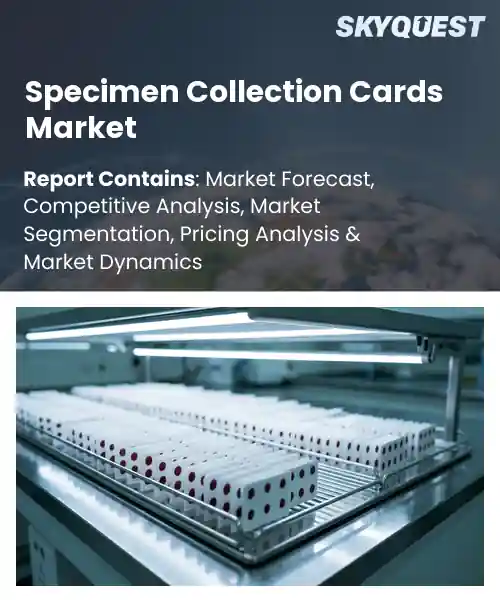
Specimen Collection Cards Market
Report ID: SQMIG35J2319
Report ID: SQMIG35J2319
[email protected]
USA +1 351-333-4748
Report ID:
SQMIG35J2319 |
Region:
Global |
Published Date: May, 2026
Pages:
157
|Tables:
118
|Figures:
72


Global Specimen Collection Cards Market size was valued at USD 282.5 Million in 2024 and is poised to grow from USD 300.07 Million in 2025 to USD 485.4 Million by 2033, growing at a CAGR of 6.22% during the forecast period (2026-2033).
The main driver of the specimen collection cards market is the shift to decentralized, minimally invasive sampling, which reduces the need for phlebotomy and cold chain logistics. Specimen collection cards including dried blood spot and filter paper cards from Guthrie newborn screening are useful for metabolic tests, infectious disease surveillance, therapeutic drug monitoring, and pharmacokinetic studies. The market matters because it reduces costs, improves access in remote and resource-limited settings and it allows for longitudinal sampling with less patient burden. Extraction chemistry and analytical sensitivity (LC-MS/MS, PCR, etc.) improvements over decades expanded utility . COVID-19 crisis accelerated adoption in public health programs .
The combination of regulatory acceptance and improvements in analytical methods is an important driver of expansion, as validated methods and clear guidance lower barriers to adoption for clinical and commercial users. Specimen cards were used by sponsors in decentralized trials and telemedicine, with higher assay sensitivity, standardized extraction protocols, and agency support, creating demand for scaled manufacturing and end-to-end logistics. Real-world examples show the impact: remote monitoring of anticoagulants reduces clinic visits, improved newborn panels increase early detection, and serosurveys of populations during pandemics provide timely policy guidance. These results demonstrate how cost reduction, easier transport and regulatory clarity open up public health impact and commercial opportunity.
How is AI improving quality control in the specimen collection cards market?
AI is helping to improve quality control in the specimen collection cards market, by automating pre analytical checks and standardizing acceptance criteria. Key aspects are image based inspection that detects under saturated or smeared spots, algorithmic adjustments for hematocrit related bias and LIMS integration for chain of custody and traceability. Labs are transitioning from manual visual inspection to camera enabled feeders and AI scoring that will send suspect cards for recollection or expert review. The changes reduce the need for repeat testing, improve reliability of downstream assays and increase consistency in workflow for newborn screening and biomarker studies.
Copan Group Achieves FDA 510k Clearance for PhenoMATRIX Image Assessment Platform, May 2026 AI-Driven Image Analysis for Daily Laboratory Use. This development automates visual QC steps, reducing the need for manual review and increasing throughput, supporting wider adoption of automated card handling and greater market efficiency.
Market snapshot - (2026-2033)
Global Market Size
USD 282.5 Million
Largest Segment
Dried Blood Spot (DBS) Cards
Fastest Growth
Saliva Collection Cards
Growth Rate
6.22% CAGR
To get more insights on this market click here to Request a Free Sample Report
Global specimen collection cards market is segmented by type, application, end-user, distribution and region. Based on type, the market is segmented into Dried Blood Spot (DBS) Cards, Dried Plasma Spot (DPS) Cards, Urine Collection Cards and Saliva Collection Cards. Based on application, the market is segmented into Newborn Screening, Pharmacokinetic Studies, Toxicology and Infectious Disease Testing. Based on end-user, the market is segmented into Hospitals, Reference Laboratories and Research Institutes. Based on distribution, the market is segmented into Direct Sales and Distributors. Based on region, the market is segmented into North America, Europe, Asia Pacific, Latin America and Middle East & Africa.
Dried Blood Spot (DBS) segment dominates due to the availability of a robust low complexity method of whole blood collection and stabilization leading to reliable downstream analysis across multiple assays. It is dominant due to high compatibility with existing laboratory workflows, lower reliance on cold chains, and familiarity with clinicians, all of which reduce the risk of sample degradation and simplify logistics, leading to consistent data quality and operational efficiencies for routine and decentralized testing.
However, Dried Plasma Spot (DPS) cards are the fastest growing area due to the increased interest in plasma specific assays and biomarker stability. Progress in DPS membrane chemistry and protocols is expanding its use for pharmacokinetic studies and proteomic analysis, regulatory clarity is improving its acceptability, and demand from labs wanting plasma level data is accelerating adoption and unlocking new clinical and research use cases.
Newborn Screening segment leads because it is a well-established and high priority public health application that requires reliable specimen collection from neonates in order to identify treatable conditions at an early stage. Its leadership is driven by standardized protocols which favour filter paper based collection, strong integration with public health programmes, and clinical imperative for early intervention, which together sustain consistent demand for validated cards and ongoing investment in screening infrastructure.
Meanwhile, Infectious Disease Testing is experiencing the most robust growth momentum as the increased needs of expanding surveillance and decentralized testing models are fueling demand for easily transportable, stable specimens. Novel pathogen monitoring, increased screening outside of traditional settings and assay innovation for dried specimens are driving rapid uptake and creating new opportunities for product differentiation and expanding the addressable market for collection cards.
To get detailed segments analysis, Request a Free Sample Report
North America dominates the market owing to the presence of matured ecosystem such as advanced healthcare infrastructure, extensive clinical research activity and well-established diagnostic laboratory networks, which are favoring the adoption of specimen collection cards. Supportive regulatory frameworks, pragmatic product validation pathways and others can accelerate clinical integration. We have solid local manufacturing and good supply chains, so we can reliably produce and distribute. Demand for decentralized sampling and home collection models will be driven by private investment and public health programs. The close collaboration between device makers, contract research organizations and healthcare providers accelerates innovation, commercialization and adoption, reinforcing the region’s leadership in setting global standards and market practices.
The Specimen Collection Cards Market is also growing due to the presence of a dense network of clinical laboratories, leading medical research institutions and a vibrant medtech ecosystem in the United States that facilitates fast product development and adoption. Payer engagement and pragmatic regulatory pathways are enabling validation studies and reimbursement conversations. Existing contract manufacturers and distribution channels are available to support scalability, and partnerships between diagnostics companies and healthcare systems enable the integration of remote collection workflows into routine testing and trials.
Canada’s specimen collection cards market is driven by coordinated public health programs, strong provincial laboratory networks and a growing interest in decentralized sampling solutions that lower barriers to access. Focus on standardization, quality control and integration with central laboratories supports deployment. Local manufacturers and international partners work together to localise production and adapt products to regional clinical needs, stakeholder engagement drives adoption in community and hospital settings, and research.
Regulatory harmonization, strong public health institutions, and active screening and biobanking programs that provide fertile ground for specimen collection cards are rapidly driving expansion in Europe. Broad validation and fast rollouts are possible because of the existing diagnostics manufacturers and dense lab networks. Cross border collaborations and funding mechanisms fuel innovation and commercialisation while sustainability priorities raise interest in low footprint sampling solutions. Integration with digital health systems and telemedicine enables traceability and usability, and active engagement of healthcare stakeholders promotes deployment in primary care, community settings, and centralized screening programs.
Specimen Collection Cards Market Germany has a well-developed manufacturing base for medical technology, stringent regulatory standards and integrated hospital and laboratory networks that facilitate rapid evaluation and adoption. Industry and research institutions are strongly linked to allow for product development and exports. The national focus on quality management and proficiency testing builds confidence in clinicians and laboratories, making Germany a top demand center and manufacturing hub in the larger European market.
A combination of public sector initiatives, private innovation and the integration of digital health platforms to support remote sampling workflows are driving the Specimen Collection Cards market in the United Kingdom. Community testing programmes, adoption by primary care, and partnerships between diagnostics firms and clinical networks speed up validation and scale. A supportive ecosystem of start-ups, contract laboratories, procurement channels allows implementation of novel sampling approaches across care pathways and consumer services.
Specimen Collection Cards Industry Decentralized sampling is being explored by authorities and clinical networks to increase screening and surveillance efforts, particularly among public health and research cohorts, with France emerging. Trial deployments are supported by an emphasis on standardization and laboratory quality assurance, and integration with national biobanking initiatives. Local manufacturers, hospitals and research centers work closely together to adapt products to clinical workflows. Stakeholder engagement encourages gradual uptake in regional health systems throughout the country.
Asia Pacific is strengthening its stature with unified investment in diagnostic infrastructure, increasing local manufacturing capabilities and government led health initiatives that focus on accessibility sampling. Maturation of regulations in the main markets and partnerships with multinational companies help in technology transfer and product registration. Increasing clinical research activity and growing decentralized care models increase the demand for transport friendly, low resource sampling methods. Cost efficiency, supply chain resilience, localization of product design and digital integration of sample logistics improve traceability and position the region as an increasingly important player in global specimen collection card development and commercialization.
Specimen Collection Cards Market Japan has a strong culture of precision manufacturing, strict quality standards and close alignment of diagnostics companies and research institutions. Established hospital networks and specialist laboratories support systematic evaluation and adoption. Local manufacturers want the product to be reliable and compatible with automated workflows. By working with international companies, they can transfer technology and access markets, which enables Japan to deliver high quality validated products to wider global markets.
The Specimen Collection Cards Industry in South Korea is marked by a vibrant innovation ecosystem, strong biotech and diagnostics startups and proactive adoption of new sampling technologies in the clinic. Agile manufacturers and contract labs accelerate product iteration and scaling. Digital health platforms and logistics companies increase traceability and patient-centric workflows. South Korea’s international partnerships and export orientation help it to boost its technological capabilities and its presence in regional markets.
To know more about the market opportunities by region and country, click here to
Buy The Complete Report
Rising Demand For Remote Testing
Growing Focus On Neonatal Screening
Regulatory Approval Complexity
Supply Chain Materials Dependence
Request Free Customization of this report to help us to meet your business objectives.
Competitive dynamics in the global specimen collection cards market are driven by product differentiation, assay compatibility and laboratory distribution partnerships that intensify rivalry between incumbents and tech entrants; recent examples include volumetric DBS innovation and point ofcollection plasma solutions, and new card chemistries for lipid and genomic stability, while firms pursue co development with labs and targeted product launches to win screening and decentralized testing contracts.
SkyQuest’s ABIRAW (Advanced Business Intelligence, Research & Analysis Wing) is our Business Information Services team that Collects, Collates, Correlates, and Analyses the Data collected by means of Primary Exploratory Research backed by robust Secondary Desk research.
As per SkyQuest analysis, the global specimen collection cards market is driven primarily by a shift toward decentralized, minimally invasive sampling that reduces cold chain reliance and expands access in remote settings, while a second driver is ongoing improvements in analytical sensitivity and growing regulatory acceptance that enable clinical and commercial adoption. A key restraint remains complex and variable regulatory approval pathways across jurisdictions that slow market entry and increase validation burdens. North America continues to dominate the market owing to advanced healthcare infrastructure, strong research activity and established supply chains, and the Dried Blood Spot card segment remains the dominant product category due to its maturity, compatibility and operational simplicity.
| Report Metric | Details |
|---|---|
| Market size value in 2024 | USD 282.5 Million |
| Market size value in 2033 | USD 485.4 Million |
| Growth Rate | 6.22% |
| Base year | 2024 |
| Forecast period | (2026-2033) |
| Forecast Unit (Value) | USD Million |
| Segments covered |
|
| Regions covered | North America (US, Canada), Europe (Germany, France, United Kingdom, Italy, Spain, Rest of Europe), Asia Pacific (China, India, Japan, Rest of Asia-Pacific), Latin America (Brazil, Rest of Latin America), Middle East & Africa (South Africa, GCC Countries, Rest of MEA) |
| Companies covered |
|
| Customization scope | Free report customization with purchase. Customization includes:-
|
To get a free trial access to our platform which is a one stop solution for all your data requirements for quicker decision making. This platform allows you to compare markets, competitors who are prominent in the market, and mega trends that are influencing the dynamics in the market. Also, get access to detailed SkyQuest exclusive matrix.
Table Of Content
Executive Summary
Market overview
Parent Market Analysis
Market overview
Market size
KEY MARKET INSIGHTS
COVID IMPACT
MARKET DYNAMICS & OUTLOOK
Market Size by Region
KEY COMPANY PROFILES
Methodology
For the Specimen Collection Cards Market, our research methodology involved a mixture of primary and secondary data sources. Key steps involved in the research process are listed below:
1. Information Procurement: This stage involved the procurement of Market data or related information via primary and secondary sources. The various secondary sources used included various company websites, annual reports, trade databases, and paid databases such as Hoover's, Bloomberg Business, Factiva, and Avention. Our team did 45 primary interactions Globally which included several stakeholders such as manufacturers, customers, key opinion leaders, etc. Overall, information procurement was one of the most extensive stages in our research process.
2. Information Analysis: This step involved triangulation of data through bottom-up and top-down approaches to estimate and validate the total size and future estimate of the Specimen Collection Cards Market.
3. Report Formulation: The final step entailed the placement of data points in appropriate Market spaces in an attempt to deduce viable conclusions.
4. Validation & Publishing: Validation is the most important step in the process. Validation & re-validation via an intricately designed process helped us finalize data points to be used for final calculations. The final Market estimates and forecasts were then aligned and sent to our panel of industry experts for validation of data. Once the validation was done the report was sent to our Quality Assurance team to ensure adherence to style guides, consistency & design.
Analyst Support
Customization Options
With the given market data, our dedicated team of analysts can offer you the following customization options are available for the Specimen Collection Cards Market:
Product Analysis: Product matrix, which offers a detailed comparison of the product portfolio of companies.
Regional Analysis: Further analysis of the Specimen Collection Cards Market for additional countries.
Competitive Analysis: Detailed analysis and profiling of additional Market players & comparative analysis of competitive products.
Go to Market Strategy: Find the high-growth channels to invest your marketing efforts and increase your customer base.
Innovation Mapping: Identify racial solutions and innovation, connected to deep ecosystems of innovators, start-ups, academics, and strategic partners.
Category Intelligence: Customized intelligence that is relevant to their supply Markets will enable them to make smarter sourcing decisions and improve their category management.
Public Company Transcript Analysis: To improve the investment performance by generating new alpha and making better-informed decisions.
Social Media Listening: To analyze the conversations and trends happening not just around your brand, but around your industry as a whole, and use those insights to make better Marketing decisions.
REQUEST FOR SAMPLE
 REQUEST FREE CUSTOMIZATION
Global Specimen Collection Cards Market size was valued at USD 282.5 Million in 2024 and is poised to grow from USD 300.07 Million in 2025 to USD 485.4 Million by 2033, growing at a CAGR of 6.22% during the forecast period (2026-2033).
Competitive dynamics in the global specimen collection cards market are driven by product differentiation, assay compatibility and laboratory distribution partnerships that intensify rivalry between incumbents and tech entrants; recent examples include volumetric DBS innovation and point ofcollection plasma solutions, and new card chemistries for lipid and genomic stability, while firms pursue co development with labs and targeted product launches to win screening and decentralized testing contracts. 'Whatman (Cytiva)', 'PerkinElmer', 'Ahlstrom-Munksjö', 'GE Healthcare Life Sciences', 'Sartorius AG', 'Munktell Filter AB', 'Haematonics', 'Meridian Biosciences', 'MACHEREY-NAGEL', 'Capitainer AB', 'DBS Systems', 'Chromsystems Instruments', 'ARCpoint Labs', 'Genoptix (Novartis)', 'Novamed'
Specimen collection cards have gained prominence as demand for remote and decentralized diagnostic testing grows, because they enable stable, convenient sample transport and long term preservation without complex cold chain logistics. Healthcare providers and laboratories can extend testing reach into communities and home settings, lowering logistical barriers and enabling broader screening programs. This accessibility supports market expansion by increasing adoption among public health initiatives and clinical services seeking reliable, low cost sample collection solutions, driving procurement of card products and encouraging manufacturers to expand offerings to meet testing needs.
Decentralized Testing Adoption: The expanding emphasis on point of care and at home specimen collection is driving demand for specimen collection cards that enable reliable sampling outside traditional laboratories. Healthcare providers and telehealth services prioritize easy to use cards that preserve sample integrity during transport and enable seamless integration with diagnostic workflows. Manufacturers are responding with user centered designs and partnerships with service providers to support broader screening programs, community clinics, and public health surveillance while improving access, patient convenience and care outcomes.
Why does North America Dominate the Global Specimen Collection Cards Market? |@12


Want to customize this report? This report can be personalized according to your needs. Our analysts and industry experts will work directly with you to understand your requirements and provide you with customized data in a short amount of time. We offer $1000 worth of FREE customization at the time of purchase.
Feedback From Our Clients


 USA (+1) 351-333-4748

