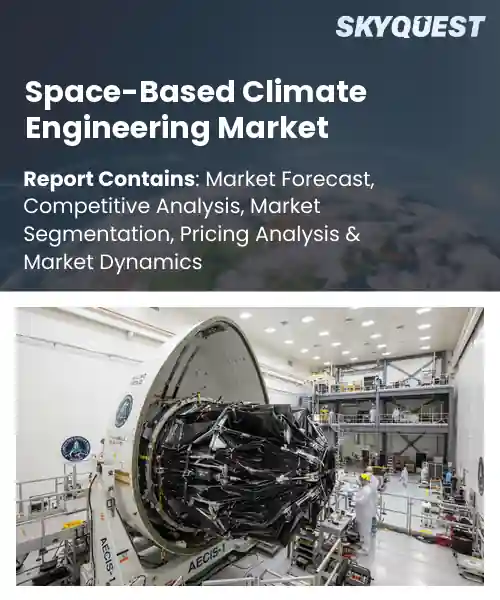
Space-Based Climate Engineering Market
Report ID: SQMIG20A2909
Report ID: SQMIG20A2909
[email protected]
USA +1 351-333-4748
Report ID:
SQMIG20A2909 |
Region:
Global |
Published Date: August, 2026
Pages:
157
|Tables:
120
|Figures:
77


Global Space-Based Climate Engineering Market size was valued at USD 912.0 Million in 2024 and is poised to grow from USD 1110.82 Million in 2025 to USD 5380.48 Million by 2033, growing at a CAGR of 21.8% during the forecast period (2026-2033).
Space based climate engineering refers to the deployment of orbital platforms that modify Earth’s radiative balance, either by injecting reflective particles into the stratosphere or by managing solar irradiance through space borne mirrors. The market emerged as governments and private firms sought scalable solutions to counteract accelerating warming after 2015 Paris Accord highlighted the insufficiency of terrestrial mitigation alone. Early demonstrations, such as the 2018 Stratospheric Aerosol Injection test conducted by a consortium, proved feasibility and sparked interest. Consequently, investors began allocating capital to satellite based albedo control systems, recognizing that interventions could complement carbon capture while bypassing constraints on emissions reductions.
Another factor boosting market growth lies in the convergence of falling launch costs and expanding megaconstellations, which together lower entry barriers for climate intervention payloads. As reusable rockets reach sub $2,000 per kilogram, operators can attach thin film reflectors to communication satellites, creating platforms that gather data and modulate sunlight. This synergy appeared in a 2023 partnership between an aerospace firm and a group, deploying a 120 kilogram reflector array alongside a satellite to test cooling over farms. The 0.3 °C temperature dip proved orbital assets can yield measurable climate benefits, spurring venture capital to fund geoengineering missions and urging regulators to craft policies.
How is AI-driven automation influencing the growth of the space‑based climate engineering market?
AI-driven automation is reshaping the space‑based climate engineering market by streamlining data processing, optimizing satellite operations, and enabling rapid scenario testing. Machine‑learning models now handle massive streams of atmospheric and oceanic observations, turning raw sensor feeds into actionable insights. Automated mission planning reduces launch preparation time, while adaptive control systems keep climate‑modifying payloads precisely positioned. These efficiencies lower operational costs and open the field to new participants, accelerating research cycles and expanding the range of viable interventions. As a result, the sector is moving from experimental pilots toward scalable solutions that can be deployed more frequently.
Market snapshot - (2026-2033)
Global Market Size
USD 912.0 Million
Largest Segment
Solar Radiation Management
Fastest Growth
Space-Based Carbon Removal Support
Growth Rate
21.8% CAGR
To get more insights on this market click here to Request a Free Sample Report
Global space-based climate engineering market is segmented by technology, component, application, end user and region. Based on technology, the market is segmented into Solar Radiation Management, Space-Based Carbon Removal Support and Climate Monitoring & Intervention Systems. Based on component, the market is segmented into Satellites, Ground Control Systems, Software & Analytics and Services. Based on application, the market is segmented into Climate Monitoring, Solar Radiation Management, Carbon Cycle Observation and Climate Research. Based on end user, the market is segmented into Government Agencies, Research Organizations, Space Agencies and Environmental Organizations. Based on region, the market is segmented into North America, Europe, Asia Pacific, Latin America and Middle East & Africa.
Solar Radiation Management segment dominates because it directly addresses the most immediate climate mitigation priority by reflecting a portion of solar energy back to space. This approach leverages proven atmospheric science and aligns with policy interest in rapid temperature control, prompting substantial investment in research, prototype missions, and international collaborations. Its clear, quantifiable impact narrative fuels stakeholder confidence, making it the cornerstone technology driving market formation and funding allocation.
However, Space-Based Carbon Removal Support is witnessing the strongest growth momentum as orbital capture and processing technologies enable direct CO₂ removal from the atmosphere. Emerging commercial interest, decreasing launch costs, and integration with satellite constellations accelerate adoption, positioning it as a pivotal driver of future market expansion and new revenue streams.
Satellites segment dominates because they constitute the essential physical platform for any space based climate engineering initiative, providing the payload capacity, orbital positioning, and longevity required to execute interventions and collect data. Continuous improvements in miniaturization, propulsion, and power systems enhance mission feasibility, while strong demand from both public and private actors fuels sustained investment, cementing satellites as the foundational component of the market.
Meanwhile, Software & Analytics is emerging as the key high growth area as advanced algorithms transform raw satellite observations into actionable climate insights. The surge in artificial intelligence, cloud processing, and demand for real time decision support drives rapid adoption, unlocking new business models and expanding the market’s value chain beyond hardware to data centric services.
To get detailed segments analysis, Request a Free Sample Report
North America leads the global space‑based climate engineering market because of a mature aerospace ecosystem, strong governmental commitment to climate mitigation, and deep private‑sector investment. The United States hosts a concentration of launch service providers, research institutions, and venture capital that accelerates technology development and deployment. Canada contributes advanced remote‑sensing capabilities and a collaborative regulatory framework that encourages cross‑border projects. Together, robust funding mechanisms, supportive policy environments, and a culture of innovation create a synergistic platform that attracts multinational partnerships and sustains leadership in the field. The region also benefits from a well‑established supply chain for satellite components and a skilled workforce that can rapidly iterate designs. Collaborative initiatives between government agencies, academia, and industry foster a pipeline of talent and intellectual property that reinforces the competitive edge of North America in this emerging domain.
Space-Based Climate Engineering Market in the United States is propelled by a dense network of launch facilities, leading research universities, and a venture ecosystem that readily funds high‑risk projects. Policy frameworks encourage public‑private collaboration, while defense and civil agencies provide testbeds for experimental concepts. This confluence of infrastructure, capital, and regulatory support enables rapid prototyping and scaling of satellite‑based climate interventions, reinforcing the United States as a global pioneer.
Space-Based Climate Engineering Market in Canada benefits from governmental research programs and a collaborative approach to international climate initiatives. The country’s expertise in Earth observation satellites provides critical data for modeling and validation of geo‑engineering concepts. A supportive regulatory environment encourages partnerships between academia, industry, and Indigenous communities, fostering inclusive innovation. These elements combine to position Canada as a key contributor to the development and responsible deployment of space‑based climate solutions.
The European space‑based climate engineering market is expanding rapidly due to coordinated policy ambition, substantial research funding, and a tradition of cross‑border collaboration. The European Union’s climate agenda integrates satellite technologies as essential tools for mitigation and adaptation, encouraging member states to invest in innovative geo‑engineering concepts. Robust aerospace clusters in Germany, the United Kingdom, and France provide a deep talent pool and advanced manufacturing capabilities. Public‑private partnerships are flourishing, with academic institutions, start‑ups, and established aerospace firms co‑creating solutions. This ecosystem, combined with a strong regulatory emphasis on environmental safety and ethical considerations, positions Europe as a leading incubator for responsible space‑based climate interventions. The region’s emphasis on open data sharing accelerates validation of climate models, while collaborative test missions across multiple nations reduce risk and cost. Moreover, a growing public awareness of climate urgency fuels political support for ambitious research programs, ensuring sustained momentum for space‑based solutions.
Space-Based Climate Engineering Market in Germany is anchored by world‑class aerospace manufacturers and a strong engineering research base. Federal programs prioritize satellite‑enabled climate monitoring and experimental geo‑engineering trials, fostering close ties between industry and universities. The country’s emphasis on precision engineering ensures high reliability of launch vehicles and payloads, while collaborative clusters promote knowledge exchange across borders. These strengths position Germany as the dominant European hub for advancing space‑based climate solutions.
Space-Based Climate Engineering Market in the United Kingdom is experiencing the fastest growth in Europe, driven by a vibrant start‑up ecosystem and aggressive government incentives. The nation leverages its legacy in satellite communications and emerging capabilities in small‑sat launch services to accelerate climate‑focused missions. Academic centres collaborate closely with industry to translate research into operational prototypes, while regulatory bodies streamline approval pathways for experimental deployments. This dynamic environment fuels rapid scaling of innovative space‑based climate interventions.
Space-Based Climate Engineering Market in France is emerging as a niche yet influential player, supported by strong governmental research agendas and a growing network of aerospace SMEs. French expertise in high‑resolution Earth observation satellites provides critical data for assessing climate‑engineering impacts. Collaborative projects between national research institutes and private firms focus on developing lightweight payloads and autonomous control systems. This combination of scientific rigor and entrepreneurial agility is positioning France as an emerging contributor to Europe’s space‑based climate strategy.
Asia Pacific is strengthening its position in the space‑based climate engineering market through rapid advancements in launch capabilities, strategic government initiatives, and a surge of innovative private enterprises. Japan and South Korea have invested heavily in reusable launch vehicles and miniaturized satellite platforms, reducing cost barriers and enabling more frequent climate‑focused missions. Regional policy frameworks increasingly recognize the role of space assets in climate mitigation, providing funding streams and regulatory pathways for experimental geo‑engineering projects. Collaborative research programs between universities, space agencies, and industry accelerate technology transfer and build a skilled workforce. This convergence of technical prowess, supportive policy, and market‑driven entrepreneurship is elevating Asia Pacific as a competitive hub for next‑generation climate solutions from orbit. The region’s emphasis on international cooperation, exemplified by joint satellite constellations and data‑sharing agreements, further amplifies its impact and fosters a collaborative environment for addressing global climate challenges.
Space-Based Climate Engineering Market in Japan leverages its long‑standing expertise in satellite engineering and a proactive governmental climate agenda. National space agencies prioritize missions that integrate climate monitoring with experimental geo‑engineering payloads, fostering a seamless transition from observation to intervention. A vibrant ecosystem of research universities and technology firms accelerates development of high‑efficiency propulsion and autonomous navigation systems. These capabilities, combined with strong public support for sustainable innovation, position Japan as a pivotal contributor to the region’s climate‑engineering ambitions.
Space-Based Climate Engineering Market in South Korea is advancing rapidly, driven by aggressive investment in launch infrastructure and a focus on miniaturized satellite technologies. Government programs encourage collaboration between the national space agency, defense research institutes, and private start‑ups to develop agile platforms for climate‑impact experiments. The country’s expertise in high‑precision optics and AI‑enabled data processing enhances the accuracy of climate‑model validation from orbit. This integrated approach is establishing South Korea as a dynamic player in the Asia Pacific climate‑engineering landscape.
To know more about the market opportunities by region and country, click here to
Buy The Complete Report
Increasing Climate Policy Support
Advancements in Satellite Technology
Regulatory Uncertainty Around Geoengineering
High Capital Expenditure Requirements
Request Free Customization of this report to help us to meet your business objectives.
The Global Space Based Climate Engineering market is intensely competitive as firms race to secure orbital assets for climate mitigation, driving rapid innovation and strategic alliances. Demand for scalable geoengineering solutions fuels partnerships and technology breakthroughs, exemplified by Virtus Solis Technologies advancing space solar power concepts and Space Forge pioneering microgravity manufacturing for carbon neutral materials. Companies leverage these tactics to differentiate and capture emerging climate focused investment.
SkyQuest’s ABIRAW (Advanced Business Intelligence, Research & Analysis Wing) is our Business Information Services team that Collects, Collates, Correlates, and Analyses the Data collected by means of Primary Exploratory Research backed by robust Secondary Desk research.
As per SkyQuest analysis the global space‑based climate engineering market is propelled chiefly by increasing climate policy support that channels public funds and incentives toward orbital mitigation projects, while AI‑driven automation further accelerates growth by cutting operational costs and enabling rapid scenario testing. The solar radiation management technology segment continues to dominate because it offers the most immediate temperature‑control impact, and North America leads the market thanks to its mature aerospace ecosystem, abundant venture capital and supportive regulatory environment. However, regulatory uncertainty around geo‑engineering creates a notable restraint, slowing investment decisions and limiting broader adoption until clearer international guidelines emerge.
| Report Metric | Details |
|---|---|
| Market size value in 2024 | USD 912.0 Million |
| Market size value in 2033 | USD 5380.48 Million |
| Growth Rate | 21.8% |
| Base year | 2024 |
| Forecast period | (2026-2033) |
| Forecast Unit (Value) | USD Million |
| Segments covered |
|
| Regions covered | North America (US, Canada), Europe (Germany, France, United Kingdom, Italy, Spain, Rest of Europe), Asia Pacific (China, India, Japan, Rest of Asia-Pacific), Latin America (Brazil, Rest of Latin America), Middle East & Africa (South Africa, GCC Countries, Rest of MEA) |
| Companies covered |
|
| Customization scope | Free report customization with purchase. Customization includes:-
|
To get a free trial access to our platform which is a one stop solution for all your data requirements for quicker decision making. This platform allows you to compare markets, competitors who are prominent in the market, and mega trends that are influencing the dynamics in the market. Also, get access to detailed SkyQuest exclusive matrix.
Table Of Content
Executive Summary
Market overview
Parent Market Analysis
Market overview
Market size
KEY MARKET INSIGHTS
COVID IMPACT
MARKET DYNAMICS & OUTLOOK
Market Size by Region
KEY COMPANY PROFILES
Methodology
For the Space-Based Climate Engineering Market, our research methodology involved a mixture of primary and secondary data sources. Key steps involved in the research process are listed below:
1. Information Procurement: This stage involved the procurement of Market data or related information via primary and secondary sources. The various secondary sources used included various company websites, annual reports, trade databases, and paid databases such as Hoover's, Bloomberg Business, Factiva, and Avention. Our team did 45 primary interactions Globally which included several stakeholders such as manufacturers, customers, key opinion leaders, etc. Overall, information procurement was one of the most extensive stages in our research process.
2. Information Analysis: This step involved triangulation of data through bottom-up and top-down approaches to estimate and validate the total size and future estimate of the Space-Based Climate Engineering Market.
3. Report Formulation: The final step entailed the placement of data points in appropriate Market spaces in an attempt to deduce viable conclusions.
4. Validation & Publishing: Validation is the most important step in the process. Validation & re-validation via an intricately designed process helped us finalize data points to be used for final calculations. The final Market estimates and forecasts were then aligned and sent to our panel of industry experts for validation of data. Once the validation was done the report was sent to our Quality Assurance team to ensure adherence to style guides, consistency & design.
Analyst Support
Customization Options
With the given market data, our dedicated team of analysts can offer you the following customization options are available for the Space-Based Climate Engineering Market:
Product Analysis: Product matrix, which offers a detailed comparison of the product portfolio of companies.
Regional Analysis: Further analysis of the Space-Based Climate Engineering Market for additional countries.
Competitive Analysis: Detailed analysis and profiling of additional Market players & comparative analysis of competitive products.
Go to Market Strategy: Find the high-growth channels to invest your marketing efforts and increase your customer base.
Innovation Mapping: Identify racial solutions and innovation, connected to deep ecosystems of innovators, start-ups, academics, and strategic partners.
Category Intelligence: Customized intelligence that is relevant to their supply Markets will enable them to make smarter sourcing decisions and improve their category management.
Public Company Transcript Analysis: To improve the investment performance by generating new alpha and making better-informed decisions.
Social Media Listening: To analyze the conversations and trends happening not just around your brand, but around your industry as a whole, and use those insights to make better Marketing decisions.
REQUEST FOR SAMPLE
 REQUEST FREE CUSTOMIZATION
Global Space-Based Climate Engineering Market size was valued at USD 912.0 Million in 2024 and is poised to grow from USD 1110.82 Million in 2025 to USD 5380.48 Million by 2033, growing at a CAGR of 21.8% during the forecast period (2026-2033).
The Global Space Based Climate Engineering market is intensely competitive as firms race to secure orbital assets for climate mitigation, driving rapid innovation and strategic alliances. Demand for scalable geoengineering solutions fuels partnerships and technology breakthroughs, exemplified by Virtus Solis Technologies advancing space solar power concepts and Space Forge pioneering microgravity manufacturing for carbon neutral materials. Companies leverage these tactics to differentiate and capture emerging climate focused investment. 'Lockheed Martin Corporation', 'Northrop Grumman Corporation', 'Airbus SE', 'Thales S.A.', 'L3Harris Technologies, Inc.', 'RTX Corporation', 'Blue Origin, LLC', 'Space Exploration Technologies Corp.', 'Rocket Lab USA, Inc.', 'Maxar Technologies Inc.', 'Planet Labs PBC', 'OHB SE', 'Mitsubishi Electric Corporation', 'Ball Corporation', 'Redwire Corporation', 'Sierra Space Corporation', 'Voyager Technologies, Inc.', 'BAE Systems plc', 'The Boeing Company', 'Leonardo S.p.A.'
Governments worldwide are integrating climate mitigation objectives into national strategies, and this policy momentum is encouraging investment in space‑based climate engineering solutions. By providing clear incentives, funding mechanisms, and long‑term commitments, policymakers create an environment where research and deployment activities can thrive. This supportive framework reduces perceived risk for private firms, attracts collaborative partnerships, and accelerates technology adoption, thereby driving market expansion and fostering sustained growth across the sector. It also aligns with international climate agreements, reinforcing credibility and encouraging cross‑border investment in innovative atmospheric interventions.
Satellite Constellation Expansion: The rapid deployment of large‑scale satellite constellations is reshaping how climate‑engineering concepts are tested and operationalized. Companies are leveraging low‑cost launch services and modular bus designs to field dozens of platforms capable of delivering aerosols, monitoring atmospheric responses, and providing real‑time data streams. This networked approach improves coverage, reduces single‑point failure risk, and accelerates iterative refinements, fostering greater confidence among investors and policymakers while enabling more granular, adaptive intervention strategies across diverse climatic zones through enhanced collaboration.
Why does North America Dominate the Global Space-Based Climate Engineering Market? |@12


Want to customize this report? This report can be personalized according to your needs. Our analysts and industry experts will work directly with you to understand your requirements and provide you with customized data in a short amount of time. We offer $1000 worth of FREE customization at the time of purchase.
Feedback From Our Clients


 USA (+1) 351-333-4748

