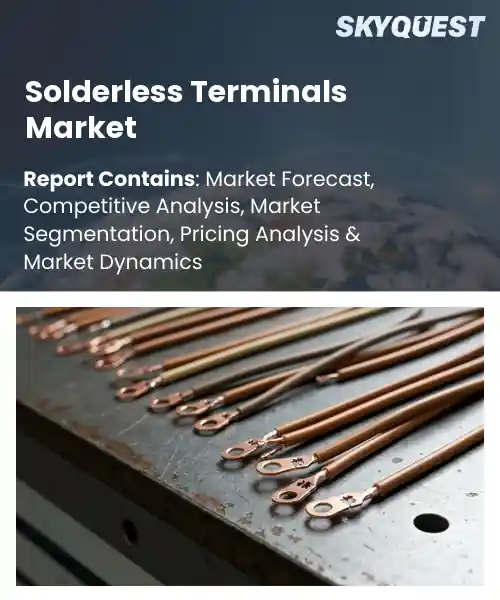
Solderless Terminals Market
Report ID: SQMIG20D2789
Report ID: SQMIG20D2789
[email protected]
USA +1 351-333-4748
Report ID:
SQMIG20D2789 |
Region:
Global |
Published Date: July, 2026
Pages:
157
|Tables:
146
|Figures:
78


Global Solderless Terminals Market size was valued at USD 2.96 Billion in 2024 and is poised to grow from USD 3.13 Billion in 2025 to USD 4.92 Billion by 2033, growing at a CAGR of 5.8% during the forecast period (2026-2033).
The solderless terminals market growth is driven by connectors that provide reliable electrical joints without solder, which shortens assembly cycles and improves production safety. The key driver is the increasing demand for wiring solutions in automotive electrification, renewable energy installations and industrial automation, where serviceability is critical. The sector began in the early 1990s with crimp-type terminals, but improvements in insulation materials and designs have expanded the breadth of application. For instance, Tesla’s Model 3 battery pack uses solderless terminals to allow module integration, and solar farms use modular terminal blocks to speed up installation and lower labor costs.
The expansion of electric-vehicle (EV) production is creating a growing demand for efficient wiring, and solderless terminals market share is providing the compact, high-current connections needed. Modular battery designs are increasingly favoured by manufacturers. Quick-change, tool-free connectors are also increasingly in demand to reduce assembly time and simplify maintenance. This opens the door to suppliers to develop higher temperature plastics, and integrated sensors to indicate connection integrity. For example, one EV battery supplier launched a spring-loaded terminal with temperature detection that cut warranty claims by 15 %. These innovations expand the market beyond automotive into renewable-energy storage and smart-grid systems where reliability and rapid deployment are critical.
How is AI-driven Automation Influencing the Growth of the Solderless Terminals Market?
Intelligent sensors and machine-learning algorithms are being integrated into the design and manufacturing processes of solderless terminals market trends, driving a revolution in the market through AI-driven automation. Now smart software helps engineers select the best connector configurations, and robotic assembly lines adjust torque in real time to make sure the contacts are reliable. Data analytics can predict wear patterns, allowing for proactive maintenance and reduced downtime. These capabilities reduce product development cycles and improve consistency, which makes solderless solutions more attractive for high-mix, low-volume applications. As factories migrate to connected equipment, the overall value proposition of solderless terminals strengthens, leading to wider adoption across automotive, renewable energy and industrial automation verticals.
In April 2026, Phoenix Contact presented an AI-optimized Push-X terminal strip that automatically calibrates connection force and includes integrated diagnostics, showcasing how intelligent automation can increase efficiency and enable market growth.
Market snapshot - (2026-2033)
Global Market Size
USD 2.96 Billion
Largest Segment
Ring Terminals
Fastest Growth
Quick Disconnect Terminals
Growth Rate
5.8% CAGR
To get more insights on this market click here to Request a Free Sample Report
Global solderless terminals market is segmented by terminal type, material, insulation type, end user, distribution channel and region. Based on terminal type, the market is segmented into ring terminals, spade terminals, butt connectors, pin terminals and quick disconnect terminals. Based on material, the market is segmented into copper, brass and aluminum. Based on insulation type, the market is segmented into insulated and non-insulated. Based on end user, the market is segmented into automotive, electrical & electronics, industrial and telecommunications. Based on distribution channel, the market is segmented into direct sales, distributors and online retail. Based on region, the market is segmented into North America, Europe, Asia Pacific, Latin America and Middle East & Africa.
Ring terminals segment dominates because they provide a reliable low resistance connection that fits a wide range of wire gauges and mechanical configurations. Their circular design enables easy insertion onto studs and bolts, reducing assembly time and error rates. Engineers favor them for durability in harsh environments, and manufacturers prioritize them for standardized production tooling, which collectively drives their market leadership in solderless terminals throughout automotive and industrial applications.
However, quick disconnect terminals are witnessing the strongest growth momentum because rising demand for modular wiring systems accelerates their adoption. Their tool free release mechanism simplifies maintenance and downtime, appealing to sectors that prioritize rapid reconfiguration. This innovation fuels new design possibilities, expanding market opportunities and encouraging broader deployment across emerging electric vehicle platforms.
Copper segment leads because its superior electrical conductivity ensures minimal voltage drop and efficient power transfer in solderless connections. The material’s malleability allows precise stamping of terminal shapes, supporting tight tolerances and repeatable quality. Industry standards often specify copper for critical applications, reinforcing trust among designers and reinforcing its prevalence across automotive and electronics assemblies, thereby cementing its dominant role in the market throughout the product lifecycle.
On the other hand, aluminum terminals are emerging as the key high growth area because lightweight design pressures drive substitution in weight critical systems. Their natural corrosion resistance reduces the need for additional plating, lowering cost and environmental impact. These attributes align with trends in electric mobility and renewable energy equipment, propelling rapid market expansion and new application development.
To get detailed segments analysis, Request a Free Sample Report
The Asia Pacific dominance is driven by a combination of deep engineering talent, robust manufacturing ecosystems and strong demand from high-growth sectors such as automotive, consumer electronics and renewable energy. Dense supplier networks in the region allow fast prototyping and cost-effective scaling of solderless terminal solutions. Ongoing investment in automation and material science underpins product reliability and performance, further enhancing the proposition to original equipment manufacturers. Supportive trade policies and strategic alliances also facilitate cross-border collaboration, extending market access beyond the region. The dynamic interplay between demand intensity and supply side innovation creates a virtuous cycle which underpins the dominance of Asia Pacific on the global stage.
Solderless terminals market outlook in Japan is characterized by a strong emphasis on precision engineering and stringent quality standards, which align with the nation’s advanced automotive and electronics manufacturing sectors. Local players leverage sophisticated automation and lean production techniques to deliver high‑performance terminals that meet demanding reliability criteria. Collaborative R&D initiatives with component manufacturers further enhance product differentiation, while a well‑established distribution network ensures timely delivery to end‑users.
Solderless terminals market forecast in South Korea thrives on the country’s reputation for rapid technology adoption and robust electronics manufacturing base. Korean firms integrate cutting‑edge materials and smart connectivity features into terminal designs, catering to the growing demand for compact and efficient power distribution in consumer devices and industrial automation. Government incentives for advanced manufacturing and strong ties with global semiconductor producers amplify the market’s capacity to innovate and scale.
North America’s rapid growth is driven by mature industrial infrastructure, increased focus on safety and reliability, and growing adoption of electrification across transportation, renewable energy, and data centers. Adoption of solderless terminals is driven by regulations that favor strong electrical connections, which provide ease of installation and maintenance. A strong engineering know-how and a culture of continuous improvement support the development of highly customized solutions for complex applications. Furthermore, strategic investments in local production decrease dependence on imports, enhancing supply chain resilience and boosting the region’s competitiveness.
Solderless terminals market regional outlook in United States benefits from a diversified industrial base that spans automotive, aerospace, and high‑tech manufacturing. Leading OEMs demand terminals that combine high current capacity with streamlined assembly processes, prompting local suppliers to prioritize innovation and rapid product iteration. Close collaboration between terminal manufacturers and system integrators accelerates the deployment of advanced connectivity solutions, while robust standards enforcement ensures consistent performance across critical applications.
Solderless terminals market regional forecast in Canada is shaped by a focus on renewable energy projects and mining operations that require reliable power distribution in harsh environments. Canadian manufacturers capitalize on expertise in corrosion‑resistant materials and modular designs to meet the specific needs of remote installations. Partnerships with research institutions drive advancements in safety features, and government support for clean‑technology initiatives further encourages adoption across the national power infrastructure.
Europe is catching up, with a combination of stringent regulatory standards, deep engineering know-how and a concerted effort to drive sustainable electrification in transportation, industrial machinery and smart grid projects. The region’s emphasis on circular economy principles encourages the creation of terminal solutions that are both recyclable and long-lasting, thereby supporting environmental objectives. Collaborative innovation clusters with universities, research centers and industry leaders are driving rapid prototyping and the integration of digital monitoring capabilities. European manufacturers can more easily access markets thanks to strong export networks and harmonised standards across member states, enabling them to capture a larger share of global demand and reinforcing the continent’s reputation for high-quality, compliant electrical components.
Solderless terminals market analysis in Germany is anchored by the country’s renowned precision engineering and a robust automotive supply chain that demands high‑performance electrical connections. German firms integrate advanced material science and stringent testing protocols to deliver terminals that meet exacting durability requirements. Close ties with industrial automation leaders promote the incorporation of smart diagnostics, while a well‑established standards framework ensures interoperability across diverse applications.
Solderless terminals market penetration in United Kingdom reflects a strong emphasis on aerospace, defense, and emerging renewable energy sectors that prioritize reliability and quick deployment. British manufacturers leverage sophisticated design software and rapid prototyping to create tailored terminal solutions for complex installations. Collaborative initiatives with research institutions drive the integration of IoT‑enabled monitoring, enhancing predictive maintenance capabilities across critical infrastructure.
Solderless terminals industry in France benefits from a vibrant electrical equipment ecosystem and a growing focus on electric mobility infrastructure. French companies emphasize modularity and ease of installation to support the rapid rollout of charging stations and public transport electrification. Government policies that encourage sustainable transport and energy efficiency reinforce demand, while partnerships with European research consortia accelerate innovation in high‑efficiency terminal designs.
To know more about the market opportunities by region and country, click here to
Buy The Complete Report
Rising Adoption Of Renewable Energy
Growth In Automotive Electronics
High Initial Component Cost
Limited Compatibility With Legacy Systems
Request Free Customization of this report to help us to meet your business objectives.
The competitive landscape of the global solderless terminals market is shaped by dominant players such as TE Connectivity, Molex, Amphenol and Japan Solderless Terminals, each leveraging extensive product portfolios and strategic collaborations with OEMs to secure market share. Recent moves include TE Connectivity’s integration of advanced high‑frequency terminal designs into automotive platforms, Molex’s rollout of miniaturized solderless solutions for IoT devices, and Japan Solderless Terminals’ partnership with electronics manufacturers to co‑develop next‑generation connector technologies. These concrete initiatives drive differentiation and intensify competition across industrial, automotive and consumer segments.
Top Player’s Company Profile
Recent Developments in the Solderless Terminals Market
SkyQuest’s ABIRAW (Advanced Business Intelligence, Research & Analysis Wing) is our Business Information Services team that Collects, Collates, Correlates, and Analyses the Data collected by means of Primary Exploratory Research backed by robust Secondary Desk research. As per SkyQuest analysis, the global solderless terminals market is being propelled primarily by the rising adoption of renewable energy, which fuels demand for fast, reliable connections in solar and wind installations, while a second strong driver is the rapid growth of automotive electronics that require dense wiring harnesses and tool‑free assembly. The market’s leading segment is ring terminals, valued for their low‑resistance, versatile fit across wire gauges, and the dominant region remains Asia‑Pacific, thanks to its extensive manufacturing base and high‑growth automotive and renewable sectors. A notable restraint is the relatively high initial component cost, which can deter price‑sensitive projects and slow broader adoption.
| Report Metric | Details |
|---|---|
| Market size value in 2024 | USD 2.96 Billion |
| Market size value in 2033 | USD 4.92 Billion |
| Growth Rate | 5.8% |
| Base year | 2024 |
| Forecast period | (2026-2033) |
| Forecast Unit (Value) | USD Billion |
| Segments covered |
|
| Regions covered | North America (US, Canada), Europe (Germany, France, United Kingdom, Italy, Spain, Rest of Europe), Asia Pacific (China, India, Japan, Rest of Asia-Pacific), Latin America (Brazil, Rest of Latin America), Middle East & Africa (South Africa, GCC Countries, Rest of MEA) |
| Companies covered |
|
| Customization scope | Free report customization with purchase. Customization includes:-
|
To get a free trial access to our platform which is a one stop solution for all your data requirements for quicker decision making. This platform allows you to compare markets, competitors who are prominent in the market, and mega trends that are influencing the dynamics in the market. Also, get access to detailed SkyQuest exclusive matrix.
Table Of Content
Executive Summary
Market overview
Parent Market Analysis
Market overview
Market size
KEY MARKET INSIGHTS
COVID IMPACT
MARKET DYNAMICS & OUTLOOK
Market Size by Region
KEY COMPANY PROFILES
Methodology
For the Solderless Terminals Market, our research methodology involved a mixture of primary and secondary data sources. Key steps involved in the research process are listed below:
1. Information Procurement: This stage involved the procurement of Market data or related information via primary and secondary sources. The various secondary sources used included various company websites, annual reports, trade databases, and paid databases such as Hoover's, Bloomberg Business, Factiva, and Avention. Our team did 45 primary interactions Globally which included several stakeholders such as manufacturers, customers, key opinion leaders, etc. Overall, information procurement was one of the most extensive stages in our research process.
2. Information Analysis: This step involved triangulation of data through bottom-up and top-down approaches to estimate and validate the total size and future estimate of the Solderless Terminals Market.
3. Report Formulation: The final step entailed the placement of data points in appropriate Market spaces in an attempt to deduce viable conclusions.
4. Validation & Publishing: Validation is the most important step in the process. Validation & re-validation via an intricately designed process helped us finalize data points to be used for final calculations. The final Market estimates and forecasts were then aligned and sent to our panel of industry experts for validation of data. Once the validation was done the report was sent to our Quality Assurance team to ensure adherence to style guides, consistency & design.
Analyst Support
Customization Options
With the given market data, our dedicated team of analysts can offer you the following customization options are available for the Solderless Terminals Market:
Product Analysis: Product matrix, which offers a detailed comparison of the product portfolio of companies.
Regional Analysis: Further analysis of the Solderless Terminals Market for additional countries.
Competitive Analysis: Detailed analysis and profiling of additional Market players & comparative analysis of competitive products.
Go to Market Strategy: Find the high-growth channels to invest your marketing efforts and increase your customer base.
Innovation Mapping: Identify racial solutions and innovation, connected to deep ecosystems of innovators, start-ups, academics, and strategic partners.
Category Intelligence: Customized intelligence that is relevant to their supply Markets will enable them to make smarter sourcing decisions and improve their category management.
Public Company Transcript Analysis: To improve the investment performance by generating new alpha and making better-informed decisions.
Social Media Listening: To analyze the conversations and trends happening not just around your brand, but around your industry as a whole, and use those insights to make better Marketing decisions.
REQUEST FOR SAMPLE
 REQUEST FREE CUSTOMIZATION
Global Solderless Terminals Market size was valued at USD 2.96 Billion in 2024 and is poised to grow from USD 3.13 Billion in 2025 to USD 4.92 Billion by 2033, growing at a CAGR of 5.8% during the forecast period (2026-2033).
The competitive landscape of the global solderless terminals market is shaped by dominant players such as TE Connectivity, Molex, Amphenol and Japan Solderless Terminals, each leveraging extensive product portfolios and strategic collaborations with OEMs to secure market share. Recent moves include TE Connectivity’s integration of advanced high‑frequency terminal designs into automotive platforms, Molex’s rollout of miniaturized solderless solutions for IoT devices, and Japan Solderless Terminals’ partnership with electronics manufacturers to co‑develop next‑generation connector technologies. These concrete initiatives drive differentiation and intensify competition across industrial, automotive and consumer segments. 'TE Connectivity plc', 'Molex, LLC', 'Amphenol Corporation', 'Panduit Corporation', 'Phoenix Contact GmbH & Co. KG', 'Weidmüller Interface GmbH & Co. KG', 'ABB Ltd.', '3M Company', 'HellermannTyton Group PLC', 'Aptiv PLC', 'Hubbell Incorporated', 'WAGO GmbH & Co. KG', 'JST Mfg. Co., Ltd.', 'Yazaki Corporation', 'Sumitomo Electric Industries, Ltd.', 'Nichifu Co., Ltd.', 'Klauke GmbH', 'NSi Industries, LLC', 'ILSCO Corporation', 'IDEAL Industries, Inc.'
The increasing integration of renewable energy systems such as solar and wind farms requires reliable electrical connections that can be assembled quickly and serviced without the need for soldering, which aligns with the inherent advantages of solderless terminals. Their ability to provide secure, repeatable connections under variable environmental conditions reduces installation time and maintenance costs, thereby encouraging system designers and installers to prefer these components. This preference drives demand for solderless terminals across power distribution and storage applications, supporting market expansion.
Rapid Adoption Of Wire‑Free Design: Manufacturers are increasingly favoring solderless terminals to simplify assembly processes and reduce reliance on wiring harnesses. By eliminating solder joints, engineers achieve cleaner layouts, faster changeovers, and enhanced design flexibility, enabling rapid prototyping and modular product architectures. This shift supports lean production philosophies and aligns with sustainability goals, as fewer materials and lower energy consumption are required during manufacturing. Consequently, supply chains experience smoother integration and lower risk of defects, prompting broader acceptance across automotive, aerospace, and industrial electronics sectors.
Why does Asia Pacific Dominate the Global Solderless Terminals Market? |@12


Want to customize this report? This report can be personalized according to your needs. Our analysts and industry experts will work directly with you to understand your requirements and provide you with customized data in a short amount of time. We offer $1000 worth of FREE customization at the time of purchase.
Feedback From Our Clients


 USA (+1) 351-333-4748

