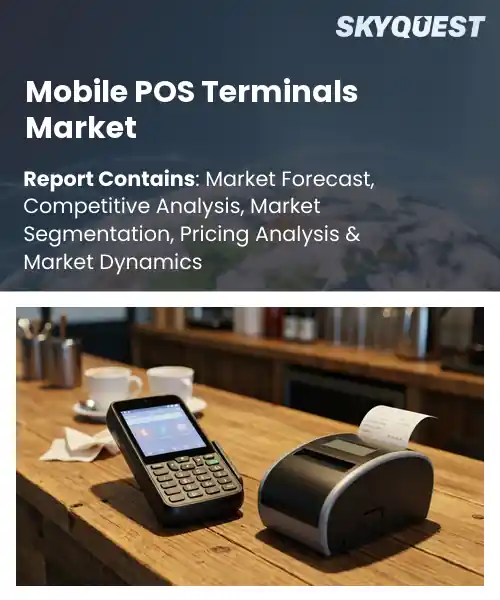
Mobile POS Terminals Market
Report ID: SQMIG45K2252
Report ID: SQMIG45K2252
[email protected]
USA +1 351-333-4748
Report ID:
SQMIG45K2252 |
Region:
Global |
Published Date: May, 2026
Pages:
157
|Tables:
176
|Figures:
79


Global Mobile Pos Terminals Market size was valued at USD 39.8 Billion in 2024 and is poised to grow from USD 43.66 Billion in 2025 to USD 91.57 Billion by 2033, growing at a CAGR of 9.7% during the forecast period (2026-2033).
The main push behind the mobile point-of-sale (mPOS) terminals market growth is the shift toward digital everywhere, and contactless buying, driven by smartphone adoption and changing how people prefer to pay. In practice, the market covers portable card readers, NFC-ready devices, and also those bundled software stacks that let a merchant accept payments basically anywhere they can stand. Over the last few years, platforms like Square, iZettle, and Clover opened the doors for card acceptance by cutting hardware expenses and making setup less annoying, also integration simpler.
In addition, one of the primary factors increasing the mobile POS terminals market penetration is payment integration with cloud commerce and analytics, which brings real measurable benefit to merchants. When terminals connect with inventory systems, CRM tools, and analytics dashboards, merchants can adjust pricing faster and tailor offers more directly, so you often see higher average ticket values and more repeat visits. For instance, restaurants using tableside mPOS can cut down on table turnaround, and tips get captured more accurately too, which improves labor efficiency and usually lifts margins. In newer or emerging markets, low-cost mobile readers can help informal vendors move toward recorded sales, and that also supports credit access, which ends up feeding financial inclusion. Overall, the whole integration story builds an ecosystem of APIs, partnerships, and SaaS offerings, and that expands opportunity at scale without needing everyone to reinvent everything.
AI is helping fraud detection in the mobile POS terminals industry by combining device intelligence, behavioral biometrics, and flexible transaction scoring into layered defenses that don’t just rely on one signal. These models can run both in the cloud and at the terminal level, so anomalies are spotted quickly, while legit customers feel almost no extra friction. The direction of travel is toward solutions that cut down false alerts and keep merchant workflows simpler. Vendors are placing identity checks, device fingerprinting, and pattern analysis inside the payment steps, so suspicious payments can get flagged earlier, and then any investigations are more focused.
All these improvements make mobile POS feel more reliable, and also easier to administer for small shops as well as bigger multi-location chains. For example, Verifone, in May 2026, announced an AI-powered fraud detection module for its Commander Central cloud that scores transactions in real time and isolates risky activity while letting verified payments flow through. That can reduce manual reviews, speed up merchant onboarding, and support broader mPOS adoption by lowering day-to-day operational costs and, in general, improving trust.
Market snapshot - (2026-2033)
Global Market Size
USD 39.8 Billion
Largest Segment
Hardware
Fastest Growth
Software
Growth Rate
9.7% CAGR
To get more insights on this market click here to Request a Free Sample Report
The global mobile pos terminals market is segmented by component, deployment mode, operating system, connectivity, enterprise size, end user, and region. Based on component, the market is segmented into Hardware, Software and Services. Based on deployment mode, the market is segmented into Cloud-Based and On-Premises. Based on operating system, the market is segmented into Android, iOS, Windows and Linux & Others. Based on connectivity, the market is segmented into Bluetooth, Wi-Fi, Cellular/4G/5G and NFC/Contactless. Based on enterprise size, the market is segmented into Small & Medium Enterprises (SMEs) and Large Enterprises. Based on end user, the market is segmented into Retail, Hospitality, Healthcare, Transportation & Logistics, Entertainment & Events, Warehousing, BFSI and Others. Based on region, the market is segmented into North America, Europe, Asia Pacific, Latin America and Middle East & Africa.
As per the mobile POS terminals market analysis, the cloud-based segment tends to dominate the market, mostly because a centralized setup makes things feel faster and smoother, from provisioning to remote management and ongoing software delivery. That overall reduction in deployment friction also takes away a lot of day-to-day operational weight for merchants. At the same time, smoother integration with payment gateways and analytics stacks gives providers room to refine features quickly, and it helps reinforce terminal security. So, this practical approach just goes deployment model, along with solid partner alignment, tends to pull more merchants in, and then platform economies kick in, extending reach even further across the market.
However, the On-premises segment is showing up as the one with the quickest expansion, though, because enterprises and regulated verticals usually want direct control over data. They also push for more precise tailoring and, importantly, guaranteed offline operation. Large merchants, in particular, seem to want tailored integrations and more deterministic performance, and that demand is nudging deployments forward. Due to that preference for localized control, specialized vendors now have an opening, and hybrid architectures that can better balance security, compliance, and operational realities, without feeling too rigid.
According to the mobile POS terminals market forecast, the Android segment dominates largely due to its open architecture and the wide range of available devices, which lowers the entry hurdles for manufacturers and independent software vendors. A fairly rich developer ecosystem and standardized APIs also help peripheral integration and payment middleware deployment, which basically shortens the time-to-market cycle. Moreover, different hardware profiles mean implementations can be tailored across retail and hospitality. That flexibility supports broad adoption, and it helps sustain leadership by growing a large ISV and partner network around the platform.
Conversely, the iOS segment is anticipated to attain the highest mobile POS terminals market share, especially as enterprises look for tightly controlled hardware and software stacks. That preference is tied to higher security, simpler certification, and a more predictable user experience. Premium operators in retail and hospitality often value consistent device behavior and enterprise management capabilities, so they’re leaning into iOS-based terminals. In turn, vendors get more room to invest in curated, high-quality applications, which can unlock new, higher-margin services and strengthen retention over time.
To get detailed segments analysis, Request a Free Sample Report
As per the mobile POS terminals market regional forecast, Asia Pacific is dominating, mostly because several capabilities converge at once, advanced technology strengths, diversified merchant needs, and resilient supply chains that keep deployment moving. In dense city areas and with all these different retail styles, there’s an ongoing, like never-ending, need for portable and secure payment acceptance and localized user experiences. Regional manufacturers and solution providers then bring cost effective and more customized hardware and software, they also adapt for language and integration requirements. At the same time, strong fintech teamwork helps push new payment features, including mobile wallet connectivity, which is important. Public and private programs that modernize payment infrastructure, paired with efficient logistics and long after sales support, make rapid rollouts more realistic. Japan and South Korea also add high quality component design and system integration know how, so they anchor the region competitiveness and influence wider adoption in nearby markets.
Japan Mobile POS Terminals Market
In Japan, the Mobile POS Terminals sector is shaped by very high expectations around quality, security, and smoother consumer experiences. Retailers and service providers tend to prefer small, dependable setups that slide into existing payment networks and loyalty programs. Local manufacturers and system integrators put a big focus on craftsmanship and certification, while technology companies and merchants collaborate to craft tailored deployments. The main focus stays on contactless payments, accessibility, and ongoing support, which underpins steady uptake among city merchants.
South Korea Mobile POS Terminals Market
For South Korea, the Mobile POS Terminals industry mirrors a mobile-first consumer style along with a strong digital infrastructure. Merchants want compact, high-performance terminals that connect neatly with local mobile wallets and messaging-related apps. Domestic firms push fast prototyping and tight integration, so they can introduce fresh form factors and software capabilities. Urban retailers and food service businesses also trial new payment experiences, and strong logistics and support networks help them scale out broadly, then keep things maintained.
What is Driving the Rapid Expansion of Mobile POS Terminals Market in North America?
The rapid expansion in North America comes from a mix of business pressure and technology momentum that basically favors mobile POS adoption across many merchant types. Merchants need these flexible portable solutions for omnichannel shopping, but they also want a checkout that feels streamlined, fast, and consistent, you know. With mature payment ecosystems and strong shopper comfort around contactless payment options, the whole thing gets smoother and less friction, which then helps adoption to actually happen. Cloud native POS platforms let them keep upgrading software without a big problem, and the analytics get more integrated over time. And then fintech partnerships, bundle payments with merchant services, which tends to pull in small to mid sized operators as well. Security requirements, certification, and interoperability are emphasized too, so acquirers and retailers feel more confident. Vendor ecosystems that integrate loyalty, inventory, and commerce platforms also speed deployments, and give merchants more differentiated offerings.
United States Mobile POS Terminals Market
In the United States, the Mobile POS Terminals Market shows up as a diverse merchant landscape where scalability and reliability matter. National chains, independent retailers, and service providers often want integration with loyalty, analytics, and inventory systems to enable personalized shopping. Ongoing experimentation with contactless checkout, mobile wallets, and omnichannel fulfillment drives the demand for flexible hardware and cloud-powered software. Compliance, data protection, and certified payment processing form the backbone of how vendors get selected, and it also shapes partnerships across industries.
Canada Mobile POS Terminals Market
Canada’s Mobile POS Terminals Market benefits from a payments environment that feels cooperative, and there is also strong backing for cross-border commerce. Retailers and hospitality operators tend to look for dependable, adaptable terminals that fit with national and regional acquirers, loyalty schemes, and e-commerce platforms. Bilingual interfaces and accessibility requirements drive customization, and value-added services like analytics and remote management attract smaller and mid-sized operators. Because service networks are robust, adoption becomes broader, and it stays more sustainable too.
Europe is strengthening its position through coordinated advances in regulation, interoperability, and collaborative innovation, which overall bring merchants and technology providers a bit closer together. There is a regulatory emphasis on open banking and strong data protection frameworks which in turn encourages secure integration between payments, banking, and commerce platforms. At the same time harmonized certification pathways can reduce that extra complexity for vendors who operate across multiple markets. Fintech hubs and established manufacturers collaborate to deliver localized solutions that handle language , and those consumer preference differences more directly. Retailers and transport operators are increasingly adopting contactless and mobile payment experiences, while system integrators focus on modular hardware and cloud native software. Also attention to sustainability, device lifecycle management and comprehensive service networks helps support durable deployments and gives European suppliers a clearer competitive edge.
Germany Mobile POS Terminals Market
The Mobile POS Terminals Market in Germany is shaped by strong industrial expertise and a clear focus on robust engineering as well as security. Retail chains and hospitality businesses want terminals that are reliable and comply with regional standards, and they should integrate with enterprise systems. Domestic manufacturers tend to push durability and modular designs for intensive usage, while solution providers bring deep integration with loyalty and inventory platforms. Sustainability and long-term service are becoming a bigger deal, and they influence future procurement decisions more than before.
United Kingdom Mobile POS Terminals Market
The Mobile POS Terminals Market in the United Kingdom is being driven by a vibrant retail and fintech environment that tends to favor innovative payment experiences. Merchants want portable terminals that connect smoothly with mobile wallets, loyalty tooling, and omnichannel platforms. Fintech firms and acquirers often collaborate on value-added services, and the certification, as well as compliance frameworks, help enable secure deployments. There is also strong attention on user experience and integration with transit and hospitality systems, which support a range of urban and suburban use cases.
France Mobile POS Terminals Market
The Mobile POS Terminals Market in France is supported by strong retailer networks and progressive payment operators that are focused on omnichannel experiences. Merchants tend to search for terminals that have multilingual interfaces, secure contactless payment acceptance, and an almost effortless fit with loyalty programs and e-commerce stacks. Meanwhile, fintech firms often collaborate with manufacturers, to assemble a more or less tailored hardware and software bundle, particularly for hospitality, and also specialty retail. There is a strong pull toward data protection, and reliable after-sales assistance , which in turn encourages adoption for both city merchants and folks in regional areas.
To know more about the market opportunities by region and country, click here to
Buy The Complete Report
Rising Adoption Of Contactless Payments
Expansion Of Mobile Retail Experiences
Security and Fraud Concerns
Fragmented Hardware and Platform Ecosystem
Request Free Customization of this report to help us to meet your business objectives.
The competitive landscape for global mobile POS terminals is marked by consolidation among acquirers, but also by rapid tech- led differentiation. SoftPOS and tap to phone adoption have become a main competitive lever, so more deals can be witnessed, collaborations, and partnerships like Worldline’s acquisition moves, and NEXGO’s strategic alliances. Vendors tend to compete through device platform evolution, API tie-ups, and merchant channel rollouts that are targeted.
Top Player’s Company Profile
Recent Developments in the Mobile POS Terminals Market
SkyQuest’s ABIRAW (Advanced Business Intelligence, Research & Analysis Wing) is our Business Information Services team that Collects, Collates, Correlates, and Analyses the Data collected by means of Primary Exploratory Research backed by robust Secondary Desk research.
As per SkyQuest analysis, the global mobile POS terminals market is mostly powered by the shift toward contactless and broadly used digital payments, while worries around security and fraud still act as a restraint that can slow down adoption. Asia Pacific stays out front due to heavy urban demand, local manufacturing capacity, and solid fintech partnerships, and cloud-based deployments dominate since they allow faster provisioning, remote management, and smoother integration overall. Another big push is how payments are being wired into cloud commerce and analytics, so that merchants can create more value by tying payments to inventory and CRM, which often results in higher average tickets and more repeat visits. And it also helps with wider financial inclusion, yeah. Moreover, there’s a scalable merchant onboarding across regions all around the globe, without the usual headache, like a frictionless sequence that just works.
| Report Metric | Details |
|---|---|
| Market size value in 2024 | USD 39.8 Billion |
| Market size value in 2033 | USD 91.57 Billion |
| Growth Rate | 9.7% |
| Base year | 2024 |
| Forecast period | (2026-2033) |
| Forecast Unit (Value) | USD Billion |
| Segments covered |
|
| Regions covered | North America (US, Canada), Europe (Germany, France, United Kingdom, Italy, Spain, Rest of Europe), Asia Pacific (China, India, Japan, Rest of Asia-Pacific), Latin America (Brazil, Rest of Latin America), Middle East & Africa (South Africa, GCC Countries, Rest of MEA) |
| Companies covered |
|
| Customization scope | Free report customization with purchase. Customization includes:-
|
To get a free trial access to our platform which is a one stop solution for all your data requirements for quicker decision making. This platform allows you to compare markets, competitors who are prominent in the market, and mega trends that are influencing the dynamics in the market. Also, get access to detailed SkyQuest exclusive matrix.
Table Of Content
Executive Summary
Market overview
Parent Market Analysis
Market overview
Market size
KEY MARKET INSIGHTS
COVID IMPACT
MARKET DYNAMICS & OUTLOOK
Market Size by Region
KEY COMPANY PROFILES
Methodology
For the Mobile POS Terminals Market, our research methodology involved a mixture of primary and secondary data sources. Key steps involved in the research process are listed below:
1. Information Procurement: This stage involved the procurement of Market data or related information via primary and secondary sources. The various secondary sources used included various company websites, annual reports, trade databases, and paid databases such as Hoover's, Bloomberg Business, Factiva, and Avention. Our team did 45 primary interactions Globally which included several stakeholders such as manufacturers, customers, key opinion leaders, etc. Overall, information procurement was one of the most extensive stages in our research process.
2. Information Analysis: This step involved triangulation of data through bottom-up and top-down approaches to estimate and validate the total size and future estimate of the Mobile POS Terminals Market.
3. Report Formulation: The final step entailed the placement of data points in appropriate Market spaces in an attempt to deduce viable conclusions.
4. Validation & Publishing: Validation is the most important step in the process. Validation & re-validation via an intricately designed process helped us finalize data points to be used for final calculations. The final Market estimates and forecasts were then aligned and sent to our panel of industry experts for validation of data. Once the validation was done the report was sent to our Quality Assurance team to ensure adherence to style guides, consistency & design.
Analyst Support
Customization Options
With the given market data, our dedicated team of analysts can offer you the following customization options are available for the Mobile POS Terminals Market:
Product Analysis: Product matrix, which offers a detailed comparison of the product portfolio of companies.
Regional Analysis: Further analysis of the Mobile POS Terminals Market for additional countries.
Competitive Analysis: Detailed analysis and profiling of additional Market players & comparative analysis of competitive products.
Go to Market Strategy: Find the high-growth channels to invest your marketing efforts and increase your customer base.
Innovation Mapping: Identify racial solutions and innovation, connected to deep ecosystems of innovators, start-ups, academics, and strategic partners.
Category Intelligence: Customized intelligence that is relevant to their supply Markets will enable them to make smarter sourcing decisions and improve their category management.
Public Company Transcript Analysis: To improve the investment performance by generating new alpha and making better-informed decisions.
Social Media Listening: To analyze the conversations and trends happening not just around your brand, but around your industry as a whole, and use those insights to make better Marketing decisions.
REQUEST FOR SAMPLE
 REQUEST FREE CUSTOMIZATION
Global Mobile Pos Terminals Market size was valued at USD 39.8 Billion in 2024 and is poised to grow from USD 43.66 Billion in 2025 to USD 91.57 Billion by 2033, growing at a CAGR of 9.7% during the forecast period (2026-2033).
The competitive landscape for global mobile POS terminals is marked by consolidation among acquirers and rapid technology led differentiation. SoftPOS and tap to phone adoption have become a primary competitive driver, prompting deals and partnerships such as Worldline's acquisition activity and NEXGO's strategic alliances. Vendors compete via device platform innovation, API partnerships, and targeted merchant channel rollouts. 'Ingenico Group', 'Verifone Systems, Inc.', 'PAX Technology Limited', 'Newland NPT Co., Ltd.', 'NCR Voyix Corporation', 'Diebold Nixdorf, Incorporated', 'Castles Technology Co., Ltd.', 'BBPOS Limited', 'Fiserv, Inc.', 'Block, Inc.', 'SumUp Inc.', 'Zebra Technologies Corporation', 'SZZT Electronics Co., Ltd.', 'Datecs Ltd.', 'Elo Touch Solutions, Inc.', 'NEC Corporation', 'Fujian Landi Commercial Equipment Co., Ltd.', 'XAC Automation Corporation', 'Spire Payments Holdings Ltd.', 'Bitel Co., Ltd.'
The widespread shift toward contactless payment preferences encourages merchants to deploy mobile POS terminals that can accept NFC and tap-to-pay transactions, enhancing transactional convenience and reducing checkout times. Retailers, hospitality providers, and service vendors perceive mobile POS as a way to meet consumer expectations for quick, secure payment experiences, leading to broader procurement and integration of these devices. As contactless acceptance becomes a competitive necessity, businesses prioritize solutions that enable seamless customer interaction, thereby driving sustained demand for mobile POS terminals across market segments.
Omnichannel Integration Momentum: Retailers and providers prioritize convergence between mobile POS, online storefronts, inventory management and loyalty systems to deliver consistent experiences across channels. Mobile terminals are evolving into hubs for unified checkout, returns and engagement, prompting partnerships between payment vendors and software platforms. Demand for flexible APIs, SDKs and middleware rises as businesses seek frictionless transitions across in-store, curbside and mobile sales. This trend drives investment in integration capabilities, developer support and interoperability to enhance retention and operational agility.
Why does Asia Pacific Dominate the Global Mobile POS Terminals Market? |@12


Want to customize this report? This report can be personalized according to your needs. Our analysts and industry experts will work directly with you to understand your requirements and provide you with customized data in a short amount of time. We offer $1000 worth of FREE customization at the time of purchase.
Feedback From Our Clients


 USA (+1) 351-333-4748

