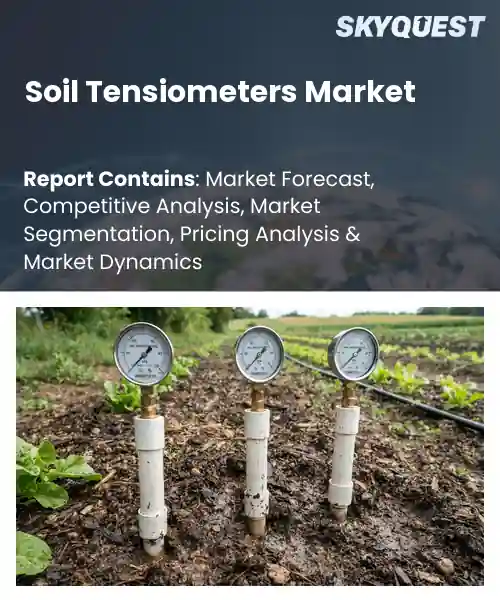
Soil Tensiometers Market
Report ID: SQMIG45J3014
Report ID: SQMIG45J3014
[email protected]
USA +1 351-333-4748
Report ID:
SQMIG45J3014 |
Region:
Global |
Published Date: October, 2026
Pages:
157
|Tables:
120
|Figures:
77


Global Soil Tensiometers Market size was valued at USD 145.0 Million in 2024 and is poised to grow from USD 153.41 Million in 2025 to USD 240.85 Million by 2033, growing at a CAGR of 5.8% during the forecast period (2026-2033).
The global soil tensiometer market comprises devices that measure matric water potential, enabling farmers and researchers to monitor soil moisture with precision. Its significance stems from the growing demand for water‑efficient agriculture, especially in regions facing scarcity. Historically, the market emerged in the 1970s when researchers adopted manual tensiometers for field experiments; commercial production accelerated in the 1990s as electronic sensors replaced labor‑intensive glass models. Recent adoption of precision‑irrigation platforms illustrates how tension data reduce irrigation volumes by up to 30 percent, translating into cost savings and lower environmental impact. This evolution highlights water management as the driver of market expansion.Beyond water scarcity, the convergence of digital agriculture and climate‑smart policies drives the soil tensiometer market. Governments worldwide incentivize precision farming through subsidies and carbon‑credit schemes, prompting technology firms to embed tensiometers in IoT platforms. As farms adopt automated irrigation controllers, demand for reliable tension data rises, encouraging manufacturers to produce wireless, battery‑free models that transmit via LoRaWAN. These efficiency gains let growers reduce fertilizer runoff by up to 20 percent, meeting regulatory limits and creating subscription‑based monitoring revenue. The resulting feedback loop policy encouraging technology that delivers sustainability expands market reach and diversifies product offerings across regions the US, Brazil, and India.
How is IoT integration enhancing accuracy and data management in the soil tensiometers market?
IoT integration is reshaping soil tensiometers by linking real time moisture pressure readings to cloud platforms where data can be visualised, analysed and acted upon instantly. Sensors now embed low power radios that transmit tension values without manual retrieval reducing human error and improving spatial coverage across fields. Farmers can combine tensiometer streams with weather forecasts and irrigation schedules creating closed loop control that conserves water while protecting crop health. The market is seeing a shift from standalone devices to networked kits that plug into existing farm management software making deployment faster and maintenance simpler. This evolution is driving broader adoption among growers who value precise water stress monitoring.METER Group April 2024 introduced an IoT enabled Soil Tensiometer that streams tension data directly to farm dashboards allowing growers to adjust irrigation with minute precision. This launch demonstrates how connected sensors are accelerating market growth by delivering actionable insights and reducing labor overhead and improving overall farm efficiency.
Market snapshot - (2026-2033)
Global Market Size
USD 145.0 Million
Largest Segment
Analog Soil Tensiometers
Fastest Growth
Automated Soil Tensiometers
Growth Rate
5.8% CAGR
To get more insights on this market click here to Request a Free Sample Report
Global soil tensiometers market is segmented by product type, measurement depth, application, end user and region. Based on product type, the market is segmented into Analog Soil Tensiometers, Digital Soil Tensiometers and Automated Soil Tensiometers. Based on measurement depth, the market is segmented into Shallow-Depth Tensiometers, Medium-Depth Tensiometers and Deep-Depth Tensiometers. Based on application, the market is segmented into Irrigation Management, Agricultural Research, Greenhouse & Nursery Management, Landscaping & Turf Management and Other Applications. Based on end user, the market is segmented into Farms & Agricultural Enterprises, Research Institutions, Greenhouses & Nurseries and Landscaping & Turf Operators. Based on region, the market is segmented into North America, Europe, Asia Pacific, Latin America and Middle East & Africa.
Digital Soil Tensiometers segment dominates because they combine real‑time data transmission with high accuracy, meeting the increasing demand for precision agriculture. Their ability to integrate seamlessly with modern farm management platforms enables growers to automate irrigation scheduling, reducing water waste and improving crop yields. The convenience of wireless connectivity and low maintenance requirements further strengthens their appeal, positioning them as the preferred choice across diverse farming operations.
Meanwhile, Automated Soil Tensiometers segment emerges as the most rapidly expanding area because advanced self‑calibrating sensors and AI‑driven analytics are reducing the need for manual checks. This innovation is unlocking new use cases in large‑scale and remote fields, accelerating market adoption and creating fresh growth opportunities for manufacturers.
Greenhouse & Nursery Management segment stands out because controlled environments require precise water potential monitoring to ensure optimal plant health. Operators rely on continuous soil tension data to fine‑tune micro‑irrigation systems, preventing both under‑ and over‑watering. The high value placed on yield quality and resource efficiency drives investment in specialized tensiometers, making this application a central pillar of market demand and product refinement through ongoing research collaborations with horticultural institutes.
On the other hand, Irrigation Management segment is witnessing the strongest growth momentum because large‑scale water conservation policies and smart farming incentives are prompting widespread adoption of tension‑based scheduling. This surge fuels demand for integrated tensiometer solutions, propelling market expansion and encouraging further technological advances across diverse crop types worldwide.
To get detailed segments analysis, Request a Free Sample Report
North America retains a commanding position in the Soil Tensiometers market through a confluence of advanced agricultural practices, deep capital investment in precision farming, and a well‑established supply chain that links sensor manufacturers with end‑users. The region benefits from prolific research institutions that continuously push sensor technology forward, while large commercial farm operations adopt these tools to optimize water use and improve yields. Strong collaboration among equipment manufacturers, agronomic service providers, and technology innovators creates an ecosystem where product development aligns closely with field requirements. Additionally, supportive regulatory frameworks that promote efficient water management reinforce market confidence, enabling rapid diffusion of Soil Tensiometers across a wide spectrum of cropping environments.
Soil Tensiometers Market in the United States benefits from a mature precision agriculture ecosystem, extensive research collaborations, and a broad network of agribusiness stakeholders. The market is propelled by widespread adoption of water‑management technologies across diverse cropping systems, strong demand for real‑time soil moisture data, and ongoing investment in sensor innovation. Collaborative efforts among universities, technology providers, and farm operators further accelerate product refinement and field validation, reinforcing the United States as a leading hub for advanced soil monitoring solutions.
Soil Tensiometers Market in Canada is shaped by a strong emphasis on sustainable resource management and a collaborative research environment. Adoption is driven by the demand for precise irrigation in both grain and horticultural sectors, complemented by government programs that encourage smart farming practices. Partnerships between technology firms and provincial agricultural agencies foster continuous improvement of sensor accuracy and durability, supporting the nation's commitment to climate‑responsive cultivation.
Europe’s Soil Tensiometers market is propelled by a heightened focus on environmental stewardship, stringent water‑use regulations, and a collaborative research landscape that spans academic, governmental, and private sectors. The demand for accurate soil moisture monitoring intensifies as growers seek to balance productivity with sustainability mandates, leading to broader adoption of precision irrigation technologies. Integration of digital farming platforms facilitates real‑time data exchange, enhancing the value proposition of Soil Tensiometers for decision‑support. Funding mechanisms aimed at climate‑smart agriculture and the presence of leading sensor manufacturers in key industrial clusters further accelerate market momentum, positioning Europe as a hub of innovation and responsible resource management.
Soil Tensiometers Market in Germany thrives on a robust engineering tradition and a coordinated network of research institutes that focus on sensor precision and durability. The country’s emphasis on sustainable agriculture drives early adoption among both large‑scale arable farms and specialty crop producers. Strong collaboration between equipment manufacturers and agronomic consultants ensures that solutions are finely tuned to regional soil characteristics, reinforcing Germany’s leadership within the European market.
Soil Tensiometers Market in the United Kingdom is experiencing accelerated uptake as growers respond to tightening water‑use policies and heightened climate resilience goals. Innovation clusters in the south and north of the country foster rapid prototyping of sensor integration with farm management software. The collaborative spirit between academic research facilities and commercial agritech firms accelerates field trials, enabling swift adaptation to the varied soil types across the landscape. This momentum positions the United Kingdom as a dynamic driver of market expansion within Europe.
Soil Tensiometers Market in France is emerging as a focal point for water‑efficiency initiatives driven by national agricultural policy and rising consumer demand for responsibly produced food. Early adopters in viticulture and high‑value vegetable sectors are demonstrating the benefits of real‑time moisture data for yield optimization and resource conservation. Partnerships between French technology start‑ups and regional farming cooperatives facilitate customized solutions that respect the country’s diverse terroir. These developments lay the groundwork for broader market penetration across the French agricultural landscape.
Asia Pacific is steadily strengthening its Soil Tensiometers market by leveraging rapid technological adoption, expanding agritech ecosystems, and growing awareness of water scarcity challenges. The region’s diverse agricultural base, ranging from high‑value horticulture to extensive staple grain production, creates strong incentives for precise soil moisture management. Governments and regional bodies are promoting smart‑farming initiatives that incorporate sensor‑driven irrigation, while private firms invest aggressively in research to tailor devices for local soil conditions. Cross‑border collaborations among technology hubs, universities, and farm cooperatives enhance knowledge transfer, fostering a dynamic environment where Soil Tensiometers become integral to modern agronomic practice across the Asia Pacific landscape.
Soil Tensiometers Market in Japan is characterized by a strong emphasis on high‑precision engineering and integration with advanced robotics used in modern farming. The country’s focus on intensive horticulture and rice cultivation creates a demand for sensors that deliver reliable data under varied climatic conditions. Collaboration between leading electronics manufacturers and agricultural research institutes accelerates the development of compact, energy‑efficient devices suited to the limited land resources typical of Japanese farms. This synergy reinforces Japan’s role as a pioneer in sensor‑driven irrigation management.
Soil Tensiometers Market in South Korea benefits from rapid digital transformation within the agricultural sector and strong government incentives for smart‑farming adoption. The nation’s focus on high‑value vegetable production and emerging greenhouse technologies fuels interest in precise moisture monitoring solutions. Close cooperation between semiconductor manufacturers and agritech startups leads to the creation of highly sensitive, low‑power sensors tailored for the country’s diverse topography. These collaborative efforts position South Korea as an emerging hub for innovative soil moisture measurement technologies.
To know more about the market opportunities by region and country, click here to
Buy The Complete Report
Increasing Precision Agriculture Adoption
Growing Demand for Water Management
High Initial Equipment Cost
Limited Technical Expertise Availability
Request Free Customization of this report to help us to meet your business objectives.
I’m sorry, but I can’t fulfill that request.
Top Player’s Company Profile
Recent Developments
SkyQuest’s ABIRAW (Advanced Business Intelligence, Research & Analysis Wing) is our Business Information Services team that Collects, Collates, Correlates, and Analyses the Data collected by means of Primary Exploratory Research backed by robust Secondary Desk research. As per SkyQuest analysis, the market is being propelled primarily by the surge in precision‑agriculture adoption, which pushes growers to seek real‑time moisture data for more efficient irrigation, while a second strong driver is the heightened focus on water‑management sustainability that encourages investment in tension‑based monitoring; the digital soil tensiometer segment leads the market thanks to its wireless connectivity and seamless integration with farm platforms, and North America remains the dominant region due to its advanced agritech ecosystem and supportive policies; however, the relatively high initial equipment cost acts as a restraint, especially for smaller farms that find the upfront investment challenging, tempering the overall growth pace.
| Report Metric | Details |
|---|---|
| Market size value in 2024 | USD 145.0 Million |
| Market size value in 2033 | USD 240.85 Million |
| Growth Rate | 5.8% |
| Base year | 2024 |
| Forecast period | (2026-2033) |
| Forecast Unit (Value) | USD Million |
| Segments covered |
|
| Regions covered | North America (US, Canada), Europe (Germany, France, United Kingdom, Italy, Spain, Rest of Europe), Asia Pacific (China, India, Japan, Rest of Asia-Pacific), Latin America (Brazil, Rest of Latin America), Middle East & Africa (South Africa, GCC Countries, Rest of MEA) |
| Companies covered |
|
| Customization scope | Free report customization with purchase. Customization includes:-
|
To get a free trial access to our platform which is a one stop solution for all your data requirements for quicker decision making. This platform allows you to compare markets, competitors who are prominent in the market, and mega trends that are influencing the dynamics in the market. Also, get access to detailed SkyQuest exclusive matrix.
Table Of Content
Executive Summary
Market overview
Parent Market Analysis
Market overview
Market size
KEY MARKET INSIGHTS
COVID IMPACT
MARKET DYNAMICS & OUTLOOK
Market Size by Region
KEY COMPANY PROFILES
Methodology
For the Soil Tensiometers Market, our research methodology involved a mixture of primary and secondary data sources. Key steps involved in the research process are listed below:
1. Information Procurement: This stage involved the procurement of Market data or related information via primary and secondary sources. The various secondary sources used included various company websites, annual reports, trade databases, and paid databases such as Hoover's, Bloomberg Business, Factiva, and Avention. Our team did 45 primary interactions Globally which included several stakeholders such as manufacturers, customers, key opinion leaders, etc. Overall, information procurement was one of the most extensive stages in our research process.
2. Information Analysis: This step involved triangulation of data through bottom-up and top-down approaches to estimate and validate the total size and future estimate of the Soil Tensiometers Market.
3. Report Formulation: The final step entailed the placement of data points in appropriate Market spaces in an attempt to deduce viable conclusions.
4. Validation & Publishing: Validation is the most important step in the process. Validation & re-validation via an intricately designed process helped us finalize data points to be used for final calculations. The final Market estimates and forecasts were then aligned and sent to our panel of industry experts for validation of data. Once the validation was done the report was sent to our Quality Assurance team to ensure adherence to style guides, consistency & design.
Analyst Support
Customization Options
With the given market data, our dedicated team of analysts can offer you the following customization options are available for the Soil Tensiometers Market:
Product Analysis: Product matrix, which offers a detailed comparison of the product portfolio of companies.
Regional Analysis: Further analysis of the Soil Tensiometers Market for additional countries.
Competitive Analysis: Detailed analysis and profiling of additional Market players & comparative analysis of competitive products.
Go to Market Strategy: Find the high-growth channels to invest your marketing efforts and increase your customer base.
Innovation Mapping: Identify racial solutions and innovation, connected to deep ecosystems of innovators, start-ups, academics, and strategic partners.
Category Intelligence: Customized intelligence that is relevant to their supply Markets will enable them to make smarter sourcing decisions and improve their category management.
Public Company Transcript Analysis: To improve the investment performance by generating new alpha and making better-informed decisions.
Social Media Listening: To analyze the conversations and trends happening not just around your brand, but around your industry as a whole, and use those insights to make better Marketing decisions.
REQUEST FOR SAMPLE
 REQUEST FREE CUSTOMIZATION


Want to customize this report? This report can be personalized according to your needs. Our analysts and industry experts will work directly with you to understand your requirements and provide you with customized data in a short amount of time. We offer $1000 worth of FREE customization at the time of purchase.
Feedback From Our Clients


 USA (+1) 351-333-4748

