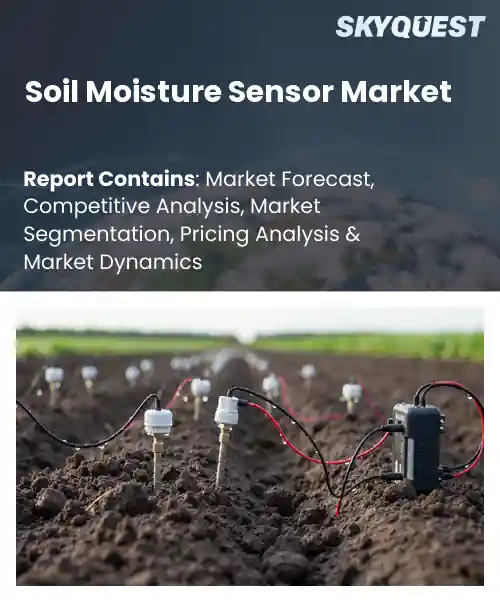
Soil Moisture Sensor Market
Report ID: SQMIG45J2450
Report ID: SQMIG45J2450
[email protected]
USA +1 351-333-4748
Report ID:
SQMIG45J2450 |
Region:
Global |
Published Date: May, 2026
Pages:
157
|Tables:
178
|Figures:
79


Global Soil Moisture Sensor Market size was valued at USD 424.6 Million in 2024 and is poised to grow from USD 480.22 Million in 2025 to USD 1285.71 Million by 2033, growing at a CAGR of 13.1% during the forecast period (2026-2033).
The primary driver of the soil moisture sensor market is the intensifying demand for water-efficient agriculture as population growth and climate variability stress freshwater resources. Soil moisture sensors quantify volumetric water content or matric potential to enable data-driven irrigation decisions, and that capability matters because it directly links limited water inputs to yield outcomes. Historically the market evolved from manual tensiometers and gravimetric sampling to electronic capacitive probes, FDR and TDR technologies, and today’s IoT-connected platforms feed decision-support software. For example, precision irrigation deployments in California orchards and Israeli greenhouse systems illustrate how sensor adoption reduced water use while stabilizing production.Building on water-efficiency pressures, the defining growth factor in the global soil moisture sensor market is the convergence of low-cost probes, expanded connectivity and advanced analytics that convert measurements into irrigation prescriptions. As sensors grew cheaper and connectivity expanded, growers deployed probe networks and the resulting data enabled ML models to predict crop water stress more accurately, which stimulated investment in digital platforms. For example, vineyards in Spain and rice farms in Southeast Asia use sensor-linked controllers to schedule irrigation, lowering water consumption, reducing fertilizer leaching and improving crop uniformity, creating new opportunities for SaaS companies and subscription sensor services.
How is AI improving accuracy and adoption in the soil moisture sensor market?
AI is improving accuracy and adoption in the soil moisture sensor market by combining smarter signal processing with system level analytics that make sensor output usable on the farm. Key aspects are automated calibration to local soils fusion of probe data with satellite and weather models anomaly detection that filters bad readings and recommendation engines that convert measurements into irrigation guidance. Today growers prefer cloud connected platforms where AI reduces uncertainty and simplifies decision making. This context is driving adoption because sensors become easier to deploy and trust. For example CropX and GroGuru pair advanced probes with cloud AI to deliver field ready insights.Spire April 2026, announced an integrated soil moisture and weather intelligence solution that combines historical records daily satellite observations and AI driven sub seasonal guidance to deliver continuous past present and future soil moisture insights. This strengthens sparse sensor networks and helps growers make more confident irrigation choices.
Market snapshot - (2026-2033)
Global Market Size
USD 424.6 Million
Largest Segment
Capacitance Sensors
Fastest Growth
Capacitance Sensors
Growth Rate
13.1% CAGR
To get more insights on this market click here to Request a Free Sample Report
Global soil moisture sensor market is segmented by product type, technology, application, installation type, end user, distribution channel and region. Based on product type, the market is segmented into Capacitance Sensors, Resistive Sensors, Tensiometers, Gypsum Block Sensors, Neutron Probes and Others. Based on technology, the market is segmented into Wired Sensors, Wireless Sensors and IoT-Enabled Sensors. Based on application, the market is segmented into Agriculture, Landscaping & Turf Management, Greenhouses, Forestry, Research & Environmental Monitoring and Others. Based on installation type, the market is segmented into Surface Sensors and Subsurface Sensors. Based on end user, the market is segmented into Farmers, Agricultural Enterprises, Research Institutes, Government Agencies and Others. Based on distribution channel, the market is segmented into Direct Sales, Distributors & Dealers and Online Sales. Based on region, the market is segmented into North America, Europe, Asia Pacific, Latin America and Middle East & Africa.
Capacitance Sensors segment dominates because their sensing principle offers rapid, low maintenance volumetric moisture estimates that suit broad agricultural and commercial deployments. Their compact form factor and compatibility with wireless and data platforms reduce installation complexity, driving adoption among growers and integrators. Reliable performance across soil textures and ease of calibration create a strong value proposition that encourages purchase and integration into irrigation management workflows, reinforcing market leadership.
However, Tensiometers are emerging as the fastest growing area due to their direct measurement of soil matric potential, preferred for precise irrigation scheduling in specialty crops. Advances in ruggedization and simplified deployment, together with growing demand for high fidelity data in water sensitive operations, make tensiometers a key source of new opportunities and premium solutions.
Wireless Sensors segment leads because their untethered connectivity lowers deployment barriers for farms and institutional users, enabling flexible sensor placement without extensive cabling. Reduced installation time and compatibility with mobile data collection facilitate rapid monitoring program rollouts. As service providers and equipment makers favor wireless platforms for scalability, ecosystem support for gateways and cloud ingestion accelerates adoption and cements wireless solutions as default choices for many use cases.
However, IoT-Enabled Sensors are witnessing the strongest growth momentum as integrated analytics and real time telemetry enable actionable irrigation decisions. Innovations in edge processing, low power protocols, and platform interoperability drive vendor differentiation, while rising demand for precise farm management and service based offerings turns IoT capable devices into catalysts for expanded value added services and subscription models.
To get detailed segments analysis, Request a Free Sample Report
Asia Pacific dominates the global soil moisture sensor market due to a convergence of intensive agricultural demand, advanced manufacturing capabilities, and rapid technology adoption across multiple countries. Widespread focus on precision agriculture and water efficiency creates strong commercial pull for accurate sensing solutions, while robust electronics sectors supply high quality components and system integration expertise. Regional research centers and industry collaborations accelerate product innovation and customization for diverse climatic zones. Large-scale irrigation projects and private sector investment prioritize remote monitoring and automation, fostering ecosystems that support sensor deployment, data services, and platform interoperability. Supportive policy frameworks and extension services enrich farmer awareness and after sales ecosystems.
Soil Moisture Sensor Market in Japan is driven by advanced electronics expertise and deep integration of sensing technologies into precision farming and greenhouse systems. Collaboration between industrial manufacturers and research institutions fosters innovation in sensor accuracy and durability. Strong domestic supply chains support reliable production while demand from high value horticulture and technology led agricultural service providers stimulates uptake. Emphasis on quality, miniaturization, and system interoperability underpins market maturity resilience.
Soil Moisture Sensor Market in South Korea benefits from strong electronics manufacturing and rapid adoption of intelligent farming platforms. Close collaboration between technology vendors and farm operators accelerates deployment of networked sensors and data analytics. Emphasis on compact, rugged devices for varied terrain supports applicability across horticulture and grain production systems. Public innovation programs and export focus encourage modular, interoperable products that align with regional irrigation management priorities and standards.
North America is experiencing rapid expansion of the soil moisture sensor market driven by an advanced agricultural technology ecosystem and growing emphasis on water resource efficiency. Strong collaboration among equipment manufacturers, software developers, and service providers enables integrated solutions that appeal to large commercial farms and precision service firms. Demand is further supported by active field validation initiatives, comprehensive distribution networks, and a culture of early adoption among commercial operators. Emphasis on interoperability with farm management platforms and irrigation systems accelerates practical deployment, while a mature after sales and support infrastructure reduces barriers to scale. Flexible financing and service models lower adoption hurdles and broaden access among medium sized operators.
Soil Moisture Sensor Market in United States is driven by adoption across major cropping systems and integrated ag technology providers. Farm operators and precision service companies require scalable sensing solutions that connect with irrigation control and farm management platforms. Extensive distribution channels and contractor networks support deployment and servicing. Trials with extension services and OEM collaborations validate performance while vendor analytics capabilities accelerate commercial adoption and ongoing product refinement efforts.
Soil Moisture Sensor Market in Canada shows interest from conservation minded producers and precision service providers across prairie and horticultural zones. Demand stresses durability for cold climates, simple integration with farm software, and dependable remote monitoring for irrigation decisions. Research stations and province extension networks contribute to field validation and knowledge transfer. Manufacturers supply rugged sensor designs and targeted support offerings that focus on maintenance, calibration, and practical data management.
Europe is strengthening its position in the soil moisture sensor market through coordinated emphasis on sustainable water management, research led innovation, and standards driven interoperability. National research institutes, agri technology firms, and cooperative networks collaborate to adapt sensing solutions to diverse soil types and climatic conditions. Policy frameworks and rural advisory services encourage precision agriculture practices, while public private partnerships accelerate pilot deployments. Focus on sensor reliability, data privacy, and integration with broader farm management systems enhances commercial trust. Targeted funding mechanisms and strong distribution partnerships support commercialization, while evolving interoperability standards reduce integration friction and enable scaled deployment across national markets.
Soil Moisture Sensor Market in Germany reflects a strong engineering focus and close alignment between industrial manufacturers and agricultural research centers. Demand favors high precision, durable sensors that integrate with automated irrigation and crop monitoring platforms. Technology transfer initiatives and testing farms accelerate validation and adoption among arable farms and growers. German suppliers emphasize system reliability, component quality, and compliance with stringent technical standards, supporting domestic uptake and export strategies.
Soil Moisture Sensor Market in United Kingdom reflects agri technology adoption among mixed farmers and expansion of precision service providers. Focus on sustainable water use and regulatory guidance encourages sensor based irrigation scheduling and environmental monitoring. Collaboration between startups, research institutions, and agricultural advisers produces user centric solutions with clear deployment paths. Suppliers emphasize ease of use, platform compatibility, and practical support to increase confidence among farm operators and advisers.
Soil Moisture Sensor Market in France benefits from emphasis on sustainable viticulture, arable cropping, and regional water management. Growers require reliable sensing that suits varied terroirs and links with local advisory services. Collaboration between agricultural research institutes and technology firms supports tailored sensor calibration and deployment. French suppliers deliver intuitive interfaces, multilingual support, and service bundles combining hardware, analytics, and field training to facilitate adoption among local cooperatives and farmers.
To know more about the market opportunities by region and country, click here to
Buy The Complete Report
Rising Demand For Precision Agriculture
Government Water Conservation Initiatives
High Initial Deployment Costs
Limited Technical Skills Among Users
Request Free Customization of this report to help us to meet your business objectives.
Competition in the soil moisture sensor market centers on platform integration and analytics differentiation, driven by consolidation and strategic alliances. Large agtech platforms pursue M&A and sensor integrations, as seen in Semios acquisitions of Altrac and Agworld, while Yara integrates third party sensors with Atfarm. Startups compete through predictive software and low power LoRaWAN sensor innovation such as VAIMEE's SOILMOS.
Top Player’s Company Profile
Recent Developments
SkyQuest’s ABIRAW (Advanced Business Intelligence, Research & Analysis Wing) is our Business Information Services team that Collects, Collates, Correlates, and Analyses the Data collected by means of Primary Exploratory Research backed by robust Secondary Desk research. As per SkyQuest analysis, the global soil moisture sensor market is being driven primarily by rising demand for water-efficient agriculture that links moisture measurement to irrigation decisions and a secondary driver of falling probe costs combined with expanded connectivity and advanced analytics that enable actionable recommendations. Capacitance sensors currently dominate due to low maintenance, rapid volumetric readings and ease of integration with wireless platforms. Asia Pacific leads the market because of intensive agriculture, strong electronics manufacturing and supportive adoption ecosystems. A key restraint remains high initial deployment costs that limit reach among smallholders and resource constrained operators, leaving space for flexible financing and lower-cost entrants to grow adoption.
| Report Metric | Details |
|---|---|
| Market size value in 2024 | USD 424.6 Million |
| Market size value in 2033 | USD 1285.71 Million |
| Growth Rate | 13.1% |
| Base year | 2024 |
| Forecast period | (2026-2033) |
| Forecast Unit (Value) | USD Million |
| Segments covered |
|
| Regions covered | North America (US, Canada), Europe (Germany, France, United Kingdom, Italy, Spain, Rest of Europe), Asia Pacific (China, India, Japan, Rest of Asia-Pacific), Latin America (Brazil, Rest of Latin America), Middle East & Africa (South Africa, GCC Countries, Rest of MEA) |
| Companies covered |
|
| Customization scope | Free report customization with purchase. Customization includes:-
|
To get a free trial access to our platform which is a one stop solution for all your data requirements for quicker decision making. This platform allows you to compare markets, competitors who are prominent in the market, and mega trends that are influencing the dynamics in the market. Also, get access to detailed SkyQuest exclusive matrix.
Table Of Content
Executive Summary
Market overview
Parent Market Analysis
Market overview
Market size
KEY MARKET INSIGHTS
COVID IMPACT
MARKET DYNAMICS & OUTLOOK
Market Size by Region
KEY COMPANY PROFILES
Methodology
For the Soil Moisture Sensor Market, our research methodology involved a mixture of primary and secondary data sources. Key steps involved in the research process are listed below:
1. Information Procurement: This stage involved the procurement of Market data or related information via primary and secondary sources. The various secondary sources used included various company websites, annual reports, trade databases, and paid databases such as Hoover's, Bloomberg Business, Factiva, and Avention. Our team did 45 primary interactions Globally which included several stakeholders such as manufacturers, customers, key opinion leaders, etc. Overall, information procurement was one of the most extensive stages in our research process.
2. Information Analysis: This step involved triangulation of data through bottom-up and top-down approaches to estimate and validate the total size and future estimate of the Soil Moisture Sensor Market.
3. Report Formulation: The final step entailed the placement of data points in appropriate Market spaces in an attempt to deduce viable conclusions.
4. Validation & Publishing: Validation is the most important step in the process. Validation & re-validation via an intricately designed process helped us finalize data points to be used for final calculations. The final Market estimates and forecasts were then aligned and sent to our panel of industry experts for validation of data. Once the validation was done the report was sent to our Quality Assurance team to ensure adherence to style guides, consistency & design.
Analyst Support
Customization Options
With the given market data, our dedicated team of analysts can offer you the following customization options are available for the Soil Moisture Sensor Market:
Product Analysis: Product matrix, which offers a detailed comparison of the product portfolio of companies.
Regional Analysis: Further analysis of the Soil Moisture Sensor Market for additional countries.
Competitive Analysis: Detailed analysis and profiling of additional Market players & comparative analysis of competitive products.
Go to Market Strategy: Find the high-growth channels to invest your marketing efforts and increase your customer base.
Innovation Mapping: Identify racial solutions and innovation, connected to deep ecosystems of innovators, start-ups, academics, and strategic partners.
Category Intelligence: Customized intelligence that is relevant to their supply Markets will enable them to make smarter sourcing decisions and improve their category management.
Public Company Transcript Analysis: To improve the investment performance by generating new alpha and making better-informed decisions.
Social Media Listening: To analyze the conversations and trends happening not just around your brand, but around your industry as a whole, and use those insights to make better Marketing decisions.
REQUEST FOR SAMPLE
 REQUEST FREE CUSTOMIZATION


Want to customize this report? This report can be personalized according to your needs. Our analysts and industry experts will work directly with you to understand your requirements and provide you with customized data in a short amount of time. We offer $1000 worth of FREE customization at the time of purchase.
Feedback From Our Clients


 USA (+1) 351-333-4748

