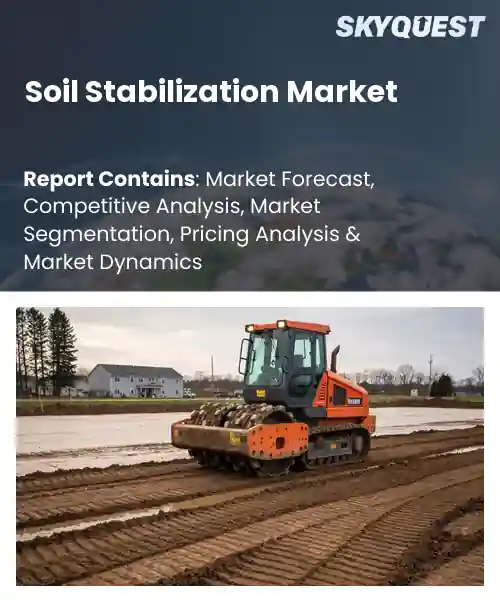
Soil Stabilization Market
Report ID: SQMIG20C2249
Report ID: SQMIG20C2249
[email protected]
USA +1 351-333-4748
Report ID:
SQMIG20C2249 |
Region:
Global |
Published Date: June, 2026
Pages:
157
|Tables:
92
|Figures:
76


Global Soil Stabilization Market size was valued at USD 33.7 Billion in 2024 and is poised to grow from USD 35.39 Billion in 2025 to USD 52.28 Billion by 2033, growing at a CAGR of 5.0% during the forecast period (2026-2033).
The global soil stabilization market is a mix of technologies and chemical additives, used to boost the load‑bearing capability of native soils, so that roads, railways, embankments, and other infrastructure can last longer. What makes it important is that it cuts construction expenses, reduces settlement-related troubles, and also helps projects comply with tough environmental rules.
Right now, the move toward chemical stabilization is helping the soil stabilization market grow, and the “low‑carbon binders” angle is standing out as the key driver. Governments are even pushing fly‑ash, geo‑polymers, and biobased additives because they reduce greenhouse‑gas emissions, while still delivering strength, so infrastructure authorities are rewriting their specs. The impact can be seen in projects like the Delhi‑Gurgaon expressway and the Texas I‑35 expansion, where eco‑friendly stabilizers were used. That’s why sales are rising for suppliers who can document sustainable performance. Also, it creates more room for R&D partnerships, better tracking of curing processes, and a push into prefab construction, all of which help firms grow penetration and profit margins.
AI-driven automation is changing how stabilization projects get planned and how they’re actually carried out. Machine learning models forecast soil response and suggest the most suitable binder combination, while sensors deliver real time information to tweak compaction during execution. Autonomous mixers, plus robotic spreaders, apply material with steadier density, so there’s less chance for human mistakes. Drone surveys then map site conditions quickly and push that info into the same workflow that organizes equipment. The overall outcome is quicker rollout, less material waste, and stronger performance, which fits the increased pressure for more resilient infrastructure. In addition, stakeholders can watch everything through cloud dashboards, making decisions faster and tightening cost control.
Market snapshot - (2026-2033)
Global Market Size
USD 33.7 Billion
Largest Segment
Chemical Stabilization
Fastest Growth
Biological Stabilization
Growth Rate
5.0% CAGR
To get more insights on this market click here to Request a Free Sample Report
The global soil stabilization market is segmented by method, additive type, application, and region. Based on method, the market is categorized into Mechanical Stabilization, Chemical Stabilization, and Biological Stabilization. By additive type, the market is segmented into Polymers, Mineral and Stabilizing Agents, and Bio-Based Additives. Based on application, the market is divided into Infrastructure Construction, Industrial Development, Commercial Development, Residential Development, and Agriculture. Regionally, the market is analyzed across North America, Europe, Asia Pacific, Latin America, and the Middle East & Africa.
As per the soil stabilization market analysis, the Mechanical stabilization segment dominates because it boosts load-bearing capacity right away, using rollers, vibro compactors, and geosynthetics, and it gives immediate strength improvements, not relying on chemical reactions . Engineers seem to prefer this route for its predictability, and the quality check is easier, also it fits neatly with existing construction timetables. Basically, leaning on well-known physical processes lowers the unknowns and keeps things more cost-effective, so it remains in the lead across the soil stabilization market, plus it helps with long term performance too.
However, the chemical stabilization segment is building the strongest growth momentum, since eco-friendly binders and admixtures are getting more attention for cutting carbon footprints. New low-emission cementitious compounds and stricter sustainability rules are pushing wider acceptance, so this method is being seen like a catalyst that opens more market possibilities, and even encourages new project specifications.
According to the soil stabilization market forecast, the Polymers segment dominated the market because molecular flexibility lets them change viscosity fast, so soil rheology can be tuned precisely for different job conditions. They can form stable gels and films, which supports moisture retention, and improves crack resistance. That’s what engineers like when they want durable results. Also polymers work well with the existing equipment, and mixing on site is simpler, so polymers end up as the preferred option for performance driven soil stabilization across infrastructure sectors.
Meanwhile, the bio-based additives segment is predicted to have the largest soil stabilization market share, since demand keeps rising for renewable, low-toxicity options. Progress with agricultural by-product polymers and microbial binding agents brings new performance traits, while green certification schemes make adoption easier, and this whole setup helps the segment expand its market reach. It also drives more innovative product development globally, significantly.
To get detailed segments analysis, Request a Free Sample Report
As per the soil stabilization market regional forecast, Asia Pacific leads the market by a mix of huge infrastructure initiatives, strong material science know how, and government rules that nudge sustainable construction. The region also has a big talent pool of engineers and ongoing ties between universities and industry, so new polymer and cementitious stabilizers get picked up quickly. As cities keep growing and transportation routes have to stay reliable in earthquake prone areas, demand rises even more. On top of that, environmental concerns push the industry toward more eco friendly binding agents while solid raw material supply chains help projects stay on track. Taken together, it makes Asia Pacific a comfortable place for market leadership, which keeps reinforcing the idea that the region is a hub for tech progress and day to day operational strength in soil stabilization.
Japan Soil Stabilization Market
The Soil Stabilization sector in Japan benefits from dense urban layouts, strict seismic design requirements, and regulatory policies that lean toward advanced stabilizing agents. Tight collaboration between construction companies and research organizations helps polymer-enhanced approaches roll out faster. National programs meant to lower the carbon footprint of infrastructure projects also increase interest in environmentally mindful solutions, and because natural aggregate reserves are rather limited, chemically upgraded stabilization becomes a tempting choice for efficient road works.
South Korea Soil Stabilization Market
The Soil Stabilization market outlook in South Korea is shaped by a planned push for high performance infrastructure able to handle heavy traffic and shifting weather patterns. Government incentives actively encourage new stabilizers that cut down dependence on conventional aggregates. Solid engineering knowhow and a busy manufacturing sector back the development of locally sourced polymer additives, improving cost efficiency during projects. The continued stress on greener construction methods connects with wider national targets to reduce environmental impact, and that supports steady growth in the soil stabilization sector.
North America is seeing fast soil stabilization market penetration because older transportation corridors need upgrades and environmental rules keep evolving. Most players in the industry tend to favor methods that stay cost sensible and durable, so pavement performance lasts longer while maintenance gets less frequent. The area also has a mature research environment that keeps turning out updated binders and recycling methods, which boosts overall material efficiency. There’s also steady pull from the oil and gas field, where stable roadways matter and pipeline routes need dependable support. With partnerships between major manufacturers and public authorities, the move toward advanced stabilization systems becomes smoother, and North America keeps its image as an innovation driven market.
United States Soil Stabilization Market
The Soil Stabilization Market in the United States is propelled by large scale roadway renewal efforts and a compliance environment that stresses lower emissions and resource conservation. Major construction firms are increasingly bringing polymer based stabilizers into their work, aiming for longer service lives and reduced life cycle costs. Public private partnerships plus federal infrastructure programs create a helpful setup for testing and deploying up to date stabilization approaches. The country’s wide geographical spread also pushes tailored solutions for different soil conditions, and that supports the markets quick expansion pattern.
Canada Soil Stabilization Market
The Soil Stabilization Market in Canada points to a strong resolve for sustainable infrastructure across multiple climate zones. Policies that prioritize low impact building encourage recycled aggregates and bio based binders, so the overall footprint stays smaller. Canada also has reputable research bodies, which helps move forward cold region stabilization practices, keeping roads steady even in severe winter periods. And when provincial authorities team up with industry leaders to scale advanced stabilization work, the market keeps expanding at a consistent pace.
Europe keeps boosting its soil stabilization reputation , mostly because it follows strict environmental directives and it also slowly moves toward circular economy thinking , where material reuse matters. In practice, a lot of the engineering community is leaning into high performance, low‑carbon binders, and they do this because the bigger standards framework basically pushes sustainability, not just strength and durability. On top of that, European Union funding tools help a lot with research into biodegradable polymers and all waste‑derived additives, so the whole sector can get technically better. There are also collaborative channels, manufacturers, universities , and policy makers all involved, which makes it easier for know how to travel faster and for new stabilization methods to actually get adopted. Overall, this connected strategy helps Europe stay ahead with environmentally aware soil stabilization.
Germany Soil Stabilization Market
The Soil Stabilization Market in Germany benefits from tough engineering standards and a clear push for eco‑efficient building. The industry clusters focus on improving polymer and cementitious stabilizers, with very specific performance requirements in mind. Federal programs also back the use of renewable materials, so recycled aggregates become more common, which cuts down reliance on virgin resources . Plus, universities and manufacturers work close together, and that ongoing feedback loop helps innovation keep moving, making Germany a visible leader in sustainable road infrastructure solutions.
United Kingdom Soil Stabilization Market
In the United Kingdom, the Soil Stabilization Market is shaped by ambitious infrastructure renewal goals , and by regulations that encourage low‑carbon construction approaches. Using advanced stabilizing agents fits with national priorities to reduce greenhouse gas emissions from the transport sector. There are also joint efforts between government bodies and research institutions, and they help drive new recyclable binders, plus waste‑derived additives. Market players then apply these changes to build road surfaces that are tougher and more consistent , while still staying aligned with the sustainability promises they made.
France Soil Stabilization Market
The Soil Stabilization Market in France mirrors a strong national agenda for greener public work , and for transportation corridors that can handle stress better. Government incentives back environmentally friendlier stabilizers that also bring recycled materials into the mix and help reduce cement consumption. France’s research ecosystem, more or less, prioritizes bio‑based polymers and low‑impact chemical additives. Partnerships between construction companies and academic labs support quicker deployment, and that strengthens France’s role in promoting sustainable soil stabilization practices.
To know more about the market opportunities by region and country, click here to
Buy The Complete Report
Adopting Innovative Technologies
Growing Urban Infrastructure Demands
High Initial Cost Barriers
Regulatory Approval Complexity
Request Free Customization of this report to help us to meet your business objectives.
Competitive dynamics in the global soil stabilization market are getting stronger, as the big manufacturers start adopting advanced polymer stabilizers and they do strategic alliances with infrastructure developers too, to satisfy tough sustainability mandates. More recent acquisitions are bunching up product lineups, and the joint ventures also speed up the deployment of low‑emission solutions, so companies can grab the growing construction demand that is pulled by urbanization and climate resilient assignments, overall.
Top Player’s Company Profile
Recent Developments in the Soil Stabilization Market
SkyQuest’s ABIRAW (Advanced Business Intelligence, Research & Analysis Wing) is our Business Information Services team that Collects, Collates, Correlates, and Analyses the Data collected by means of Primary Exploratory Research backed by robust Secondary Desk research.
As per SkyQuest analysis, the global soil stabilization market is projected to grow toward $52.3 billion by 2033, and what’s driving it is the growing adoption of advanced polymer and nanomaterial stabilizers, which speed up installation and also help reduce emissions. Another major driver is the surge in urban infrastructure projects that basically require durable foundations, and not just for a short time either. Even so, there are still high initial cost barriers as a restraint, so smaller contractors can struggle to adopt these solutions at scale. Asia Pacific dominates the market, due to large construction programmes, solid material-science capabilities, and supportive policies. Mechanical stabilization still holds the largest share, since it gives immediate load-bearing improvements with rollers and geosynthetics, and when these factors are combined it shapes the market path and keeps fueling investment into more sustainable options.
| Report Metric | Details |
|---|---|
| Market size value in 2024 | USD 33.7 Billion |
| Market size value in 2033 | USD 52.28 Billion |
| Growth Rate | 5.0% |
| Base year | 2024 |
| Forecast period | (2026-2033) |
| Forecast Unit (Value) | USD Billion |
| Segments covered |
|
| Regions covered | North America (US, Canada), Europe (Germany, France, United Kingdom, Italy, Spain, Rest of Europe), Asia Pacific (China, India, Japan, Rest of Asia-Pacific), Latin America (Brazil, Rest of Latin America), Middle East & Africa (South Africa, GCC Countries, Rest of MEA) |
| Companies covered |
|
| Customization scope | Free report customization with purchase. Customization includes:-
|
To get a free trial access to our platform which is a one stop solution for all your data requirements for quicker decision making. This platform allows you to compare markets, competitors who are prominent in the market, and mega trends that are influencing the dynamics in the market. Also, get access to detailed SkyQuest exclusive matrix.
Table Of Content
Executive Summary
Market overview
Parent Market Analysis
Market overview
Market size
KEY MARKET INSIGHTS
COVID IMPACT
MARKET DYNAMICS & OUTLOOK
Market Size by Region
KEY COMPANY PROFILES
Methodology
For the Soil Stabilization Market, our research methodology involved a mixture of primary and secondary data sources. Key steps involved in the research process are listed below:
1. Information Procurement: This stage involved the procurement of Market data or related information via primary and secondary sources. The various secondary sources used included various company websites, annual reports, trade databases, and paid databases such as Hoover's, Bloomberg Business, Factiva, and Avention. Our team did 45 primary interactions Globally which included several stakeholders such as manufacturers, customers, key opinion leaders, etc. Overall, information procurement was one of the most extensive stages in our research process.
2. Information Analysis: This step involved triangulation of data through bottom-up and top-down approaches to estimate and validate the total size and future estimate of the Soil Stabilization Market.
3. Report Formulation: The final step entailed the placement of data points in appropriate Market spaces in an attempt to deduce viable conclusions.
4. Validation & Publishing: Validation is the most important step in the process. Validation & re-validation via an intricately designed process helped us finalize data points to be used for final calculations. The final Market estimates and forecasts were then aligned and sent to our panel of industry experts for validation of data. Once the validation was done the report was sent to our Quality Assurance team to ensure adherence to style guides, consistency & design.
Analyst Support
Customization Options
With the given market data, our dedicated team of analysts can offer you the following customization options are available for the Soil Stabilization Market:
Product Analysis: Product matrix, which offers a detailed comparison of the product portfolio of companies.
Regional Analysis: Further analysis of the Soil Stabilization Market for additional countries.
Competitive Analysis: Detailed analysis and profiling of additional Market players & comparative analysis of competitive products.
Go to Market Strategy: Find the high-growth channels to invest your marketing efforts and increase your customer base.
Innovation Mapping: Identify racial solutions and innovation, connected to deep ecosystems of innovators, start-ups, academics, and strategic partners.
Category Intelligence: Customized intelligence that is relevant to their supply Markets will enable them to make smarter sourcing decisions and improve their category management.
Public Company Transcript Analysis: To improve the investment performance by generating new alpha and making better-informed decisions.
Social Media Listening: To analyze the conversations and trends happening not just around your brand, but around your industry as a whole, and use those insights to make better Marketing decisions.
REQUEST FOR SAMPLE
 REQUEST FREE CUSTOMIZATION
Global Soil Stabilization Market size was valued at USD 33.7 Billion in 2024 and is poised to grow from USD 35.39 Billion in 2025 to USD 52.28 Billion by 2033, growing at a CAGR of 5.0% during the forecast period (2026-2033).
Competitive dynamics in the global soil stabilization market are intensifying as major manufacturers adopt advanced polymer stabilizers and forge strategic alliances with infrastructure developers to meet stringent sustainability requirements. Recent acquisitions have consolidated product portfolios, while joint ventures accelerate rollout of low‑emission technologies, positioning firms to capture expanding construction demand driven by urbanization and climate‑resilient projects. 'Propex Operating Company LLC', 'Tensar International Corporation', 'BASF SE', 'Sika AG', 'Caterpillar Inc.', 'Wirtgen Group', 'Fayat Group', 'Volvo Construction Equipment', 'Arkema Group', 'SNF Holding Company', 'Global Road Technology', 'Graymont Limited', 'Carmeuse Holding SA', 'Lhoist Group', 'Boral Limited', 'TenCate Geosynthetics', 'GCP Applied Technologies Inc.', 'CellTek Geosynthetics LLC', 'Substratum Group', 'Soilworks LLC'
Adoption of advanced polymer and nanomaterial stabilizers enables faster installation, longer lasting performance, and reduced environmental impact, encouraging contractors to replace conventional methods. These technologies address soil variability more effectively, lowering risk of post‑construction failures. As project owners prioritize sustainable solutions, the appeal of such innovative products rises, prompting broader market acceptance. Consequently, the sector experiences heightened demand driven by the perceived reliability and efficiency gains associated with modern stabilization techniques and improved cost‑effectiveness over the project lifecycle which further incentivizes investment decisions.
Sustainable Additive Adoption: The industry is rapidly embracing eco‑friendly binding agents such as bio‑based polymers, industrial by‑product fly ash, and enzymatic stabilizers. Manufacturers are positioning these sustainable additives as alternatives to traditional cementitious solutions, responding to customer demand for lower carbon footprints and compliance with emerging green procurement policies. This shift is driving collaborative R&D programs between construction firms, research institutes, and specialty chemical suppliers, accelerating product validation cycles and creating new market niches focused on environmentally responsible infrastructure development through strategic partnerships and knowledge sharing.
Why does Asia Pacific Dominate the Global Soil Stabilization Market? |@12


Want to customize this report? This report can be personalized according to your needs. Our analysts and industry experts will work directly with you to understand your requirements and provide you with customized data in a short amount of time. We offer $1000 worth of FREE customization at the time of purchase.
Feedback From Our Clients


 USA (+1) 351-333-4748

