Soil Aerators Market
Report ID: SQMIG20H2103
Report ID: SQMIG20H2103
[email protected]
USA +1 351-333-4748
Report ID:
SQMIG20H2103 |
Region:
Global |
Published Date: July, 2026
Pages:
157
|Tables:
122
|Figures:
77


Global Soil Aerators Market size was valued at USD 19.99 Billion in 2024 and is poised to grow from USD 21.31 Billion in 2025 to USD 35.54 Billion by 2033, growing at a CAGR of 6.6% during the forecast period (2026-2033).
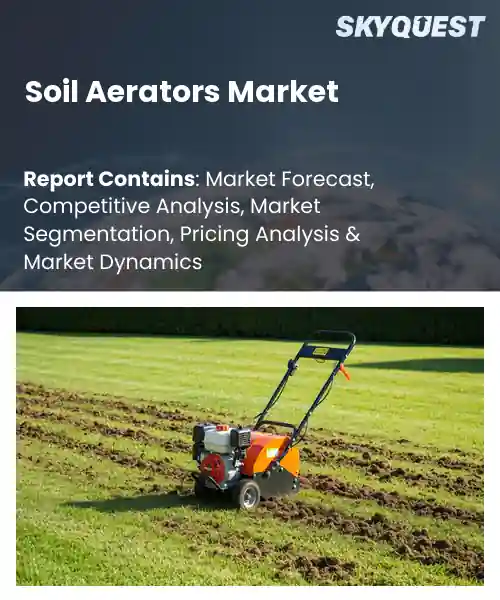
Soil aerators in the global soil aerators industry consist of equipment that helps in loosening soil for the better circulation of air, water, and nutrients required for agriculture or horticulture operations. This industry is significant because increased soil respiration leads to higher production levels and less waste of fertilizers and water, which are the elements of sustainability. The industry has started using basic hand tiling equipment in the 1960s but gradually developed into the use of motorized spike aerators and core aerators in the 1990s and even GPS-enabled soil aerators currently. The main catalyst of this growth is the growing need for farming due to population increases and climate change.
Another major factor reconfiguring the worldwide soil aerator market is digital surveillance and precise control, where ecological imperatives become commercial opportunities. With the use of IoT in agriculture for assessing soil compacting and moisture conditions, the producers build in self-adjusting algorithms for the depth of the aerator operation, which makes it possible for an aerator to immediately adapt to field conditions. This leads to the decreased number of passes and lowered fuel consumption and improved oxygenation of roots; as an example, a midwestern corn farm saved 12 percent on its expenses using a GPS-enabled system of core aerators.
How is IoT Integration Enhancing Efficiency in the Soil Aerators Market?
With regard to IoT-enabled aerators, it involves installation of sensors which measure moisture, temperature, and compaction in real time and send data to the management systems at the farms. With data in hand, farmers can plan their aeration activities when conditions are favorable to save on extra passes and fuel cost. The remote capabilities will help in troubleshooting the status of motors and batteries to eliminate breakdowns without any physical presence of technicians. It uses predictive analytics for monitoring historical data and recommending preventive maintenance to extend the life of machinery. With the connection of the machines with irrigation and fertilization equipment, farms can perform a combination of measures to improve soil health and increase yield and save resources.
Market snapshot - (2026-2033)
Global Market Size
USD 19.99 Billion
Largest Segment
Core / Plug Aerators
Fastest Growth
Liquid Aerators
Growth Rate
6.6% CAGR
To get more insights on this market click here to Request a Free Sample Report
Global soil aerators market is segmented by product type, application, power source, end user and region. Based on product type, the market is segmented into Core / Plug Aerators, Spike / Solid-Tine Aerators, Slicing / Disc Aerators, Liquid Aerators and Subsoilers & Deep-Tillage Aerators. Based on application, the market is segmented into Lawn & Garden Maintenance, Golf Course & Sports Field Maintenance, Agricultural Soil Aeration and Commercial Landscaping. Based on power source, the market is segmented into Walk-Behind (Self-Propelled), Tow-Behind, Riding / Tractor-Mounted and Manual. Based on end user, the market is segmented into Farmers & Agricultural Producers, Golf Courses & Sports Facilities, Landscaping & Lawn Care Companies and Residential / Home Owners. Based on region, the market is segmented into North America, Europe, Asia Pacific, Latin America and Middle East & Africa.
Core / Plug Aerators are the market leader as they deliver the highest level of efficiency in terms of soil penetration and aeration and at the same time are easy to use. The mechanical nature of the device provides an even distribution of holes which promotes better root respiration and water percolation. The combination of reliability and recognition of the manufacturer/service provider is responsible for the leadership of the segment in the market.
Nevertheless, the Liquid Aerators segment represents the fastest growing opportunity as they allow aeration without disturbing the soil physically. They are popular with organic farmers and those who practice water conservation. Special formulations which increase the activity of microorganisms in soil and facilitate the process of nutrient uptake are driving the growth of the segment.
Golf Course & Sports Field Maintenance application has the largest share since high-quality turf needs accurate aeration to preserve both the playability and beauty of the field. Equipment which provides consistent hole patterns and fast recovery and thus guarantees perfect root condition and low compaction of the surface is preferred. Large budgets, short service intervals, and strict technical requirements ensure continuous demand for special aerators, thus making this application a core element of market development.
On the other hand, Agricultural Soil Aeration application experiences the most robust growth since soil health and yield become more important. Therefore, aeration is becoming increasingly popular among farmers. Modern technologies and affordable equipment, along with policies to decrease compaction, make this application a driving force of market development.
To get detailed segments analysis, Request a Free Sample Report
North America has the advantage of a developed agriculture industry that focuses on being productive and sustainable. Modern mechanization, prevalence of precise farming techniques, and well-developed research and development industries result in the need for effective soil aeration technology. Well-developed distribution channels and advanced technical competence in equipment manufacturers create an environment for continuous innovations. Moreover, supportive regulatory frameworks facilitate the adoption of technologies that promote soil health and minimize compaction while enhancing water infiltration. The synergy of consumer awareness, professional services, and the attitude towards innovation make North America a market and technology leader in soil aerators.
United States' Soil Aerators Market exhibits the intensive agriculture on large areas of land, where the key consideration is yield maximization. It is common for farmers to use machinery that offers regular soil aeration required for optimal root formation and nutrient absorption. Numerous leading agronomic research centers speed up the adoption of innovative technologies, whereas competition among suppliers leads to the availability of various mechanical and pneumatic machines.
Canada Soil Aerators market demonstrates the high degree of commitment towards sustainable land management in different climate zones. The companies located in the prairie provinces make use of the aeration method to cope with soil compaction associated with grain farming. In the eastern part, the farmers engaged in horticulture and dairies use aerators to enhance soil quality and its water holding capacity. Partnership projects between agricultural institutions and equipment suppliers help to provide customized solutions for soils, whereas environmental government programs encourage sustainable farming involving aeration.
In Europe, the agricultural sector includes the use of premium specialty crops along with strict environmental laws, forming an ideal scenario for developing soil aeration systems. The authorities give importance to soil preservation, biodiversity, and carbon sequestration, thus encouraging farmers to engage in practices that increase soil porosity and promote microbial processes. Due to the strong inclination of the European region towards international collaboration in scientific research, innovation in aeration systems that have minimal impact and consume less energy is expedited. With a supply chain that facilitates the provision of sophisticated equipment to large commercial farms and specialized organic farmers, the market players reap benefits.
Germany Soil Aerators market is powered by a blend of engineering prowess and green farming approach. The German agricultural enterprises have always been concerned about using the most accurate technology in order to disturb the soil as little as possible and to provide roots with maximum comfort. University-industry cooperation results in very effective pneumatic and mechanical soil aerators for various types of soil found in the country.
Soil Aerators Market in the United Kingdom is rapidly growing owing to the usage of technology in farming for sustainable intensification. There is rising awareness among British farmers about addressing the issue of soil compaction due to the use of heavy farm equipment; this results in an increased demand for more mobile and flexible machines. The knowledge sharing that occurs in agriculture advisory networks stresses the importance of aeration to increase biodiversity and achieve stable yields in unpredictable climatic conditions. Innovations are being carried out in the UK to create light and energy-efficient aerator designs.
French Soil Aerators Market is the epitome of an impressive blend of high-quality farming with eco-friendly practices. The French vineyards, orchards, and arable lands make use of the process of aeration in order to increase the strength of the roots, particularly in soils that are considered to be dense. Various government subsidies promote technologies which maintain soil structure along with organic matter content. Joint ventures between research institutes and equipment manufacturers have enabled them to produce a large variety of aerators.
Asia Pacific will take advantage of fast agricultural development and an increasing emphasis on the health of soils to grow further around soil aerators. Asia Pacific nations will be increasing the use of mechanization to help them cope with their food needs and the problems of soil deterioration and lack of water resources. Modern innovations that involve the aeration process and the use of sensors for control purposes are becoming popular. Joint efforts between governments and private sector companies will encourage the use of machinery with reduced emission rates.
The market for Soil Aerators in Japan is influenced by intensive farming operations and a culture that values precision agriculture. The farmers in Japan place importance on machines that ensure uniform aeration while avoiding damage to the root systems of plants. Japan has a robust Research & Development environment that promotes the manufacture of compact and efficient soil aerators that suit the small size of farms in Japan.
South Korea Soil Aerators Market is indicative of the dedication towards technological innovations in agriculture. Korean agricultural enterprises make use of modern aeration technologies to deal with soil compaction due to mechanized processes on productive lands. The government’s promotion of smart farming projects fosters the implementation of aerators with the ability to perform analysis and thus aid in making decisions regarding irrigation and fertilization. Collaboration of local producers and research organizations leads to innovations in energy-efficient aerator designs.
To know more about the market opportunities by region and country, click here to
Buy The Complete Report
Increasing Sustainable Farming Practices
Adoption of sustainable agriculture results in the adoption of soil aerators, which helps in improving the well-being of roots, increasing water permeability, and avoiding soil compaction. When such practices become part of soil management, farmers realize increased productivity while retaining soil integrity. These factors result in an increase in demand for environmentally friendly and efficient aeration devices, and thus the creation of high-quality and energy-efficient devices by manufactures. The market grows organically because of the focus on sustainability and regulation compliance of manufacturers.
Rising Adoption of Precision Agriculture
Data analysis is an important component of precision farming that is complemented by equipment automation, whereby the use of soil aerators will be further coupled with sensors to detect moisture and compaction. This collaboration allows for precise aeration, thus cutting unnecessary effort. With the use of automated guidance on farmsteads increasing, the demand for appropriate aeration systems is bound to grow, and the manufacturers will respond with IoT-integrated units. The improvements in effectiveness and manpower reductions drive market growth, as farmers appreciate the advantages of the technology combination.
High Initial Equipment Investment
The cost needed to acquire the expensive soil aerator equipment may pose serious barriers to small-scale or resource-poor farmers due to their inability to meet the high initial cost. High initial cost discourages the adoption process even though the technology will have long-term benefits for agriculture since the farmer will have no option but to go for the labor-intensive method. Such financial constraints act as market barriers to the spread of this technology in areas with poor credit facilities or where the recovery period exceeds budget periods.
Complex Maintenance Requirements
Most advanced models of soil aerators use some mechanical and electronic elements requiring special skills to maintain and repair. Those without trained technicians will encounter greater periods of time not working, hence lowering their productivity and adding more costs. Such technical difficulties discourage investment, especially in farmers who require simple and reliable equipment in the fields. Therefore, the growth in the market is limited due to reluctance to embrace technology that is difficult to maintain in the long run. The requirement of exclusive parts makes it costly to serve and repair them.
Request Free Customization of this report to help us to meet your business objectives.
The competitive environment is fueled by highly competitive mergers and acquisitions, partnerships with equipment producers, and fast technological development like IoT-enabled sensors for aerators. The recent cases include the acquisition of one of the top agronomy companies of a precision soil health startup and partnership of one of the top hardware companies with a company specialized in data analytics to incorporate moisture monitoring in aerators.
Sustainable Practice Adoption: This new focus on environmental sustainability is causing agricultural producers to incorporate soil aeration into their normal practices. Producers understand that increasing the amount of oxygen that reaches the roots will increase water percolation and decrease compaction and encourage beneficial microbial activity. As such, there is an increased need for aerators that are flexible and have low impact and can meet the requirements of organic certification and regenerative agriculture. Such a development is encouraging equipment makers to work in partnership with agronomists to create effective solutions.
Digital Integration Driving Efficiency: The growing availability of precision agriculture solutions is bringing changes to the way that the job of soil aeration is done. With the use of integrated sensors, it is possible to measure soil compaction in real time, and, due to the GPS guidance of the aerators, it is easy to control their depth and frequency of work, thereby reducing overlap and fuel costs. Thus, the use of such information helps agronomists to determine when to conduct soil aeration procedures depending on the cycle of the crop and weather conditions.
SkyQuest’s ABIRAW (Advanced Business Intelligence, Research & Analysis Wing) is our Business Information Services team that Collects, Collates, Correlates, and Analyses the Data collected by means of Primary Exploratory Research backed by robust Secondary Desk research.
As per SkyQuest analysis, the worldwide market for soil aerators is mainly driven by the increasing trend towards sustainable agriculture, which makes farmers opt for machinery that ensures healthy roots and water infiltration. On the other hand, the second major driving factor is the quick adoption of digital technology like Internet-of-Things sensors and GPS guidance, which helps in reducing passes and fuel consumption. The core/plug aerators continue to lead in the market owing to their effectiveness on different surfaces. North America takes the lead in the market owing to its mechanization, research facilities, and favorable regulatory policies. However, the growth of the market is restricted by the costly nature of advanced aerators.
| Report Metric | Details |
|---|---|
| Market size value in 2024 | USD 19.99 Billion |
| Market size value in 2033 | USD 35.54 Billion |
| Growth Rate | 6.6% |
| Base year | 2024 |
| Forecast period | (2026-2033) |
| Forecast Unit (Value) | USD Billion |
| Segments covered |
|
| Regions covered | North America (US, Canada), Europe (Germany, France, United Kingdom, Italy, Spain, Rest of Europe), Asia Pacific (China, India, Japan, Rest of Asia-Pacific), Latin America (Brazil, Rest of Latin America), Middle East & Africa (South Africa, GCC Countries, Rest of MEA) |
| Companies covered |
|
| Customization scope | Free report customization with purchase. Customization includes:-
|
To get a free trial access to our platform which is a one stop solution for all your data requirements for quicker decision making. This platform allows you to compare markets, competitors who are prominent in the market, and mega trends that are influencing the dynamics in the market. Also, get access to detailed SkyQuest exclusive matrix.
Table Of Content
Executive Summary
Market overview
Parent Market Analysis
Market overview
Market size
KEY MARKET INSIGHTS
COVID IMPACT
MARKET DYNAMICS & OUTLOOK
Market Size by Region
KEY COMPANY PROFILES
Methodology
For the Soil Aerators Market, our research methodology involved a mixture of primary and secondary data sources. Key steps involved in the research process are listed below:
1. Information Procurement: This stage involved the procurement of Market data or related information via primary and secondary sources. The various secondary sources used included various company websites, annual reports, trade databases, and paid databases such as Hoover's, Bloomberg Business, Factiva, and Avention. Our team did 45 primary interactions Globally which included several stakeholders such as manufacturers, customers, key opinion leaders, etc. Overall, information procurement was one of the most extensive stages in our research process.
2. Information Analysis: This step involved triangulation of data through bottom-up and top-down approaches to estimate and validate the total size and future estimate of the Soil Aerators Market.
3. Report Formulation: The final step entailed the placement of data points in appropriate Market spaces in an attempt to deduce viable conclusions.
4. Validation & Publishing: Validation is the most important step in the process. Validation & re-validation via an intricately designed process helped us finalize data points to be used for final calculations. The final Market estimates and forecasts were then aligned and sent to our panel of industry experts for validation of data. Once the validation was done the report was sent to our Quality Assurance team to ensure adherence to style guides, consistency & design.
Analyst Support
Customization Options
With the given market data, our dedicated team of analysts can offer you the following customization options are available for the Soil Aerators Market:
Product Analysis: Product matrix, which offers a detailed comparison of the product portfolio of companies.
Regional Analysis: Further analysis of the Soil Aerators Market for additional countries.
Competitive Analysis: Detailed analysis and profiling of additional Market players & comparative analysis of competitive products.
Go to Market Strategy: Find the high-growth channels to invest your marketing efforts and increase your customer base.
Innovation Mapping: Identify racial solutions and innovation, connected to deep ecosystems of innovators, start-ups, academics, and strategic partners.
Category Intelligence: Customized intelligence that is relevant to their supply Markets will enable them to make smarter sourcing decisions and improve their category management.
Public Company Transcript Analysis: To improve the investment performance by generating new alpha and making better-informed decisions.
Social Media Listening: To analyze the conversations and trends happening not just around your brand, but around your industry as a whole, and use those insights to make better Marketing decisions.
REQUEST FOR SAMPLE
 REQUEST FREE CUSTOMIZATION
Global Soil Aerators Market size was valued at USD 19.99 Billion in 2024 and is poised to grow from USD 21.31 Billion in 2025 to USD 35.54 Billion by 2033, growing at a CAGR of 6.6% during the forecast period (2026-2033).
The competitive landscape is shaped by aggressive M&A activity, strategic partnerships with equipment manufacturers, and rapid tech innovation such as IoT‑enabled aeration sensors; recent examples include a leading agronomy firm acquiring a precision soil‑health startup and a major hardware provider partnering with a data‑analytics company to embed real‑time moisture monitoring in aerators. These moves intensify rivalry and accelerate product differentiation across the market. 'Deere & Company (John Deere)', 'CNH Industrial N.V. (Case IH, New Holland)', 'AGCO Corporation', 'KUBOTA Corporation', 'HUSQVARNA Group', 'TORO Company', 'Ariens Company', 'MTD Products Inc.', 'Cub Cadet (MTD)', 'Briggs & Stratton', 'Blue Bird Corporation', 'Deweze Manufacturing Inc.', 'Florentine Corp. (Aeroquip)', 'Ryan (Husqvarna)', 'BillyGoat Industries Inc.', 'NorthStar Equipment', 'Zone Defense Golf', 'Toro Company's Sitework Systems', 'Briggs & Stratton Power Products', 'Charles Machine Works'
Adoption of sustainable farming practices encourages the use of soil aerators to improve root health, enhance water infiltration, and reduce compaction. By integrating aeration into routine soil management, growers can achieve higher yields while preserving soil structure. This alignment with environmental stewardship drives demand for efficient aeration equipment, prompting manufacturers to develop advanced, energy‑saving models that meet ecological standards. Consequently, the market experiences organic growth as producers prioritize long‑term soil vitality and regulatory compliance, reinforcing the value proposition of aeration technologies.
Sustainable Practice Adoption: The growing emphasis on environmental stewardship is prompting agricultural producers to integrate soil aeration into routine management practices. Farmers recognize that enhanced root oxygenation improves water infiltration, reduces compaction, and supports healthier microbial activity. Consequently, demand for versatile, low‑impact aerators is rising as operators seek equipment that aligns with organic certification standards and regenerative farming goals. This shift is fostering collaborative innovation between equipment manufacturers and agronomy experts to deliver solutions that reinforce soil health while maintaining cost efficiency for long‑term profitability globally.
Why does North America Dominate the Global Soil Aerators Market? |@12


Want to customize this report? This report can be personalized according to your needs. Our analysts and industry experts will work directly with you to understand your requirements and provide you with customized data in a short amount of time. We offer $1000 worth of FREE customization at the time of purchase.
Feedback From Our Clients


 USA (+1) 351-333-4748

