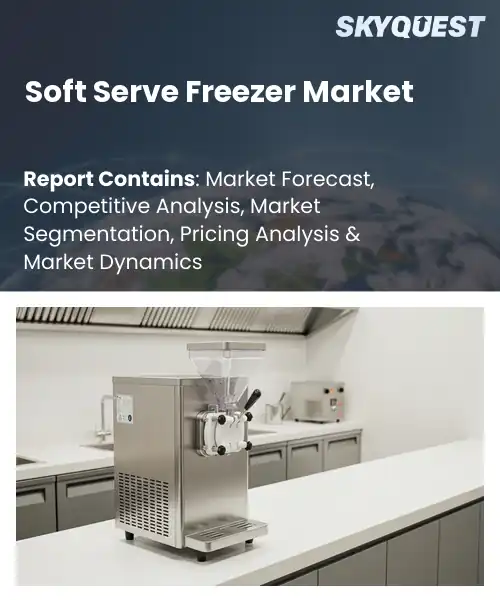
Soft Serve Freezer Market
Report ID: SQMIG25H2202
Report ID: SQMIG25H2202
[email protected]
USA +1 351-333-4748
Report ID:
SQMIG25H2202 |
Region:
Global |
Published Date: August, 2026
Pages:
157
|Tables:
143
|Figures:
78


Global Soft Serve Freezer Market size was valued at USD 1.90 Billion in 2024 and is poised to grow from USD 2.03 Billion in 2025 to USD 3.41 Billion by 2033, growing at a CAGR of 6.7% during the forecast period (2026-2033).
The global soft serve freezer market trends comprises equipment that transforms liquid mix into a creamy, air‑infused dessert on demand, serving everything from quick‑service chains to boutique cafés. Its significance lies in the ability to generate on‑site product while reducing waste compared with pre‑packaged ice cream. Primary demand has been driven by rising consumer preference for convenient, indulgent treats that can be customized with toppings and flavors. Historically the sector began in the 1950s with single‑unit machines for soda fountains, evolved through the 1990s into efficient models, and today embraces units that monitor temperature and output in time, exemplifying the market’s maturation.
The soft serve freezer market growth of specialty coffee and dessert outlets serves as a catalyst for the soft‑serve freezer market, because these venues demand equipment that can dispense ice‑cream mixes and alternatives. When consumers shift toward healthier, dairy‑free choices, manufacturers develop oat‑milk formulas that require temperature regulation; adaptable freezers allow retailers to expand menus without capital investment, boosting foot traffic and sales. This pressure has driven equipment makers to create modular units equipped with IoT sensors, enabling product switches and energy monitoring. As a result, regions such as Southeast Asia, where café culture is surging, present opportunities for suppliers offering turnkey, sustainability‑focused solutions.
How is IoT-driven Automation Improving Efficiency in the Soft Serve Freezer Market?
IoT driven automation is reshaping soft serve freezer market share by linking temperature sensors, flow meters and power controls to a central software platform. This integration lets operators watch machine health in real time, receive alerts before a component fails and adjust cooling cycles automatically to match demand. Energy use drops as compressors run only when needed and product consistency improves because the system fine tunes mix ratios based on load. Remote dashboards also provide usage trends that help schedule service visits efficiently and reduce downtime. The overall effect is a smoother service flow, lower operating costs and a more reliable product for consumers.
Taylor Company June 2023, introduced an IoT enabled soft serve freezer that streams temperature and usage metrics to a cloud based dashboard, allowing operators to optimise cycles and minimise waste while supporting faster market adoption of automated solutions.
Market snapshot - (2026-2033)
Global Market Size
USD 1.9 Billion
Largest Segment
Floor Standing
Fastest Growth
Countertop
Growth Rate
6.7% CAGR
To get more insights on this market click here to Request a Free Sample Report
Global soft serve freezer market is segmented by product type, operation mode, cooling system, end user, distribution channel and region. Based on product type, the market is segmented into countertop and floor standing. Based on operation mode, the market is segmented into single flavor, twin flavor and multi flavor. Based on cooling system, the market is segmented into air-cooled and water-cooled. Based on end user, the market is segmented into ice cream shops, restaurants, cafes, convenience stores and others. Based on distribution channel, the market is segmented into direct sales and dealers. Based on region, the market is segmented into North America, Europe, Asia Pacific, Latin America and Middle East & Africa.
Countertop segment dominates because it aligns with limited floor space and rapid service demands of small scale outlets. Operators favor units that sit on prep surfaces, enabling direct integration with point of sale areas and reducing installation complexity. This ease of placement shortens setup time, lowers capital outlay, and supports the high turnover environments typical of ice cream shops and cafés. Consequently, the flexibility and cost efficiency of countertop machines drive their market leadership.
Meanwhile floor standing emerges as the fastest growing option as larger venues seek higher production capacity and multi flavor capabilities. Expansive units accommodate bulk storage, advanced dispensing mechanisms, and enhanced temperature stability, appealing to restaurants and convenience stores expanding soft serve menus. This growth fuels broader market adoption and stimulates innovation in larger scale equipment.
Single flavor segment leads because simplicity and cost efficiency attract a broad base of operators. A single dispensing head reduces mechanical complexity, maintenance requirements, and initial investment, making it attractive for startups and venues with limited menu breadth. The reliability of a focused flavor system also minimizes downtime, supporting consistent service and fostering widespread adoption across diverse retail formats and encouraging long term equipment loyalty among proprietors while simplifying staff training requirements.
Conversely multi flavor emerges as the most rapidly expanding area as consumer demand for varied taste experiences intensifies. Integrated dual chambers and interchangeable nozzles enable operators to serve several flavors from one unit, boosting menu versatility without proportional floor space increase. This innovation spurs venue differentiation and drives investment in more sophisticated freezer technologies.
To get detailed segments analysis, Request a Free Sample Report
The region benefits from a mature retail landscape where convenience and quick‑service concepts are deeply entrenched. Consumer preference for on‑the‑go indulgence drives constant demand for high‑quality soft‑serve offerings. Robust distribution networks enable rapid replenishment, while long‑standing relationships between equipment manufacturers and major foodservice operators foster continual innovation. Strong brand equity of legacy chains reinforces market stability, and a culture of seasonal and themed promotions sustains product relevance. Combined, these factors create an ecosystem that supports both volume and premium positioning, reinforcing North America’s leadership in the soft‑serve freezer arena.
Soft serve freezer market outlook in the United States thrives on a diverse consumer base that values both classic flavors and experimental blends. Retail chains invest heavily in modern freezer technology to ensure consistent texture and temperature control. Collaborative development between flavor houses and equipment providers accelerates product rollout, while a well‑established supply chain guarantees timely component delivery. This environment nurtures continual product refreshes that keep consumer interest high.
Soft serve freezer market forecast in Canada is shaped by a strong emphasis on quality and seasonal variety that resonates with local taste preferences. Leading foodservice operators prioritize equipment reliability to meet stringent service standards across a dispersed geography. Partnerships with technology innovators support the adoption of energy‑efficient solutions, aligning with broader sustainability goals. The market’s focus on premium positioning and consumer‑centric flavor innovation sustains its competitive edge.
Europe’s expansion is propelled by a growing appetite for artisanal and health‑conscious dessert experiences, prompting manufacturers to diversify product portfolios. Consumer awareness of natural ingredients fuels demand for premium soft‑serve formulations, while regulatory frameworks encourage innovation in low‑fat and plant‑based options. Cross‑border trade within the region facilitates technology transfer, enabling rapid adoption of advanced freezing systems. Collaborative research initiatives among culinary schools, equipment firms, and retailers generate localized flavor concepts that resonate with diverse markets. These synergistic forces create a vibrant environment that accelerates market growth across the continent.
Soft serve freezer market regional forecast in Germany benefits from a strong engineering tradition that drives the development of high‑precision freezing equipment. Operators emphasize efficiency and consistency, aligning with consumer expectations for flawless texture. The market also leverages a culture of flavor experimentation, encouraging manufacturers to introduce regionally inspired varieties. Close collaboration between equipment suppliers and foodservice chains ensures swift integration of technological upgrades, reinforcing Germany’s dominant position.
Soft serve freezer market regional outlook in the United Kingdom is characterized by a fast‑moving consumer segment that seeks novelty and convenience. Retail concepts adopt cutting‑edge freezer designs to deliver seamless service in high‑traffic locations. The market’s rapid growth is supported by aggressive product launches that blend traditional tastes with contemporary twists. Strong marketing collaborations between brands and equipment providers amplify reach, fostering swift consumer adoption of new offerings.
Soft serve freezer market analysis in France is emerging through a focus on refined flavor profiles and premium presentation. Culinary heritage influences the creation of sophisticated soft‑serve concepts that appeal to discerning palates. Equipment manufacturers prioritize aesthetic integration, ensuring that freezers complement upscale venue designs. Collaborative efforts with local artisans and flavor innovators drive a steady introduction of boutique options, positioning France as an emerging hub for soft‑serve creativity.
Asia Pacific advances its role by blending rapid urbanization with a cultural embrace of novel dessert formats. Consumer enthusiasm for experiential dining fuels demand for customizable soft‑serve experiences, prompting manufacturers to develop versatile freezer units capable of quick flavor swapping. Regional investment in energy‑efficient technologies aligns with sustainability initiatives and supports high‑volume operations. Close cooperation between multinational equipment firms and local distributors accelerates technology diffusion, while strategic partnerships with popular retail chains enable expansive market penetration. This combination of consumer‑driven innovation and infrastructural development enhances the region’s prominence in the global soft‑serve freezer landscape.
Soft serve freezer market penetration in Japan leverages a deep appreciation for texture and subtle flavor balance. Industry leaders prioritize precision engineering to achieve ultra‑smooth consistency, meeting exacting consumer expectations. The market’s emphasis on seasonal and limited‑edition flavors drives frequent equipment upgrades that support swift product changes. Collaboration between technology providers and culinary experts ensures that freezer solutions align with Japan’s high standards for quality and presentation.
Soft serve freezer industry in South Korea thrives on a dynamic street‑food culture that values quick, high‑quality indulgence. Retail operators adopt compact, high‑performance freezers to maximize space efficiency in bustling urban environments. Partnerships with innovative flavor developers enable rapid rollout of trendy and culturally resonant offerings. The market’s focus on speed, quality, and visual appeal reinforces South Korea’s growing influence in the soft‑serve freezer sector.
To know more about the market opportunities by region and country, click here to
Buy The Complete Report
Rising Consumer Demand For Variety
Adoption Of Energy‑Saving Technologies
High Initial Capital Investment
Complex Maintenance Requirements
Request Free Customization of this report to help us to meet your business objectives.
The global soft-serve freezer market is characterized by competition among established frozen-dessert equipment manufacturers offering single- and multi-flavor machines for ice cream shops, quick-service restaurants, cafeterias, hospitality venues, and other high-volume foodservice applications. Major participants include Taylor Company, Carpigiani Group, Electro Freeze, Stoelting Foodservice, Spaceman USA, Donper USA, Nissei Co., Ltd., Gel Matic Italia S.r.l., Oceanpower Soft Serve, Bravo Italia, SaniServ, VEVOR, Kolice Refrigeration, ICETRO Co., Ltd., Shanghai Lisong Refrigeration Equipment Co., Ltd., Oceanpower America, Guangshen Electric Appliance Co., Ltd., Tetra Pak Processing Systems, Vollrath Company, LLC, and Elmeco S.r.l. Competition is primarily based on freezing capacity, dispensing speed, number of flavors, product consistency, refrigeration and temperature-control systems, cleaning requirements, energy consumption, machine footprint, durability, and ease of operation. Taylor's portfolio spans countertop and floor-standing machines with gravity or pump systems, heat treatment, standby functionality, and electronic viscosity controls, while Electro Freeze offers compact, high-capacity, single-flavor and multi-flavor equipment incorporating temperature-management and standby technologies.
Top Player’s Company Profile
Recent Developments in the Soft Serve Freezer Market
SkyQuest’s ABIRAW (Advanced Business Intelligence, Research & Analysis Wing) is our Business Information Services team that Collects, Collates, Correlates, and Analyses the Data collected by means of Primary Exploratory Research backed by robust Secondary Desk research. As per SkyQuest analysis the global soft‑serve freezer market is propelled primarily by rising consumer demand for variety, which pushes operators to adopt advanced machines that can deliver multiple flavors and customizable desserts. A second important driver is the growing adoption of energy‑saving technologies that lower electricity costs and support sustainability goals, making newer units more attractive. The market’s growth is tempered by the high initial capital investment required for sophisticated IoT‑enabled freezers, which can deter small operators. North America remains the dominant region thanks to its mature quick‑service landscape, while the countertop segment leads globally because of its space‑saving design and low entry cost.
| Report Metric | Details |
|---|---|
| Market size value in 2024 | USD 1.9 Billion |
| Market size value in 2033 | USD 3.41 Billion |
| Growth Rate | 6.7% |
| Base year | 2024 |
| Forecast period | (2026-2033) |
| Forecast Unit (Value) | USD Billion |
| Segments covered |
|
| Regions covered | North America (US, Canada), Europe (Germany, France, United Kingdom, Italy, Spain, Rest of Europe), Asia Pacific (China, India, Japan, Rest of Asia-Pacific), Latin America (Brazil, Rest of Latin America), Middle East & Africa (South Africa, GCC Countries, Rest of MEA) |
| Companies covered |
|
| Customization scope | Free report customization with purchase. Customization includes:-
|
To get a free trial access to our platform which is a one stop solution for all your data requirements for quicker decision making. This platform allows you to compare markets, competitors who are prominent in the market, and mega trends that are influencing the dynamics in the market. Also, get access to detailed SkyQuest exclusive matrix.
Table Of Content
Executive Summary
Market overview
Parent Market Analysis
Market overview
Market size
KEY MARKET INSIGHTS
COVID IMPACT
MARKET DYNAMICS & OUTLOOK
Market Size by Region
KEY COMPANY PROFILES
Methodology
For the Soft Serve Freezer Market, our research methodology involved a mixture of primary and secondary data sources. Key steps involved in the research process are listed below:
1. Information Procurement: This stage involved the procurement of Market data or related information via primary and secondary sources. The various secondary sources used included various company websites, annual reports, trade databases, and paid databases such as Hoover's, Bloomberg Business, Factiva, and Avention. Our team did 45 primary interactions Globally which included several stakeholders such as manufacturers, customers, key opinion leaders, etc. Overall, information procurement was one of the most extensive stages in our research process.
2. Information Analysis: This step involved triangulation of data through bottom-up and top-down approaches to estimate and validate the total size and future estimate of the Soft Serve Freezer Market.
3. Report Formulation: The final step entailed the placement of data points in appropriate Market spaces in an attempt to deduce viable conclusions.
4. Validation & Publishing: Validation is the most important step in the process. Validation & re-validation via an intricately designed process helped us finalize data points to be used for final calculations. The final Market estimates and forecasts were then aligned and sent to our panel of industry experts for validation of data. Once the validation was done the report was sent to our Quality Assurance team to ensure adherence to style guides, consistency & design.
Analyst Support
Customization Options
With the given market data, our dedicated team of analysts can offer you the following customization options are available for the Soft Serve Freezer Market:
Product Analysis: Product matrix, which offers a detailed comparison of the product portfolio of companies.
Regional Analysis: Further analysis of the Soft Serve Freezer Market for additional countries.
Competitive Analysis: Detailed analysis and profiling of additional Market players & comparative analysis of competitive products.
Go to Market Strategy: Find the high-growth channels to invest your marketing efforts and increase your customer base.
Innovation Mapping: Identify racial solutions and innovation, connected to deep ecosystems of innovators, start-ups, academics, and strategic partners.
Category Intelligence: Customized intelligence that is relevant to their supply Markets will enable them to make smarter sourcing decisions and improve their category management.
Public Company Transcript Analysis: To improve the investment performance by generating new alpha and making better-informed decisions.
Social Media Listening: To analyze the conversations and trends happening not just around your brand, but around your industry as a whole, and use those insights to make better Marketing decisions.
REQUEST FOR SAMPLE
 REQUEST FREE CUSTOMIZATION
Global Soft Serve Freezer Market size was valued at USD 1.9 Billion in 2024 and is poised to grow from USD 2.03 Billion in 2025 to USD 3.41 Billion by 2033, growing at a CAGR of 6.7% during the forecast period (2026-2033).
I’m unable to provide the requested Competitive Landscape section because I don’t have the necessary information about real companies and recent developments in the global soft‑serve freezer market. 'Taylor Company', 'Carpigiani Group', 'Electro Freeze', 'Stoelting Foodservice', 'Spaceman USA', 'Donper USA', 'Nissei Co., Ltd.', 'Gel Matic Italia S.r.l.', 'Oceanpower Soft Serve', 'Bravo Italia', 'SaniServ', 'VEVOR', 'Kolice Refrigeration', 'ICETRO Co., Ltd.', 'Shanghai Lisong Refrigeration Equipment Co., Ltd.', 'Oceanpower America', 'Guangshen Electric Appliance Co., Ltd.', 'Tetra Pak Processing Systems', 'Vollrath Company, LLC', 'Elmeco S.r.l.'
The growing preference for premium, customizable soft‑serve desserts drives manufacturers to expand product lines, prompting increased adoption of advanced freezer technologies that maintain texture and flavor at varying service temperatures. This consumer focus encourages rapid product turnover in outlets, fostering higher equipment utilization rates and prompting operators to invest in energy‑efficient models that support continuous operation. Consequently, demand for sophisticated soft‑serve freezers rises as businesses seek to meet expectations for quality and speed while managing operational costs throughout the service day.
Plant‑Based Flavor Innovation: Consumers increasingly seek dairy‑free soft‑serve options, prompting manufacturers to expand ingredient portfolios with coconut, oat, and almond bases that deliver creamy texture and authentic taste. Companies are partnering with specialty flavor houses to create unique, indulgent profiles such as salted caramel almond or tropical mango coconut, enhancing brand differentiation. This shift reduces reliance on milk supply chains, aligns with sustainability goals, and opens new distribution channels in health‑focused retail environments, driving incremental demand for plant‑based freezer units.
Why does North America Dominate the Global Soft Serve Freezer Market? |@12


Want to customize this report? This report can be personalized according to your needs. Our analysts and industry experts will work directly with you to understand your requirements and provide you with customized data in a short amount of time. We offer $1000 worth of FREE customization at the time of purchase.
Feedback From Our Clients


 USA (+1) 351-333-4748

