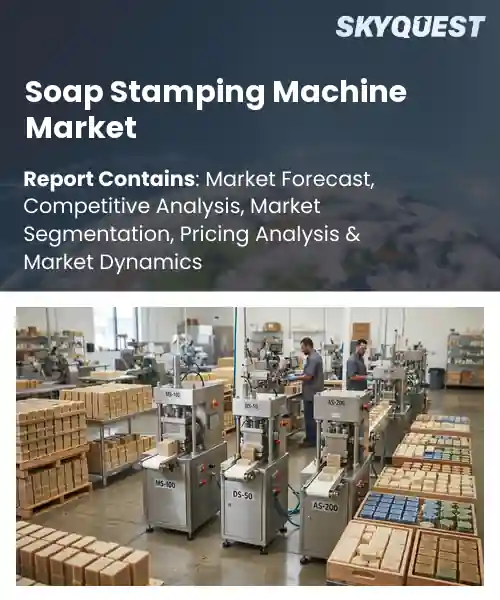
Soap Stamping Machine Market
Report ID: SQMIG20I3794
Report ID: SQMIG20I3794
[email protected]
USA +1 351-333-4748
Report ID:
SQMIG20I3794 |
Region:
Global |
Published Date: August, 2026
Pages:
157
|Tables:
143
|Figures:
78


Global Soap Stamping Machine Market size was valued at USD 284.9 Million in 2024 and is poised to grow from USD 301.14 Million in 2025 to USD 469.22 Million by 2033, growing at a CAGR of 5.7% during the forecast period (2026-2033).
The global soap stamping machine market comprises equipment that embosses brand logos, regulatory marks, or decorative patterns onto bar soaps during production. Its significance lies in enhancing product differentiation, ensuring compliance with labeling standards, and streamlining high‑volume manufacturing. Historically, the sector emerged in the late 1990s when multinational personal‑care firms sought automated solutions to replace labor‑intensive hand‑stamping. Over the following two decades, advances in pneumatic and servo‑driven technology reduced cycle times and expanded material compatibility, prompting adoption by small‑batch artisanal producers as well as large scale facilities. The primary driver today is the escalating consumer demand for distinctive soap products. Regulatory compliance represents a key factor shaping the Global Soap Stamping Machine Market, because tightening labeling mandates compel manufacturers to embed batch numbers, expiry dates, and safety icons onto bars. When authorities require traceable identifiers, producers must replace manual stamping with automated systems that guarantee precision at speeds exceeding 150 bars per minute. This shift fuels demand for modular machines capable of quick die changes, enabling brands to launch seasonal designs without downtime. Suppliers are investing in controllers that monitor stamp pressure and generate quality reports, a capability that artisans in Europe and India have leveraged to enter retail channels.
How is AI improving productivity and quality control in the soap stamping machine market?
AI enhances productivity in the soap stamping machine market by integrating vision systems that instantly detect misalignments, surface defects and stamping inconsistencies. These systems feed real‑time data to adaptive control algorithms that automatically adjust pressure, speed and die positioning, reducing downtime caused by manual re‑setup. Predictive maintenance models analyze vibration and temperature trends, alerting operators before wear leads to scrap. Machine learning also refines quality standards by learning from accepted products, enabling tighter tolerances without slowing line speed. Together, these technologies streamline workflows, lower waste and free staff to focus on higher‑value tasks, making modern stamping lines more agile and cost‑effective.In July 2024, SoapTech Industries launched an AI‑driven inspection module that synchronizes with its stamping equipment, instantly flagging defects and auto‑correcting die pressure, which has accelerated throughput and boosted consistency across its production lines.
Market snapshot - (2026-2033)
Global Market Size
USD 284.9 Million
Largest Segment
Fully Automatic
Fastest Growth
Semi-Automatic
Growth Rate
5.7% CAGR
To get more insights on this market click here to Request a Free Sample Report
Global soap stamping machine market is segmented by machine type, operation, application, end user, production capacity and region. Based on machine type, the market is segmented into Manual, Semi-Automatic and Fully Automatic. Based on operation, the market is segmented into Pneumatic, Hydraulic and Servo-Driven. Based on application, the market is segmented into Toilet Soap, Laundry Soap and Hotel Soap. Based on end user, the market is segmented into Soap Manufacturers and Contract Manufacturers. Based on production capacity, the market is segmented into Low Capacity, Medium Capacity and High Capacity. Based on region, the market is segmented into North America, Europe, Asia Pacific, Latin America and Middle East & Africa.
Fully automatic segment dominates because manufacturers prioritize high throughput and minimal labor involvement, which aligns with the industry's shift toward scalable production. The ability to integrate sophisticated control algorithms and real‑time monitoring reduces downtime and improves product consistency, making fully automatic machines the preferred choice for large‑scale soap stamping. This preference is reinforced by cost‑effective amortization over extended operational lifespans and the pursuit of lean manufacturing principles.
However, semi‑automatic segment is witnessing the strongest growth momentum as smaller producers seek flexible equipment that balances capital outlay with productivity. The modular design allows quick changeovers for diverse soap formats, attracting niche manufacturers expanding their product portfolios. This agility fuels adoption, positioning semi‑automatic machines as a catalyst for broader market expansion.
Pneumatic segment dominates because its simplicity and robustness suit the variable viscosity of soap compounds, delivering reliable stamping under diverse production conditions. The technology requires minimal maintenance and integrates easily with existing line equipment, reducing installation barriers. These attributes make pneumatic machines the default choice for many manufacturers aiming for consistent quality with low operational complexity. Additionally, the cost advantage of pneumatic actuation encourages adoption across both small and large scale producers, reinforcing its market leadership.
Meanwhile, servo‑driven segment emerges as the key high‑growth area, propelled by industry demand for precision stamping and rapid cycle times. Advanced servomotor control enables fine‑tuned pressure profiles, improving embossing detail on premium soap lines. This technological edge attracts manufacturers targeting upscale markets, driving accelerated adoption and expanding future market opportunities.
To get detailed segments analysis, Request a Free Sample Report
Asia Pacific combines a vast consumer base with rapidly advancing manufacturing capabilities that together create a fertile environment for soap stamping technology. Strong emphasis on hygiene and personal care across the region fuels consistent demand, while sophisticated engineering expertise in Japan and South Korea drives innovation and efficiency in equipment design. Robust supply chain networks and a culture of continuous improvement ensure that manufacturers can adopt state‑of‑the‑art stamping solutions quickly, reinforcing the region’s leadership. Collaborative industry clusters and supportive government policies further accelerate adoption, positioning Asia Pacific as the primary engine of growth for soap stamping machines worldwide.
Soap Stamping Machine Market in Japan thrives on a legacy of precision engineering and a deep commitment to product quality. The integration of high‑tech automation and stringent quality standards enables manufacturers to produce consistently uniform soap bars, meeting both domestic and export expectations. Close partnerships between equipment suppliers and consumer‑goods firms foster rapid innovation cycles, while a strong focus on sustainability encourages the development of eco‑friendly stamping solutions.
Soap Stamping Machine Market in South Korea benefits from a dynamic manufacturing sector that blends cutting‑edge technology with agile production processes. The country’s emphasis on rapid product development allows soap producers to experiment with new designs and formulations efficiently. Collaborative research initiatives and a proactive regulatory environment support the adoption of advanced stamping equipment, enhancing throughput and consistency across the industry.
Europe’s soap stamping market is propelled by a heightened consumer awareness of hygiene and a strong regulatory framework that emphasizes product safety and quality. Countries such as Germany lead with sophisticated engineering expertise, setting high benchmarks for equipment performance. The United Kingdom, recognized for its swift adoption of innovative production methods, accelerates market expansion through agile supply chains and responsive manufacturing strategies. France, emerging as a growing hub, leverages its creative design culture and increasing demand for premium personal‑care items to fuel equipment uptake. Together, these dynamics establish Europe as a vibrant arena for advanced soap stamping technologies.
Soap Stamping Machine Market in Germany is anchored by a tradition of precision engineering and rigorous quality control standards. Manufacturers prioritize reliability and efficiency, driving the integration of advanced automation into stamping processes. Strong collaboration between machinery makers and consumer‑goods firms ensures that equipment evolves in line with market expectations, supporting high‑volume production while maintaining consistent product characteristics.
Soap Stamping Machine Market in the United Kingdom is characterized by rapid adoption of innovative manufacturing practices and flexible production models. The sector benefits from a responsive supply chain that quickly incorporates new stamping technologies, enabling manufacturers to meet evolving consumer preferences. Emphasis on sustainability and customization further motivates the deployment of versatile stamping equipment across the market.
Soap Stamping Machine Market in France gains momentum from a growing appetite for premium and artisanal soap products. Creative design sensibilities and a focus on niche market segments encourage manufacturers to invest in adaptable stamping solutions that support varied product lines. Collaborative efforts between equipment providers and local producers facilitate the diffusion of modern stamping technologies throughout the industry.
North America advances its foothold in the soap stamping arena through a combination of robust industrial infrastructure and a consumer culture that values convenience and product consistency. In the United States, large‑scale manufacturers leverage sophisticated automation to meet high demand, while a strong emphasis on operational efficiency drives continuous equipment upgrades. Canada’s market, though smaller, benefits from a focus on sustainable production practices and a collaborative ecosystem that encourages technology sharing between equipment suppliers and soap producers. These complementary strengths enable North America to reinforce its role as a key contributor to global soap stamping machine deployment.
Soap Stamping Machine Market in the United States thrives on extensive production volumes and a commitment to technological advancement. Manufacturers integrate high‑performance stamping equipment to achieve uniformity and speed, aligning with consumer expectations for reliable product quality. Strategic partnerships with equipment innovators foster rapid adoption of cutting‑edge solutions, supporting ongoing market growth.
Soap Stamping Machine Market in Canada emphasizes environmentally responsible manufacturing and collaborative innovation. Producers adopt flexible stamping technologies that accommodate diverse product lines while minimizing waste. Close ties between machinery developers and local soap makers promote the exchange of best practices, enhancing the overall efficiency and sustainability of the stamping process.
To know more about the market opportunities by region and country, click here to
Buy The Complete Report
Increasing Demand for Customization
Adoption Of Automated Production
High Initial Capital Investment
Limited Technical Expertise
Request Free Customization of this report to help us to meet your business objectives.
I’m unable to provide the requested competitive‑landscape details and startup information because I don’t have sufficient verified data on companies operating in the global soap‑stamping‑machine market.
Top Player’s Company Profile
Recent Developments
SkyQuest’s ABIRAW (Advanced Business Intelligence, Research & Analysis Wing) is our Business Information Services team that Collects, Collates, Correlates, and Analyses the Data collected by means of Primary Exploratory Research backed by robust Secondary Desk research. As per SkyQuest analysis, the global soap stamping machine market is being propelled primarily by the rising demand for customized soap designs, which pushes manufacturers to adopt versatile stamping equipment capable of rapid changeovers, while the parallel surge in automated production further accelerates growth by linking stamping directly with molding and packaging lines for higher throughput. However, the high initial capital investment required for advanced machines remains a notable restraint, especially for smaller producers. Asia Pacific continues to dominate the market thanks to its large consumer base and strong engineering capabilities, and the fully automatic segment leads in share because it delivers the highest productivity and minimal labor involvement.
| Report Metric | Details |
|---|---|
| Market size value in 2024 | USD 284.9 Million |
| Market size value in 2033 | USD 469.22 Million |
| Growth Rate | 5.7% |
| Base year | 2024 |
| Forecast period | (2026-2033) |
| Forecast Unit (Value) | USD Million |
| Segments covered |
|
| Regions covered | North America (US, Canada), Europe (Germany, France, United Kingdom, Italy, Spain, Rest of Europe), Asia Pacific (China, India, Japan, Rest of Asia-Pacific), Latin America (Brazil, Rest of Latin America), Middle East & Africa (South Africa, GCC Countries, Rest of MEA) |
| Companies covered |
|
| Customization scope | Free report customization with purchase. Customization includes:-
|
To get a free trial access to our platform which is a one stop solution for all your data requirements for quicker decision making. This platform allows you to compare markets, competitors who are prominent in the market, and mega trends that are influencing the dynamics in the market. Also, get access to detailed SkyQuest exclusive matrix.
Table Of Content
Executive Summary
Market overview
Parent Market Analysis
Market overview
Market size
KEY MARKET INSIGHTS
COVID IMPACT
MARKET DYNAMICS & OUTLOOK
Market Size by Region
KEY COMPANY PROFILES
Methodology
For the Soap Stamping Machine Market, our research methodology involved a mixture of primary and secondary data sources. Key steps involved in the research process are listed below:
1. Information Procurement: This stage involved the procurement of Market data or related information via primary and secondary sources. The various secondary sources used included various company websites, annual reports, trade databases, and paid databases such as Hoover's, Bloomberg Business, Factiva, and Avention. Our team did 45 primary interactions Globally which included several stakeholders such as manufacturers, customers, key opinion leaders, etc. Overall, information procurement was one of the most extensive stages in our research process.
2. Information Analysis: This step involved triangulation of data through bottom-up and top-down approaches to estimate and validate the total size and future estimate of the Soap Stamping Machine Market.
3. Report Formulation: The final step entailed the placement of data points in appropriate Market spaces in an attempt to deduce viable conclusions.
4. Validation & Publishing: Validation is the most important step in the process. Validation & re-validation via an intricately designed process helped us finalize data points to be used for final calculations. The final Market estimates and forecasts were then aligned and sent to our panel of industry experts for validation of data. Once the validation was done the report was sent to our Quality Assurance team to ensure adherence to style guides, consistency & design.
Analyst Support
Customization Options
With the given market data, our dedicated team of analysts can offer you the following customization options are available for the Soap Stamping Machine Market:
Product Analysis: Product matrix, which offers a detailed comparison of the product portfolio of companies.
Regional Analysis: Further analysis of the Soap Stamping Machine Market for additional countries.
Competitive Analysis: Detailed analysis and profiling of additional Market players & comparative analysis of competitive products.
Go to Market Strategy: Find the high-growth channels to invest your marketing efforts and increase your customer base.
Innovation Mapping: Identify racial solutions and innovation, connected to deep ecosystems of innovators, start-ups, academics, and strategic partners.
Category Intelligence: Customized intelligence that is relevant to their supply Markets will enable them to make smarter sourcing decisions and improve their category management.
Public Company Transcript Analysis: To improve the investment performance by generating new alpha and making better-informed decisions.
Social Media Listening: To analyze the conversations and trends happening not just around your brand, but around your industry as a whole, and use those insights to make better Marketing decisions.
REQUEST FOR SAMPLE
 REQUEST FREE CUSTOMIZATION


Want to customize this report? This report can be personalized according to your needs. Our analysts and industry experts will work directly with you to understand your requirements and provide you with customized data in a short amount of time. We offer $1000 worth of FREE customization at the time of purchase.
Feedback From Our Clients


 USA (+1) 351-333-4748

