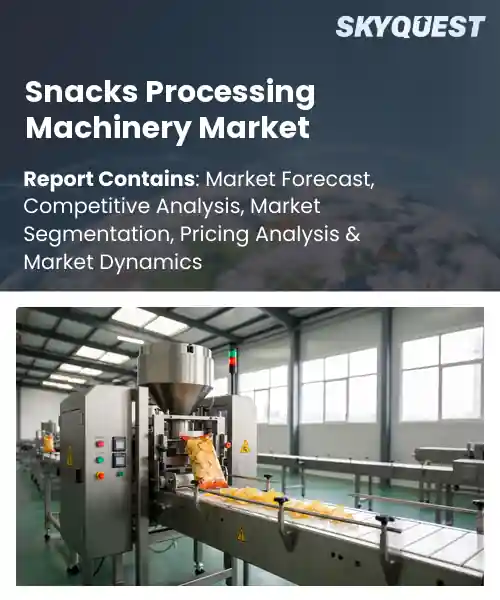
Snacks Processing Machinery Market
Report ID: SQMIG20I3778
Report ID: SQMIG20I3778
[email protected]
USA +1 351-333-4748
Report ID:
SQMIG20I3778 |
Region:
Global |
Published Date: August, 2026
Pages:
157
|Tables:
124
|Figures:
77


Global Snacks Processing Machinery Market size was valued at USD 10.75 Billion in 2024 and is poised to grow from USD 11.63 Billion in 2025 to USD 21.86 Billion by 2033, growing at a CAGR of 8.2% during the forecast period (2026-2033).
Key factor shaping the market is the integration of digital analytics and predictive maintenance, which translates into equipment uptime and operating costs. As manufacturers adopt Industry 4.0 platforms, sensors collect data on torque, vibration and energy consumption, enabling algorithms to forecast component wear before failure occurs. This approach reduces unplanned shutdowns, allowing producers to honor delivery schedules demanded by retailers launching flavors. For example, a European snack firm installed a monitoring suite on its extrusion lines and reported a 15 percent significant decline in downtime, while its ability to switch recipes quickly opened contracts with consumer goods brands seeking seasonal snack innovations.
How are AI and IoT integration transforming the snacks processing machinery market?
AI and IoT are reshaping snacks processing machinery by creating smarter, more adaptable production lines. Sensors now monitor temperature, humidity, and ingredient flow in real time, feeding data to AI algorithms that predict optimal settings and detect anomalies before they cause downtime. This continuous feedback loop enables machines to self‑adjust, reducing waste and improving product consistency. Operators benefit from intuitive dashboards that visualize performance metrics, allowing quick decisions and streamlined maintenance schedules. The integration also supports predictive maintenance, where AI forecasts component wear, scheduling service only when needed, which keeps factories running efficiently and lowers operational costs. As consumer demand for fresh, high‑quality snacks grows, manufacturers are adopting these technologies to stay competitive and meet tighter quality standards.In March 2024, Baker Perkins introduced an AI‑driven extrusion system, demonstrating how intelligent automation can boost throughput while maintaining precise texture control, reinforcing the market’s shift toward data‑centric production.
Market snapshot - (2026-2033)
Global Market Size
USD 10.75 Billion
Largest Segment
Packaging Equipment
Fastest Growth
Drying Equipment
Growth Rate
8.2% CAGR
To get more insights on this market click here to Request a Free Sample Report
Global snacks processing machinery market is segmented by machine type, snack type, automation level, end user and region. Based on machine type, the market is segmented into Mixing & Blending Equipment, Forming Equipment, Frying Equipment, Baking Equipment, Seasoning Equipment, Drying Equipment, Packaging Equipment and Other Processing Equipment. Based on snack type, the market is segmented into Potato Snacks, Extruded Snacks, Nuts & Seeds Snacks, Popcorn, Bakery Snacks and Other Snacks. Based on automation level, the market is segmented into Semi-Automatic and Fully Automatic. Based on end user, the market is segmented into Large Food Manufacturers, Small & Medium Food Processors and Contract Manufacturers. Based on region, the market is segmented into North America, Europe, Asia Pacific, Latin America and Middle East & Africa.
Potato Snacks segment dominates because potatoes remain the most widely consumed base ingredient for savory snack portfolios, anchoring steady demand for dedicated processing lines. The simplicity of slicing, blanching, and frying operations creates a predictable production flow that aligns with cost sensitive manufacturers. Continual enhancements in oil management and texture control reinforce its profitability, prompting firms to prioritize capital allocation toward potato focused machinery to secure market share and operational efficiency.
Meanwhile, Extruded Snacks segment is emerging as the key high growth area as consumer appetites shift toward innovative, shelf stable products with diverse flavors and shapes. Leveraging advances in extrusion technology, manufacturers can create puffed, textured, and nutritionally enriched formats that meet clean label expectations. This rapid product development fuels equipment demand, positioning extruded snack machinery as a primary driver of future market expansion.
Mixing & blending equipment segment dominates because it provides the foundational processing capability that determines product uniformity and texture across a wide range of snack categories. Its versatility allows manufacturers to handle diverse ingredient bases, from simple potato mash to complex extruded blends, fostering efficient scale up. Improvements in shear technology and energy efficiency further cement its central role, making it the preferred investment for processors seeking consistent quality and operational reliability.
However, forming equipment segment is witnessing the strongest growth momentum as manufacturers pursue intricate shapes and portion controlled formats. Advances in high speed extrusion and compression technologies enable rapid mold changes and precise dimensional control, matching consumer demand for novel textures and convenient servings. This innovation pipeline fuels expansion and positions forming equipment as a catalyst for future market diversification.
To get detailed segments analysis, Request a Free Sample Report
North America benefits from a highly integrated supply chain that blends advanced engineering expertise with deep consumer insight. The region’s manufacturers excel in delivering modular, high‑efficiency equipment that meets exacting standards for speed, hygiene, and automation. Strong collaboration between equipment providers and major snack producers fosters continuous innovation, while a mature regulatory environment ensures consistent quality and safety practices. Additionally, the presence of leading research institutions supports rapid adoption of emerging technologies such as digital twins and predictive maintenance, reinforcing the region’s reputation as a benchmark for operational excellence in snack processing.
United States Snacks Processing Machinery Market
Snacks Processing Machinery Market in the United States is characterized by a robust ecosystem of original equipment manufacturers that prioritize customization and rapid deployment. Industry players leverage extensive domestic supplier networks to streamline component sourcing, enabling swift adaptation to shifting product trends. Collaboration with leading confectionery and savory snack brands drives iterative product development, ensuring equipment aligns with evolving consumer preferences for texture and flavor complexity. The market also benefits from a strong focus on sustainability, with manufacturers integrating energy‑efficient designs and waste‑reduction features into new machinery lines.
Canada Snacks Processing Machinery Market
Snacks Processing Machinery Market in Canada emphasizes precision engineering and compliance with stringent food safety standards. Local manufacturers often adopt a collaborative approach with regional snack producers, tailoring equipment to accommodate the unique demands of specialty and premium snack segments. Emphasis on environmentally responsible practices leads to the integration of low‑emission technologies and recyclable material handling systems. The market’s close proximity to major North American supply corridors facilitates efficient logistics, supporting timely delivery and after‑sales service that enhance overall equipment reliability.
Europe’s expansion is propelled by a convergence of culinary tradition, regulatory rigor, and a strong orientation toward sustainable production. The region’s snack manufacturers are keen to adopt flexible, multi‑product machines that accommodate diverse ingredient profiles while maintaining high hygiene standards mandated by European directives. A culture of collaborative innovation among equipment suppliers, research institutes, and food processors accelerates the integration of advanced automation and digital monitoring tools. Additionally, consumer demand for healthier, ethically sourced snack options incentivizes manufacturers to seek machinery capable of precise portion control and energy‑efficient operation, reinforcing Europe’s position as a hub for cutting‑edge snack processing technology.
Germany Snacks Processing Machinery Market
Snacks Processing Machinery Market in Germany stands out for its emphasis on engineering precision and high‑throughput solutions that serve both large‑scale producers and niche artisans. German equipment firms combine rigorous quality controls with modular designs, allowing rapid reconfiguration to meet varied product specifications. Close ties with research universities foster the incorporation of cutting‑edge sensor technologies and AI‑driven analytics, enhancing process optimization and reducing downtime. Sustainability initiatives are deeply embedded, with manufacturers prioritizing low‑energy consumption and waste minimization in their machinery offerings.
United Kingdom Snacks Processing Machinery Market
Snacks Processing Machinery Market in the United Kingdom is emerging as a dynamic arena where innovation meets market agility. British equipment providers focus on developing adaptable, compact machines that cater to the growing number of boutique snack brands and rapid‑turnaround production cycles. Emphasis on digital connectivity enables real‑time monitoring and agile response to shifting consumer trends, particularly in flavored and specialty snack categories. Collaboration with culinary institutes strengthens the ability to integrate novel processing techniques that align with the UK’s evolving taste preferences.
France Snacks Processing Machinery Market
Snacks Processing Machinery Market in France is experiencing swift growth driven by a strong emphasis on artisanal quality and health‑focused product development. French manufacturers prioritize flexible machinery capable of handling diverse doughs, coatings, and shape‑forming processes, supporting the nation’s reputation for premium snack creations. Integration of advanced automation with a focus on preserving flavor integrity appeals to both traditional and innovative snack producers. Environmental stewardship is a key consideration, with equipment designs increasingly incorporating energy‑saving features and recyclable material handling to align with France’s sustainability goals.
Asia Pacific is advancing its role through a blend of rapid industrialization, technology transfer, and a burgeoning consumer base with eclectic snack preferences. The region’s manufacturers are adept at scaling production capacity while embedding smart automation that accommodates high‑speed, low‑cost operations. Strong government support for advanced manufacturing initiatives encourages the adoption of robotics, IoT connectivity, and data‑driven process control. Moreover, the cultural diversity across the region spurs demand for versatile equipment capable of producing a wide array of snack formats, from traditional rice‑based items to contemporary flavor‑infused products, reinforcing Asia Pacific’s growing influence.
Japan Snacks Processing Machinery Market
Snacks Processing Machinery Market in Japan is distinguished by a pursuit of precision and high‑quality standards that reflect the nation’s culinary heritage. Japanese equipment developers focus on compact, high‑efficiency machines that deliver consistent texture and flavor across varied snack lines. Integration of sophisticated sensor arrays and predictive maintenance systems ensures minimal disruption and superior product consistency. Emphasis on sustainability drives the incorporation of low‑energy designs and waste‑reduction mechanisms, aligning with Japan’s broader environmental objectives.
South Korea Snacks Processing Machinery Market
Snacks Processing Machinery Market in South Korea is marked by rapid adoption of innovative automation and a strong orientation toward consumer trends driven by bold flavors and convenience. Korean manufacturers leverage advanced robotics and AI‑enhanced control systems to achieve high‑speed production while maintaining flexibility for product diversification. Close collaboration with snack brands enables swift adaptation to emerging taste profiles, supporting the market’s dynamic growth. Environmental considerations are increasingly prioritized, with equipment featuring energy‑efficient components and strategies for minimizing material waste.
To know more about the market opportunities by region and country, click here to
Buy The Complete Report
Rising Demand for Healthy Snacks
Adoption of Advanced Automation Technologies
High Capital Investment Requirements
Stringent Food Safety Regulations
Request Free Customization of this report to help us to meet your business objectives.
Competition intensifies as major OEMs vie for market share, driving rapid adoption of advanced automation and sustainability features. Leading firms accelerate product differentiation through strategic acquisitions, joint ventures with ingredient suppliers, and integration of AI‑enabled quality control. These moves respond to rising demand for higher‑throughput snack lines and tighter regulatory standards on energy use and waste.
Top Player’s Company Profile
Recent Developments
SkyQuest’s ABIRAW (Advanced Business Intelligence, Research & Analysis Wing) is our Business Information Services team that Collects, Collates, Correlates, and Analyses the Data collected by means of Primary Exploratory Research backed by robust Secondary Desk research.
As per SkyQuest analysis, the global snacks processing machinery market is being propelled primarily by the rising demand for healthier snack options, which pushes manufacturers to invest in flexible, high‑throughput equipment, while the parallel adoption of advanced automation and AI‑driven predictive maintenance serves as a second powerful catalyst by cutting downtime and improving product consistency. North America remains the dominant region, thanks to its integrated supply chain and strong engineering base, and mixing and blending equipment continues to lead the segment hierarchy because it underpins uniformity across all snack categories. However, the steep upfront capital outlay required for cutting‑edge machinery acts as a notable restraint, tempering growth for smaller producers.
| Report Metric | Details |
|---|---|
| Market size value in 2024 | USD 10.75 Billion |
| Market size value in 2033 | USD 21.86 Billion |
| Growth Rate | 8.2% |
| Base year | 2024 |
| Forecast period | (2026-2033) |
| Forecast Unit (Value) | USD Billion |
| Segments covered |
|
| Regions covered | North America (US, Canada), Europe (Germany, France, United Kingdom, Italy, Spain, Rest of Europe), Asia Pacific (China, India, Japan, Rest of Asia-Pacific), Latin America (Brazil, Rest of Latin America), Middle East & Africa (South Africa, GCC Countries, Rest of MEA) |
| Companies covered |
|
| Customization scope | Free report customization with purchase. Customization includes:-
|
To get a free trial access to our platform which is a one stop solution for all your data requirements for quicker decision making. This platform allows you to compare markets, competitors who are prominent in the market, and mega trends that are influencing the dynamics in the market. Also, get access to detailed SkyQuest exclusive matrix.
Table Of Content
Executive Summary
Market overview
Parent Market Analysis
Market overview
Market size
KEY MARKET INSIGHTS
COVID IMPACT
MARKET DYNAMICS & OUTLOOK
Market Size by Region
KEY COMPANY PROFILES
Methodology
For the Snacks Processing Machinery Market, our research methodology involved a mixture of primary and secondary data sources. Key steps involved in the research process are listed below:
1. Information Procurement: This stage involved the procurement of Market data or related information via primary and secondary sources. The various secondary sources used included various company websites, annual reports, trade databases, and paid databases such as Hoover's, Bloomberg Business, Factiva, and Avention. Our team did 45 primary interactions Globally which included several stakeholders such as manufacturers, customers, key opinion leaders, etc. Overall, information procurement was one of the most extensive stages in our research process.
2. Information Analysis: This step involved triangulation of data through bottom-up and top-down approaches to estimate and validate the total size and future estimate of the Snacks Processing Machinery Market.
3. Report Formulation: The final step entailed the placement of data points in appropriate Market spaces in an attempt to deduce viable conclusions.
4. Validation & Publishing: Validation is the most important step in the process. Validation & re-validation via an intricately designed process helped us finalize data points to be used for final calculations. The final Market estimates and forecasts were then aligned and sent to our panel of industry experts for validation of data. Once the validation was done the report was sent to our Quality Assurance team to ensure adherence to style guides, consistency & design.
Analyst Support
Customization Options
With the given market data, our dedicated team of analysts can offer you the following customization options are available for the Snacks Processing Machinery Market:
Product Analysis: Product matrix, which offers a detailed comparison of the product portfolio of companies.
Regional Analysis: Further analysis of the Snacks Processing Machinery Market for additional countries.
Competitive Analysis: Detailed analysis and profiling of additional Market players & comparative analysis of competitive products.
Go to Market Strategy: Find the high-growth channels to invest your marketing efforts and increase your customer base.
Innovation Mapping: Identify racial solutions and innovation, connected to deep ecosystems of innovators, start-ups, academics, and strategic partners.
Category Intelligence: Customized intelligence that is relevant to their supply Markets will enable them to make smarter sourcing decisions and improve their category management.
Public Company Transcript Analysis: To improve the investment performance by generating new alpha and making better-informed decisions.
Social Media Listening: To analyze the conversations and trends happening not just around your brand, but around your industry as a whole, and use those insights to make better Marketing decisions.
REQUEST FOR SAMPLE
 REQUEST FREE CUSTOMIZATION
Global Snacks Processing Machinery Market size was valued at USD 10.75 Billion in 2024 and is poised to grow from USD 11.63 Billion in 2025 to USD 21.86 Billion by 2033, growing at a CAGR of 8.2% during the forecast period (2026-2033).
Competition intensifies as major OEMs vie for market share, driving rapid adoption of advanced automation and sustainability features. Leading firms accelerate product differentiation through strategic acquisitions, joint ventures with ingredient suppliers, and integration of AI‑enabled quality control. These moves respond to rising demand for higher‑throughput snack lines and tighter regulatory standards on energy use and waste. 'GEA Group AG', 'Bühler Holding AG', 'JBT Marel Corporation', 'Heat and Control, Inc.', 'TNA Solutions Pty Ltd.', 'The Middleby Corporation', 'Baker Perkins Limited', 'Reading Bakery Systems', 'Clextral SAS', 'Syntegon Technology GmbH', 'HOSOKAWA MICRON CORPORATION', 'Fritsch GmbH', 'Kaak Group B.V.', 'Kiremko B.V.', 'Meyer Industries, Inc.', 'PPM Technologies Holdings, LLC', 'Schenck Process Holding GmbH', 'IMA Industria Macchine Automatiche S.p.A.', 'Nothum Food Processing Systems', 'AC Horn Manufacturing'
The growing consumer preference for nutritious and low‑calorie snack options is prompting manufacturers to expand production capabilities, which in turn drives demand for advanced processing machinery. Equipment that can handle diverse formulations, maintain product integrity, and operate efficiently under stringent hygiene standards becomes essential. As brands seek to introduce innovative health‑focused lines, they invest in flexible, high‑throughput machines that support rapid changeovers, thereby accelerating market growth for snack processing equipment. These investments also encourage suppliers to develop smarter automation solutions that further enhance productivity and reduce waste.
Sustainable Packaging Integration: Manufacturers are increasingly pairing processing equipment with recyclable and compostable packaging solutions, driven by consumer demand for environmentally responsible snacking options. Machinery vendors respond by offering modular extruders and coating lines that can handle bio-based films without compromising speed or product quality. This alignment reduces waste streams, supports brand sustainability narratives, and creates new service revenue through equipment retrofits and consultancy. The convergence of processing and packaging sustainability accelerates product differentiation and strengthens market positioning for forward‑looking snack producers globally.
Why does North America Dominate the Global Snacks Processing Machinery Market? |@12


Want to customize this report? This report can be personalized according to your needs. Our analysts and industry experts will work directly with you to understand your requirements and provide you with customized data in a short amount of time. We offer $1000 worth of FREE customization at the time of purchase.
Feedback From Our Clients


 USA (+1) 351-333-4748

