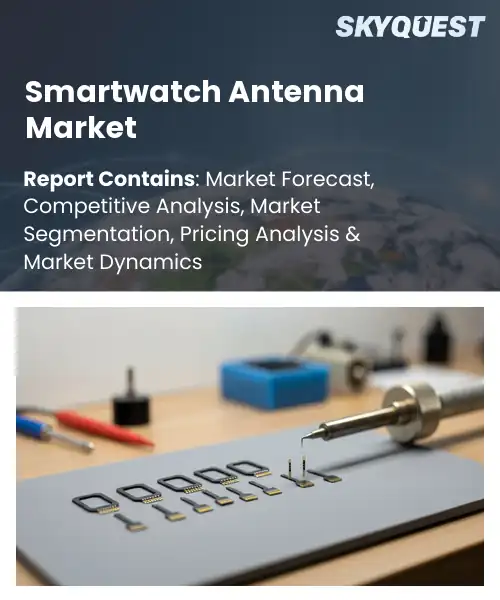
Smartwatch Antenna Market
Report ID: SQMIG45H2168
Report ID: SQMIG45H2168
[email protected]
USA +1 351-333-4748
Report ID:
SQMIG45H2168 |
Region:
Global |
Published Date: March, 2026
Pages:
157
|Tables:
118
|Figures:
77


Global Smartwatch Antenna Market size was valued at USD 5.00 Billion in 2024 and is poised to grow from USD 5.50 Billion in 2025 to USD 11.79 Billion by 2033, growing at a CAGR of 10.0% during the forecast period (2026-2033).
The global smartwatch antenna market growth results from two main factors which include the development of miniaturized RF components together with the increasing market demand for wearable devices, and the ability to operate on multiple frequency bands. The market includes antennas which manufacturers place inside smartwatch models and their associated wristbands for people to access cellular networks and Bluetooth and Wi-Fi, and GNSS connections. It's essential function allows users to monitor their health and track their location and communicate through voice while using a watch-based device.
In addition, the global smartwatch antenna market outlook has transformed during the last ten years from offering basic Bluetooth coils to now presenting advanced multi-technology antennas, that raised the standards for device performance and trustworthiness. The global smartwatch antenna market requires advanced RF front-end technology, which companies use to create antenna systems because their tighter component connections allow to cut insertion loss and increase battery runtime and decrease board space usage. The introduction of multi-band tunable antennas with switchable matching networks by manufacturers will enable carriers to support standalone LTE smartwatches, which will make emergency SOS features operational, thus creating B2B demand for healthcare providers who need remote patient monitoring solutions. The process creates multiple commercial opportunities through which provide extended operational periods together with dependable GPS routes that outdoor fitness trackers can use.
How is IoT Transforming to the Smartwatch Antenna Market?
The IoT system creates a market need for permanent connectivity, which enables continuous access to multiple internet-connected devices with extensive sensor capabilities and processing power located on the device. The main features of the device include its ability to achieve small dimensions and operate on multiple frequencies while maintaining functionality in environments with numerous radio signals. Antenna manufacturers focus on developing new geometries and materials and antenna switching systems which enable them to create compact cases that maintain their original battery capacity. Antenna systems need to evolve because devices require cellular and satellite and local link connectivity for their advanced intelligence functions, which will become standard on upcoming platforms. The design selection process follows real-world situations that involve platform releases and supplier showcases which create a path toward establishing dependable positioning systems together with reliable telemetry systems.
The company Huawei announced a new antenna design for their upcoming running watch in February 2026 that allows for better tracking accuracy when running, while its tracking system operates smoothly even when signals are interrupted. The IoT system creates a market growth opportunity through its sensor fusion technology, which connects devices.
Market snapshot - (2026-2033)
Global Market Size
USD 5.0 Billion
Largest Segment
FPC (Flexible Printed Circuit) Antennas
Fastest Growth
On-Chip/Antenna-in-Package (AiP)
Growth Rate
10.0% CAGR
To get more insights on this market click here to Request a Free Sample Report
The global smartwatch antenna market is segmented by antenna technology, connectivity protocol, material substrate, application tier, and region. Based on antenna technology, the market is categorized into laser direct structuring (LDS) antennas, flexible printed circuit (FPC) antennas, and on-chip or antenna-in-package (AiP) solutions. In terms of connectivity protocol, it includes GNSS/GPS for positioning, Bluetooth and Wi-Fi, cellular connectivity such as LTE and 5G (Sub-6GHz), and NFC for payments and access. By material substrate, the market is divided into ceramic substrates, plastic or polymer composites, and liquid crystal polymer (LCP). Based on application tier, it is segmented into premium or flagship smartwatches, entry-level or budget wearables, and rugged or outdoor specialized devices. Regionally, the market is analyzed across North America, Europe, Asia Pacific, Latin America, and the Middle East & Africa.
As per the global smartwatch antenna market analysis, the LDS (laser direct structuring) antennas segment leads the market through its ability to create three-dimensional conductor paths directly onto molded housings, which enables manufacturers to design compact antenna systems that fit perfectly into smartwatch spaces. The system reduces the requirements for separate antenna modules through its ability to decrease assembly tasks and achieve better, which leads to faster product development times and encourages OEMs to use LDS as their standard material for all thin devices because of its dependable RF performance.
However, the on-chip/antenna-in-package (AiP) segment shows the greatest expansion because designers now require packaged antenna systems to achieve their goals of making systems smaller and their components more compact. The latest semiconductor integration technologies together with modern antenna modeling solutions make AiP an appealing option because it enables companies to reduce assembly operations while their chipsets can support multiple frequency bands in a smaller physical footprint, which results in new small device designs that speed up product development for advanced watches.
According to the global smartwatch antenna market forecast, the bluetooth & Wi-Fi segment leads the market because these two protocols function as essential local data channels, which enable all basic smartwatch operations starting from smartphone tethering and ending with media streaming and app synchronization. The combination of advanced chipset integration with established coexistence systems provides designers a chance to position antennas for optimal performance because it eliminates signal interference problems while maintaining battery life efficiency. The combination of user expectations and engineering simplicity drives sustained adoption of Bluetooth and Wi-Fi antenna designs.
However, the demand for standalone, constantly connected watches drives the growth of cellular (LTE/5G Sub-6GHz) as the fastest growing segment because the network technology infrastructure continues to evolve. Manufacturers will activate strong cellular antennas because eSIM adoption combined with enhanced RF front-end technology, which adds operational difficulty, creates chances for developing advanced tuning systems and modular antenna frameworks plus new premium applications, which will expand market reach.
To get detailed segments analysis, Request a Free Sample Report
As per the smartwatch antenna market regional forecast, the electronics ecosystem of Asia Pacific operates through a comprehensive network of industrial links which connects component manufacturing with precision production and consumer electronics design work. Regional supply chains allow antenna specialists to work closely with device OEMs, which helps them develop compact multi-band antenna designs for wearables. Organizations maintain an innovative culture which develops new materials and miniaturization techniques and electromagnetic testing methods to create antenna designs that fulfill strict aesthetic and performance specifications. Domestic consumer electronics brands maintain their demand for antenna research, which results in companies creating custom antenna solutions. The combination of export-friendly policies which aid high-tech exports and low-cost manufacturing with local testing facilities generates a competitive environment which allows businesses to develop advanced antenna technologies at both small-scale operations and full-scale production.
The Japanese smartwatch antenna industry benefits from top tier combined with an established electronics supply chain which delivers dependable performance and product excellence. The research field of materials science creates close connections with antenna design work which produces compact radiating elements that perform well in advanced wearable technology. The development of solutions which combine performance with aesthetic design for high-end users depends on electromagnetic compatibility assessment, dedicated testing facilities, and the joint work of component makers with high-end device manufacturers.
The smartwatch antenna sector in South Korea operates within a dynamic environment which centers on semiconductor development and mobile device production while delivering excellent connectivity and effective product development. Antenna subsystem design results in optimized systems for compact wearables through the combined work of chipset developers, antenna designers, and device manufacturers. The combination of network compatibility requirements with advanced wireless specifications and strong industrial design capabilities creates new flexible embedded antenna designs for both standard and high-end wearable products.
North America experiences the smartwatch antenna market penetration because of two main factors which include increasing demand for connected wearable devices and an active innovation ecosystem that contains chipset developers and specialized design houses and system integrators. The development of compact multi-band antennas occurs because enterprises need antennas which function well across different situations while health monitoring requirements drive the need for such antennas. The startup community works with established technology companies to develop new antenna miniaturization and integration techniques through their partnerships with testing laboratories and certification organizations. The combination of strong intellectual property systems with advanced testing capabilities allows businesses to create and commercialize their products at a fast pace. The region strengthens its position as the leading provider of premium smartwatch antenna solutions through its cross-border collaborations and manufacturing partnerships that focus on creating custom products.
The smartwatch antenna market trends in United States operates through an ecosystem which includes chipset developers and wearable manufacturers and research institutions that specialize in advanced connectivity solutions. The design houses together with testing facilities to enable fast development of new antenna designs which suit small devices and their complicated radio frequency environments. The three market segments from health tech, enterprise, and premium consumer products create demand for antenna solutions which deliver reliable connectivity while supporting multiple device types in crowded spectrum situations.
The smartwatch antenna market share in Canada develops antenna requirements through its applied health technology research partnerships which operate together with research organizations. The relationship between local design firms and international manufacturers enables small companies to create specialized antennas which meet exacting performance standards. Organizations ensure that their antenna modules meet both consumer and clinical wearable requirements through its quality assurance processes and testing access and skilled engineering staff.
Europe establishes its position through advanced engineering capabilities and unified regulatory systems, and its research projects that focus on interoperability and spectrum efficiency for wearable devices. The precision component manufacturing process and system level testing capabilities of regional manufacturers enable them to produce antennas which fulfill both industrial and consumer product quality requirements. The automotive and healthcare and fashion industries work together to develop new product designs and integration methods which create hybrid solutions. Supply chain diversification and sustainable manufacturing investments strengthen the organization's ability to withstand challenges. European design standards combined with robust intellectual property protection systems enable businesses to sell antenna products which attract both local and international wearable technology brands.
The German smartwatch antenna market benefits from precision engineering which establishes dependable testing infrastructure to guarantee product reliability and regulatory compliance. Antenna specialists work together with automotive and industrial partners to develop performance standards and miniaturization methods through their research efforts. The process of making antenna modules through operational excellence processes results in products which meet the exacting standards required for high-end wearable technology.
The United Kingdom smartwatch antenna market features design and innovation centers which combine industrial design with modern RF engineering to develop new products. The academic research centers and startup ecosystem create an environment which supports the development of experimental antenna designs and quick prototype testing. The market for health applications and user experience drives the development of custom antenna solutions which work with different types of wearables and their operational systems.
The smartwatch antenna market in France utilizes device designs that prioritize aesthetics and telecommunications research to create antennas which achieve both visual appeal and practical performance. The system integrators and fashion device designers and telecom research institutions work together to develop new methods for embedding technology and designing systems that monitor spectrum usage. The development of antennas for premium and lifestyle wearables requires regulatory compliance and craftsmanship standards which need to be maintained at high quality levels.
To know more about the market opportunities by region and country, click here to
Buy The Complete Report
Advancements In Wearable Health Monitoring
Integration With Advanced Connectivity Standards
Design And Size Constraints
Regulatory Compliance And EMF Limits
Request Free Customization of this report to help us to meet your business objectives.
The global smartwatch antenna market shows intense competition because companies compete to develop smaller products which support multiple frequency bands while winning original equipment manufacturer design contracts. Novocomms actively seeks manufacturing partnerships and capacity enhancement while chipset and RF module manufacturers launched integrated antenna products to enable their customers to create wearable systems with reduced product development cycles.
SkyQuest’s ABIRAW (Advanced Business Intelligence, Research & Analysis Wing) is our Business Information Services team that Collects, Collates, Correlates, and Analyses the Data collected by means of Primary Exploratory Research backed by robust Secondary Desk research.
As per SkyQuest analysis, the global smartwatch antenna market is being driven by the convergence of miniaturized RF components and rising consumer demand for always-connected wearables, with a key driver being manufacturers' push for multi-band, tunable antennas to support richer services. The second demand driver stems from IoT applications which require continuous network access and need smaller devices that function well in areas with high RF radio frequency activity. The designing process faces a major challenge because design limits and size restrictions result in decreased radiation efficacy while making integration work more complicated. Asia Pacific controls the market because it has both a complete electronics production system and a large manufacturing capacity. At the same time, LDS antennas dominate because they enable compact smartwatch designs to use three-dimensional space-efficient integration.
| Report Metric | Details |
|---|---|
| Market size value in 2024 | USD 5.0 Billion |
| Market size value in 2033 | USD 11.79 Billion |
| Growth Rate | 10.0% |
| Base year | 2024 |
| Forecast period | (2026-2033) |
| Forecast Unit (Value) | USD Billion |
| Segments covered |
|
| Regions covered | North America (US, Canada), Europe (Germany, France, United Kingdom, Italy, Spain, Rest of Europe), Asia Pacific (China, India, Japan, Rest of Asia-Pacific), Latin America (Brazil, Rest of Latin America), Middle East & Africa (South Africa, GCC Countries, Rest of MEA) |
| Companies covered |
|
| Customization scope | Free report customization with purchase. Customization includes:-
|
To get a free trial access to our platform which is a one stop solution for all your data requirements for quicker decision making. This platform allows you to compare markets, competitors who are prominent in the market, and mega trends that are influencing the dynamics in the market. Also, get access to detailed SkyQuest exclusive matrix.
Table Of Content
Executive Summary
Market overview
Parent Market Analysis
Market overview
Market size
KEY MARKET INSIGHTS
COVID IMPACT
MARKET DYNAMICS & OUTLOOK
Market Size by Region
KEY COMPANY PROFILES
Methodology
For the Smartwatch Antenna Market, our research methodology involved a mixture of primary and secondary data sources. Key steps involved in the research process are listed below:
1. Information Procurement: This stage involved the procurement of Market data or related information via primary and secondary sources. The various secondary sources used included various company websites, annual reports, trade databases, and paid databases such as Hoover's, Bloomberg Business, Factiva, and Avention. Our team did 45 primary interactions Globally which included several stakeholders such as manufacturers, customers, key opinion leaders, etc. Overall, information procurement was one of the most extensive stages in our research process.
2. Information Analysis: This step involved triangulation of data through bottom-up and top-down approaches to estimate and validate the total size and future estimate of the Smartwatch Antenna Market.
3. Report Formulation: The final step entailed the placement of data points in appropriate Market spaces in an attempt to deduce viable conclusions.
4. Validation & Publishing: Validation is the most important step in the process. Validation & re-validation via an intricately designed process helped us finalize data points to be used for final calculations. The final Market estimates and forecasts were then aligned and sent to our panel of industry experts for validation of data. Once the validation was done the report was sent to our Quality Assurance team to ensure adherence to style guides, consistency & design.
Analyst Support
Customization Options
With the given market data, our dedicated team of analysts can offer you the following customization options are available for the Smartwatch Antenna Market:
Product Analysis: Product matrix, which offers a detailed comparison of the product portfolio of companies.
Regional Analysis: Further analysis of the Smartwatch Antenna Market for additional countries.
Competitive Analysis: Detailed analysis and profiling of additional Market players & comparative analysis of competitive products.
Go to Market Strategy: Find the high-growth channels to invest your marketing efforts and increase your customer base.
Innovation Mapping: Identify racial solutions and innovation, connected to deep ecosystems of innovators, start-ups, academics, and strategic partners.
Category Intelligence: Customized intelligence that is relevant to their supply Markets will enable them to make smarter sourcing decisions and improve their category management.
Public Company Transcript Analysis: To improve the investment performance by generating new alpha and making better-informed decisions.
Social Media Listening: To analyze the conversations and trends happening not just around your brand, but around your industry as a whole, and use those insights to make better Marketing decisions.
REQUEST FOR SAMPLE
 REQUEST FREE CUSTOMIZATION
Global Smartwatch Antenna Market size was valued at USD 5.0 Billion in 2024 and is poised to grow from USD 5.5 Billion in 2025 to USD 11.79 Billion by 2033, growing at a CAGR of 10.0% during the forecast period (2026-2033).
Competitive rivalry in the global smartwatch antenna market centres on miniaturization, multi band integration and OEM design wins, driving firms to deploy M&A, supply partnerships and rapid RF innovation. For example Novocomms has publicly pursued strategic manufacturer partnerships and capacity expansion, while major chipset and RF module vendors have introduced integrated antenna modules to secure wearable system design slots and shorten time to market. 'Qualcomm', 'Broadcom', 'Molex', 'Amphenol', 'Skyworks Solutions', 'Laird Connectivity', 'Texas Instruments', 'Panasonic', 'RF Micro Devices', 'Antenova', 'Rohde & Schwarz', 'Airoha Technology', 'u-blox', 'Huber+Suhner', 'Celestica', 'Würth Elektronik', 'Shenzhen Sunway Communication', 'SiTIncrement', 'Ethertronics', 'EM Microelectronic'
Advancements in wearable health monitoring have increased expectations for continuous, reliable wireless connectivity, prompting smartwatch designers to integrate more sophisticated antenna solutions that ensure stable signal reception in compact form factors. Antenna manufacturers respond by refining designs to meet tighter space constraints while maintaining performance, enabling improved data transmission and sensor interoperability. This demand for compact, high performance antennas stimulates research and collaboration among suppliers and device makers, accelerating adoption of innovative materials and integration techniques that support market expansion.
Health Integration Focus: Smartwatch antennas are evolving to support richer biometric and medical sensors, enabling seamless, low-interference connectivity between on-board modules and external health networks. Manufacturers prioritize antenna solutions that facilitate continuous data streams, secure transmission, and coexistence with heart rate, ECG, and oxygen saturation sensing subsystems. This trend emphasizes collaborative design with sensor OEMs, user comfort, and reliable signal fidelity in diverse wear conditions, unlocking premium health monitoring services and closer integration with clinical and wellness ecosystems and remote care pathways for consumers.
Why does Asia Pacific Dominate the Global Smartwatch Antenna Market? |@12


Want to customize this report? This report can be personalized according to your needs. Our analysts and industry experts will work directly with you to understand your requirements and provide you with customized data in a short amount of time. We offer $1000 worth of FREE customization at the time of purchase.
Feedback From Our Clients


 USA (+1) 351-333-4748

