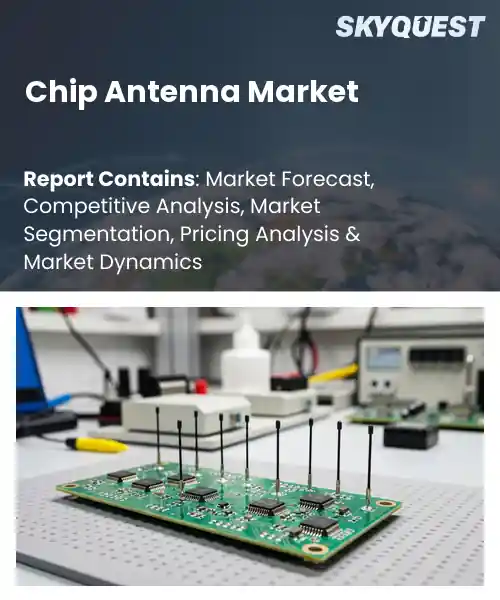
Chip Antenna Market
Report ID: SQMIG45K2279
Report ID: SQMIG45K2279
[email protected]
USA +1 351-333-4748
Report ID:
SQMIG45K2279 |
Region:
Global |
Published Date: June, 2026
Pages:
157
|Tables:
121
|Figures:
72


Global Chip Antenna Market size was valued at USD 1.52 Billion in 2024 and is poised to grow from USD 1.68 Billion in 2025 to USD 3.82 Billion by 2033, growing at a CAGR of 10.72% during the forecast period (2026-2033).
Compact and pre-manufactured chip antenna market trends were developed to provide wireless communications where space is limited (for example, inside many electronic products), and this market has grown as the market for wireless functionality in consumer electronics, industrial equipment and automotive continues to grow. Chip antennas play an important role by providing reliable RF Performance, particularly when the boards don’t have enough space available for large antennas. This is especially relevant to designers of products that need to operate on multiple bands and with an even tighter form factor than before. The evolution from wire and PCB antennas to ceramic and printed chip antennas has taken place as a result of miniaturization of products and advances in the material sciences, particularly when the demand for small, repeatable antennas from smartphones and wearables are taken into consideration, globally.
In addition to this, the need for multiple bands and protocols to be integrated into devices that have limited housing (such as true wireless earbuds), is a key driver in the global chip antenna market growth, and provides opportunities for manufacturers of tunable antennas. The growth of volumes from automotive telematics and IoT applications has opened up opportunities to deliver high-margin, custom-designed antenna products, as well as provide opportunities for antenna package integration, particularly in the Asia Pacific region.
How is IoT Driving Demand in the Global Chip Antenna Market?
Chip antennas are compact surface mount radiators designed to save board space while providing wireless connectivity in constrained IoT products. Key aspects are small form factor, board dependent performance, and tuning for Bluetooth Wi Fi GNSS and sub gigahertz bands. The market today is shaped by rising adoption of connected sensors trackers and wearables that need low power multi band antennas that fit tight enclosures. That drives demand for higher efficiency materials embedded ceramic designs and better vendor support to reduce integration risk. Examples include LTCC chip antennas and stacked patch elements used in compact IoT modules.
Taoglas February 2026, introduced an AI driven antenna product recommendation engine to speed selection and tuning for compact IoT designs. The tool shortens development cycles and improves antenna match in tight layouts allowing device makers to deliver more reliable connected sensors and wearables with less rework.
Market snapshot - (2026-2033)
Global Market Size
USD 1.52 Billion
Largest Segment
Internal Chip Antennas
Fastest Growth
Internal Chip Antennas
Growth Rate
10.72% CAGR
To get more insights on this market click here to Request a Free Sample Report
Global chip antenna market is segmented by type, frequency, application, connectivity standard and region. Based on type, the market is segmented into internal chip antennas and external chip antennas. Based on frequency, the market is segmented into sub-GHz, 2.4 GHz, 5 GHz and multi-band. Based on application, the market is segmented into consumer electronics, IoT devices, automotive, industrial and medical. Based on connectivity standard, the market is segmented into Wi-Fi, Bluetooth, GPS, 5G/LTE and RFID. Based on region, the market is segmented into North America, Europe, Asia Pacific, Latin America and Middle East & Africa.
The internal chip antennas segment is the largest segment because they have low profiles and form factors that make them easy to integrate into small spaces for IoT devices. Thus, they reduce the amount of board space and complexity in assembly for manufacturers. Therefore, OEMs prefer internal units as they allow for cost savings, provide aesthetic parity, and help create standardized designs with a tighter supply chain relationship. As they provide stable and reliable performance in a controlled environment and a manufacturing-ready footprint, the use of internal chip antennas is accelerating, leading antenna design practices to converge upon internal chip antennas and bolstering their procurement and validation pipeline.
However, external chip antennas (ECAs) are now the fastest growing segment of chip antennas as manufacturers seek ways to produce higher-gain antennas that can be tuned in the field and give manufacturers more flexibility to retrofit or upgrade their system. Their modular design allows manufacturers to upgrade or retrofit antennas using new designs for multiple frequency bands, which opens up fresh retrofit markets to manufacturers.
The growing need for reliable high-speed data transfer over Wi-Fi networks among both consumers and businesses, there is significant focus on optimizing and integrating antenna designs for Wi-Fi chipset manufacturers. Wi-Fi chip antenna design has established performance requirements, ranging from standards that save time in design and development to certification pathways that allow manufacturers to create standardized designs for consistency and compatibility. The concentration of design engineering and supply chain alignment focuses on retaining market share and continually enhancing antenna characteristics.
In contrast, Bluetooth has the potential to be the fastest-growing area of connectivity due to the integration of the low-power mode of operation, enabling successful integration of Bluetooth technology into wearable devices and smart products; therefore there is a need for miniaturizing antennas, as well as size-efficient solutions. The development of more efficient Bluetooth protocols and the increasing ability to develop applications on various platforms increases demand for customized chip antenna products/variants that create easy design wins and after-market opportunities.
To get detailed segments analysis, Request a Free Sample Report
The chip antenna market is driven by the large number of electronics manufacturers in the Asia Pacific region and the corresponding supplier networks and the overall consumption of these antennas in both consumer electronics and industrial markets. The established supply chain of components that exist, the level of cooperation between module manufacturers and device manufacturers and the innovation in designing smaller antennas all provide for a shortened cycle time for product development. The high volume of manufacturing operations, the availability of local testing facilities, a quick ramp up for large volume sales. Collaborative industry-academia programs and specialized contract manufacturers offer further refinement and cost reduction of product development. Furthermore, the regional proximity to very large contract electronic manufacturers and the high concentration of wireless device manufacturing facilities provide continued demand for advanced chip antennas in a wide range of applications. Ongoing local investment into research & development and through actively participating in local standards development organizations further improve interoperability and accelerate market acceptance, thus extending the competitive advantage held by the Asia Pacific region.
Chip antenna market analysis in Japan benefits from advanced semiconductor design capabilities, proximity to precision component suppliers, and strong culture of miniaturization. Close collaboration between system integrators and antenna designers yields solutions tailored for compact devices and specialized industrial equipment. Established testing infrastructure and rigorous quality standards support high-reliability deployments. Demand from premium consumer and automotive electronics stimulates iterative product refinement, positioning Japan as a key hub for chip antenna innovation.
Chip antenna market forecast in South Korea is driven by strong integration between mobile OEMs, semiconductor foundries, and design houses focused on compact wireless solutions. Emphasis on high-frequency performance and multi-band compatibility aligns with advanced device roadmaps. Local contract manufacturers and testing laboratories enable prototyping cycles. Close cooperation with system integrators and automotive electronics suppliers accelerates deployment in mobility and consumer segments, reinforcing South Korea role in regional supply chains.
North America's expansion is being propelled by three key drivers the growth of advanced electronic design activity; the robust regional demand for end products, and a strategic emphasis on sourcing components from North America. Rapidly advancing research & development institutions, along with specialized design organizations, help accelerate the development of unique antenna topologies that are specifically tailored to fit compact multi-band devices. System integrators and OEM's are actively engaged with suppliers during the product development cycle allowing for shorter development cycles and increased opportunities for customization. The regulatory focus on secure and resilient communications is prompting many entities to actively pursue qualified components throughout their business process. Numerous companies within North America are now placing a greater emphasis on onshore manufacturing, and diversifying their supply chains to produce locally and perform their testing locally. Newly funded companies seeking to create innovative technologies, as well as collaborative ecosystems, continue to spur innovation, while being closely related to the wireless service provider and device manufacturer communities support real-world validation and chip antenna solution adoption across multiple types of applications.
Chip antenna market penetration in United States benefits from deep research institutions, defense and aerospace demand, and a startup community focused on RF innovation. Strong ties between OEMs, system integrators, and specialized contract manufacturers enable rapid prototyping and customization for specialized applications. Emphasis on component qualification and secure communications supports adoption in critical systems. Collaboration with wireless service providers and testing laboratories accelerates field validation for automotive, industrial, and consumer portfolios.
Chip antenna market regional outlook in Canada is anchored by applied research capabilities, precision manufacturing, and partnerships between design firms and industrial OEMs. Emphasis on connected vehicle systems, remote monitoring solutions, and industrial wireless applications drives demand for specialized antenna form factors. Local testing facilities and collaboration with North American supply chain partners support qualification and integration. A stable regulatory environment and supportive innovation programs further encourage pilot deployments and scalable manufacturing.
The chip antenna sector in Europe is advancing with the support of engineered technology and an established ecosystem in the automotive and industrial industries. OEMs, and other precision parts suppliers are supporting these types of antennas through their request for high reliability, application-specific antennas for their applications. Cross-industry consortia working on R&D and technology clusters encourage the rapid development of prototype and test methodology across borders. The emphasis placed on interoperability and electromagnetic compatibility continues to support deployment across multiple markets. In addition to supporting custom-designed antennas for niche industries and vehicular applications through investment in flexible manufacturing processes and small-batch manufacturing, there are regulatory frameworks that support robust communications between critical infrastructure and connected mobility, supporting qualification of the component. Testing labs and local design houses work with telecom service providers to verify antenna performance in a live condition when connected to the network; meanwhile, sustainability goals create opportunities for improving materials and manufacturing. The combination of these cooperative efforts helps to create a competitive advantage for European manufacturers and encourages adoption throughout automotive, industrial, and smart city applications.
Chip antenna market regional forecast in Germany benefits from a strong automotive supply base, engineering firms, and expertise in high-reliability components. Collaboration between OEMs, tier suppliers, and specialized antenna designers supports tailored solutions for vehicular and industrial communications. Robust testing infrastructure and adherence to electromagnetic compatibility standards ensure dependable integration. Focus on integration with vehicle systems and industrial automation drives iterative refinement, positioning Germany as source of high-quality, application-specific chip antenna solutions.
Chip antenna industry in United Kingdom leverages strong wireless design expertise, active telecom research centers, and startup ecosystem exploring RF topologies. Collaboration with defense, maritime, and connectivity projects provides validation opportunities for compact antenna solutions. Flexible prototyping services and testing laboratories support rapid iteration and compliance. Emphasis on customization for dense deployments and specialized industrial use cases, effectively positions United Kingdom as an innovation-focused market for chip antenna application development.
Chip antenna industry trends in France is supported by strong aerospace and industrial electronics sectors, materials expertise, and research institutes. Partnership between system integrators, antenna designers, and testing centers facilitates development of robust solutions. Emphasis on certification and compliance for demanding applications bolsters confidence among OEMs. A mix of suppliers and design firms enables tailored antenna solutions for vehicular, industrial, and aviation use cases, reinforcing France position in regional supply networks.
To know more about the market opportunities by region and country, click here to
Buy The Complete Report
Miniaturization In Electronic Devices
Rising IoT and Wearable Adoption
Performance Limitations At High Frequencies
Supply Chain and Material Constraints
Request Free Customization of this report to help us to meet your business objectives.
Competitive landscape in the global chip antenna market centers on rapid miniaturization and IoT adoption, driving direct innovation and strategic consolidation. Tier one component makers pursue acquisitions to add antenna subsystems, while specialist startups secure partnerships and investor backing to commercialize novel antenna boosters and phased arrays, for example Gilat’s acquisition of Stellar Blu, Telesat’s investment in Farcast, and Ignion’s virtual antenna technology.
Top Player’s Company Profile
Recent Developments in the Chip Antenna Market
SkyQuest’s ABIRAW (Advanced Business Intelligence, Research & Analysis Wing) is our Business Information Services team that Collects, Collates, Correlates, and Analyses the Data collected by means of Primary Exploratory Research backed by robust Secondary Desk research. As per SkyQuest analysis, the global chip antenna market is being driven primarily by accelerating demand for multi-band, multi-protocol connectivity in ever more compact devices and further supported by rising IoT and wearable adoption, which together push suppliers toward tunable, high-efficiency designs. Internal chip antennas lead the market due to their low profile and integration-friendly form factor, while Asia Pacific dominates thanks to dense electronics manufacturing and strong supplier ecosystems. However, adoption faces restraint from performance limitations at higher frequencies that can require iterative tuning and custom matching. Overall, opportunities center on materials innovation, AI-aided selection tools and closer OEM-vendor collaboration to reduce integration risk and speed time to market.
| Report Metric | Details |
|---|---|
| Market size value in 2024 | USD 1.52 Billion |
| Market size value in 2033 | USD 3.82 Billion |
| Growth Rate | 10.72% |
| Base year | 2024 |
| Forecast period | (2026-2033) |
| Forecast Unit (Value) | USD Billion |
| Segments covered |
|
| Regions covered | North America (US, Canada), Europe (Germany, France, United Kingdom, Italy, Spain, Rest of Europe), Asia Pacific (China, India, Japan, Rest of Asia-Pacific), Latin America (Brazil, Rest of Latin America), Middle East & Africa (South Africa, GCC Countries, Rest of MEA) |
| Companies covered |
|
| Customization scope | Free report customization with purchase. Customization includes:-
|
To get a free trial access to our platform which is a one stop solution for all your data requirements for quicker decision making. This platform allows you to compare markets, competitors who are prominent in the market, and mega trends that are influencing the dynamics in the market. Also, get access to detailed SkyQuest exclusive matrix.
Table Of Content
Executive Summary
Market overview
Parent Market Analysis
Market overview
Market size
KEY MARKET INSIGHTS
COVID IMPACT
MARKET DYNAMICS & OUTLOOK
Market Size by Region
KEY COMPANY PROFILES
Methodology
For the Chip Antenna Market, our research methodology involved a mixture of primary and secondary data sources. Key steps involved in the research process are listed below:
1. Information Procurement: This stage involved the procurement of Market data or related information via primary and secondary sources. The various secondary sources used included various company websites, annual reports, trade databases, and paid databases such as Hoover's, Bloomberg Business, Factiva, and Avention. Our team did 45 primary interactions Globally which included several stakeholders such as manufacturers, customers, key opinion leaders, etc. Overall, information procurement was one of the most extensive stages in our research process.
2. Information Analysis: This step involved triangulation of data through bottom-up and top-down approaches to estimate and validate the total size and future estimate of the Chip Antenna Market.
3. Report Formulation: The final step entailed the placement of data points in appropriate Market spaces in an attempt to deduce viable conclusions.
4. Validation & Publishing: Validation is the most important step in the process. Validation & re-validation via an intricately designed process helped us finalize data points to be used for final calculations. The final Market estimates and forecasts were then aligned and sent to our panel of industry experts for validation of data. Once the validation was done the report was sent to our Quality Assurance team to ensure adherence to style guides, consistency & design.
Analyst Support
Customization Options
With the given market data, our dedicated team of analysts can offer you the following customization options are available for the Chip Antenna Market:
Product Analysis: Product matrix, which offers a detailed comparison of the product portfolio of companies.
Regional Analysis: Further analysis of the Chip Antenna Market for additional countries.
Competitive Analysis: Detailed analysis and profiling of additional Market players & comparative analysis of competitive products.
Go to Market Strategy: Find the high-growth channels to invest your marketing efforts and increase your customer base.
Innovation Mapping: Identify racial solutions and innovation, connected to deep ecosystems of innovators, start-ups, academics, and strategic partners.
Category Intelligence: Customized intelligence that is relevant to their supply Markets will enable them to make smarter sourcing decisions and improve their category management.
Public Company Transcript Analysis: To improve the investment performance by generating new alpha and making better-informed decisions.
Social Media Listening: To analyze the conversations and trends happening not just around your brand, but around your industry as a whole, and use those insights to make better Marketing decisions.
REQUEST FOR SAMPLE
 REQUEST FREE CUSTOMIZATION
Global Chip Antenna Market size was valued at USD 1.52 Billion in 2024 and is poised to grow from USD 1.68 Billion in 2025 to USD 3.82 Billion by 2033, growing at a CAGR of 10.72% during the forecast period (2026-2033).
Competitive landscape in the global chip antenna market centers on rapid miniaturization and IoT adoption, driving direct innovation and strategic consolidation. Tier one component makers pursue acquisitions to add antenna subsystems, while specialist startups secure partnerships and investor backing to commercialize novel antenna boosters and phased arrays, for example Gilat’s acquisition of Stellar Blu, Telesat’s investment in Farcast, and Ignion’s virtual antenna technology. 'Murata Manufacturing', 'TDK Corporation', 'Molex LLC (Koch)', 'Taoglas', 'Fractus Antennas', 'TE Connectivity', 'Pulse Electronics (YAGEO)', 'Antenova Ltd.', 'Linx Technologies', 'Ethertronics (AVX)', 'Abracon LLC', 'Galtronics (Baylin Technologies)', 'CTS Corporation', 'Vishay Intertechnology', 'Kyocera AVX Components'
Chip antennas enable significant size reduction in device radio front ends, allowing manufacturers to integrate reliable RF functionality into increasingly compact products. Their small footprint and predictable performance simplify enclosure and PCB design, reduce the need for external matching components, and facilitate placement in constrained spaces such as wearables and IoT modules. This alignment with miniaturization priorities shortens development cycles, lowers product integration complexity, and encourages designers to choose chip antennas to meet consumer demand for slimmer, multifunctional devices with consistent wireless connectivity.
Iot Integration And Ecosystems: Chip antennas are increasingly designed to integrate seamlessly into IoT ecosystems, enabling simplified module-level connectivity and deployment. Manufacturers prioritize compatibility with diverse communication stacks and form factors, facilitating third-party module certification and ecosystem partnerships. This trend drives emphasis on software-defined tuning, certification-friendly footprints, and collaboration between antenna vendors and platform providers to streamline integration. As the ecosystem model matures, chip antennas that offer predictable performance across device architectures gain preference, accelerating adoption in smart home, industrial and consumer IoT segments.
Why does Asia Pacific Dominate the Global Chip Antenna Market? |@12


Want to customize this report? This report can be personalized according to your needs. Our analysts and industry experts will work directly with you to understand your requirements and provide you with customized data in a short amount of time. We offer $1000 worth of FREE customization at the time of purchase.
Feedback From Our Clients


 USA (+1) 351-333-4748

