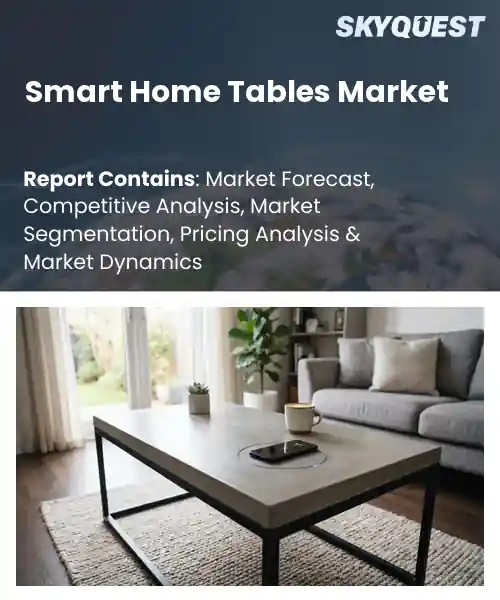
Smart Home Tables Market
Report ID: SQMIG25F2171
Report ID: SQMIG25F2171
[email protected]
USA +1 351-333-4748
Report ID:
SQMIG25F2171 |
Region:
Global |
Published Date: November, 2026
Pages:
157
|Tables:
146
|Figures:
78


Global Smart Home Tables Market size was valued at USD 450.0 Million in 2024 and is poised to grow from USD 506.25 Million in 2025 to USD 1298.93 Million by 2033, growing at a CAGR of 12.5% during the forecast period (2026-2033).
Smart home tables represent an emerging niche that blends furniture with integrated interfaces, voice assistants, and IoT connectivity. Their importance lies in converting a central household surface into a command hub for lighting, climate, entertainment, and security systems, thereby simplifying daily routines. The market originated in the early 2010s as manufacturers embedded Wi‑Fi modules and touchscreens into coffee and dining tables, initially targeting affluent consumers seeking automation. Adoption accelerated after 2018 when major smart‑speaker ecosystems opened APIs, enabling developers to create dashboards. Consequently, sales have shifted from niche boutique brands to mainstream retailers, illustrating an evolution from novelty to staple. The growth catalyst for the smart home tables market is the convergence of entertainment demand and remote‑work trends, which pushes households to seek surfaces that combine computing, charging, and collaboration. As companies such as IKEA and Samsung embed 5G‑enabled displays and microphones, consumers can stream video, join conferences, and control devices without leaving their seats. This capability creates a loop: user engagement encourages developers to add productivity apps, raising the furniture’s perceived value and encouraging retailers to expand distribution. Consequently, investment in modular design and subscription content services becomes a lucrative opportunity for manufacturers targeting a share of the ecosystem.
How is AI and IoT integration driving growth in the smart home tables market?
AI and IoT are reshaping the smart home tables market by turning ordinary furniture into interactive hubs. AI provides predictive behavior, learning user habits to adjust lighting, temperature or surface functions without manual input. IoT connects the table to other devices, enabling voice commands, seamless streaming and real time data sharing. Today manufacturers embed sensors that detect weight, gesture and ambient conditions, creating tables that can charge devices, display digital content or monitor health metrics. This convergence enhances convenience, personalizes experiences and reduces energy waste, making smart tables attractive to tech savvy homeowners and driving demand across residential and hospitality spaces.IKEA March 2024, introduced a smart coffee table that blends AI driven voice interaction with IoT connectivity, allowing users to control lighting, play music and monitor room conditions from the tabletop. This product showcases how integrated intelligence fuels consumer interest and expands the market.
Market snapshot - (2026-2033)
Global Market Size
USD 450.0 Million
Largest Segment
Smart Coffee Tables
Fastest Growth
Smart Work Tables
Growth Rate
12.5% CAGR
To get more insights on this market click here to Request a Free Sample Report
Global smart home tables market is segmented by product type, technology, connectivity, end user, distribution channel and region. Based on product type, the market is segmented into Smart Coffee Tables, Smart Dining Tables, Smart Work Tables and Other Smart Tables. Based on technology, the market is segmented into Integrated Touchscreen Tables, Wireless Charging Tables, Connected Smart Tables and Multifunctional Smart Tables. Based on connectivity, the market is segmented into Wi-Fi, Bluetooth and Other Connectivity Technologies. Based on end user, the market is segmented into Residential and Commercial & Hospitality. Based on distribution channel, the market is segmented into Online Retail, Furniture Stores, Specialty Electronics Stores and Direct Sales. Based on region, the market is segmented into North America, Europe, Asia Pacific, Latin America and Middle East & Africa.
Smart Coffee Tables segment dominates because they integrate entertainment and utility functions directly into living spaces, offering users touch controls, wireless charging, and voice activated assistants. Their ability to replace multiple separate devices streamlines the home environment, driving consumer preference for consolidated smart furnishings. This convergence of convenience, aesthetics, and connectivity fuels their leadership in the smart home tables market. Homeowners increasingly value seamless interaction with décor, reinforcing demand for such multifunctional pieces.
However, smart work tables are witnessing the strongest growth momentum because hybrid work drives demand for integrated productivity surfaces. Their built in displays, charging zones, and collaboration tools enable seamless office to home transitions, opening new use cases and enlarging market appeal. This rapid adoption fuels future expansion and opportunity creation in the smart home tables market.
Wireless Charging Tables segment dominates because they provide a seamless power solution that eliminates the need for separate charging accessories, directly embedding energy transfer into the tabletop. This convenience aligns with consumer expectations for clutter free environments and enhances the perceived value of smart furnishings. By merging power delivery with everyday use, these tables foster continuous device connectivity, encouraging higher adoption rates and establishing them as the cornerstone of the smart home tables market.
Meanwhile, integrated touchscreen tables are emerging as the key high growth area because interactive surfaces enable dynamic content sharing, personalized controls, and immersive experiences. Advances in display technology and software ecosystems expand their application across entertainment, education, and home automation, accelerating market expansion and creating new opportunities for complementary services within the smart home tables market.
To get detailed segments analysis, Request a Free Sample Report
The region benefits from a mature consumer base that embraces connectivity and convenience as lifestyle essentials. Strong integration of technology ecosystems, robust retail channels, and a culture of early adoption accelerate product diffusion. Innovative design collaborations between furniture manufacturers and technology providers create compelling value propositions that resonate with discerning homeowners. Additionally, supportive regulatory frameworks encourage seamless integration of smart features, while extensive digital infrastructure ensures reliable performance. These combined factors position the region as a leader in shaping consumer expectations and setting industry standards for smart home furnishings.
Smart Home Tables Market in United States reflects a sophisticated demand for multifunctional pieces that blend aesthetics with advanced connectivity. Consumers prioritize seamless integration with voice assistants and mobile platforms, prompting manufacturers to embed intuitive controls and adaptive lighting. Collaboration between tech giants and furniture designers fuels a pipeline of sleek, high‑functionality offerings that cater to both urban apartments and spacious residences. The market thrives on continual innovation and a willingness to invest in premium experiences.
Smart Home Tables Market in Canada is characterized by a strong focus on sustainability alongside smart functionality. Buyers seek eco‑friendly materials that do not compromise on integrated technologies such as wireless charging and ambient sound. Retail networks emphasize educational experiences, helping consumers understand the benefits of connected furniture within energy‑efficient homes. Partnerships with local design houses further tailor solutions to regional preferences, fostering confidence in the adoption of intelligent tabletop solutions.
European consumers display a heightened appreciation for design elegance paired with intelligent features, encouraging manufacturers to blend heritage craftsmanship with cutting‑edge technology. Stringent energy‑efficiency standards and a growing emphasis on wellness drive the inclusion of health‑monitoring sensors and adaptive ergonomics in table designs. Collaborative ecosystems between tech innovators and traditional furniture makers enable rapid prototyping and customization, aligning with diverse cultural aesthetics across the continent. Furthermore, progressive sustainability mandates stimulate the use of recyclable components, reinforcing the market’s appeal to environmentally conscious households.
Smart Home Tables Market in Germany is anchored by a reputation for precision engineering and functional design. Clients value seamless integration with home automation platforms that support robust security and energy management. Domestic manufacturers capitalize on strong research institutions to embed advanced sensor arrays and intuitive interfaces, delivering products that meet exacting quality expectations. The market benefits from a consumer mindset that prioritizes reliability and long‑term performance in smart furnishings.
Smart Home Tables Market in United Kingdom experiences swift momentum as urban dwellers seek compact yet highly connected living solutions. The prevalence of smart speaker adoption encourages demand for tables that act as central command hubs, offering voice‑controlled lighting and climate functions. Retail experiences emphasize demonstration of interactive features, fostering confidence among first‑time buyers. Design trends favor minimalist aesthetics, merging sleek surfaces with discreet technology that complements contemporary interiors.
Smart Home Tables Market in France is emerging through a blend of artisanal craftsmanship and modern connectivity. Consumers appreciate bespoke finishes paired with intuitive controls for entertainment and hospitality applications. Manufacturers emphasize integration with popular home assistant ecosystems, enabling effortless synchronization of lighting, music, and environmental settings. The market is further energized by a cultural emphasis on convivial living spaces, prompting the development of tables that facilitate both social interaction and digital convenience.
The Asia Pacific region leverages rapid urbanization and a tech‑savvy populace to accelerate adoption of intelligent furniture solutions. High density living environments encourage multifunctional designs that incorporate space‑saving features alongside sophisticated connectivity. Strong manufacturing capabilities enable cost‑effective yet high‑quality production, while a vibrant startup ecosystem pushes forward innovative interfaces and AI‑driven personalization. Collaboration between regional electronics firms and furniture producers enhances ecosystem compatibility, fostering seamless integration with ubiquitous mobile platforms. These dynamics collectively elevate the region’s influence in shaping global smart home table trends.
Smart Home Tables Market in Japan emphasizes meticulous craftsmanship merged with futuristic functionality. Consumers seek tables that harmonize minimalistic aesthetics with integrated touch controls, wireless charging, and ambient lighting that adapts to daily rhythms. Partnerships between traditional carpentry workshops and electronics leaders produce offerings that honor cultural design principles while delivering cutting‑edge convenience. The market thrives on a culture of continuous improvement, encouraging iterative enhancements that align with evolving lifestyle preferences.
Smart Home Tables Market in South Korea is propelled by a high penetration of high‑speed connectivity and a strong appetite for immersive digital experiences. Products frequently incorporate augmented reality interfaces and synchronized entertainment systems, catering to a generation that values hyper‑connected environments. Domestic brands capitalize on rapid prototyping capabilities and design agility to launch stylish yet technologically rich tables that resonate with urban millennials. The market benefits from synergistic relationships with leading smartphone manufacturers, ensuring seamless cross‑device integration.
To know more about the market opportunities by region and country, click here to
Buy The Complete Report
Rising Consumer Interest In Automation
Improved Interoperability Across Devices
High Initial Installation Costs
Data Privacy And Security Concerns
Request Free Customization of this report to help us to meet your business objectives.
I do not have sufficient verified information to generate the requested Competitive Landscape section.
Top Player’s Company Profile
Recent Developments
SkyQuest’s ABIRAW (Advanced Business Intelligence, Research & Analysis Wing) is our Business Information Services team that Collects, Collates, Correlates, and Analyses the Data collected by means of Primary Exploratory Research backed by robust Secondary Desk research. As per SkyQuest analysis, the global smart home tables market is expanding at a 12.5% CAGR through 2033, propelled primarily by rising consumer interest in automation that drives demand for integrated, voice‑controlled surfaces, while improved interoperability across devices further fuels adoption by simplifying connections with existing home ecosystems. The market is led by North America, where early‑adopter culture and strong retail networks accelerate diffusion, and the smart coffee‑table segment holds the largest share thanks to its blend of entertainment, charging and control functions. However, high initial installation costs act as a restraint, limiting price‑sensitive buyers and slowing mass‑market penetration in the near term.
| Report Metric | Details |
|---|---|
| Market size value in 2024 | USD 450.0 Million |
| Market size value in 2033 | USD 1298.93 Million |
| Growth Rate | 12.5% |
| Base year | 2024 |
| Forecast period | (2026-2033) |
| Forecast Unit (Value) | USD Million |
| Segments covered |
|
| Regions covered | North America (US, Canada), Europe (Germany, France, United Kingdom, Italy, Spain, Rest of Europe), Asia Pacific (China, India, Japan, Rest of Asia-Pacific), Latin America (Brazil, Rest of Latin America), Middle East & Africa (South Africa, GCC Countries, Rest of MEA) |
| Companies covered |
|
| Customization scope | Free report customization with purchase. Customization includes:-
|
To get a free trial access to our platform which is a one stop solution for all your data requirements for quicker decision making. This platform allows you to compare markets, competitors who are prominent in the market, and mega trends that are influencing the dynamics in the market. Also, get access to detailed SkyQuest exclusive matrix.
Table Of Content
Executive Summary
Market overview
Parent Market Analysis
Market overview
Market size
KEY MARKET INSIGHTS
COVID IMPACT
MARKET DYNAMICS & OUTLOOK
Market Size by Region
KEY COMPANY PROFILES
Methodology
For the Smart Home Tables Market, our research methodology involved a mixture of primary and secondary data sources. Key steps involved in the research process are listed below:
1. Information Procurement: This stage involved the procurement of Market data or related information via primary and secondary sources. The various secondary sources used included various company websites, annual reports, trade databases, and paid databases such as Hoover's, Bloomberg Business, Factiva, and Avention. Our team did 45 primary interactions Globally which included several stakeholders such as manufacturers, customers, key opinion leaders, etc. Overall, information procurement was one of the most extensive stages in our research process.
2. Information Analysis: This step involved triangulation of data through bottom-up and top-down approaches to estimate and validate the total size and future estimate of the Smart Home Tables Market.
3. Report Formulation: The final step entailed the placement of data points in appropriate Market spaces in an attempt to deduce viable conclusions.
4. Validation & Publishing: Validation is the most important step in the process. Validation & re-validation via an intricately designed process helped us finalize data points to be used for final calculations. The final Market estimates and forecasts were then aligned and sent to our panel of industry experts for validation of data. Once the validation was done the report was sent to our Quality Assurance team to ensure adherence to style guides, consistency & design.
Analyst Support
Customization Options
With the given market data, our dedicated team of analysts can offer you the following customization options are available for the Smart Home Tables Market:
Product Analysis: Product matrix, which offers a detailed comparison of the product portfolio of companies.
Regional Analysis: Further analysis of the Smart Home Tables Market for additional countries.
Competitive Analysis: Detailed analysis and profiling of additional Market players & comparative analysis of competitive products.
Go to Market Strategy: Find the high-growth channels to invest your marketing efforts and increase your customer base.
Innovation Mapping: Identify racial solutions and innovation, connected to deep ecosystems of innovators, start-ups, academics, and strategic partners.
Category Intelligence: Customized intelligence that is relevant to their supply Markets will enable them to make smarter sourcing decisions and improve their category management.
Public Company Transcript Analysis: To improve the investment performance by generating new alpha and making better-informed decisions.
Social Media Listening: To analyze the conversations and trends happening not just around your brand, but around your industry as a whole, and use those insights to make better Marketing decisions.
REQUEST FOR SAMPLE
 REQUEST FREE CUSTOMIZATION


Want to customize this report? This report can be personalized according to your needs. Our analysts and industry experts will work directly with you to understand your requirements and provide you with customized data in a short amount of time. We offer $1000 worth of FREE customization at the time of purchase.
Feedback From Our Clients


 USA (+1) 351-333-4748

