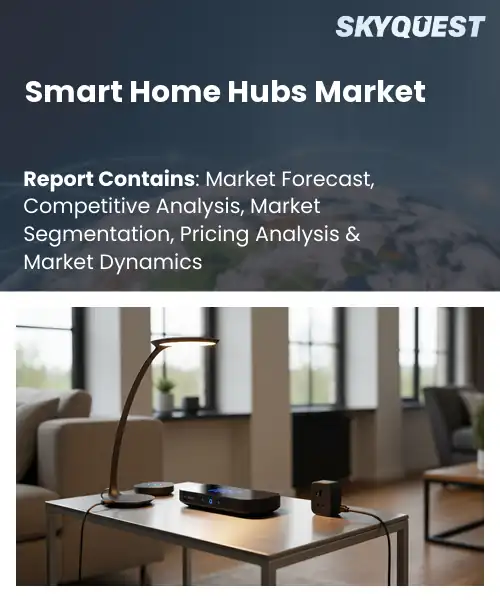
Smart Home Hubs Market
Report ID: SQMIG45I2473
Report ID: SQMIG45I2473
[email protected]
USA +1 351-333-4748
Report ID:
SQMIG45I2473 |
Region:
Global |
Published Date: July, 2026
Pages:
157
|Tables:
151
|Figures:
78


Global Smart Home Hubs Market size was valued at USD 8.5 Billion in 2024 and is poised to grow from USD 9.14 Billion in 2025 to USD 16.3 Billion by 2033, growing at a CAGR of 7.5% during the forecast period (2026-2033).
The global smart home hubs market comprises platforms that integrate lighting, security, climate control and entertainment devices through voice‑activated or app‑based interface. Its relevance drives from consumers’ desire for convenience, energy efficiency and heightened security, trends that have accelerated as broadband penetration and IoT sensor costs have fallen. Initially, hubs such as Amazon Echo and Google Nest emerged in 2014 to provide voice commands, but over the past five years they have incorporated routines, capabilities and skill ecosystems. This evolution has transformed the hub from a peripheral gadget into a central command node that orchestrates data flow across a modern connected home.
The surge in 5G rollout stands as the dominant catalyst reshaping the smart‑home‑hub landscape because low latency and expanded bandwidth enable real‑time coordination of video streams, security analytics and control of appliances. As households adopt Wi‑Fi routers with 5G backhaul, hubs can offload processing to edge servers, cutting device power draw while preserving voice interaction. This advantage fuels partnerships; Samsung’s SmartThings platform embeds 5G‑enabled cameras that feed live video to the hub, allowing instant threat detection without cloud delay. Consequently, manufacturers move into higher tiers and consumers shows greater safety and automated energy savings, broadening the market beyond early adopters.
How is AI-driven automation influencing the growth of the global smart home hubs market?
AI‑driven automation is reshaping the global smart home hubs market by turning static controllers into learning orchestrators. Modern hubs now embed machine‑learning models that anticipate user actions, streamline device pairing, and optimize energy use without manual input. This shift reduces friction for consumers, encouraging broader adoption of connected appliances. Vendors are integrating natural‑language processing so voice commands trigger multi‑device scenes, while edge computing keeps data processing local for faster response and privacy. As households add more sensors and appliances, AI enables hubs to manage complexity, turning disparate products into a cohesive ecosystem. The result is a more intuitive, efficient, and scalable smart home experience that fuels market momentum.
In June 2024, a leading smart home hub manufacturer introduced an AI‑driven hub that learns user routines and coordinates devices, boosting adoption and operational efficiency. The device processes commands locally, reduces latency, and offers predictive scene creation, demonstrating how AI automation can accelerate market growth by delivering tangible convenience and energy savings to consumers.
Market snapshot - (2026-2033)
Global Market Size
USD 8.5 Billion
Largest Segment
Matter
Fastest Growth
Matter
Growth Rate
7.5% CAGR
To get more insights on this market click here to Request a Free Sample Report
Global smart home hubs market is segmented by connectivity technology, product type, application, end user, distribution channel and region. Based on connectivity technology, the market is segmented into Wi-Fi, Zigbee, Z-Wave, Matter and Others. Based on product type, the market is segmented into Smart Speaker Hubs, Dedicated Smart Home Hubs, Display-Based Smart Hubs and Others. Based on application, the market is segmented into Lighting Control, Security & Surveillance, HVAC Control, Entertainment Control and Others. Based on end user, the market is segmented into Residential, Multi-Dwelling Buildings, Small Commercial and Others. Based on distribution channel, the market is segmented into Online Retail, Consumer Electronics Stores, Home Improvement Stores and Others. Based on region, the market is segmented into North America, Europe, Asia Pacific, Latin America and Middle East & Africa.
Matter segment dominates with large smart home hubs market share because it offers a unified, royalty free protocol that simplifies device interoperability across brands, reducing friction for consumers. By enabling seamless onboarding through common standards, it accelerates ecosystem development and strengthens consumer confidence. The industry’s push for a single language fosters faster innovation cycles, and manufacturers prioritize Matter compatibility to meet retailer expectations, reinforcing its central role in the smart home hubs market overall strategic importance for growth.
As per smart home hubs market outlook, Zigbee segment is witnessing the strongest growth momentum as manufacturers leverage its low power mesh capabilities for expanding sensor networks. Emerging use cases in energy management and affordable lighting solutions drive interest, while firmware enhancements broaden compatibility. This surge fuels hub adoption and creates integration opportunities across the ecosystem.
As per smart home hubs market forecast, Smart speaker hubs segment leads because they combine voice control with built in audio, delivering an intuitive entry point for everyday users. The familiar form factor reduces perceived complexity, while integrated assistants streamline command execution across devices. Continuous improvements in natural language processing and third party skill ecosystems deepen functionality, encouraging households to centralize control. This convergence of convenience and entertainment drives widespread acceptance and reinforces the hub’s position as a primary household gateway.
Meanwhile, display based smart hubs are emerging as the key high growth segment because visual feedback enhances interaction and supports advanced scenarios such as video calls and interactive dashboards. Developers integrate richer UI frameworks, and consumers value the appliance for entertainment and control, expanding demand and unlocking revenue streams for manufacturers.
To get detailed segments analysis, Request a Free Sample Report
North America maintains a leading position through a confluence of advanced technology infrastructure, high consumer readiness for connected living, and strong brand ecosystems that drive widespread adoption. The region benefits from deep integration of smart hubs with energy management solutions and home entertainment platforms, supported by extensive broadband coverage and a regulatory climate that encourages innovation. Consumer preferences for convenience and security align with the presence of major manufacturers and developers that continuously enhance functionality and compatibility. Collaborative partnerships among service providers, device makers, and utility firms further reinforce the market’s robustness, while a culture of early adoption accelerates diffusion across residential settings.
As per smart home hubs market regional outlook, United States thrives on a vibrant ecosystem of technology innovators, extensive retail channels, and strong consumer appetite for seamless connectivity. Integration with voice assistants and home security solutions is commonplace, driving everyday relevance. Robust broadband penetration and supportive standards foster interoperability, while collaborative initiatives between utilities and tech firms enhance energy‑efficient applications. The market benefits from continuous product enhancements that align with lifestyle expectations and a proactive approach to data privacy.
As per smart home hubs market regional forecast, Canada is shaped by a forward‑looking consumer base that values comfort, security, and sustainability. Broad adoption of broadband services enables reliable hub performance, while government incentives for energy‑saving technologies encourage integration with smart appliances. Partnerships between local utilities and technology providers create tailored solutions that address climate considerations. The market enjoys a steady influx of innovative products that align with Canadian preferences for privacy and seamless user experience.
Europe experiences rapid expansion driven by a strong emphasis on energy efficiency, stringent data protection standards, and a culturally diverse demand for integrated home experiences. Collaborative standards across the region facilitate device interoperability, while consumer awareness of environmental impact fuels interest in smart energy management. Leading manufacturers and startups alike are investing in design that reflects local aesthetics and multilingual support, enhancing user acceptance. Public‑private initiatives promote the rollout of high‑speed connectivity, enabling richer functionality and fostering a trusted ecosystem that accelerates market momentum.
Germany benefits from a well‑established engineering tradition and a consumer focus on precision and reliability. Integration with renewable energy systems and smart heating solutions resonates with sustainability goals. Strong standards for data security bolster consumer confidence, while a network of local technology firms drives continuous innovation. Retail channels and online platforms together ensure widespread accessibility for a market that values quality and long‑term performance.
United Kingdom is propelled by a dynamic consumer culture that embraces convenience and cutting‑edge design. High penetration of broadband and mobile networks supports seamless hub operation, while collaboration between telecom operators and device makers expands service bundles. A regulatory environment that prioritizes privacy and interoperability encourages confidence in connected solutions. The market sees rapid adoption of voice‑controlled assistants and security integrations that align with lifestyle preferences.
France is emerging through a blend of lifestyle‑driven demand and supportive governmental initiatives. Consumers prioritize ease of use and aesthetic integration, leading to adoption of hubs that complement interior design. Energy‑saving incentives promote connections with smart thermostats and lighting. Partnerships between French design houses and technology providers create solutions that respect cultural nuances while delivering reliable connectivity and data protection.
Asia Pacific is strengthening its role by leveraging rapid urbanization, increasing consumer connectivity, and a growing emphasis on smart living concepts across diverse markets. The region’s manufacturers are emphasizing affordability without compromising functionality, enabling broader household penetration. Expanding high‑speed network infrastructure supports more sophisticated hub capabilities, while regional collaborations foster standardization that eases cross‑border device compatibility. Cultural emphasis on family safety and convenience drives demand for integrated security and automation features, positioning the region as a fertile ground for innovation and adoption.
Japan integrates advanced robotics and home automation traditions, offering solutions that align with space‑saving living environments. Consumer focus on reliability and minimalist design influences product development, while high broadband reliability ensures smooth operation. Partnerships between electronics giants and local service providers encourage seamless integration with energy and security systems, reinforcing a market that values precision, privacy, and ease of use.
South Korea benefits from a tech‑savvy population and pervasive high‑speed connectivity that supports sophisticated hub functionalities. Strong collaboration between telecom operators and device manufacturers accelerates the rollout of bundled services. Consumer interest in smart entertainment and home security drives integration with cutting‑edge audio‑visual platforms. Government support for smart city initiatives further encourages the adoption of connected home solutions that enhance convenience and safety.
To know more about the market opportunities by region and country, click here to
Buy The Complete Report
Increasing Consumer Adoption of IoT
Integration of Voice Assistants
Privacy Concerns Around Data
Fragmented Compatibility Across Devices
Request Free Customization of this report to help us to meet your business objectives.
The competitive landscape is shaped by aggressive M&A activity, strategic platform integrations and rapid tech innovation, with Amazon’s acquisition of Ring and its deep integration into Alexa, Google’s expansion of Nest Hub features, and Apple’s partnership with third‑party device makers to enrich HomeKit, all driving differentiation and pressuring rivals to accelerate ecosystem development and AI‑enabled voice control.
SkyQuest’s ABIRAW (Advanced Business Intelligence, Research & Analysis Wing) is our Business Information Services team that Collects, Collates, Correlates, and Analyses the Data collected by means of Primary Exploratory Research backed by robust Secondary Desk research.
As per SkyQuest analysis the global smart home hubs market growth is being propelled primarily by the growing consumer adoption of IoT devices which creates a strong demand for a single interface to control lighting, climate and security, while a second driver comes from AI‑driven automation that turns hubs into predictive assistants capable of learning routines and optimizing energy use. However, privacy concerns around data collection act as a notable restraint, making some buyers hesitant to embrace fully integrated hubs. North America remains the dominant region due to its advanced broadband, strong brand ecosystems and early‑adopter culture, and within the market the smart speaker hub segment leads the competition due to its familiar voice‑assistant experience and ease of use. The global smart home hubs market trend driven by increasing adoption of connected home devices, rising consumer demand for centralized home automation, and expanding smart city initiatives.
| Report Metric | Details |
|---|---|
| Market size value in 2024 | USD 8.5 Billion |
| Market size value in 2033 | USD 16.3 Billion |
| Growth Rate | 7.5% |
| Base year | 2024 |
| Forecast period | (2026-2033) |
| Forecast Unit (Value) | USD Billion |
| Segments covered |
|
| Regions covered | North America (US, Canada), Europe (Germany, France, United Kingdom, Italy, Spain, Rest of Europe), Asia Pacific (China, India, Japan, Rest of Asia-Pacific), Latin America (Brazil, Rest of Latin America), Middle East & Africa (South Africa, GCC Countries, Rest of MEA) |
| Companies covered |
|
| Customization scope | Free report customization with purchase. Customization includes:-
|
To get a free trial access to our platform which is a one stop solution for all your data requirements for quicker decision making. This platform allows you to compare markets, competitors who are prominent in the market, and mega trends that are influencing the dynamics in the market. Also, get access to detailed SkyQuest exclusive matrix.
Table Of Content
Executive Summary
Market overview
Parent Market Analysis
Market overview
Market size
KEY MARKET INSIGHTS
COVID IMPACT
MARKET DYNAMICS & OUTLOOK
Market Size by Region
KEY COMPANY PROFILES
Methodology
For the Smart Home Hubs Market, our research methodology involved a mixture of primary and secondary data sources. Key steps involved in the research process are listed below:
1. Information Procurement: This stage involved the procurement of Market data or related information via primary and secondary sources. The various secondary sources used included various company websites, annual reports, trade databases, and paid databases such as Hoover's, Bloomberg Business, Factiva, and Avention. Our team did 45 primary interactions Globally which included several stakeholders such as manufacturers, customers, key opinion leaders, etc. Overall, information procurement was one of the most extensive stages in our research process.
2. Information Analysis: This step involved triangulation of data through bottom-up and top-down approaches to estimate and validate the total size and future estimate of the Smart Home Hubs Market.
3. Report Formulation: The final step entailed the placement of data points in appropriate Market spaces in an attempt to deduce viable conclusions.
4. Validation & Publishing: Validation is the most important step in the process. Validation & re-validation via an intricately designed process helped us finalize data points to be used for final calculations. The final Market estimates and forecasts were then aligned and sent to our panel of industry experts for validation of data. Once the validation was done the report was sent to our Quality Assurance team to ensure adherence to style guides, consistency & design.
Analyst Support
Customization Options
With the given market data, our dedicated team of analysts can offer you the following customization options are available for the Smart Home Hubs Market:
Product Analysis: Product matrix, which offers a detailed comparison of the product portfolio of companies.
Regional Analysis: Further analysis of the Smart Home Hubs Market for additional countries.
Competitive Analysis: Detailed analysis and profiling of additional Market players & comparative analysis of competitive products.
Go to Market Strategy: Find the high-growth channels to invest your marketing efforts and increase your customer base.
Innovation Mapping: Identify racial solutions and innovation, connected to deep ecosystems of innovators, start-ups, academics, and strategic partners.
Category Intelligence: Customized intelligence that is relevant to their supply Markets will enable them to make smarter sourcing decisions and improve their category management.
Public Company Transcript Analysis: To improve the investment performance by generating new alpha and making better-informed decisions.
Social Media Listening: To analyze the conversations and trends happening not just around your brand, but around your industry as a whole, and use those insights to make better Marketing decisions.
REQUEST FOR SAMPLE
 REQUEST FREE CUSTOMIZATION
Global Smart Home Hubs Market size was valued at USD 8.5 Billion in 2024 and is poised to grow from USD 9.14 Billion in 2025 to USD 16.3 Billion by 2033, growing at a CAGR of 7.5% during the forecast period (2026-2033).
The competitive landscape is shaped by aggressive M&A activity, strategic platform integrations and rapid tech innovation, with Amazon’s acquisition of Ring and its deep integration into Alexa, Google’s expansion of Nest Hub features, and Apple’s partnership with third‑party device makers to enrich HomeKit, all driving differentiation and pressuring rivals to accelerate ecosystem development and AI‑enabled voice control. 'Amazon.com, Inc.', 'Google LLC', 'Apple Inc.', 'Samsung Electronics Co., Ltd.', 'Lumi United Technology Co., Ltd.', 'Home Assistant', 'Hubitat Inc.', 'Aeotec Group GmbH', 'Ezlo Innovation', 'Athom B.V.', 'HomeSeer Technologies LLC', 'Crestron Electronics, Inc.', 'Savant Systems, Inc.', 'Fibaro Group', 'TP-Link Corporation Limited', 'LG Electronics Inc.', 'Xiaomi Corporation', 'Tuya Smart Inc.', 'ABB Ltd.', 'Schneider Electric SE'
Ai-Driven Voice Interfaces: The proliferation of conversational AI is reshaping smart home hubs, turning them into proactive assistants that anticipate user needs. Advanced natural‑language processing enables contextual understanding, allowing hubs to coordinate lighting, climate, security, and entertainment without explicit commands. As manufacturers embed larger language models, personalization improves, delivering tailored recommendations and seamless multi‑modal interactions. This shift drives consumer appeal, encourages ecosystem lock‑in, and accelerates the transition from reactive control panels to intelligent command centers that learn and adapt over time daily comfort.
Why does North America Dominate the Global Smart Home Hubs Market? |@12


Want to customize this report? This report can be personalized according to your needs. Our analysts and industry experts will work directly with you to understand your requirements and provide you with customized data in a short amount of time. We offer $1000 worth of FREE customization at the time of purchase.
Feedback From Our Clients


 USA (+1) 351-333-4748

