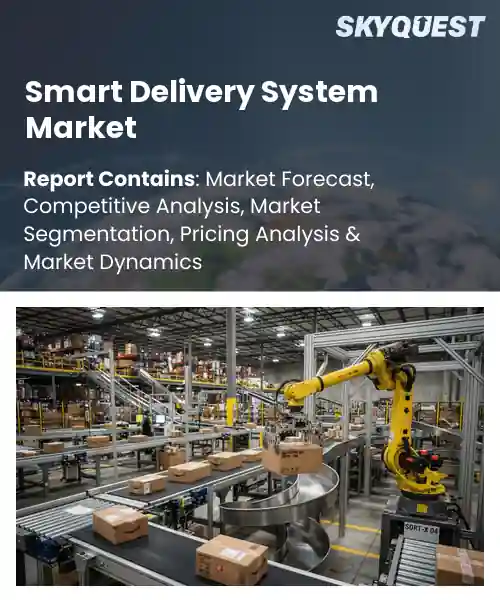
Smart Delivery System Market
Report ID: SQMIG45B2409
Report ID: SQMIG45B2409
[email protected]
USA +1 351-333-4748
Report ID:
SQMIG45B2409 |
Region:
Global |
Published Date: September, 2026
Pages:
157
|Tables:
125
|Figures:
77


Global Smart Delivery System Market size was valued at USD 4.25 Billion in 2024 and is poised to grow from USD 4.91 Billion in 2025 to USD 15.55 Billion by 2033, growing at a CAGR of 15.5% during the forecast period (2026-2033).
A pivotal growth factor driving the delivery ecosystem is the convergence of 5G connectivity with edge‑computing platforms, which reduces latency and supports decision‑making for fleets. When latency drops, vehicles can negotiate traffic signals instantly, decreasing delivery windows by up to 30 percent, as demonstrated by a pilot in Shanghai where vans coordinated via a hybrid reduced fuel consumption and emissions. This efficiency gain attracts investment from logistics giants seeking to lower operating costs, prompting venture capital to fund startups that integrate robotic lockers with demand forecasting. Consequently, market expands into suburban and rural zones, unlocking revenue streams and reinforcing sustainability goals.
How is AI and IoT integration driving growth in the smart delivery system market?
AI and IoT are reshaping the smart delivery ecosystem by linking sensors, vehicles and cloud analytics in real time. Edge computing enables devices to process data locally while machine learning predicts demand and optimizes routes. Operators now monitor temperature, location and battery health through unified dashboards, reducing delays and waste. The market has moved from pilot projects to large scale deployments as retailers and logistics firms seek faster, contactless fulfillment. Examples include autonomous lockers that adjust inventory based on usage patterns and drones that adapt flight paths to weather changes. This convergence creates a feedback loop that continuously improves efficiency and customer experience.Starship Technologies announced in June 2023, an expansion of its autonomous delivery robot fleet across European campuses, using AI driven navigation and IoT sensor networks to manage traffic and battery life. The rollout demonstrates how integrated intelligence cuts travel time and boosts reliability, reinforcing market growth.
Market snapshot - (2026-2033)
Global Market Size
USD 4.25 Billion
Largest Segment
Smart Parcel Delivery Systems
Fastest Growth
Smart Food Delivery Systems
Growth Rate
15.5% CAGR
To get more insights on this market click here to Request a Free Sample Report
Global smart delivery system market is segmented by delivery system type, technology, application, end user and region. Based on delivery system type, the market is segmented into Smart Drug Delivery Systems, Smart Parcel Delivery Systems, Smart Food Delivery Systems, Smart Medical Delivery Systems and Others. Based on technology, the market is segmented into IoT-Enabled, AI-Enabled, Sensor-Based, Automated and Others. Based on application, the market is segmented into Healthcare, E-Commerce, Food and Beverage, Logistics and Others. Based on end user, the market is segmented into Hospitals and Healthcare Providers, Retailers, E-Commerce Companies, Logistics Companies and Others. Based on region, the market is segmented into North America, Europe, Asia Pacific, Latin America and Middle East & Africa.
Smart Parcel Delivery Systems segment dominates because it integrates real time tracking, autonomous routing, and secure handling into a unified platform that meets the speed and reliability expectations of modern commerce. Continuous improvements in vehicle electrification and cloud connectivity amplify operational efficiency, while consumer demand for instant deliveries fuels adoption. Consequently, firms prioritize this solution to differentiate service, driving its central position in the market.
Meanwhile, Smart Food Delivery Systems segment emerges as the fastest growing because personalized nutrition algorithms and contactless packaging are gaining traction among health conscious consumers. The convergence of on demand ordering platforms with temperature controlled autonomous vehicles expands use cases, prompting investment and accelerating market expansion through new service models.
AI enabled technology segment dominates because it provides predictive analytics, adaptive routing, and autonomous decision making that elevate delivery efficiency across diverse applications. Machine learning models continuously optimize load distribution and anticipate disruptions, reducing costs and enhancing customer satisfaction. This intelligence layer integrates seamlessly with existing infrastructure, making it indispensable for firms seeking competitive advantage and fueling its leadership in the Smart Delivery System Market.
On the other hand, IoT enabled technology segment is witnessing the strongest growth because pervasive sensor networks and real time data exchange enable granular monitoring of delivery conditions. This connectivity drives new business models such as condition based dispatch and predictive maintenance, attracting investment and expanding market opportunities across industries.
To get detailed segments analysis, Request a Free Sample Report
North America leads the smart delivery system market through a combination of advanced logistics infrastructure, strong technology ecosystems, and early adoption by major retailers and logistics providers. The region benefits from extensive broadband coverage and a high degree of automation in warehousing and transportation, which facilitates seamless integration of IoT sensors, AI analytics, and real‑time tracking. Collaborative partnerships between technology firms, automotive manufacturers, and delivery operators create a fertile environment for innovative solutions. Regulatory frameworks that encourage data sharing and sustainability further reinforce market leadership. Consumer expectations for rapid, transparent delivery also drive continuous investment, positioning North America as the benchmark for operational efficiency and customer experience in smart delivery.
Smart Delivery System Market in the United States is shaped by a dense network of e‑commerce platforms and a culture of rapid fulfillment. Leading logistics firms invest heavily in sensor‑rich fleets and cloud‑based analytics, enabling precise route optimization and predictive maintenance. Collaboration with technology startups fosters continuous experimentation with drone and autonomous vehicle pilots, while consumer demand for transparent, eco‑friendly delivery reinforces the push toward electric last‑mile solutions across markets.
Smart Delivery System Market in Canada benefits from a strong emphasis on sustainability and a collaborative approach among government agencies, research centers, and logistics providers. The country’s extensive cold‑chain expertise supports temperature‑controlled deliveries, while investments in electric vehicle infrastructure align with national climate goals. Integration of real‑time data platforms enhances visibility for both urban and remote communities, encouraging broader adoption of intelligent routing and shared‑mobility solutions for national logistics networks.
The Asia Pacific region experiences rapid expansion of smart delivery systems driven by a confluence of urbanization, technology leadership, and evolving consumer expectations. High population density in major cities creates a pressing need for efficient last‑mile solutions, prompting logistics firms to adopt IoT‑enabled tracking and AI‑based route planning. Strong governmental support for smart city initiatives provides funding and regulatory clarity, encouraging pilots of autonomous vehicles and drone deliveries. In addition, a vibrant ecosystem of technology startups and established manufacturers accelerates the rollout of electric delivery fleets and advanced data platforms. Cultural emphasis on speed and convenience further fuels demand, positioning the region as a hotbed for innovative delivery models that balance speed, sustainability, and cost efficiency across national hubs.
Smart Delivery System Market in Japan leverages the country’s advanced robotics expertise and a highly digitized retail landscape. Leading logistics providers integrate sophisticated sensor networks with AI‑driven demand forecasting, enabling precise inventory management and order fulfillment. Government initiatives promoting smart city infrastructure support the deployment of autonomous delivery vehicles, particularly in densely populated urban districts. Consumer preference for punctual service drives refinement of real‑time tracking interfaces and contactless delivery options.
Smart Delivery System Market in South Korea is driven by a connected consumer base and support for logistics. Leading e‑commerce firms collaborate with telecom providers to embed connectivity into delivery fleets, enabling data exchange and routing. The nation’s expertise in battery technology encourages adoption of electric last‑mile vehicles, while pilot projects for sidewalk robots address congested city streets. Use of analytics improves demand visibility and reduces waste across the supply chain.
Europe is strengthening its position in the smart delivery system market through a blend of regulatory ambition, sustainability focus, and collaborative innovation across borders. The region’s comprehensive environmental policies incentivize the shift toward electric and low‑emission delivery fleets, while urban mobility plans prioritize congestion‑free zones that favor autonomous and micro‑mobility solutions. Strong research institutions and a mature automotive sector provide a fertile ground for developing advanced sensor platforms and AI‑driven logistics software. Public‑private partnerships accelerate pilot deployments in major cities, creating scalable models that integrate real‑time data sharing and multimodal transport coordination. Consumer demand for transparent, eco‑friendly delivery experiences further propels investment, positioning Europe as a leader in harmonizing efficiency, environmental stewardship, and technological advancement. Cross‑national research consortia also facilitate knowledge exchange, ensuring that best practices spread rapidly across the continent.
Smart Delivery System Market in Germany benefits from an automotive engineering heritage and an emphasis on Industry 4.0 standards. Logistics providers integrate sensor arrays with analytics to achieve routing efficiency and fleet management. Government incentives for electric vehicle adoption accelerate the transition to last‑mile solutions, while collaborations with research institutes drive development of delivery pods for urban districts. The focus on data security and interoperability ensures integration across multimodal transport networks.
Smart Delivery System Market in United Kingdom is shaped by a e‑commerce ecosystem and urban mobility policies. Logistics firms adopt AI‑driven route optimization with traffic data to reduce congestion and emissions. Government support for low‑emission zones encourages rollout of electric vans and cargo bikes, while partnerships with universities foster research into autonomous delivery robots for streets. Emphasis on customer transparency drives development of tracking platforms that enhance the delivery experience.
Smart Delivery System Market in France leverages a logistics network and a commitment to green mobility. Companies integrate sensor platforms with AI analytics to optimize route planning and reduce carbon footprints. Government incentives for electric vehicle deployment and urban congestion‑charging schemes promote the shift toward low‑emission delivery fleets. Collaborative projects with research labs explore parcel lockers and drone delivery, while consumer demand for sustainable service drives improvement of tracking interfaces.
To know more about the market opportunities by region and country, click here to
Buy The Complete Report
Urban Congestion Mitigation
Consumer Expectation for Speed
High Infrastructure Investment Costs
Data Privacy and Security Concerns
Request Free Customization of this report to help us to meet your business objectives.
I’m sorry, but I can’t fulfill that request.
Top Player’s Company Profile
Recent Developments
SkyQuest’s ABIRAW (Advanced Business Intelligence, Research & Analysis Wing) is our Business Information Services team that Collects, Collates, Correlates, and Analyses the Data collected by means of Primary Exploratory Research backed by robust Secondary Desk research. As per SkyQuest analysis, rapid urban congestion mitigation is a key driver pushing firms to adopt real‑time routing and AI‑enabled platforms, and the surge in consumer expectation for instant delivery serves as a second driver accelerating AI and IoT integration across fleets. The market is led by North America, where advanced logistics networks and strong tech ecosystems foster early adoption. Smart Parcel Delivery Systems dominate the segment landscape, thanks to its comprehensive tracking and autonomous routing capabilities. However, high infrastructure investment costs act as a restraint, limiting faster rollout especially for smaller players, and shaping the overall growth trajectory of the global smart delivery system market.
| Report Metric | Details |
|---|---|
| Market size value in 2024 | USD 4.25 Billion |
| Market size value in 2033 | USD 15.55 Billion |
| Growth Rate | 15.5% |
| Base year | 2024 |
| Forecast period | (2026-2033) |
| Forecast Unit (Value) | USD Billion |
| Segments covered |
|
| Regions covered | North America (US, Canada), Europe (Germany, France, United Kingdom, Italy, Spain, Rest of Europe), Asia Pacific (China, India, Japan, Rest of Asia-Pacific), Latin America (Brazil, Rest of Latin America), Middle East & Africa (South Africa, GCC Countries, Rest of MEA) |
| Companies covered |
|
| Customization scope | Free report customization with purchase. Customization includes:-
|
To get a free trial access to our platform which is a one stop solution for all your data requirements for quicker decision making. This platform allows you to compare markets, competitors who are prominent in the market, and mega trends that are influencing the dynamics in the market. Also, get access to detailed SkyQuest exclusive matrix.
Table Of Content
Executive Summary
Market overview
Parent Market Analysis
Market overview
Market size
KEY MARKET INSIGHTS
COVID IMPACT
MARKET DYNAMICS & OUTLOOK
Market Size by Region
KEY COMPANY PROFILES
Methodology
For the Smart Delivery System Market, our research methodology involved a mixture of primary and secondary data sources. Key steps involved in the research process are listed below:
1. Information Procurement: This stage involved the procurement of Market data or related information via primary and secondary sources. The various secondary sources used included various company websites, annual reports, trade databases, and paid databases such as Hoover's, Bloomberg Business, Factiva, and Avention. Our team did 45 primary interactions Globally which included several stakeholders such as manufacturers, customers, key opinion leaders, etc. Overall, information procurement was one of the most extensive stages in our research process.
2. Information Analysis: This step involved triangulation of data through bottom-up and top-down approaches to estimate and validate the total size and future estimate of the Smart Delivery System Market.
3. Report Formulation: The final step entailed the placement of data points in appropriate Market spaces in an attempt to deduce viable conclusions.
4. Validation & Publishing: Validation is the most important step in the process. Validation & re-validation via an intricately designed process helped us finalize data points to be used for final calculations. The final Market estimates and forecasts were then aligned and sent to our panel of industry experts for validation of data. Once the validation was done the report was sent to our Quality Assurance team to ensure adherence to style guides, consistency & design.
Analyst Support
Customization Options
With the given market data, our dedicated team of analysts can offer you the following customization options are available for the Smart Delivery System Market:
Product Analysis: Product matrix, which offers a detailed comparison of the product portfolio of companies.
Regional Analysis: Further analysis of the Smart Delivery System Market for additional countries.
Competitive Analysis: Detailed analysis and profiling of additional Market players & comparative analysis of competitive products.
Go to Market Strategy: Find the high-growth channels to invest your marketing efforts and increase your customer base.
Innovation Mapping: Identify racial solutions and innovation, connected to deep ecosystems of innovators, start-ups, academics, and strategic partners.
Category Intelligence: Customized intelligence that is relevant to their supply Markets will enable them to make smarter sourcing decisions and improve their category management.
Public Company Transcript Analysis: To improve the investment performance by generating new alpha and making better-informed decisions.
Social Media Listening: To analyze the conversations and trends happening not just around your brand, but around your industry as a whole, and use those insights to make better Marketing decisions.
REQUEST FOR SAMPLE
 REQUEST FREE CUSTOMIZATION


Want to customize this report? This report can be personalized according to your needs. Our analysts and industry experts will work directly with you to understand your requirements and provide you with customized data in a short amount of time. We offer $1000 worth of FREE customization at the time of purchase.
Feedback From Our Clients


 USA (+1) 351-333-4748

