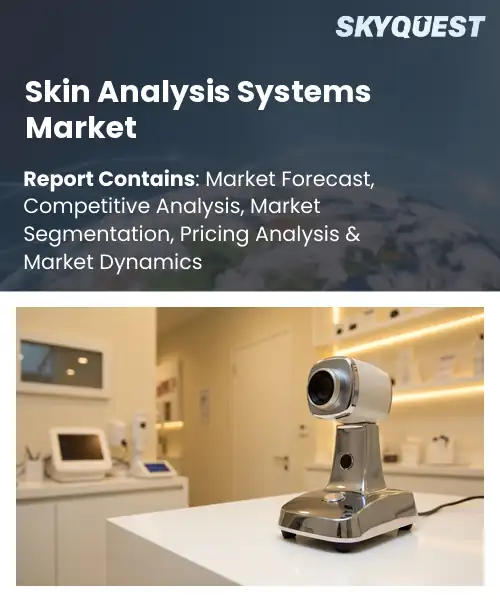
Skin Analysis Systems Market
Report ID: SQMIG35A4211
Report ID: SQMIG35A4211
[email protected]
USA +1 351-333-4748
Report ID:
SQMIG35A4211 |
Region:
Global |
Published Date: July, 2026
Pages:
157
|Tables:
153
|Figures:
78


Global Skin Analysis Systems Market size was valued at USD 1.02 Billion in 2024 and is poised to grow from USD 1.1 Billion in 2025 to USD 8.36 Billion by 2033, growing at a CAGR of 7.4% during the forecast period (2026-2033).
Artificial Intelligence combined with data capture has emerged as the catalyst driving the skin analysis systems market forward. By converting spectral or 3‑D measurements into actionable insights, AI reduces diagnostic latency and enables personalized product recommendations, which in turn boosts consumer trust and drives repeat purchases. Companies such as L’Oréal have deployed AI‑enhanced scanners across retail locations, allowing shoppers to receive hydration scores and tailored serums on the spot. This feedback loop encourages retailers to integrate skin diagnostics into loyalty programs, expanding revenue streams beyond product sales. Moreover, regulatory endorsement of AI‑validated algorithms for melanoma detection opens hospital procurement channels, widening the addressable market.
How is AI enhancing accuracy in the skin analysis systems market?
AI is reshaping skin analysis systems by improving image interpretation, personalizing assessments, and reducing human error. Modern devices combine high resolution cameras with deep learning models that can detect subtle variations in tone, texture and lesion characteristics. This precision enables dermatologists and consumers to receive faster, more reliable recommendations for treatment or product use. The market now sees a shift from manual visual checks to automated platforms that continuously learn from diverse skin types. Companies such as SkinVision and Curology illustrate how AI driven diagnostics are expanding access while maintaining clinical relevance, making the technology a cornerstone of growth.
In June 2023, L'Oréal launched its AI powered skin analysis platform that integrates real time imaging with predictive algorithms to refine diagnosis and personalize skincare recommendations, boosting market confidence and accelerating adoption across consumers and professionals alike. The system learns from thousands of user inputs, improving accuracy over time and supporting broader clinical validation.
Market snapshot - (2026-2033)
Global Market Size
USD 1.02 Billion
Largest Segment
Optical Imaging Systems
Fastest Growth
AI-Based Skin Analysis Systems
Growth Rate
7.4% CAGR
To get more insights on this market click here to Request a Free Sample Report
Global skin analysis systems market is segmented by technology, component, modality, application, end user and region. Based on technology, the market is segmented into Optical Imaging Systems, AI-Based Skin Analysis Systems, Multi-Spectral & Hyperspectral Imaging Systems, 3D Skin Imaging Systems and Others. Based on component, the market is segmented into Hardware, Software and Services. Based on modality, the market is segmented into Desktop Systems and Portable/Handheld Systems. Based on application, the market is segmented into Wrinkle & Fine Line Analysis, Pigmentation & Skin Tone Analysis, Acne & Blemish Assessment, Pore Analysis, Hydration & Moisture Analysis, UV Damage & Sun Exposure Assessment, Skin Texture & Elasticity Analysis and Others. Based on end user, the market is segmented into Dermatology Clinics, Hospitals, Medical Aesthetic Clinics, Cosmetic & Skincare Companies, Beauty Salons & Spas and Research & Academic Institutes. Based on region, the market is segmented into North America, Europe, Asia Pacific, Latin America and Middle East & Africa.
AI-based skin analysis systems segment dominates with large skin analysis systems market share because its ability to integrate deep learning algorithms with real‑time imaging delivers highly personalized diagnostic insights. Clinicians value the precision in detecting subtle dermal changes, while consumers appreciate the seamless user experience on connected devices. This convergence of clinical accuracy and consumer convenience fuels strong adoption across dermatology clinics and home‑care platforms, reinforcing its leadership in the skin analysis market globally today and continuously.
As per skin analysis systems market outlook, multi‑spectral & hyperspectral imaging systems are witnessing the strongest growth momentum because they capture detailed spectral signatures that reveal hidden physiological markers. Advances in sensor miniaturization and cloud‑based analytics are expanding their use in research and cosmetic product development, creating new revenue streams and accelerating overall market expansion.
Pigmentation & skin tone analysis segment dominates because it directly addresses consumer demand for blemish‑free complexion and offers clinicians a quantifiable method to track melanin distribution. The capability to objectively assess hyperpigmentation supports personalized treatment plans and product recommendations, fostering trust among users. Integration with mobile apps and AI‑driven trend forecasting further amplifies its relevance, cementing its position as a core driver of market adoption across clinical and retail environments.
As per skin analysis systems market forecast, hydration & moisture analysis is emerging as the key high‑growth area because increasing awareness of barrier function links skin health to overall wellbeing. Novel non‑invasive sensors and real‑time feedback mechanisms enable personalized skincare regimens, attracting both dermatologists and beauty consumers. This surge in demand broadens application scenarios, propelling market expansion and encouraging further investment in related technologies.
To get detailed segments analysis, Request a Free Sample Report
North America leverages a mature healthcare infrastructure combined with a high adoption rate of advanced diagnostic technologies. Strong collaboration between research institutions, technology providers, and cosmetic enterprises fuels continuous innovation in skin imaging and AI-driven analysis. Consumer awareness of personalized skincare drives demand, while robust reimbursement frameworks support clinical integration. The region benefits from a skilled workforce and high investment in digital health initiatives, creating an ecosystem where cutting‑edge devices are rapidly brought to market and embraced by both professionals and end users.
As per skin analysis systems market regional outlook, United States thrives on a vibrant venture capital environment that accelerates startup growth and encourages partnership with established dermatology brands. The market is supported by extensive clinical trial networks that validate new algorithms, and by a consumer base eager for data‑driven skincare solutions. Regulatory pathways that balance safety with speed further enable rapid product launches, while leading beauty retailers integrate these tools into in‑store experiences, reinforcing market depth.
As per skin analysis systems market regional forecast, Canada is shaped by a strong public health focus on preventive dermatology and a collaborative research culture linking universities with technology firms. Government incentives promote the development of interoperable platforms, and provincial health programs increasingly incorporate digital skin assessment tools. Consumer interest in personalized wellness, coupled with a high level of digital literacy, drives retail adoption, while partnerships with multinational manufacturers expand the reach of sophisticated analysis devices across the country.
Europe’s expansion is propelled by a unified regulatory landscape that encourages cross‑border innovation and market entry. The region’s emphasis on scientific rigor and evidence‑based practice ensures that new skin analysis technologies meet stringent quality standards, fostering trust among clinicians and consumers. Strong cultural appreciation for personalized beauty regimens fuels retailer investment in in‑store diagnostics, while collaborative research clusters in key countries accelerate algorithm refinement and device miniaturization. Together, these factors position Europe as a fertile ground for sustained market growth.
As per skin analysis systems industry analysis, Germany benefits from a dense network of research institutions that specialize in dermatology and optical engineering. The market is reinforced by a tradition of precision manufacturing, enabling the production of high‑quality imaging hardware. Collaborative projects between universities and cosmetics giants accelerate the integration of AI insights, while a consumer base attuned to scientific skincare drives retail uptake of advanced analysis tools.
United Kingdom experiences rapid acceleration through strong ties between academic dermatology departments and fintech‑enabled health platforms. The market is energized by a vibrant startup ecosystem that leverages artificial intelligence to deliver real‑time skin assessments. Consumer demand for bespoke skincare solutions, amplified by digital marketing channels, encourages retailers to embed analysis stations, while regulatory support for digital health accelerates product diffusion.
France is emerging as a niche yet dynamic segment, powered by a deep cultural emphasis on skincare excellence. Collaborative initiatives between cosmetic laboratories and technology incubators foster innovative sensor designs tailored to French consumer preferences. High engagement with boutique beauty outlets encourages trial of personalized diagnostic tools, while government programs that support digital health experimentation provide a supportive backdrop for market development.
Asia Pacific advances its position through a confluence of high consumer enthusiasm for technology‑enabled beauty and government-backed initiatives that promote digital health integration. The region’s large, tech‑savvy population accelerates adoption of mobile‑first skin analysis applications, while local manufacturers focus on cost‑effective yet sophisticated device engineering. Cross‑regional partnerships enable knowledge transfer from established markets, and the proliferation of e‑commerce platforms provides a rapid distribution channel for innovative solutions, collectively reinforcing the region’s growing influence.
Japan is characterized by a meticulous approach to product quality and a strong affinity for precision aesthetics. Collaboration between leading electronics firms and dermatology research centers drives the development of compact, high‑resolution imaging devices. Consumer acceptance is bolstered by a cultural preference for data‑driven skincare routines, and seamless integration of analysis tools into popular beauty salons and department stores expands market reach.
South Korea is propelled by a hyper‑connected consumer environment and a robust K‑beauty industry that embraces innovation. Technology companies partner closely with cosmetic brands to embed AI‑powered skin diagnostics into mobile applications and in‑store experiences. High consumer willingness to experiment with novel skincare regimens accelerates product uptake, while government support for digital health research nurtures continuous advancement of analysis technologies.
To know more about the market opportunities by region and country, click here to
Buy The Complete Report
Increasing Demand For Personalized Skincare
Adoption of AI‑Powered Imaging
High Initial Equipment Cost
Regulatory Approval Complexities
Request Free Customization of this report to help us to meet your business objectives.
The competitive landscape is shaped by intense rivalry among technology‑driven dermatology platforms, with recent M&A activity consolidating capabilities and expanding geographic reach. Strategic partnerships between device manufacturers and AI developers accelerate product integration, while firms invest in proprietary imaging algorithms to differentiate performance and clinical accuracy. These moves intensify competition, driving rapid innovation cycles and prompting players to secure exclusive distribution agreements to capture emerging market segments.
SkyQuest’s ABIRAW (Advanced Business Intelligence, Research & Analysis Wing) is our Business Information Services team that Collects, Collates, Correlates, and Analyses the Data collected by means of Primary Exploratory Research backed by robust Secondary Desk research.
As per SkyQuest analysis the global skin analysis systems market growth is being propelled primarily by the increasing demand for personalized skincare, which pushes clinics and beauty brands to adopt advanced imaging tools, while the second driver is the rapid adoption of AI‑powered imaging that shortens diagnostic time and improves accuracy across clinical and retail settings. The market’s dominant segment is AI‑based skin analysis systems, reflecting the strong preference for deep‑learning driven assessments, and North America remains the leading region due to its mature healthcare infrastructure and high consumer tech adoption. However, high initial equipment cost acts as a restraint, limiting uptake among smaller practices and slowing broader market penetration. The global skin analysis systems market trend driven by rising consumer awareness of personalized skincare, increasing demand for aesthetic procedures, and rapid advancements in artificial intelligence (AI) and imaging technologies.
| Report Metric | Details |
|---|---|
| Market size value in 2024 | USD 1.02 Billion |
| Market size value in 2033 | USD 8.36 Billion |
| Growth Rate | 7.4% |
| Base year | 2024 |
| Forecast period | (2026-2033) |
| Forecast Unit (Value) | USD Billion |
| Segments covered |
|
| Regions covered | North America (US, Canada), Europe (Germany, France, United Kingdom, Italy, Spain, Rest of Europe), Asia Pacific (China, India, Japan, Rest of Asia-Pacific), Latin America (Brazil, Rest of Latin America), Middle East & Africa (South Africa, GCC Countries, Rest of MEA) |
| Companies covered |
|
| Customization scope | Free report customization with purchase. Customization includes:-
|
To get a free trial access to our platform which is a one stop solution for all your data requirements for quicker decision making. This platform allows you to compare markets, competitors who are prominent in the market, and mega trends that are influencing the dynamics in the market. Also, get access to detailed SkyQuest exclusive matrix.
Table Of Content
Executive Summary
Market overview
Parent Market Analysis
Market overview
Market size
KEY MARKET INSIGHTS
COVID IMPACT
MARKET DYNAMICS & OUTLOOK
Market Size by Region
KEY COMPANY PROFILES
Methodology
For the Skin Analysis Systems Market, our research methodology involved a mixture of primary and secondary data sources. Key steps involved in the research process are listed below:
1. Information Procurement: This stage involved the procurement of Market data or related information via primary and secondary sources. The various secondary sources used included various company websites, annual reports, trade databases, and paid databases such as Hoover's, Bloomberg Business, Factiva, and Avention. Our team did 45 primary interactions Globally which included several stakeholders such as manufacturers, customers, key opinion leaders, etc. Overall, information procurement was one of the most extensive stages in our research process.
2. Information Analysis: This step involved triangulation of data through bottom-up and top-down approaches to estimate and validate the total size and future estimate of the Skin Analysis Systems Market.
3. Report Formulation: The final step entailed the placement of data points in appropriate Market spaces in an attempt to deduce viable conclusions.
4. Validation & Publishing: Validation is the most important step in the process. Validation & re-validation via an intricately designed process helped us finalize data points to be used for final calculations. The final Market estimates and forecasts were then aligned and sent to our panel of industry experts for validation of data. Once the validation was done the report was sent to our Quality Assurance team to ensure adherence to style guides, consistency & design.
Analyst Support
Customization Options
With the given market data, our dedicated team of analysts can offer you the following customization options are available for the Skin Analysis Systems Market:
Product Analysis: Product matrix, which offers a detailed comparison of the product portfolio of companies.
Regional Analysis: Further analysis of the Skin Analysis Systems Market for additional countries.
Competitive Analysis: Detailed analysis and profiling of additional Market players & comparative analysis of competitive products.
Go to Market Strategy: Find the high-growth channels to invest your marketing efforts and increase your customer base.
Innovation Mapping: Identify racial solutions and innovation, connected to deep ecosystems of innovators, start-ups, academics, and strategic partners.
Category Intelligence: Customized intelligence that is relevant to their supply Markets will enable them to make smarter sourcing decisions and improve their category management.
Public Company Transcript Analysis: To improve the investment performance by generating new alpha and making better-informed decisions.
Social Media Listening: To analyze the conversations and trends happening not just around your brand, but around your industry as a whole, and use those insights to make better Marketing decisions.
REQUEST FOR SAMPLE
 REQUEST FREE CUSTOMIZATION
Global Skin Analysis Systems Market size was valued at USD 1.02 Billion in 2024 and is poised to grow from USD 1.1 Billion in 2025 to USD 8.36 Billion by 2033, growing at a CAGR of 7.4% during the forecast period (2026-2033).
The competitive landscape is shaped by intense rivalry among technology‑driven dermatology platforms, with recent M&A activity consolidating capabilities and expanding geographic reach. Strategic partnerships between device manufacturers and AI developers accelerate product integration, while firms invest in proprietary imaging algorithms to differentiate performance and clinical accuracy. These moves intensify competition, driving rapid innovation cycles and prompting players to secure exclusive distribution agreements to capture emerging market segments. 'Canfield Scientific Inc', 'Cortex Technology ApS', 'Callegari Srl', 'Bomtech Electronics Co Ltd', 'Courage+Khazaka electronic GmbH', 'Moritex Corporation', 'DermoScan GmbH', 'FotoFinder Systems GmbH', 'Pixience', 'Quantificare SA', 'Brera Medical Technologies Srl', 'Meicet', 'Dermalight', 'Aram Huvis Co Ltd', 'Chowis Co Ltd', 'Nourish', 'Miravex Limited', '美测', 'Biolitec AG', 'SkinCam'
The growing consumer interest in tailored dermatological solutions drives adoption of advanced skin analysis systems, as these devices enable precise assessment of individual skin conditions and recommendation of customized treatment regimens. By providing objective data, they enhance practitioner confidence and improve patient outcomes, encouraging clinics and cosmetic brands to integrate such technology into routine workflows. This alignment with personalized care trends fuels market expansion and stimulates ongoing research into more sophisticated imaging and analytics capabilities, and faster decision-making for both clinicians and consumers, ultimately enhancing satisfaction.
Ai‑Driven Diagnostic Integration: The adoption of artificial‑intelligence algorithms within skin analysis platforms is reshaping clinical workflows by delivering instant, image‑based assessments. Vendors are embedding deep‑learning models that recognize subtle textural changes, enabling earlier detection of dermatological conditions. This capability supports personalized treatment recommendations and streamlines referrals, fostering stronger collaboration between cosmetic and medical practitioners. As confidence in algorithmic accuracy grows, healthcare providers increasingly rely on these tools to augment expertise, reducing reliance on invasive biopsies and accelerating patient engagement and improving overall outcomes.
Why does North America Dominate the Global Skin Analysis Systems Market? |@12


Want to customize this report? This report can be personalized according to your needs. Our analysts and industry experts will work directly with you to understand your requirements and provide you with customized data in a short amount of time. We offer $1000 worth of FREE customization at the time of purchase.
Feedback From Our Clients


 USA (+1) 351-333-4748

