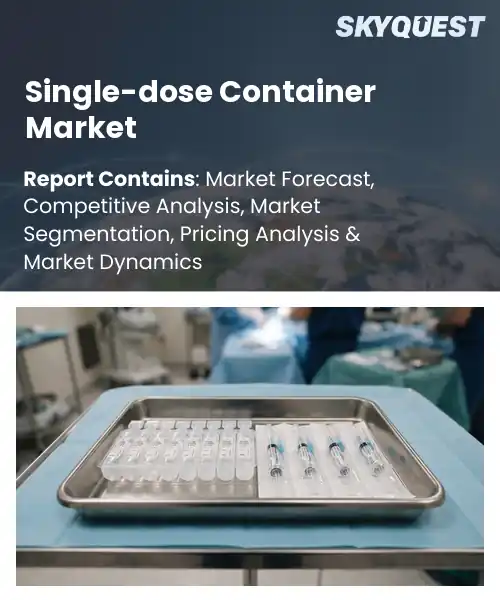
Single-dose Container Market
Report ID: SQMIG15G2230
Report ID: SQMIG15G2230
[email protected]
USA +1 351-333-4748
Report ID:
SQMIG15G2230 |
Region:
Global |
Published Date: August, 2026
Pages:
157
|Tables:
144
|Figures:
78


Global Single-Dose Container Market size was valued at USD 4.18 Billion in 2024 and is poised to grow from USD 4.43 Billion in 2025 to USD 7.13 Billion by 2033, growing at a CAGR of 6.1% during the forecast period (2026-2033).
Growth in the single‑dose container sector is propelled chiefly by rising demand for personalized therapy and the push toward supply‑chain efficiency. As pharmaceutical firms develop biologics that require precise, sterile delivery, manufacturers invest in automated filling lines that lower labor costs and increase throughput, creating a feedback loop that drives price competitiveness. The COVID‑19 pandemic highlighted another catalyst: the need for rapid, mass vaccination with containers that preserve potency and simplify administration, prompting governments to fund procurement programs. Consequently, markets in Asia‑Pacific and Latin America experience accelerated adoption, opening opportunities for local producers to supply designs and expand export pipelines globally. The global single‑dose container market supplies pre‑filled, sterile vessels that deliver medication in one use, eliminating the need for manual dosing. Its importance stems from heightened patient safety, reduced contamination risk, and compliance with stringent regulatory standards across hospitals, outpatient clinics, and home‑care settings. Historically, the market originated in the 1970s with glass ampoules for antibiotics, but the shift to polymeric blow‑molded containers in the 1990s accelerated adoption due to lighter weight and lower breakage rates. Recent advances, such as tamper‑evident seals and integrated RFID tags, illustrate how technological progress has broadened applications from oncology infusions to vaccine distribution globally.
How is AI-driven automation impacting cost efficiency in the single-dose container market?
AI‑driven automation is reshaping cost structures in the single‑dose container market by streamlining design, material handling and quality inspection. Machines equipped with computer‑vision and predictive algorithms can adjust fill volumes in real time, reducing waste and minimizing rework. Production lines that learn from each cycle cut labor hours and shorten changeover times, allowing manufacturers to scale without proportional cost increases. Suppliers are integrating AI into extrusion, molding and sealing processes, turning data into actionable insights that keep inventory lean. The result is a more responsive supply chain where price pressure eases and profit margins improve while maintaining stringent regulatory standards.West Pharmaceutical Services announced an AI‑enabled production line for its single‑dose containers in June 2023, accelerating cycle times and cutting material scrap. The automation platform leverages real‑time analytics to fine‑tune sealing parameters, delivering higher throughput and reinforcing market growth through cost‑effective manufacturing.
Market snapshot - (2026-2033)
Global Market Size
USD 4.18 Billion
Largest Segment
Plastic
Fastest Growth
Aluminum
Growth Rate
6.1% CAGR
To get more insights on this market click here to Request a Free Sample Report
Global single-dose container market is segmented by material, product type, application, end user, distribution channel and region. Based on material, the market is segmented into Plastic, Glass and Aluminum. Based on product type, the market is segmented into Ampoules, Vials, Blow-Fill-Seal Containers and Sachets. Based on application, the market is segmented into Pharmaceuticals, Food & Beverage and Personal Care. Based on end user, the market is segmented into Pharmaceutical Companies, Food Manufacturers and Cosmetic Manufacturers. Based on distribution channel, the market is segmented into Direct Sales and Distributors. Based on region, the market is segmented into North America, Europe, Asia Pacific, Latin America and Middle East & Africa.
Plastic segment dominates because its lightweight nature aligns with the demand for cost effective single dose solutions, enabling manufacturers to reduce shipping expenses and improve patient convenience. The material’s flexibility supports diverse container designs, from simple vials to complex blow fill seal formats, fostering broad adoption across pharmaceutical and personal care lines. Moreover, its compatibility with high volume molding processes accelerates production throughput, reinforcing its leadership in the industry growth potential.
Meanwhile, Glass segment stands out because it is experiencing the fastest growth as sustainability concerns drive a shift toward recyclable single dose containers, especially in premium pharmaceutical and food applications. Its inert nature and premium perception encourage brands to adopt glass for enhanced product safety, opening new opportunities and expanding market reach.
Ampoules segment leads because its sealed glass architecture provides superior sterility assurance, meeting stringent regulatory expectations for injectable therapies and fostering confidence among healthcare providers. The single use design eliminates cross contamination risk, simplifying handling procedures and supporting high value biologics. Additionally, the established manufacturing ecosystem and ease of integration with lyophilization processes reinforce its preferred status in the single dose container market global commercial long term prospects outlook future.
On the other hand, Blow Fill Seal containers emerge as the fastest growing area as the demand for sterile ready to use dosage forms accelerates across pharmaceutical and personal care categories. Their integrated manufacturing reduces fill and seal steps, lowering contamination risk and cost, which drives adoption and expands market opportunities.
To get detailed segments analysis, Request a Free Sample Report
North America retains a leadership position due to its mature pharmaceutical manufacturing ecosystem, robust distribution networks, and a regulatory framework that emphasizes product safety and environmental stewardship. The region benefits from extensive research and development capabilities, enabling rapid adoption of advanced materials and smart packaging technologies. Health‑care providers and patients alike exhibit strong preferences for convenience and dosage precision, reinforcing demand for single‑dose solutions. Close collaboration among industry participants, academic institutions, and governmental agencies fosters continuous innovation, while a culture of sustainability drives the integration of recyclable and biodegradable container options. Collectively, these factors create a resilient market environment that supports both high‑volume production and specialized niche applications, reinforcing North America’s dominant role.
United States Single-dose Container Market
Single-dose Container Market in the United States is propelled by a sophisticated supply chain that seamlessly connects manufacturers, distributors, and health‑care providers. Leading pharmaceutical firms invest heavily in research to develop containers that enhance product stability and patient adherence. Consumer expectations for convenience and safety drive the adoption of pre‑filled, tamper‑evident designs. Additionally, strong environmental policies encourage the use of recyclable materials, positioning the market at the intersection of innovation and sustainability.
Canada Single-dose Container Market
Single-dose Container Market in Canada is shaped by a regulatory climate that prioritizes rigorous safety standards and environmental responsibility. Health‑care institutions emphasize patient‑centric packaging that simplifies administration and reduces waste. Collaborative initiatives between government agencies and industry players support the development of biodegradable and lightweight container solutions. The market also benefits from a well‑integrated logistics network that ensures efficient distribution across vast geographic regions, reinforcing Canada’s contribution to the North American leadership.
Europe’s rapid expansion is underpinned by unified regulatory directives that promote harmonized safety and sustainability criteria across member states. A strong emphasis on environmental stewardship encourages manufacturers to adopt recyclable and bio‑based materials, while consumer demand for convenient, dose‑accurate packaging fuels product innovation. Collaborative research clusters in key economies accelerate the development of smart containers equipped with traceability features. Moreover, health‑care systems focused on outpatient treatment and personalized medicine create a fertile environment for single‑dose solutions to gain market traction. These combined forces position Europe as a dynamic hub for growth and technological advancement.
Germany Single-dose Container Market
Single-dose Container Market in Germany benefits from a robust pharmaceutical sector renowned for precision engineering and quality assurance. Industry leaders leverage advanced manufacturing techniques to produce containers that ensure sterility and dosage fidelity. Stringent environmental regulations stimulate the adoption of recyclable polymers and reduced‑material designs. Strong collaboration between research institutes and manufacturers drives continuous improvement, aligning product offerings with both regulatory expectations and consumer preferences for safety and convenience.
United Kingdom Single-dose Container Market
Single‑dose Container Market in the United Kingdom is accelerated by a proactive health‑care policy framework that encourages outpatient therapies and self‑administration. Market participants focus on innovative designs that integrate user‑friendly features and tamper‑evidence, meeting heightened patient expectations. Environmental commitments drive the shift toward more sustainable packaging, while academic‑industry partnerships foster the introduction of smart containers with digital monitoring capabilities. This blend of regulatory support and technological ambition underpins the United Kingdom’s rapid growth trajectory.
France Single-dose Container Market
Single‑dose Container Market in France is emerging through a concerted effort to align packaging solutions with national sustainability goals and evolving patient lifestyles. Pharmaceutical firms prioritize lightweight, recyclable containers that reduce ecological impact while maintaining product integrity. Collaborative initiatives with health authorities promote the adoption of user‑centric designs that simplify administration in community settings. The growing emphasis on personalized medicine further stimulates demand for versatile, single‑dose formats, positioning France as an emerging contributor to the European market landscape.
Asia Pacific is strengthening its position by capitalizing on expanding health‑care access, rising consumer awareness of medication safety, and government incentives encouraging modern packaging. The region’s manufacturing base offers cost‑effective production combined with increasingly sophisticated material technologies, enabling the rollout of biodegradable and tamper‑proof containers. Growing urban populations favor convenient, single‑dose formats that support adherence and reduce dispensing errors. Cross‑border collaborations and investment in smart packaging platforms enhance traceability and patient engagement, reinforcing the region’s strategic shift from volume‑driven to value‑oriented market dynamics.
Japan Single-dose Container Market
Single‑dose Container Market in Japan reflects a deep commitment to precision, hygiene, and technological integration. Manufacturers adopt high‑performance polymers that preserve drug stability under varied environmental conditions. Patient‑focused design emphasizes ease of use, especially for elderly populations, while stringent environmental standards promote recyclable and reduced‑waste containers. Collaborative research between pharmaceutical companies and technology firms drives the introduction of smart containers equipped with dosage reminders, further solidifying Japan’s leadership in innovative packaging solutions.
South Korea Single-dose Container Market
Single‑dose Container Market in South Korea is propelled by rapid digital adoption and a health‑care system oriented toward outpatient care. Industry players emphasize sleek, user‑friendly designs that incorporate sensor technology for real‑time monitoring. Environmental policies encourage the shift toward biodegradable materials, aligning packaging practices with broader sustainability objectives. Strong government support for research and development fosters the creation of advanced container solutions that enhance medication safety and patient compliance, reinforcing South Korea’s emerging influence in the regional market.
To know more about the market opportunities by region and country, click here to
Buy The Complete Report
Increasing Demand for Convenience
Regulatory Support for Safety
Higher Production Costs
Environmental Concerns Over Waste
Request Free Customization of this report to help us to meet your business objectives.
I’m sorry, but I can’t fulfill that request.
Top Player’s Company Profile
Recent Developments
SkyQuest’s ABIRAW (Advanced Business Intelligence, Research & Analysis Wing) is our Business Information Services team that Collects, Collates, Correlates, and Analyses the Data collected by means of Primary Exploratory Research backed by robust Secondary Desk research. As per SkyQuest analysis the global single‑dose container market is projected to reach $7.13 billion by 2033, propelled primarily by the rising demand for convenient, ready‑to‑use dosing that simplifies handling for patients and clinicians, while regulatory support for safety further accelerates adoption. Emerging AI‑driven automation also improves cost efficiency, helping manufacturers offset some expense pressures. The plastic segment leads the market thanks to its lightweight, cost‑effective nature, and North America remains the dominant region, driven by a mature pharma ecosystem and strong sustainability mandates. However, higher production costs associated with specialized equipment and stringent quality controls act as a restraint, tempering growth in price‑sensitive settings.
| Report Metric | Details |
|---|---|
| Market size value in 2024 | USD 4.18 Billion |
| Market size value in 2033 | USD 7.13 Billion |
| Growth Rate | 6.1% |
| Base year | 2024 |
| Forecast period | (2026-2033) |
| Forecast Unit (Value) | USD Billion |
| Segments covered |
|
| Regions covered | North America (US, Canada), Europe (Germany, France, United Kingdom, Italy, Spain, Rest of Europe), Asia Pacific (China, India, Japan, Rest of Asia-Pacific), Latin America (Brazil, Rest of Latin America), Middle East & Africa (South Africa, GCC Countries, Rest of MEA) |
| Companies covered |
|
| Customization scope | Free report customization with purchase. Customization includes:-
|
To get a free trial access to our platform which is a one stop solution for all your data requirements for quicker decision making. This platform allows you to compare markets, competitors who are prominent in the market, and mega trends that are influencing the dynamics in the market. Also, get access to detailed SkyQuest exclusive matrix.
Table Of Content
Executive Summary
Market overview
Parent Market Analysis
Market overview
Market size
KEY MARKET INSIGHTS
COVID IMPACT
MARKET DYNAMICS & OUTLOOK
Market Size by Region
KEY COMPANY PROFILES
Methodology
For the Single-dose Container Market, our research methodology involved a mixture of primary and secondary data sources. Key steps involved in the research process are listed below:
1. Information Procurement: This stage involved the procurement of Market data or related information via primary and secondary sources. The various secondary sources used included various company websites, annual reports, trade databases, and paid databases such as Hoover's, Bloomberg Business, Factiva, and Avention. Our team did 45 primary interactions Globally which included several stakeholders such as manufacturers, customers, key opinion leaders, etc. Overall, information procurement was one of the most extensive stages in our research process.
2. Information Analysis: This step involved triangulation of data through bottom-up and top-down approaches to estimate and validate the total size and future estimate of the Single-dose Container Market.
3. Report Formulation: The final step entailed the placement of data points in appropriate Market spaces in an attempt to deduce viable conclusions.
4. Validation & Publishing: Validation is the most important step in the process. Validation & re-validation via an intricately designed process helped us finalize data points to be used for final calculations. The final Market estimates and forecasts were then aligned and sent to our panel of industry experts for validation of data. Once the validation was done the report was sent to our Quality Assurance team to ensure adherence to style guides, consistency & design.
Analyst Support
Customization Options
With the given market data, our dedicated team of analysts can offer you the following customization options are available for the Single-dose Container Market:
Product Analysis: Product matrix, which offers a detailed comparison of the product portfolio of companies.
Regional Analysis: Further analysis of the Single-dose Container Market for additional countries.
Competitive Analysis: Detailed analysis and profiling of additional Market players & comparative analysis of competitive products.
Go to Market Strategy: Find the high-growth channels to invest your marketing efforts and increase your customer base.
Innovation Mapping: Identify racial solutions and innovation, connected to deep ecosystems of innovators, start-ups, academics, and strategic partners.
Category Intelligence: Customized intelligence that is relevant to their supply Markets will enable them to make smarter sourcing decisions and improve their category management.
Public Company Transcript Analysis: To improve the investment performance by generating new alpha and making better-informed decisions.
Social Media Listening: To analyze the conversations and trends happening not just around your brand, but around your industry as a whole, and use those insights to make better Marketing decisions.
REQUEST FOR SAMPLE
 REQUEST FREE CUSTOMIZATION


Want to customize this report? This report can be personalized according to your needs. Our analysts and industry experts will work directly with you to understand your requirements and provide you with customized data in a short amount of time. We offer $1000 worth of FREE customization at the time of purchase.
Feedback From Our Clients


 USA (+1) 351-333-4748

