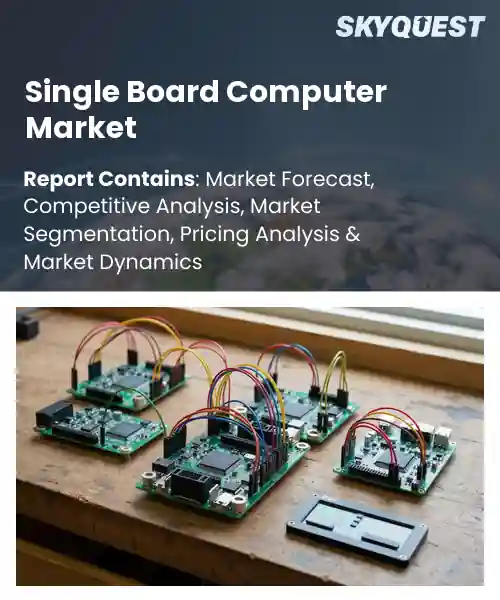
Single Board Computer Market
Report ID: SQMIG45I2411
Report ID: SQMIG45I2411
[email protected]
USA +1 351-333-4748
Report ID:
SQMIG45I2411 |
Region:
Global |
Published Date: June, 2026
Pages:
157
|Tables:
93
|Figures:
76


Global Single Board Computer Market size was valued at USD 3.64 Billion in 2024 and is poised to grow from USD 3.81 Billion in 2025 to USD 5.55 Billion by 2033, growing at a CAGR of 4.8% during the forecast period (2026-2033).
Single board computers (SBCs) act like compact, all in one computing platforms, where it offers the CPU, memory, storage interfaces and connectivity tied together on one circuit board, and the main reason people talk about them is the surge of Internet of Things and edge computing needs, which want low cost, low-power processing near the actual data sources. The market matters because these boards help with fast prototyping, affordable learning, and more scalable industrial rollouts, so product development moves quicker, and the entry barrier drops a little too.
As form factors and performance levels keep diversifying, a real growth driver became the meeting point of affordable, high performance SoCs with a widening edge software ecosystem, and that mix pushed industries to adopt SBCs for workloads where latency is king, and also where budgets are tight. For instance, factory operators use NVIDIA Jetson modules in vision systems so defects can be spotted in real time. Meanwhile, telecom providers drop ARM based SBCs into 5G edge nodes, partly to cut backhaul expenses, and partly to support private network setups. This demand pushes component miniaturization, it also encourages standardized carrier boards, and it strengthens OS support, so suddenly there are openings for value added services, longer maintenance contracts, and more verticalized solutions plus partnerships.
AI integration is basically turning maker style and educational boards into edge AI appliances, and that is raising performance expectations everywhere in this SBC market. Some key pressure points are higher sustained compute, dedicated AI accelerators, more memory bandwidth, better thermal design, and software toolchains that are actually built for modern development. In the current state, vendors are shipping optimized AI stacks and smaller compact modules, so devices can handle real time vision or voice tasks right at the edge. Also the market itself is splitting, can see it in the difference between low cost maker boards and industrial grade SBCs, which must keep reliability high and throughput steady over time. This direction in vendor roadmaps is noticed and in new product lines that explicitly prioritize AI inferencing and developer ecosystems.
Market snapshot - (2026-2033)
Global Market Size
USD 3.64 Billion
Largest Segment
ARM
Fastest Growth
Others
Growth Rate
4.8% CAGR
To get more insights on this market click here to Request a Free Sample Report
The global single board computer market is segmented by processor architecture, component, end-use industry and region. Based on processor architecture, the market is segmented into ARM, x86, PowerPC and Others. Based on component, the market is segmented into Logic Devices, Memory Devices, and Others. Based on end-use industry, the market is segmented into Industrial Automation, Aerospace and Defense, Healthcare, Consumer Electronics and Others. Based on region, the market is segmented into North America, Europe, Asia Pacific, Latin America and Middle East & Africa.
As per the single board computer market analysis, the ARM segment dominates because its energy efficient RISC design lines up with single board computers priorities, mainly low power consumption, thermal efficiency, and cost effective integration. Compact instruction sets help vendors squeeze better board layouts, and also make battery powered deployments easier. Meanwhile broad software ecosystems plus established toolchains reduce development friction , and that makes the whole thing feel smoother in practice. Together these reasons form a virtuous cycle where manufacturers lean toward ARM architectures so they can ship products faster and still cover a wide range of embedded application needs.
However, x86 is becoming the most rapidly expanding option, because the demand for legacy desktop software compatibility keeps rising. Enhanced single core performance also matters a lot for compute intensive single board applications, so adoption increases where performance per core is a big deal. Stronger compiler support, familiar development environments, and more low power x86 chips available are letting designers handle complicated workloads. In turn, that opens new industrial and multimedia uses, or at least it makes them more reachable for teams.
According to the single board computer market forecast, the Memory Devices segment dominates, since storage and volatile memory basically decide single board computer responsiveness, boot behavior , and long term data integrity which embedded apps really rely on. High performance flash, plus scalable DRAM choices, pull board design decisions and system costs in specific directions. At the same time, newer non volatile memories are enabling more complex firmware and more secure storage options. So, manufacturers prioritize memory architecture to meet application specific latency, endurance, and reliability requirements, directly.
On the other hand, Logic Devices are the fastest growing category, driven by surging integration of programmable logic, FPGAs and specialized accelerators into single board computer designs. Flexible logic supports rapid prototyping, workload offloading, and customizable input output functions. It attracts innovators building edge AI, real time control, and adaptable industrial solutions that expand addressable applications, and also grow supplier ecosystems around them.
To get detailed segments analysis, Request a Free Sample Report
As per the single board computer market regional forecast, Asia Pacific is taking over the market, not just because one thing, but because a blend of supply chain density, concentrated build know-how, and this solid web of component vendors and contract manufacturing. When hardware folks and system integrators connect tightly, they can iterate faster, and, they also squeeze costs out in a more efficient way, even when the requirements keep shifting. And demand is all over the map, from consumer gadgets , industrial automation, education tools, and telecommunications, so the addressable market stays wide enough to justify multiple shape styles and different performance rungs. At the same time, local tech hubs teaming up with research institutes helps push things forward in low power design , edge computing, and specialized interfaces. Then there’s regional policy support for electronics manufacturing, plus money for fabrication and packaging, which locks in competitiveness. Also proximity to component suppliers matters, because it shortens development cycles and lets companies do quick variations for international clients that want adaptable single board computer solutions.
Japan Single Board Computer Market
The Single Board Computer sector in Japan tends to benefit from thick electronics supply routes, and also a culture of exacting engineering that makes room for tailored board designs aimed at industrial and automotive use. The collaboration between long-standing component manufacturers and university or research groups helps turn into new ideas around reliability, thermal handling, and practical endurance. Local integrators often stress quality assurance and long lifespans, so Japan becomes a dependable source of reliable modules for both export and domestic adoption, especially across telecom systems, factory automation and embedded instrumentation.
South Korea Single Board Computer Market
The Single Board Computer industry in South Korea plays a different card by leveraging strong semiconductor design ability, plus a fast moving electronics manufacturing base, to enable advanced single board computer development for telecom, consumer electronics, and industrial automation. There is close work between chipset vendors, OEMs, and research communities, which helps speed up feature blending and cooptimization between software and hardware. The focus on miniaturization, connectivity , and energy efficiency makes South Korea look like a go to region for compact high performance modules, for both regional and global system integrators who need density without giving up too much speed.
North America’s single board computer market is expanding quickly, mostly because edge computing rollouts are getting heavy attention, plus there’s this broad mix of end uses, and also a mature software development and integration ecosystem that actually supports production. Telecom, aerospace, medical devices, and smart infrastructure pull demand upward, and that leads to customization plus more rigorous certification processes, which often lifts the design value. Meanwhile venture capital and corporate funding in system software, security components, and specialized accelerators help teams get solutions ready faster for commercial adoption. Startups building hardware together with original equipment manufacturers, and cloud service providers too, cuts time to market. Add strong channel networks and system integrators, and offer more tailored system builds. And when cybersecurity plus functional safety get regulatory spotlight, that raises the bar for specs, which tends to favor established design houses and already validated single board computer platforms worldwide.
United States Single Board Computer Market
The Single Board Computer Market in the United States benefits from tight integration across cloud service providers, edge infrastructure initiatives, and an energetic startup ecosystem that prototypes creative new form factors. Strong interest from telecom operators, industrial automation, and defense drives demand for advanced thermal control and security oriented design. Established contract manufacturers plus specialized system integrators help reduce friction in prototyping and compliance testing, so the United States is often treated like a development and commercialization hub for customized single board computer solutions.
Canada Single Board Computer Market
The Single Board Computer Market in Canada leans on cooperation between research institutions and integrators to support energy, transportation, and smart city projects. Procurement often pushes interoperability, secure design, and those expectations, so validation is taken seriously. Local companies tend to concentrate on ruggedization, connectivity , and power efficiency for remote deployments where conditions are not friendly. Partnerships with software providers and nearby manufacturers also improve customization and long term maintainability, making Canada a reliable regional source for application specific single board computer platforms.
Europe is strengthening its position in the single board computer market via coordinated industrial actions, and there is also this emphasis on standards… plus they’re really pushing for high reliability use cases. Investments in local design skills and partnerships between semiconductor companies and systems integrators encourages modular architectures, and they keep returning to interoperability like it’s a big deal. Then there are sectors like automotive, industrial control, and medical devices which basically demand strict functional safety and certification, so suppliers tend to lean toward stronger validation routines and clearer supply chain transparency. On top of that, regional initiatives around semiconductor sovereignty and more localized manufacturing, give more control over where components come from. A more mature engineering talent base, mixed with sustainability and lifecycle management priorities is shifting procurement toward suppliers that can show long term support, and environmental compliance for single board computer solutions. Also cross border research programs and clustering of specialized manufacturers help accelerate prototyping, and they make tailored supply arrangements easier for OEMs, so Europe starts looking even more attractive as a source of certified, application specific single board computer platforms.
Germany Single Board Computer Market
The Single Board Computer Market in Germany leans heavily into industrial grade designs for manufacturing, automotive and energy management systems. There is close collaboration between auto suppliers, automation firms and semiconductor designers, this helps build robust architectures and certified interfaces. Integrators tend to prioritize lifecycle support, predictable sourcing and compliance with demanding industrial standards. So the demand is mainly for durable, reliable single board computer platforms engineered for long term deployment in rough industrial surroundings, and for integration into more complex control systems, not just simple deployments.
United Kingdom Single Board Computer Market
The Single Board Computer Market in the United Kingdom benefits from a strong ecosystem of design consultancies, research centers and specialist manufacturers, especially for telecom, IoT and defense. The focus is on interoperability, security standards, and modular design, which pushes scalable solutions forward. Integrators and independent test houses provide rigorous validation and certification backing, while collaborative innovation hubs speed up prototype transitions. Overall the market favors flexible but secure single board computer modules that can integrate with cloud platforms and infrastructure deployments without much drama.
France Single Board Computer Market
The Single Board Computer Market in France benefits from a mix of research led development, specialized manufacturing and systems integrators that serve aerospace, transport and industrial automation. The emphasis on regulatory compliance, robustness and energy efficiency influences the way the boards are architected and how supply chain choices are made. Partnerships between labs and SMEs help accelerate niche solutions and get certification readiness closer to reality faster. French providers also put a premium on modularity and software compatibility, so they can handle different customer requirements across security sensitive, and mission critical applications.
To know more about the market opportunities by region and country, click here to
Buy The Complete Report
Proliferation Of IoT Applications
Expansion Of Smart Device Ecosystem
Complex Hardware and Software Integration
Intellectual Property and Licensing Constraints
Request Free Customization of this report to help us to meet your business objectives.
The competitive scenery in the worldwide single-board computer market is getting pushed forward by consolidation, strategic OEM distributor tie-ups, and processor-platform innovation that forces differentiation harder than before. This can be seen in congatec’s 2025 purchase of JUMPtec, Radxa teaming up with StarFive to ship RISC-V boards, OKdo’s NXP-supported E1 platform, and DeepComputing’s recent RISC-V mainboard rollouts — basically, very specific moves that shape both market placement and supply chain flow.
Top Player’s Company Profile
Recent Developments in the Single Board Computer Market
SkyQuest’s ABIRAW (Advanced Business Intelligence, Research & Analysis Wing) is our Business Information Services team that Collects, Collates, Correlates, and Analyses the Data collected by means of Primary Exploratory Research backed by robust Secondary Desk research.
As per SkyQuest analysis, the global single board computer market is being propelled by the spread of IoT applications that need compact, low power processing near data sources, yet there is still a restraint—hardware plus software integration can get complex, especially for varied peripherals and certified deployments. ARM processor architectures continue to dominate due to energy efficiency and the wide software support behind them. Regionally, Asia Pacific is leading, mostly because there are dense supply chains and manufacturing ecosystems that move quickly. Another big driver is AI integration at the edge, which drives up both performance expectations and thermal requirements, but it also opens up new vertical opportunities in vision, robotics, and telecom. Vendors that can balance scalability, ongoing support, and sustainability will likely grab the most growth, and frankly it’s not just about speed it’s about fit and long term manageability.
| Report Metric | Details |
|---|---|
| Market size value in 2024 | USD 3.64 Billion |
| Market size value in 2033 | USD 5.55 Billion |
| Growth Rate | 4.8% |
| Base year | 2024 |
| Forecast period | (2026-2033) |
| Forecast Unit (Value) | USD Billion |
| Segments covered |
|
| Regions covered | North America (US, Canada), Europe (Germany, France, United Kingdom, Italy, Spain, Rest of Europe), Asia Pacific (China, India, Japan, Rest of Asia-Pacific), Latin America (Brazil, Rest of Latin America), Middle East & Africa (South Africa, GCC Countries, Rest of MEA) |
| Companies covered |
|
| Customization scope | Free report customization with purchase. Customization includes:-
|
To get a free trial access to our platform which is a one stop solution for all your data requirements for quicker decision making. This platform allows you to compare markets, competitors who are prominent in the market, and mega trends that are influencing the dynamics in the market. Also, get access to detailed SkyQuest exclusive matrix.
Table Of Content
Executive Summary
Market overview
Parent Market Analysis
Market overview
Market size
KEY MARKET INSIGHTS
COVID IMPACT
MARKET DYNAMICS & OUTLOOK
Market Size by Region
KEY COMPANY PROFILES
Methodology
For the Single Board Computer Market, our research methodology involved a mixture of primary and secondary data sources. Key steps involved in the research process are listed below:
1. Information Procurement: This stage involved the procurement of Market data or related information via primary and secondary sources. The various secondary sources used included various company websites, annual reports, trade databases, and paid databases such as Hoover's, Bloomberg Business, Factiva, and Avention. Our team did 45 primary interactions Globally which included several stakeholders such as manufacturers, customers, key opinion leaders, etc. Overall, information procurement was one of the most extensive stages in our research process.
2. Information Analysis: This step involved triangulation of data through bottom-up and top-down approaches to estimate and validate the total size and future estimate of the Single Board Computer Market.
3. Report Formulation: The final step entailed the placement of data points in appropriate Market spaces in an attempt to deduce viable conclusions.
4. Validation & Publishing: Validation is the most important step in the process. Validation & re-validation via an intricately designed process helped us finalize data points to be used for final calculations. The final Market estimates and forecasts were then aligned and sent to our panel of industry experts for validation of data. Once the validation was done the report was sent to our Quality Assurance team to ensure adherence to style guides, consistency & design.
Analyst Support
Customization Options
With the given market data, our dedicated team of analysts can offer you the following customization options are available for the Single Board Computer Market:
Product Analysis: Product matrix, which offers a detailed comparison of the product portfolio of companies.
Regional Analysis: Further analysis of the Single Board Computer Market for additional countries.
Competitive Analysis: Detailed analysis and profiling of additional Market players & comparative analysis of competitive products.
Go to Market Strategy: Find the high-growth channels to invest your marketing efforts and increase your customer base.
Innovation Mapping: Identify racial solutions and innovation, connected to deep ecosystems of innovators, start-ups, academics, and strategic partners.
Category Intelligence: Customized intelligence that is relevant to their supply Markets will enable them to make smarter sourcing decisions and improve their category management.
Public Company Transcript Analysis: To improve the investment performance by generating new alpha and making better-informed decisions.
Social Media Listening: To analyze the conversations and trends happening not just around your brand, but around your industry as a whole, and use those insights to make better Marketing decisions.
REQUEST FOR SAMPLE
 REQUEST FREE CUSTOMIZATION
Global Single Board Computer Market size was valued at USD 3.64 Billion in 2024 and is poised to grow from USD 3.81 Billion in 2025 to USD 5.55 Billion by 2033, growing at a CAGR of 4.8% during the forecast period (2026-2033).
The competitive landscape in the global single-board computer market is being driven by consolidation, strategic OEM-distributor partnerships, and processor-platform innovation that intensifies differentiation. Examples include congatec’s 2025 acquisition of JUMPtec, Radxa’s collaboration with StarFive to deliver RISC-V boards, OKdo’s NXP-backed E1 platform, and DeepComputing’s recent RISC-V mainboard launches — concrete tactics shaping market positioning and supply chains. 'Siemens', 'General Electric', 'Intel', 'Qualcomm', 'Fujitsu', 'NVIDIA', 'Texas Instruments', 'Advantech', 'Kontron', 'Mercury Systems', 'Digi International', 'Adlink Technology', 'Aaeon', 'Raspberry Pi Foundation', 'Broadcom', 'Xilinx', 'Microchip Technology', 'SolidRun', 'Eurotech', 'Abaco Systems'
The widespread deployment of connected sensors and embedded systems across industrial, consumer, and commercial environments increases demand for compact, energy efficient processing platforms that can handle diverse I/O and protocol requirements. Single board computers provide flexible hardware interfaces and development ecosystems that simplify integration with wireless modules, sensors, and gateways, enabling faster prototyping and deployment of IoT solutions. This practical compatibility with heterogeneous subsystems and support for custom software stacks encourages system designers to select single board computers as a practical foundation for connected product and service offerings.
Edge Ai Acceleration: The single board computer market is increasingly driven by demand for localized artificial intelligence processing, with vendors optimizing SBC architectures for on-device inference, neural compute modules and hardware-aware model deployment. This trend emphasizes low-latency decision making, enhanced privacy through edge processing, and integration into robotics, autonomous systems and smart vision. Ecosystem maturation around software toolchains, prevalidated models and middleware reduces time to deployment and enables solution providers to deliver differentiated, application-specific SBC offerings across diverse industry segments.
Why does Asia Pacific Dominate the Global Single Board Computer Market? |@12


Want to customize this report? This report can be personalized according to your needs. Our analysts and industry experts will work directly with you to understand your requirements and provide you with customized data in a short amount of time. We offer $1000 worth of FREE customization at the time of purchase.
Feedback From Our Clients


 USA (+1) 351-333-4748

