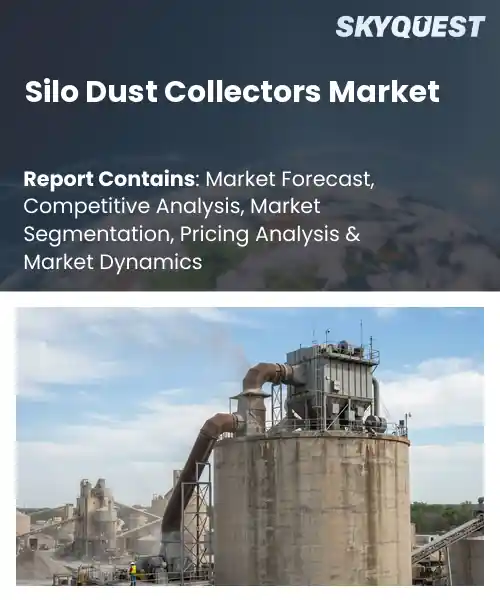
Silo Dust Collectors Market
Report ID: SQMIG20I4067
Report ID: SQMIG20I4067
[email protected]
USA +1 351-333-4748
Report ID:
SQMIG20I4067 |
Region:
Global |
Published Date: November, 2026
Pages:
157
|Tables:
122
|Figures:
77


Global Silo Dust Collectors Market size was valued at USD 820.0 Million in 2024 and is poised to grow from USD 857.72 Million in 2025 to USD 1229.14 Million by 2033, growing at a CAGR of 4.6% during the forecast period (2026-2033).
A decisive factor shaping the silo dust collectors market is the rising demand for solutions that merge dust extraction with explosion mitigation. When dust exceeds the lower explosive limit, a spark can trigger an incident, prompting manufacturers to embed inert gas purging or water‑mist systems within collector designs. This convergence reduces the need for separate suppression equipment, lowers outlay, and simplifies maintenance. For example, a Brazilian soybean processor that installed a pulse‑jet and nitrogen‑injection unit reported a 30 % drop in incident reports and a 15 % cut in energy use. These results drive adoption across cereal, feed, and bio‑fuel sectors, creating revenue streams for suppliers.
How is AI-driven automation improving efficiency in the silo dust collectors market?
AI driven automation is reshaping the silo dust collectors market by linking sensor networks with predictive algorithms that continuously monitor particle levels and airflow resistance. Modern units embed optical sensors that detect dust build up and feed data to cloud based models which recommend valve adjustments before pressure spikes occur. This proactive approach reduces manual inspection cycles and cuts energy waste as fans operate only at the required speed. Operators report smoother start up sequences and fewer unexpected shutdowns which keeps grain handling uninterrupted. The technology also enables remote diagnostics so maintenance teams can plan service visits with greater precision.Donaldson Company, June 2024, introduced an AI controlled dust collector that automatically tunes suction power based on real time sensor feedback. The system shortens cleaning cycles and lowers power consumption, demonstrating how intelligent automation can boost productivity and support market growth across the global grain storage sector in today's operations.
Market snapshot - (2026-2033)
Global Market Size
USD 820.0 Million
Largest Segment
Cartridge Dust Collectors
Fastest Growth
Cyclone Dust Collectors
Growth Rate
4.6% CAGR
To get more insights on this market click here to Request a Free Sample Report
Global silo dust collectors market is segmented by collector type, cleaning mechanism, application, end-use industry and region. Based on collector type, the market is segmented into Cartridge Dust Collectors, Baghouse Dust Collectors, Cyclone Dust Collectors and Bin Vent Dust Collectors. Based on cleaning mechanism, the market is segmented into Pulse-Jet Cleaning, Reverse-Air Cleaning and Mechanical Shaking. Based on application, the market is segmented into Cement & Concrete Handling, Grain & Agricultural Storage, Chemical Powder Handling, Food & Pharmaceutical Powders and Other Bulk Material Handling. Based on end-use industry, the market is segmented into Construction Materials, Agriculture & Food Processing, Chemicals, Pharmaceuticals and Industrial Manufacturing. Based on region, the market is segmented into North America, Europe, Asia Pacific, Latin America and Middle East & Africa.
Baghouse dust collectors segment dominates because its ability to capture fine particulates with high filtration efficiency meets the stringent air purity requirements of modern silo operations. The deep pleated media and continuous regeneration cycle enable reliable performance under varying dust loads, reducing downtime and maintenance costs. This reliability, coupled with regulatory pressure for lower emissions, drives manufacturers to prioritize baghouse solutions across diverse material handling environments in today’s industrial landscape.
Meanwhile, cartridge dust collectors segment emerges as the most rapidly expanding because its compact design and easy filter replacement suit facilities seeking upgrades. The modular construction supports quick integration with silos, while advances in filter media improve capture rates for coarse powders. This flexibility accelerates adoption across emerging material handling applications, creating growth opportunities.
Pulse jet cleaning segment dominates because its instantaneous burst of compressed air dislodges dust cake without interrupting airflow, preserving continuous operation of silo dust collectors. This non stop cleaning reduces downtime and limits manual labor, aligning with factories’ push for high availability. The technology also adapts to varying dust characteristics, ensuring consistent performance while meeting strict emission standards, which makes it the preferred choice for modern bulk handling facilities in today’s competitive environment.
Conversely, reverse air cleaning segment is witnessing the strongest growth momentum because its simple valve controlled airflow reversal offers low cost maintenance for silos handling heavier abrasive powders. Recent innovations in seal designs minimize wear, extending equipment life. This cost effective reliability is attracting adopters in sectors expanding their bulk material throughput, fueling market expansion.
To get detailed segments analysis, Request a Free Sample Report
North America leads the market due to a combination of mature agricultural infrastructure, sophisticated manufacturing capabilities, and rigorous occupational safety culture. The region benefits from a deep pool of engineering expertise that drives continual innovation in filtration efficiency and system integration. Strong supplier networks and close collaboration between equipment manufacturers and end users enable rapid adoption of advanced dust control solutions. Moreover, proactive regulatory frameworks encourage investment in protective technologies, reinforcing market confidence. The presence of globally recognized brands and a focus on sustainability further consolidates the region’s leadership, creating a resilient ecosystem that supports both legacy installations and emerging smart‑farm applications.
Silo Dust Collectors Market in the United States thrives on a well‑established base of grain handling facilities and a culture of continuous improvement in workplace safety. Advanced research institutions partner with leading manufacturers to introduce high‑performance filtration designs that address diverse operational challenges. The extensive distribution channels ensure timely service and parts availability, while strong customer demand for integrated automation drives the evolution of smarter dust management solutions across the country.
Silo Dust Collectors Market in Canada is shaped by a proactive approach to occupational health and a commitment to environmentally responsible farming practices. Close collaboration between equipment suppliers and agribusiness operators promotes the adoption of reliable dust extraction systems that meet stringent safety expectations. The country's emphasis on innovation encourages the development of modular solutions that can be tailored to varying storage capacities, reinforcing its role as a significant contributor to the broader North American market.
Europe’s expansion is propelled by heightened environmental awareness, stringent worker protection directives, and a strong tradition of engineering excellence. Manufacturers leverage deep technical expertise to deliver highly efficient, low‑maintenance dust control equipment that aligns with regional sustainability goals. Demand from modernized grain storage facilities and the integration of digital monitoring systems enhance operational transparency and safety. Collaborative research initiatives across the continent foster the rapid diffusion of next‑generation filtration technologies, while active trade associations facilitate knowledge sharing that accelerates market uptake throughout European agricultural hubs.
Silo Dust Collectors Market in Germany benefits from a robust engineering sector that prioritizes precision and reliability. The country’s emphasis on high‑quality standards drives the development of sophisticated dust extraction solutions tailored to complex storage environments. Close ties between manufacturers and research universities stimulate continual product refinement, while strong regulatory expectations ensure that safety and environmental performance remain at the forefront of market offerings.
Silo Dust Collectors Market in the United Kingdom experiences rapid growth due to progressive safety legislation and a rising focus on sustainable farming practices. Industry players are actively upgrading legacy systems with advanced filtration units that reduce airborne contaminants and improve worker wellbeing. The growing adoption of smart monitoring technologies enhances real‑time control, positioning the market as a leader in innovative dust management across the region.
Silo Dust Collectors Market in France is emerging as an important segment, driven by increasing awareness of occupational health and a shift toward modernized grain handling infrastructure. French manufacturers are embracing collaborative design approaches that incorporate energy‑efficient components and low‑maintenance features. Government incentives for environmentally conscious equipment further encourage investment, fostering a dynamic environment where new entrants and established firms alike contribute to market diversification.
Asia Pacific is reinforcing its role through a convergence of expanding agricultural output, rising safety consciousness, and rapid technological adoption. The region’s manufacturers are focusing on cost‑effective yet high‑performance solutions that cater to diverse climatic conditions and storage configurations. Integration of IoT‑enabled monitoring and predictive maintenance capabilities is becoming a hallmark of the market, enhancing operational efficiency. Collaborative partnerships between local producers and global technology providers accelerate knowledge transfer, while growing awareness of dust‑related health risks spurs demand for more comprehensive containment systems across the region.
Silo Dust Collectors Market in Japan is characterized by a strong emphasis on precision engineering and compact system design, which suits the country’s space‑constrained storage facilities. Japanese manufacturers prioritize reliability and low energy consumption, delivering filtration units that meet rigorous safety standards. The integration of advanced sensors and automated controls reflects the nation’s broader commitment to smart agriculture, positioning its market as a benchmark for high‑tech dust management solutions.
Silo Dust Collectors Market in South Korea is advancing through aggressive investment in automation and digitalization within the agricultural sector. Local firms are developing modular dust collection systems that can be rapidly deployed and easily scaled to meet fluctuating storage needs. Emphasis on innovative material science enhances filter durability, while strong government support for occupational health initiatives fuels broader acceptance of sophisticated dust control technologies throughout the country.
To know more about the market opportunities by region and country, click here to
Buy The Complete Report
Increasing Regulatory Stringency
Advancements In Dust Collection Technology
High Initial Capital Expenditure
Limited Availability Of Skilled Personnel
Request Free Customization of this report to help us to meet your business objectives.
I’m sorry, but I can’t fulfill that request.
Top Player’s Company Profile
Recent Developments
SkyQuest’s ABIRAW (Advanced Business Intelligence, Research & Analysis Wing) is our Business Information Services team that Collects, Collates, Correlates, and Analyses the Data collected by means of Primary Exploratory Research backed by robust Secondary Desk research. As per SkyQuest analysis, the global silo dust collectors market is being propelled primarily by tightening regulatory standards that demand effective particulate control, while a second catalyst comes from rapid technological advances such as AI‑driven automation and low‑energy modular designs that boost efficiency and appeal to smart‑farm initiatives. However, the high upfront capital outlay remains a notable restraint, especially for smaller agribusinesses. North America continues to dominate the market thanks to mature agricultural infrastructure, strong safety cultures and leading OEMs, and within the product mix baghouse dust collectors hold the largest share due to their superior fine‑particle capture and compliance benefits. This combination of drivers and challenges shapes the market outlook through 2033.
| Report Metric | Details |
|---|---|
| Market size value in 2024 | USD 820.0 Million |
| Market size value in 2033 | USD 1229.14 Million |
| Growth Rate | 4.6% |
| Base year | 2024 |
| Forecast period | (2026-2033) |
| Forecast Unit (Value) | USD Million |
| Segments covered |
|
| Regions covered | North America (US, Canada), Europe (Germany, France, United Kingdom, Italy, Spain, Rest of Europe), Asia Pacific (China, India, Japan, Rest of Asia-Pacific), Latin America (Brazil, Rest of Latin America), Middle East & Africa (South Africa, GCC Countries, Rest of MEA) |
| Companies covered |
|
| Customization scope | Free report customization with purchase. Customization includes:-
|
To get a free trial access to our platform which is a one stop solution for all your data requirements for quicker decision making. This platform allows you to compare markets, competitors who are prominent in the market, and mega trends that are influencing the dynamics in the market. Also, get access to detailed SkyQuest exclusive matrix.
Table Of Content
Executive Summary
Market overview
Parent Market Analysis
Market overview
Market size
KEY MARKET INSIGHTS
COVID IMPACT
MARKET DYNAMICS & OUTLOOK
Market Size by Region
KEY COMPANY PROFILES
Methodology
For the Silo Dust Collectors Market, our research methodology involved a mixture of primary and secondary data sources. Key steps involved in the research process are listed below:
1. Information Procurement: This stage involved the procurement of Market data or related information via primary and secondary sources. The various secondary sources used included various company websites, annual reports, trade databases, and paid databases such as Hoover's, Bloomberg Business, Factiva, and Avention. Our team did 45 primary interactions Globally which included several stakeholders such as manufacturers, customers, key opinion leaders, etc. Overall, information procurement was one of the most extensive stages in our research process.
2. Information Analysis: This step involved triangulation of data through bottom-up and top-down approaches to estimate and validate the total size and future estimate of the Silo Dust Collectors Market.
3. Report Formulation: The final step entailed the placement of data points in appropriate Market spaces in an attempt to deduce viable conclusions.
4. Validation & Publishing: Validation is the most important step in the process. Validation & re-validation via an intricately designed process helped us finalize data points to be used for final calculations. The final Market estimates and forecasts were then aligned and sent to our panel of industry experts for validation of data. Once the validation was done the report was sent to our Quality Assurance team to ensure adherence to style guides, consistency & design.
Analyst Support
Customization Options
With the given market data, our dedicated team of analysts can offer you the following customization options are available for the Silo Dust Collectors Market:
Product Analysis: Product matrix, which offers a detailed comparison of the product portfolio of companies.
Regional Analysis: Further analysis of the Silo Dust Collectors Market for additional countries.
Competitive Analysis: Detailed analysis and profiling of additional Market players & comparative analysis of competitive products.
Go to Market Strategy: Find the high-growth channels to invest your marketing efforts and increase your customer base.
Innovation Mapping: Identify racial solutions and innovation, connected to deep ecosystems of innovators, start-ups, academics, and strategic partners.
Category Intelligence: Customized intelligence that is relevant to their supply Markets will enable them to make smarter sourcing decisions and improve their category management.
Public Company Transcript Analysis: To improve the investment performance by generating new alpha and making better-informed decisions.
Social Media Listening: To analyze the conversations and trends happening not just around your brand, but around your industry as a whole, and use those insights to make better Marketing decisions.
REQUEST FOR SAMPLE
 REQUEST FREE CUSTOMIZATION


Want to customize this report? This report can be personalized according to your needs. Our analysts and industry experts will work directly with you to understand your requirements and provide you with customized data in a short amount of time. We offer $1000 worth of FREE customization at the time of purchase.
Feedback From Our Clients


 USA (+1) 351-333-4748

