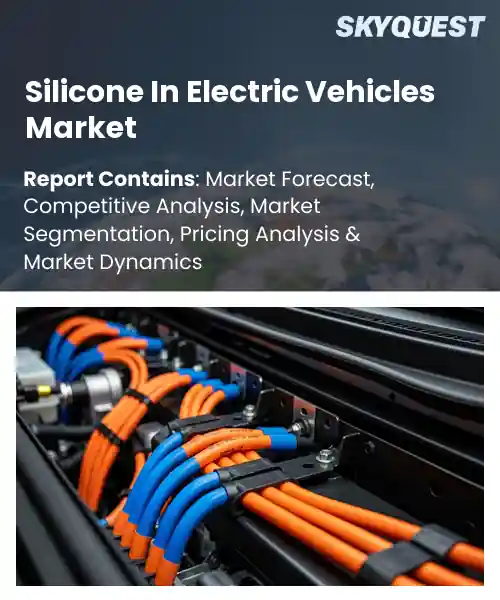
Silicone In Electric Vehicles Market
Report ID: SQMIG15B2204
Report ID: SQMIG15B2204
[email protected]
USA +1 351-333-4748
Report ID:
SQMIG15B2204 |
Region:
Global |
Published Date: May, 2026
Pages:
157
|Tables:
183
|Figures:
79


Global Silicone In Electric Vehicles Market size was valued at USD 9.6 Billion in 2024 and is poised to grow from USD 10.43 Billion in 2025 to USD 20.17 Billion by 2033, growing at a CAGR of 8.6% during the forecast period (2026-2033).
Silicone materials have become increasingly important due to the global switch from gas powered vehicles to electric vehicles. There are now many applications for silicone in electric vehicles including elastomers, adhesives, thermal interface materials, and sealants used in batteries, power electronics, electric motors, and EV charging infrastructure, all of which need chemical stability, a broad temperature range, and electrical insulation to perform safely without downtime. The use of silicone has evolved over time from niche sealing applications in traditional combustion vehicles to critical components that limit thermal runaway and meet robust safety requirements. Additionally, silicone potting applications for batteries among top OEMs and high-voltage gaskets used in today’s electric vehicles demonstrate this transformation.
In addition, the increasing energy density of EV batteries has been a major contributor to the silicone in electric vehicles market growth, as the higher density means that the electrical and thermal stresses on the EV batteries also increase significantly. Manufacturers build packs with higher temperature limits to increase the driving range of EVs, and as such, engineers are increasingly using silicone-based materials such as thermal interface materials, potting compounds, and high-voltage insulators. The reason for this is the excellent thermal conductivity, flexibility, and dielectric strength of silicone-based materials in reducing hotspots and preventing electrical insulation breakdown, all of which translates into fewer warranty costs and longer life for electric vehicles.
This causal pressure drives suppliers to develop high-conductivity silicone gels and flame-retardant formulations, enabling use cases such as bonded battery modules, compact inverter assemblies and weatherproof fast chargers deployed by utilities and fleet operators worldwide.
How is AI Enhancing Silicone Thermal Management In Electric Vehicles?
Silicone thermal management pertains to technologically designing materials or systems to dissipate heat from batteries, inverters, and power electronics in electric vehicles, ensuring the performance and durability of those devices. The development of new materials based on silicon is being advanced by AI through expedited material discovery, predictions of thermal properties and performance, and assistance in establish system level cooling strategies.
Current demand for increased power density and greater reliability has driven a significant interest in the use of advanced silicone materials in electric vehicle power electronic applications. The utilization of AI tools has enabled the use of virtual screening of formulations, real-time monitoring of the cooling process using sensors, and automated inspection of product quality during manufacturing. The result is reduced time required for the development processes of silicone materials and quicker qualification of manufacturers using silicone solutions, and enhanced operational resilience.
On September 4, 2020, Dow introduced the DOWSIL EG-4175 Silicone Gel product line to address the growing need for power electronics used to control high voltage in electric vehicles. The use of AI driven formulation screening methods, prediction of thermal performance, and other AI based tools will reduce the time it takes to validate these types of silicone products and increase the number of manufacturers who use silicone materials in battery and inverter components as well as improve the operational efficiency of those same manufacturers.
Market snapshot - (2026-2033)
Global Market Size
USD 9.6 Billion
Largest Segment
Silicone Elastomers
Fastest Growth
Silicone Thermal Interface Materials
Growth Rate
8.6% CAGR
To get more insights on this market click here to Request a Free Sample Report
Global silicone in electric vehicles market is segmented by product type, application, vehicle type, form, end use, sales channel and region. Based on product type, the market is segmented into Silicone Elastomers, Silicone Fluids, Silicone Resins, Silicone Gels, Silicone Adhesives & Sealants, Silicone Thermal Interface Materials and Others. Based on application, the market is segmented into Battery Systems, Power Electronics, Electric Motors & Drivetrain, Lighting Systems, Interior & Exterior Components, Wiring & Cable Insulation, Sensors & Electronic Components and Charging Infrastructure Components. Based on vehicle type, the market is segmented into Battery Electric Vehicles (BEV), Plug-in Hybrid Electric Vehicles (PHEV), Hybrid Electric Vehicles (HEV) and Fuel Cell Electric Vehicles (FCEV). Based on form, the market is segmented into Liquid Silicone Rubber (LSR), High Consistency Rubber (HCR), Room Temperature Vulcanizing (RTV) Silicone, Heat Cure Silicone and Silicone Foams. Based on end use, the market is segmented into Passenger Electric Vehicles, Commercial Electric Vehicles, Electric Two-Wheelers & Three-Wheelers and Off-Highway Electric Vehicles. Based on sales channel, the market is segmented into OEM and Aftermarket. Based on region, the market is segmented into North America, Europe, Asia Pacific, Latin America and Middle East & Africa.
As per silicone in electric vehicles market analysis, Silicone Thermal Interface Materials segment leads the way because it uniquely combines high thermal conductivity, electrical insulation and mechanical compliance to reliably transfer heat from power electronics while protecting the components sensitive to heat transfer. Because of their ability to be formed into the desired shape and their longevity, Silicone Thermal Interface Materials reduce thermal resistance due to vibration and thermal cycling, thus decreasing the probability of component failure and increasing component life. Due to the focus on producing compact, high-density power modules, manufacturers of these modules are directly using Silicone Thermal Interface Materials to allow for higher power density and the implementation of safer thermal management strategies.
As per silicone in electric vehicles market forecast, the sub-segment of Silicone Adhesives & Sealants is the fastest-growing sub-segment because adhesive solutions are reacting to the need for multifunctional bonding and sealing solutions required for electrified vehicle assemblies. Through utilization of improved cure chemistries and innovative formulations that enable improved adhesion to a variety of substrates, the demand for Silicone Adhesives & Sealants is increasing in both battery pack assemblies and cable potting applications, thereby allowing for more efficient assembly processes and creating repair opportunities for customers in the aftermarket.
Liquid Silicone Rubber leads the charge with its low viscosity and fast molding capabilities that provide a consistent insulation thickness on more complicated harnesses and connector bodies. These two attributes also offer an exceptional dielectric capability as well as flexibility through various temperatures. In addition to those advantages, Liquid Silicone Rubber will withstand thermal cycling, oils or chemicals, and resists aging, which requires little to no maintenance and meets automotive reliability standards. Additionally, LSR’s high throughput processing capabilities meet an OEM’s production economics; therefore, it has become widely utilized in wiring/cable systems.
As per silicone in electric vehicles market outlook, RTV Silicone has been the fastest growing silicone formulation in terms of both application ease and lack of heat curing when applying sealants/adhesives while sealing/repairing harnesses/connector combinations within the field. As the aftermarket service grows and there is an increase in rapid prototypes for new electric vehicle designs, RTVs are also anticipated to have an increase in their adoption by maintenance operations, providing flexible options for retrofitted insulation solutions.
To get detailed segments analysis, Request a Free Sample Report
Concentrated automotive production, its close location to battery and power electronics production, as well as its maturing chemicals industry, are all major factors contributing to Asia Pacific’s dominance in terms of specialty silicones. The OEM and supplier networks already established in this region allow for a quick and easy method of integrating silicone products into thermal management, sealing, and insulating systems; localization reduces lead time and promotes localization/customization. There is also strong R&D within material sciences within Asia Pacific due to the large companies making large investments in these two sectors (electronics & automotive). A collaborative approach is seen between the two industries allows both industries to be able to develop and qualify specialty silicones at scale (large volume). The large volume created by these certifications/both qualification and certification allows Asia Pacific to develop cost and performance standards for the production of electric vehicle components that influences the adoption of electric vehicles throughout the world. An industrial policy that assists manufactures develop qualifying processes quickly has aided in the commercialization of specialty silicone products/technology. Also, an established research and testing environment that complies with high standards as dictated by automotive OEMs has provided confidence to the supply chain.
The Japanese silicone in electric vehicles market is benefiting from a large manufacturing ecosystem and a very close working relationship with automotive OEMs. Silicone suppliers have established a maintenance system that allows their respective manufacturers to charge and manage power in addition to insulating, thermally managing and bonding vehicles' components. The focus on quality, reliability, and adherence to strict engineering standards also means that silicone applications can be deployed on any applications that utilize battery systems or power electronic devices in Japan and throughout the world.
The South Korean silicone in electric vehicles market is benefitting from the manufacturers' unique ability to develop, test and manufacture highly functional and usable parts due to the facilities available for testing and developing those parts, electronic components and batteries are geographically located close together. South Korean manufacturers have developed a partnership with each of their suppliers so they can work directly with them in creating custom formulations for thermal management, sealing, and electrical insulation, based on the specific configurations and characteristics of compact-vehicle designs used in South Korea. This close working relationship has resulted in the accelerated development of silicone materials for use in power electronic devices and battery modules used in both electric vehicles and gasoline-powered vehicles. The high degree of reliability associated with silicone solutions will increase the overall use of silicone products in the electric vehicle markets.
Europe expansion is driven by a confluence of strict regulatory frameworks promoting vehicle electrification, a strong incumbent automotive industry, and focused investments in electrified powertrain and battery ecosystems. OEMs and tier suppliers in region emphasize performance, durability, and regulatory compliance, prompting demand for advanced silicone solutions in high-voltage insulation, thermal management, and sealing. A dense network of research institutions and materials specialists supports rapid innovation and application testing, while growing consumer acceptance of electric mobility encourages scale up of localized supply chains. Cross border collaboration among manufacturers, material suppliers, and testing laboratories further accelerates qualification of silicone formulations tailored to European operating conditions and stringent safety standards, positioning Europe as a dynamic and demanding market for specialty silicones in electric vehicles.
Silicone In Electric Vehicles Market in Germany is characterized by a concentrated automotive manufacturing ecosystem, deep supplier networks, and strong engineering expertise. German materials firms work closely with OEMs and tier suppliers to develop performance silicones for power electronics, battery enclosures, and robust sealing applications. A regulatory and testing environment encourages reliability standards, while clusters of research institutes and facilities enable iteration and qualification of silicone compounds for demanding vehicular applications.
Silicone In Electric Vehicles Market in United Kingdom is emerging through advanced research centers, nimble materials suppliers, and collaborative initiatives. Local firms specialize in tailored silicones for lightweighting, acoustic damping, and precision bonding suited to varied vehicle architectures. Pilot programs and engineering partnerships with OEMs foster qualification and iteration of novel formulations. Emphasis on sustainability and cross sector innovation supports wider adoption and testing of silicone solutions across electric vehicle projects.
Silicone In Electric Vehicles Market in France is experiencing rapid expansion driven by industry investments, materials research, and collaborative ecosystems linking chemical manufacturers with vehicle producers. French firms focus on versatile silicone chemistries for thermal management, adhesion, and vibration control adapted to European requirements. Initiatives support pilot projects and accelerated qualification, while design oriented engineering teams emphasize integration of silicone components for reliability and sustainable material selection across electric vehicle platforms.
North America is strengthening its role through focused investments in domestic manufacturing, strategic partnerships between OEMs and materials companies, and concentrated research in advanced silicone technologies for electrified powertrains. Efforts to localize critical supply chains and expand qualification facilities enable faster adoption of silicone solutions for battery modules, inverters, and high voltage cable systems. Collaboration with universities and national labs accelerates material innovation and real world testing under varied operating conditions. Additionally, a growing network of tier suppliers and specialty formulators provides tailored silicone chemistries addressing thermal management, sealing, and durability, enhancing the region capability to meet commercial vehicle performance and safety expectations. Policy measures that support clean transportation and incentives for industrial investment, combined with demand from fleet electrification and commercial vehicle sectors, further stimulate advancement of silicone applications across manufacturing and service ecosystems.
Silicone In Electric Vehicles Market in United States benefits from automotive manufacturing capacity, a base of silicone and specialty chemical producers, and extensive research infrastructure. Materials developers partner with OEMs and power electronics firms to tailor silicones for battery thermal control, high voltage insulation, and sealing solutions. Investment in qualification facilities and supply chain localization supports commercialization, while diverse supplier networks enable customized formulations for varied vehicle architectures and climate conditions.
Silicone In Electric Vehicles Market in Canada leverages materials expertise, a cluster of chemical manufacturers, and research partnerships focused on cold climate performance. Local silicone producers develop formulations for sealing, thermal stability, and cable insulation suited to harsh operating conditions. Collaboration with vehicle manufacturers and academic centers accelerates testing and qualification, while emphasis on sustainable sourcing and circular material strategies supports adoption across broader domestic and export electric vehicle supply chains.
To know more about the market opportunities by region and country, click here to
Buy The Complete Report
Enhanced Thermal Management Capabilities
Stringent Safety and insulation Needs
High Material and processing Costs
Limited Long-Term Supply Stability
Request Free Customization of this report to help us to meet your business objectives.
Competitive pressure in the silicone for EVs market is driven by OEM thermal targets and rapid electrification, forcing suppliers into partnerships acquisitions and targeted investments to meet qualification cycles. Examples include Dow and Carbice partnering on CNT enhanced silicone thermal interface materials a joint ROHM Arieca development for liquid metal embedded TIMs and strategic VC backing of nanostructured TIM startup NovoLINC.
SkyQuest’s ABIRAW (Advanced Business Intelligence, Research & Analysis Wing) is our Business Information Services team that Collects, Collates, Correlates, and Analyses the Data collected by means of Primary Exploratory Research backed by robust Secondary Desk research.
As per SkyQuest analysis, the global silicone in electric vehicles market is propelled by rising battery energy density that increases thermal and electrical stress and drives demand for high-performance silicone thermal interface materials, with silicone TIMs emerging as the dominant segment due to their combined thermal conductivity, electrical insulation and mechanical compliance. A second strong driver is mounting safety and insulation requirements for high-voltage systems. Growth is concentrated in Asia Pacific because of its dense automotive manufacturing base, localized supply chains and materials R&D. However adoption is tempered by high material and processing costs that challenge cost-sensitive OEMs and slow qualification across multiple vehicle platforms.
| Report Metric | Details |
|---|---|
| Market size value in 2024 | USD 9.6 Billion |
| Market size value in 2033 | USD 20.17 Billion |
| Growth Rate | 8.6% |
| Base year | 2024 |
| Forecast period | (2026-2033) |
| Forecast Unit (Value) | USD Billion |
| Segments covered |
|
| Regions covered | North America (US, Canada), Europe (Germany, France, United Kingdom, Italy, Spain, Rest of Europe), Asia Pacific (China, India, Japan, Rest of Asia-Pacific), Latin America (Brazil, Rest of Latin America), Middle East & Africa (South Africa, GCC Countries, Rest of MEA) |
| Companies covered |
|
| Customization scope | Free report customization with purchase. Customization includes:-
|
To get a free trial access to our platform which is a one stop solution for all your data requirements for quicker decision making. This platform allows you to compare markets, competitors who are prominent in the market, and mega trends that are influencing the dynamics in the market. Also, get access to detailed SkyQuest exclusive matrix.
Table Of Content
Executive Summary
Market overview
Parent Market Analysis
Market overview
Market size
KEY MARKET INSIGHTS
COVID IMPACT
MARKET DYNAMICS & OUTLOOK
Market Size by Region
KEY COMPANY PROFILES
Methodology
For the Silicone In Electric Vehicles Market, our research methodology involved a mixture of primary and secondary data sources. Key steps involved in the research process are listed below:
1. Information Procurement: This stage involved the procurement of Market data or related information via primary and secondary sources. The various secondary sources used included various company websites, annual reports, trade databases, and paid databases such as Hoover's, Bloomberg Business, Factiva, and Avention. Our team did 45 primary interactions Globally which included several stakeholders such as manufacturers, customers, key opinion leaders, etc. Overall, information procurement was one of the most extensive stages in our research process.
2. Information Analysis: This step involved triangulation of data through bottom-up and top-down approaches to estimate and validate the total size and future estimate of the Silicone In Electric Vehicles Market.
3. Report Formulation: The final step entailed the placement of data points in appropriate Market spaces in an attempt to deduce viable conclusions.
4. Validation & Publishing: Validation is the most important step in the process. Validation & re-validation via an intricately designed process helped us finalize data points to be used for final calculations. The final Market estimates and forecasts were then aligned and sent to our panel of industry experts for validation of data. Once the validation was done the report was sent to our Quality Assurance team to ensure adherence to style guides, consistency & design.
Analyst Support
Customization Options
With the given market data, our dedicated team of analysts can offer you the following customization options are available for the Silicone In Electric Vehicles Market:
Product Analysis: Product matrix, which offers a detailed comparison of the product portfolio of companies.
Regional Analysis: Further analysis of the Silicone In Electric Vehicles Market for additional countries.
Competitive Analysis: Detailed analysis and profiling of additional Market players & comparative analysis of competitive products.
Go to Market Strategy: Find the high-growth channels to invest your marketing efforts and increase your customer base.
Innovation Mapping: Identify racial solutions and innovation, connected to deep ecosystems of innovators, start-ups, academics, and strategic partners.
Category Intelligence: Customized intelligence that is relevant to their supply Markets will enable them to make smarter sourcing decisions and improve their category management.
Public Company Transcript Analysis: To improve the investment performance by generating new alpha and making better-informed decisions.
Social Media Listening: To analyze the conversations and trends happening not just around your brand, but around your industry as a whole, and use those insights to make better Marketing decisions.
REQUEST FOR SAMPLE
 REQUEST FREE CUSTOMIZATION
Global Silicone In Electric Vehicles Market size was valued at USD 9.6 Billion in 2024 and is poised to grow from USD 10.43 Billion in 2025 to USD 20.17 Billion by 2033, growing at a CAGR of 8.6% during the forecast period (2026-2033).
Competitive pressure in the silicone for EVs market is driven by OEM thermal targets and rapid electrification, forcing suppliers into partnerships acquisitions and targeted investments to meet qualification cycles. Examples include Dow and Carbice partnering on CNT enhanced silicone thermal interface materials a joint ROHM Arieca development for liquid metal embedded TIMs and strategic VC backing of nanostructured TIM startup NovoLINC. 'Dow', 'Wacker Chemie AG', 'Shin-Etsu Chemical Co., Ltd.', 'Momentive Performance Materials Inc.', 'Elkem ASA', 'KCC Corporation', 'Bluestar Silicones International', 'Evonik Industries AG', 'Henkel AG & Co. KGaA', '3M Company', 'DuPont de Nemours, Inc.', 'Saint-Gobain', 'SABIC', 'H.B. Fuller Company', 'Parker Hannifin Corporation', 'Master Bond Inc.', 'Avantor, Inc.', 'Reiss Manufacturing, Inc.', 'Stockwell Elastomerics, Inc.', 'Siltech Corporation'
Silicone materials offer superior thermal stability and efficient heat transfer that protect battery packs and power electronics from temperature-induced degradation, enabling designers to develop compact cooling solutions and improve overall vehicle reliability; this material's ability to maintain performance under wide temperature ranges and exposure to harsh operating conditions reduces the need for bulky mechanical cooling, supports lightweight engineering approaches, and encourages broader integration of silicone-based components throughout electric powertrains, thereby driving demand in the electric vehicle market.
Silicone Integration In Power Electronics: Silicones are increasingly specified for encapsulation, insulation and potting within onboard power converters and inverters due to electrical stability, flexibility and resistance to harsh automotive environments. Their compatibility with complex geometries and novel packaging approaches supports reliability and assembly practices. OEMs and suppliers favor silicone formulations that simplify thermal coupling while preserving long term performance under vibration and temperature cycles. This trend extends silicone use beyond seals into functional system components, enabling closer integration of electronic assemblies across vehicle architectures.
Why does Asia Pacific Dominate the Global Silicone In Electric Vehicles Market? |@12


Want to customize this report? This report can be personalized according to your needs. Our analysts and industry experts will work directly with you to understand your requirements and provide you with customized data in a short amount of time. We offer $1000 worth of FREE customization at the time of purchase.
Feedback From Our Clients


 USA (+1) 351-333-4748

