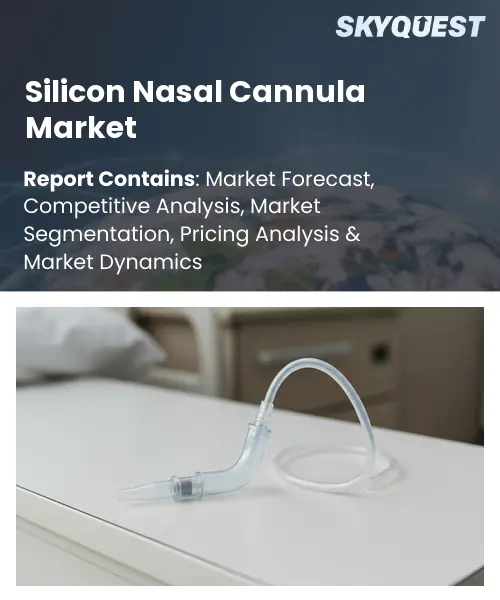
Silicon Nasal Cannula Market
Report ID: SQMIG20I2842
Report ID: SQMIG20I2842
[email protected]
USA +1 351-333-4748
Report ID:
SQMIG20I2842 |
Region:
Global |
Published Date: April, 2026
Pages:
157
|Tables:
119
|Figures:
77


Global Silicon Nasal Cannula Market size was valued at USD 482.6 Million in 2024 and is poised to grow from USD 509.14 Million in 2025 to USD 484.9 Million by 2033, growing at a CAGR of 5.5% during the forecast period (2026-2033).
The primary driver of the silicon nasal cannula market is the convergence of rising respiratory disease prevalence and demand for improved patient comfort, which has shifted procurement toward soft, biocompatible tubing. Silicon cannulas are flexible, hypoallergenic, and withstand repeated sterilization, so hospitals and homecare providers increasingly prefer them over PVC disposables for long term oxygen therapy. This market matters because oxygen delivery is essential across COPD management, neonatal care, and perioperative recovery, and improvements in cannula design can reduce skin breakdown and treatment interruptions. Over the past decade, manufacturers introduced ergonomic prongs with integrated sensors, illustrating adoption and innovation globally.Building on rising clinical adoption, a key growth factor is integration of smart monitoring and reusable design features because hospitals prioritize outcomes and cost of care. When cannulas incorporate sensors or connect to telehealth platforms, clinicians detect hypoxia earlier, which reduces readmissions and supports remote management, increasing device value. Similarly, reusable silicon options respond to sustainability and procurement budget pressures, prompting bulk purchasing agreements with OEMs and manufacturing that lower unit costs. Real world use cases include neonatal units reducing trauma with softer prongs and homecare agencies bundling cannulas with portable concentrators to serve COPD and post COVID patient populations.
How is AI improving patient monitoring and outcomes in the silicon nasal cannula market?
AI is enhancing patient monitoring and outcomes in the silicon nasal cannula market by pairing softer cannula interfaces with smarter sensing and analytics. Key aspects include embedded SpO2 and capnography sampling, advanced signal filtering that cuts noise from motion and humidified gas, and cloud connected platforms that enable remote clinician oversight. The current state shows a shift toward silicone comfort designs that support longer wear and neonatal use while vendors add AI driven alerting and predictive trends. These advances help clinicians detect deterioration earlier reduce false alarms and smooth transitions between hospital and home care.Masimo September 2025, expanded a strategic partnership with Royal Philips to integrate Masimo sensing and AI analytics into Philips monitoring platforms which supports wider adoption of AI enabled cannula monitoring and more proactive intervention.
Market snapshot - (2026-2033)
Global Market Size
USD 482.6 Million
Largest Segment
Standard Nasal Cannula (Low Flow)
Fastest Growth
High-Flow Nasal Cannula (HFNC)
Growth Rate
5.5% CAGR
To get more insights on this market click here to Request a Free Sample Report
Global silicon nasal cannula market is segmented by product configuration, material specification, clinical application, end-user facility and region. Based on product configuration, the market is segmented into Standard Nasal Cannula (Low Flow), High-Flow Nasal Cannula (HFNC), Specialized Pediatric & Neonatal Cannula and Curved & Flared Tip Cannula. Based on material specification, the market is segmented into 100% Medical Grade Silicone, Soft-touch Silicone Composites and Phthalate-free/Latex-free Variants. Based on clinical application, the market is segmented into Chronic Obstructive Pulmonary Disease (COPD), Respiratory Distress & Sleep Apnea, Post-operative Oxygen Therapy and Acute Respiratory Failure. Based on end-user facility, the market is segmented into Hospitals & Critical Care Units, Home Healthcare & Long-term Care and Ambulatory Surgical Centers (ASCs). Based on region, the market is segmented into North America, Europe, Asia Pacific, Latin America and Middle East & Africa.
High-Flow Nasal Cannula (HFNC) segment dominates because HFNC systems address acute and critical respiratory needs by delivering heated, humidified oxygen at elevated flow rates that improve gas exchange and patient comfort. This clinical effectiveness drives adoption in intensive care and emergency settings, shapes clinician preferences, and motivates manufacturers to refine silicon cannula interfaces. As a result, HFNC demand directs product design priorities and procurement strategies across care providers, reinforcing its market leadership.
However, Specialized Pediatric & Neonatal Cannula is the fastest growing area because rising emphasis on neonatal respiratory care requires gentler, size-specific fittings that reduce trauma and improve tolerance. Innovations in softer profiles, improved fixation, and compatibility with neonatal monitoring are accelerating uptake in neonatal care units and creating targeted product differentiation and specialized manufacturing opportunities.
100% Medical Grade Silicone segment dominates because its established biocompatibility, inert chemical profile, and resistance to repeated sterilization meet clinician and regulatory expectations for long-contact respiratory devices. These material advantages reduce irritation risks, support diverse sterilization and single-use models, and bolster device durability, prompting procurement preference. Consequently, manufacturers prioritize this material to satisfy safety and performance criteria, making it the default for premium silicon nasal cannula offerings.
Meanwhile, Soft-touch Silicone Composites are witnessing the strongest growth momentum as demand for enhanced patient comfort and improved seal drives material innovation. Advances in softer, textured blends that enhance fit and reduce skin pressure are attracting interest from homecare and chronic therapy users, encouraging manufacturers to introduce differentiated, comfort-focused lines that expand application reach and consumer acceptance.
To get detailed segments analysis, Request a Free Sample Report
North America leads the global silicon nasal cannula market owing to a combination of mature healthcare infrastructure, concentrated clinical demand across acute and home care settings, and a dense presence of device manufacturers and specialized suppliers. High levels of clinical adoption are supported by established procurement networks and comprehensive service ecosystems that expedite product introduction and maintenance. Collaborative research and clinical partnerships drive iterative product improvements and rigorous quality validation. Regulatory clarity and efficient distribution channels facilitate wide market access, while focused investment in clinician training and after sales support sustains long term utilization and reinforces market leadership.
Silicon Nasal Cannula Market United States benefits from extensive clinical adoption, a dense network of hospitals and home care providers, and proximity to leading developers and suppliers. Innovation clusters and well resourced research centers promote advanced product development and safety validation. Regulatory pathways are well defined, enabling scalable commercialization. Comprehensive distribution channels and strong after sales support enhance clinician confidence and patient acceptance, reinforcing the market position across care settings.
Silicon Nasal Cannula Market Canada exhibits robust institutional procurement and growing emphasis on patient centered respiratory care, with strong uptake in both hospital and community health programs. Domestic specialist suppliers collaborate with international manufacturers to tailor offerings to regional clinical needs. Focus on device comfort, infection prevention, and serviceability drives preference for silicone based solutions. Networked healthcare providers and training initiatives support consistent implementation and adoption.
Europe is experiencing rapid expansion in the silicon nasal cannula market driven by coordinated healthcare policies, mature hospital procurement systems, and a growing emphasis on patient comfort and infection control. Established medical device manufacturers and specialized distributors enable efficient market access and localized product adaptations. Cross border collaboration among clinics, research centers, and standards bodies fosters harmonized quality and interoperability. Increasing clinician awareness of silicone material benefits elevates product preference, while targeted investments in training and aftercare, together with value oriented purchasing approaches and regulatory harmonization, further accelerate adoption across acute and community health services.
Silicon Nasal Cannula Market Germany maintains a leading position through integrated hospital procurement, strong domestic manufacturing capabilities, and emphasis on clinical evidence for device selection. Collaboration between academic centers and industry fosters rigorous testing and adherence to high quality standards. Focus on infection prevention and durable material performance aligns with clinician priorities. Distribution networks and service support ensure reliable supply, strengthening acceptance in intensive care and community respiratory programs broadly.
Silicon Nasal Cannula Market United Kingdom is benefiting from proactive clinical adoption, emphasis on patient comfort, and agile procurement mechanisms that favor innovative silicone solutions. Close cooperation between hospitals, community care providers, and technology developers accelerates local trials and scale up. Training programs and clinician engagement support best practice use. Supplier responsiveness and focused distribution models improve availability across acute and home care settings, reinforcing expanding utilization and clinician confidence.
Silicon Nasal Cannula Market France is characterized by growing clinical awareness, emphasis on patient centered design, and increasing collaboration between regional hospitals and medical device developers. Local manufacturers and specialized distributors adapt silicone solutions to meet clinical preferences and infection control priorities. Pilot programs and clinician training promote acceptance in hospital and outpatient contexts. Focus on ergonomic design, material safety, and post market support underpins integration into respiratory care pathways.
Asia Pacific is strengthening its position in the silicon nasal cannula market through expanding manufacturing capabilities, targeted product customization, and growing clinical sophistication. Regional manufacturers invest in material science optimization and ergonomic design to meet clinician and patient needs. Partnerships with global suppliers accelerate technology transfer and local distribution, while public and private healthcare providers adopt silicone based solutions for improved comfort and infection control. Emerging research hubs conduct applied studies that validate performance and support standards alignment, while pilot procurement initiatives demonstrate practical benefits and scale oriented manufacturing enhances supply reliability across diverse care models.
Silicon Nasal Cannula Market Japan leverages advanced material science capabilities and precision manufacturing to produce high quality silicone respiratory interfaces. Close collaboration between research institutions, clinical centers, and manufacturers supports rigorous performance evaluation and iterative design improvement. Emphasis on ergonomic comfort, biocompatibility, and sterilization resilience aligns with clinician expectations. Streamlined regulatory processes and established distribution channels facilitate adoption in acute care and home respiratory programs, enhancing availability and clinical confidence.
Silicon Nasal Cannula Market South Korea benefits from dynamic medical technology firms, focused R and D efforts, and strong integration with hospital procurement practices. Domestic producers emphasize material performance, comfortable fit, and manufacturability for supply. Collaborative pilot initiatives with clinical partners validate clinical utility and support market acceptance. Efficient logistics and responsive after sales service strengthen supplier credibility, widely supporting adoption across hospital wards and community based respiratory care settings.
To know more about the market opportunities by region and country, click here to
Buy The Complete Report
Rising Prevalence Of Respiratory Conditions
Advances In Material Technology
High Procurement And Manufacturing Costs
Regulatory And Reimbursement Challenges
Request Free Customization of this report to help us to meet your business objectives.
Competition in the global silicon nasal cannula market centers on consolidation and rapid product innovation by incumbents and insurgent medtechs. Established players use acquisitions to expand respiratory portfolios, illustrated by ICU Medical's acquisition of Smiths Medical. Startups pursue regulatory clearances and distribution partnerships to access hospital channels, as seen in recent Bonhawa approvals and commercialization deals.
Top Player’s Company Profile
Recent Developments
SkyQuest’s ABIRAW (Advanced Business Intelligence, Research & Analysis Wing) is our Business Information Services team that Collects, Collates, Correlates, and Analyses the Data collected by means of Primary Exploratory Research backed by robust Secondary Desk research. As per SkyQuest analysis, the silicon nasal cannula market is being driven by the rising prevalence of respiratory diseases and growing demand for improved patient comfort, while high procurement and manufacturing costs remain a key restraint. North America dominates the market and the High-Flow Nasal Cannula segment leads in clinical adoption. A second driver is the integration of smart monitoring and reusable design features that support remote care, earlier intervention and lifecycle savings. Manufacturers prioritizing 100% medical grade silicone, ergonomic designs and telehealth compatibility are best positioned to capture hospital and homecare adoption even as purchasers weigh upfront expenses and regulatory hurdles.
| Report Metric | Details |
|---|---|
| Market size value in 2024 | USD 482.6 Million |
| Market size value in 2033 | USD 484.9 Million |
| Growth Rate | 5.5% |
| Base year | 2024 |
| Forecast period | (2026-2033) |
| Forecast Unit (Value) | USD Million |
| Segments covered |
|
| Regions covered | North America (US, Canada), Europe (Germany, France, United Kingdom, Italy, Spain, Rest of Europe), Asia Pacific (China, India, Japan, Rest of Asia-Pacific), Latin America (Brazil, Rest of Latin America), Middle East & Africa (South Africa, GCC Countries, Rest of MEA) |
| Companies covered |
|
| Customization scope | Free report customization with purchase. Customization includes:-
|
To get a free trial access to our platform which is a one stop solution for all your data requirements for quicker decision making. This platform allows you to compare markets, competitors who are prominent in the market, and mega trends that are influencing the dynamics in the market. Also, get access to detailed SkyQuest exclusive matrix.
Table Of Content
Executive Summary
Market overview
Parent Market Analysis
Market overview
Market size
KEY MARKET INSIGHTS
COVID IMPACT
MARKET DYNAMICS & OUTLOOK
Market Size by Region
KEY COMPANY PROFILES
Methodology
For the Silicon Nasal Cannula Market, our research methodology involved a mixture of primary and secondary data sources. Key steps involved in the research process are listed below:
1. Information Procurement: This stage involved the procurement of Market data or related information via primary and secondary sources. The various secondary sources used included various company websites, annual reports, trade databases, and paid databases such as Hoover's, Bloomberg Business, Factiva, and Avention. Our team did 45 primary interactions Globally which included several stakeholders such as manufacturers, customers, key opinion leaders, etc. Overall, information procurement was one of the most extensive stages in our research process.
2. Information Analysis: This step involved triangulation of data through bottom-up and top-down approaches to estimate and validate the total size and future estimate of the Silicon Nasal Cannula Market.
3. Report Formulation: The final step entailed the placement of data points in appropriate Market spaces in an attempt to deduce viable conclusions.
4. Validation & Publishing: Validation is the most important step in the process. Validation & re-validation via an intricately designed process helped us finalize data points to be used for final calculations. The final Market estimates and forecasts were then aligned and sent to our panel of industry experts for validation of data. Once the validation was done the report was sent to our Quality Assurance team to ensure adherence to style guides, consistency & design.
Analyst Support
Customization Options
With the given market data, our dedicated team of analysts can offer you the following customization options are available for the Silicon Nasal Cannula Market:
Product Analysis: Product matrix, which offers a detailed comparison of the product portfolio of companies.
Regional Analysis: Further analysis of the Silicon Nasal Cannula Market for additional countries.
Competitive Analysis: Detailed analysis and profiling of additional Market players & comparative analysis of competitive products.
Go to Market Strategy: Find the high-growth channels to invest your marketing efforts and increase your customer base.
Innovation Mapping: Identify racial solutions and innovation, connected to deep ecosystems of innovators, start-ups, academics, and strategic partners.
Category Intelligence: Customized intelligence that is relevant to their supply Markets will enable them to make smarter sourcing decisions and improve their category management.
Public Company Transcript Analysis: To improve the investment performance by generating new alpha and making better-informed decisions.
Social Media Listening: To analyze the conversations and trends happening not just around your brand, but around your industry as a whole, and use those insights to make better Marketing decisions.
REQUEST FOR SAMPLE
 REQUEST FREE CUSTOMIZATION


Want to customize this report? This report can be personalized according to your needs. Our analysts and industry experts will work directly with you to understand your requirements and provide you with customized data in a short amount of time. We offer $1000 worth of FREE customization at the time of purchase.
Feedback From Our Clients


 USA (+1) 351-333-4748

