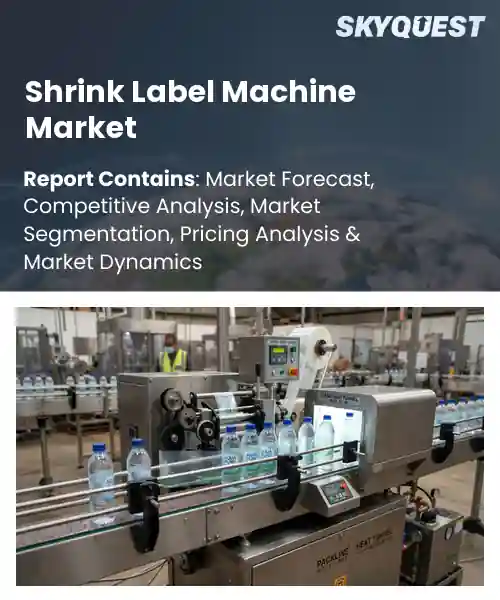
Shrink Label Machine Market
Report ID: SQMIG20I3899
Report ID: SQMIG20I3899
[email protected]
USA +1 351-333-4748
Report ID:
SQMIG20I3899 |
Region:
Global |
Published Date: September, 2026
Pages:
157
|Tables:
121
|Figures:
77


Global Shrink Label Machine Market size was valued at USD 520.0 Million in 2024 and is poised to grow from USD 562.64 Million in 2025 to USD 1056.94 Million by 2033, growing at a CAGR of 8.2% during the forecast period (2026-2033).
The global shrink‑label machine market comprises equipment that applies heat‑shrinkable polymer films to product packaging, creating a tight‑fitting label that conforms to irregular surfaces. Its importance stems from the need for durable, tamper‑evident branding across food, pharmaceuticals, and consumer electronics. The primary driver is the rising demand for sustainable packaging; manufacturers seek to replace bulky paper sleeves with lightweight film that reduces material waste and transportation weight. Since the early 2000s, advances in infrared and hot‑air technology have lowered energy consumption, while companies such as Avery Dennison and Bosch have introduced compact, IoT‑enabled units that integrate directly into automated lines, illustrating the market’s evolution from manual tabletop devices to sophisticated, data‑rich systems today they dominate supply chains. Beyond sustainability, the expansion of e‑commerce creates a pressing need for rapid, low‑cost labeling across diverse SKUs. Online retailers ship millions of small parcels, and shrink‑label machines enable quick turnaround by eliminating separate labeling steps; for example, Amazon’s fulfillment centers use inline shrink‑label stations that have cut labor hours by 15 percent while preserving barcode integrity. The cause‑effect chain is clear: faster labeling accelerates order fulfillment, improves customer satisfaction, and drives repeat purchases, thereby fueling demand for compact, high‑throughput machines. Emerging opportunities stem from integrating vision‑inspection sensors that provide real‑time defect detection, boosting compliance for regulated sectors such as medical devices.
How is AI-driven automation improving efficiency in the shrink label machine market?
AI driven automation is reshaping the shrink label machine market by linking vision systems, predictive analytics and robotic handling into a seamless workflow. Machines now detect label placement errors in real time, adjust tension automatically and synchronize with upstream packaging lines. This reduces changeover time, cuts waste and frees operators to focus on higher value tasks. Suppliers are embedding edge computing to process sensor data locally, enabling faster decision loops and greater reliability. As manufacturers demand higher throughput and tighter quality control, AI driven solutions are becoming a standard expectation rather than a niche add‑on throughout the production floor for customers.Markem‑Imaje April 2024, introduced an AI powered shrink label system that automatically calibrates laser settings and predicts maintenance needs, eliminating manual tuning and unexpected downtime. This innovation accelerates line speed and supports market growth by delivering consistent quality with less human intervention across diverse packaging environments and improves overall operational agility.
Market snapshot - (2026-2033)
Global Market Size
USD 520.0 Million
Largest Segment
Steam Shrink Labeling Machines
Fastest Growth
Infrared Shrink Labeling Machines
Growth Rate
8.2% CAGR
To get more insights on this market click here to Request a Free Sample Report
Global shrink label machine market is segmented by machine type, automation, container type, end user and region. Based on machine type, the market is segmented into Steam Shrink Labeling Machines, Hot Air Shrink Labeling Machines, Infrared Shrink Labeling Machines and Others. Based on automation, the market is segmented into Semi-Automatic and Automatic. Based on container type, the market is segmented into Bottles, Cans, Jars, Tubes and Others. Based on end user, the market is segmented into Food & Beverage, Pharmaceuticals, Cosmetics & Personal Care, Chemicals and Others. Based on region, the market is segmented into North America, Europe, Asia Pacific, Latin America and Middle East & Africa.
Infrared shrink labeling machines segment dominates because they provide precise heat application that minimizes label waste and reduces energy consumption. Their ability to quickly reach target temperatures without prolonged heating cycles aligns with manufacturers’ goals of lowering carbon footprints while maintaining high label quality. This efficiency, combined with compatibility with recyclable materials, makes infrared technology the preferred choice for eco‑conscious production lines.
Meanwhile, steam shrink labeling machines segment is witnessing the strongest growth momentum because its robust design supports high volume operations on traditional containers and offers low upfront cost for small to medium facilities. Continuous improvements in steam efficiency and integration with smart controls attract producers seeking reliable performance, driving rapid adoption and expanding market opportunities.
Automatic automation segment dominates because it delivers continuous operation without operator intervention, meeting the high throughput requirements of large scale producers. Its integration with PLC controls and vision systems improves labeling accuracy and reduces labor costs, making it attractive for facilities seeking efficiency gains. The ability to synchronize with upstream and downstream equipment further consolidates its position as the preferred choice for modern production lines.
On the other hand, semi automatic automation segment is emerging as a high growth area because it offers an accessible entry point for midsize manufacturers. Lower capital investment and simple integration enable quick deployment, while rising demand for customized labeling on varied product lines fuels uptake. This flexibility creates new opportunities and drives broader market adoption.
To get detailed segments analysis, Request a Free Sample Report
Asia Pacific leads the market through a combination of advanced manufacturing ecosystems, strong consumer product sectors, and aggressive adoption of automation technologies. Engineers in the region have pioneered compact, high‑speed equipment that addresses the diverse packaging needs of food, beverage, and pharmaceuticals. Robust supply chains ensure rapid component sourcing, while strategic collaborations between equipment makers and downstream users accelerate innovation cycles. Moreover, regional policies encourage technology upgrades and support export‑oriented production, reinforcing the area's position as a hub for both original equipment manufacturers and end‑users seeking reliable shrink labeling solutions.
Japan Shrink Label Machine Market
Shrink Label Machine Market in Japan benefits from a deep heritage of precision engineering and a consumer base that values high‑quality packaging. Local manufacturers integrate sophisticated control systems that cater to intricate label designs and stringent hygiene requirements. Collaborative R&D initiatives with food and cosmetics producers drive continuous refinements, while strong after‑sales networks provide confidence in equipment uptime. This environment sustains a demand for versatile machines that can handle both high‑volume lines and niche artisanal operations.
South Korea Shrink Label Machine Market
Shrink Label Machine Market in South Korea is propelled by a dynamic electronics and cosmetics sector that demands rapid, accurate labeling. Domestic producers leverage cutting‑edge robotics and IoT connectivity to offer smart solutions that enhance line efficiency. Government incentives for automation encourage mid‑size manufacturers to upgrade, fostering a competitive ecosystem of innovative suppliers. The emphasis on speed and flexibility aligns with the fast‑changing product cycles characteristic of the Korean market, reinforcing steady adoption of advanced shrink labeling technology.
In North America, the market expands rapidly due to heightened focus on supply‑chain resilience, evolving consumer preferences for sustainable packaging, and the integration of digital technologies across production lines. Manufacturers prioritize equipment that reduces waste, improves label adhesion, and supports rapid changeovers to meet diverse product assortments. Collaborative ecosystems linking equipment providers with packaging designers accelerate the rollout of intelligent labeling solutions. Meanwhile, strong logistics networks and a culture of continuous improvement motivate end‑users to invest in machines that enhance throughput while maintaining high quality standards.
United States Shrink Label Machine Market
Shrink Label Machine Market in the United States is shaped by a broad spectrum of industries ranging from consumer packaged goods to pharmaceuticals, each seeking speed and precision. Equipment providers emphasize modular designs that can be scaled for large distribution centers and smaller specialty facilities alike. The emphasis on regulatory compliance drives demand for machines with advanced tracking and verification capabilities. Robust service infrastructures and a culture of technological adoption further encourage companies to modernize labeling operations, reinforcing the United States as a key growth engine.
Canada Shrink Label Machine Market
Shrink Label Machine Market in Canada reflects a balanced mix of large‑scale food processing and specialty craft producers who value versatility and environmental stewardship. Companies prioritize machines that minimize material consumption and support recyclable label substrates. Collaborative research initiatives with academic institutions foster innovations in energy‑efficient operation. The presence of strong trade channels with neighboring markets also enables Canadian firms to adopt globally sourced technology while customizing solutions for local regulatory nuances, sustaining steady market momentum.
Europe enhances its position through a concerted focus on regulatory compliance, circular economy objectives, and cross‑border collaboration among manufacturers and technology innovators. The region's mature consumer goods sector demands sophisticated labeling that meets stringent quality and sustainability criteria. Investment in smart manufacturing and data‑driven decision‑making enables producers to optimize machine performance and reduce downtime. Collaborative standards bodies harmonize specifications, allowing equipment to be deployed seamlessly across multiple markets, thereby reinforcing Europe’s reputation as a leader in high‑performance shrink labeling solutions.
Germany Shrink Label Machine Market
Shrink Label Machine Market in Germany is driven by engineering excellence and a strong automotive‑inspired precision culture applied to packaging equipment. German firms prioritize robust, high‑throughput machines that can integrate with Industry 4.0 platforms, offering real‑time monitoring and predictive maintenance. Close partnerships with multinational consumer brands ensure that equipment meets diverse compliance and sustainability standards. This focus on reliability and technological integration sustains Germany’s influential role in setting market benchmarks.
United Kingdom Shrink Label Machine Market
Shrink Label Machine Market in the United Kingdom benefits from a vibrant food and beverage sector that seeks rapid, flexible labeling to support premium and private‑label products. Providers emphasize user‑friendly interfaces and quick changeover capabilities that align with the fast‑paced retail environment. Collaborative efforts with design agencies foster creative label applications, while adherence to strict health and safety regulations drives continuous improvement in machine hygiene and traceability features. This combination supports ongoing demand for advanced shrink labeling solutions.
France Shrink Label Machine Market
Shrink Label Machine Market in France is closely linked to a sophisticated luxury goods and gourmet food industry that values aesthetic appeal and precision. Equipment manufacturers focus on delivering machines capable of handling delicate substrates and intricate label shapes without compromising speed. Emphasis on eco‑friendly processes aligns with national sustainability goals, encouraging the adoption of low‑energy, waste‑reduction technologies. Strong ties between equipment suppliers and artisan producers promote customized solutions, reinforcing France’s distinctive position within the European market.
To know more about the market opportunities by region and country, click here to
Buy The Complete Report
Increasing Demand for Sustainable Packaging
Adoption of Automation in Manufacturing
High Initial Capital Expenditure
Complexity of Integration with Existing Lines
Request Free Customization of this report to help us to meet your business objectives.
The competitive landscape of the global shrink label machine market is shaped by aggressive M&A activity, strategic partnerships, and rapid technology innovation, with incumbents such as Quadrel, Sealpac and Dascom securing patents for ultra‑fast heating elements and forming joint ventures with packaging converters to expand service capabilities, while recent acquisitions of niche thermal‑transfer firms are intensifying pressure on pricing and product differentiation.
Top Player’s Company Profile
Recent Developments
SkyQuest’s ABIRAW (Advanced Business Intelligence, Research & Analysis Wing) is our Business Information Services team that Collects, Collates, Correlates, and Analyses the Data collected by means of Primary Exploratory Research backed by robust Secondary Desk research. As per SkyQuest analysis, the global shrink label machine market is being propelled primarily by the rising demand for sustainable packaging, which pushes manufacturers toward lightweight, recyclable film solutions, while a second strong catalyst is the fast‑growing adoption of automation that boosts throughput and cuts labor costs. However, high initial capital expenditure remains a notable restraint, especially for small and mid‑size producers. The Asia Pacific region leads the market, benefiting from advanced manufacturing ecosystems and supportive policies. Among equipment types, infrared shrink labeling machines dominate because their precise heat application minimizes energy use and material waste, reinforcing the sustainability agenda throughout the supply chain.
| Report Metric | Details |
|---|---|
| Market size value in 2024 | USD 520.0 Million |
| Market size value in 2033 | USD 1056.94 Million |
| Growth Rate | 8.2% |
| Base year | 2024 |
| Forecast period | (2026-2033) |
| Forecast Unit (Value) | USD Million |
| Segments covered |
|
| Regions covered | North America (US, Canada), Europe (Germany, France, United Kingdom, Italy, Spain, Rest of Europe), Asia Pacific (China, India, Japan, Rest of Asia-Pacific), Latin America (Brazil, Rest of Latin America), Middle East & Africa (South Africa, GCC Countries, Rest of MEA) |
| Companies covered |
|
| Customization scope | Free report customization with purchase. Customization includes:-
|
To get a free trial access to our platform which is a one stop solution for all your data requirements for quicker decision making. This platform allows you to compare markets, competitors who are prominent in the market, and mega trends that are influencing the dynamics in the market. Also, get access to detailed SkyQuest exclusive matrix.
Table Of Content
Executive Summary
Market overview
Parent Market Analysis
Market overview
Market size
KEY MARKET INSIGHTS
COVID IMPACT
MARKET DYNAMICS & OUTLOOK
Market Size by Region
KEY COMPANY PROFILES
Methodology
For the Shrink Label Machine Market, our research methodology involved a mixture of primary and secondary data sources. Key steps involved in the research process are listed below:
1. Information Procurement: This stage involved the procurement of Market data or related information via primary and secondary sources. The various secondary sources used included various company websites, annual reports, trade databases, and paid databases such as Hoover's, Bloomberg Business, Factiva, and Avention. Our team did 45 primary interactions Globally which included several stakeholders such as manufacturers, customers, key opinion leaders, etc. Overall, information procurement was one of the most extensive stages in our research process.
2. Information Analysis: This step involved triangulation of data through bottom-up and top-down approaches to estimate and validate the total size and future estimate of the Shrink Label Machine Market.
3. Report Formulation: The final step entailed the placement of data points in appropriate Market spaces in an attempt to deduce viable conclusions.
4. Validation & Publishing: Validation is the most important step in the process. Validation & re-validation via an intricately designed process helped us finalize data points to be used for final calculations. The final Market estimates and forecasts were then aligned and sent to our panel of industry experts for validation of data. Once the validation was done the report was sent to our Quality Assurance team to ensure adherence to style guides, consistency & design.
Analyst Support
Customization Options
With the given market data, our dedicated team of analysts can offer you the following customization options are available for the Shrink Label Machine Market:
Product Analysis: Product matrix, which offers a detailed comparison of the product portfolio of companies.
Regional Analysis: Further analysis of the Shrink Label Machine Market for additional countries.
Competitive Analysis: Detailed analysis and profiling of additional Market players & comparative analysis of competitive products.
Go to Market Strategy: Find the high-growth channels to invest your marketing efforts and increase your customer base.
Innovation Mapping: Identify racial solutions and innovation, connected to deep ecosystems of innovators, start-ups, academics, and strategic partners.
Category Intelligence: Customized intelligence that is relevant to their supply Markets will enable them to make smarter sourcing decisions and improve their category management.
Public Company Transcript Analysis: To improve the investment performance by generating new alpha and making better-informed decisions.
Social Media Listening: To analyze the conversations and trends happening not just around your brand, but around your industry as a whole, and use those insights to make better Marketing decisions.
REQUEST FOR SAMPLE
 REQUEST FREE CUSTOMIZATION


Want to customize this report? This report can be personalized according to your needs. Our analysts and industry experts will work directly with you to understand your requirements and provide you with customized data in a short amount of time. We offer $1000 worth of FREE customization at the time of purchase.
Feedback From Our Clients


 USA (+1) 351-333-4748

