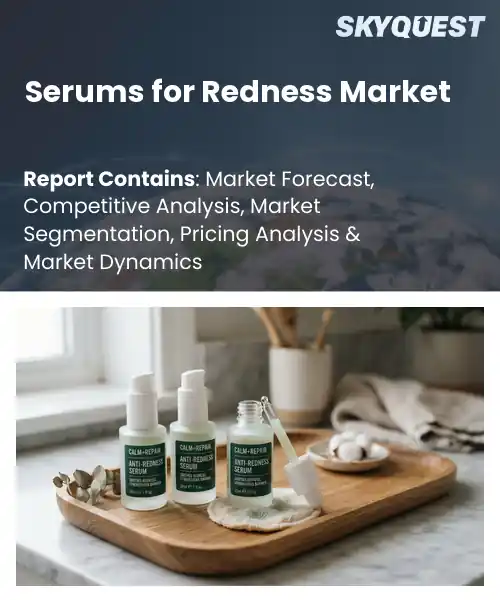
Serums for Redness Market

Report ID: SQMIG30L2572

[email protected]
USA +1 351-333-4748

Serums for Redness Market Size, Share, and Growth Analysis

Serums for Redness Market

Serums for Redness Market By Ingredient Type (Niacinamide-Based, Hyaluronic Acid-Based, Centella Asiatica-Based, Ceramide-Based, Others), By Skin Type (Sensitive Skin, Dry Skin, Combination Skin, Oily Skin), By Distribution Channel, By End User, By Region - Industry Forecast 2026-2033


Report ID: SQMIG30L2572 | Region: Global | Published Date: August, 2026
Pages: 157 |Tables: 120 |Figures: 77

Format - word format excel data power point presentation

Serums for Redness Market Insights

Global Serums For Redness Market size was valued at USD 2.83 Billion in 2024 and is poised to grow from USD 3.11 Billion in 2025 to USD 6.57 Billion by 2033, growing at a CAGR of 9.8% during the forecast period (2026-2033).

Demand for solutions to facial erythema has become the primary driver of the global serums for redness market. This segment comprises topical formulations that combine active ingredients such as niacinamide, azelaic acid, and botanical extracts to calm vascular inflammation and improve barrier function. Consumers value these products because they offer a discreet regimen that avoids the side effects of corticosteroids. Over the past decade the market has evolved from simple moisturizers to engineered serums, illustrated by early launches from dermatology‑focused brands and later lines that leverage delivery systems. Consequently, awareness of skin‑health trends has turned redness management into a concern. The surge in tele‑dermatology appointments serves as the key factor accelerating growth in the global serums for redness market, because clinicians now recommend over‑the‑counter products to complement consultations. When patients receive diagnoses of rosacea or sensitive skin, they seek immediate, easy‑to‑apply solutions, prompting retailers to expand shelf space for clinically validated serums. Brands such as CeraVe and Paula’s Choice have launched targeted lines that cite peer‑reviewed studies, thereby building consumer trust and driving repeat purchases. This dynamic creates opportunities for ingredient innovators to supply niacinamide and anti‑inflammatory peptides, while e‑commerce platforms leverage data analytics to personalize recommendations, expanding market penetration.

How is AI-driven formulation impacting the serums for redness market?

AI-driven formulation is reshaping the serums for redness market by accelerating ingredient discovery and enabling highly targeted blends. Machine learning models analyze skin microbiome data and irritation pathways, allowing formulators to predict efficacy before physical testing. This reduces development cycles and cuts waste, making it easier to launch products that address specific redness triggers. Brands can also personalize concentrations for different skin types, enhancing consumer confidence. The technology integrates real‑time feedback from digital trials, refining textures and stability on the fly. As awareness of rosacea and sensitive skin grows, the ability to deliver consistent soothing results quickly is becoming a key differentiator.Prequel, January 2026, introduced an AI‑optimized Redness Reform Soothing Serum that leverages predictive modeling to fine‑tune actives and texture. The streamlined formulation cut lab time dramatically and delivered a product that meets consumer demand for fast, reliable relief, reinforcing market momentum.

Market snapshot - (2026-2033)

Global Market Size

USD 2.83 Billion

Largest Segment

Niacinamide-Based

Fastest Growth

Centella Asiatica-Based

Growth Rate

9.8% CAGR

Serums for Redness Market ($ Bn)
Country Share for North America Region (%)

To get more insights on this market click here to Request a Free Sample Report

Serums for Redness Market Segments Analysis

Global serums for redness market is segmented by ingredient type, skin type, distribution channel, end user and region. Based on ingredient type, the market is segmented into Niacinamide-Based, Hyaluronic Acid-Based, Centella Asiatica-Based, Ceramide-Based and Others. Based on skin type, the market is segmented into Sensitive Skin, Dry Skin, Combination Skin and Oily Skin. Based on distribution channel, the market is segmented into Supermarkets & Hypermarkets, Specialty Stores, Pharmacies and Online Retail. Based on end user, the market is segmented into Individual Consumers and Professional Skincare Clinics. Based on region, the market is segmented into North America, Europe, Asia Pacific, Latin America and Middle East & Africa.

What role does niacinamide play in transforming the serums for redness market?

Niacinamide-Based segment dominates because its dual action of soothing inflammation and strengthening barrier function aligns perfectly with consumer expectations for redness relief. The ingredient’s proven efficacy in reducing erythema, coupled with its compatibility with a wide range of formulations, encourages brands to prioritize it. Moreover, its safety profile for frequent use on delicate skin builds trust, driving consistent demand across product lines throughout the market and sustaining long‑term growth prospects.

Meanwhile, Centella Asiatica-Based segment is witnessing the strongest growth momentum because rising consumer interest in botanical actives fuels its appeal. Extracts offer calming and repair benefits that complement redness reduction, prompting innovative blends and premium positioning. This enthusiasm expands formulation possibilities and attracts new adopters, significantly accelerating market expansion rapidly.

how are pharmacies influencing consumer trust in the serums for redness market?

Pharmacies segment dominates because they provide a trusted environment where consumers seek clinically validated skincare solutions for redness concerns. The presence of trained pharmacists reinforces product credibility, while the convenience of in‑store counsel aligns with shoppers’ desire for personalized recommendations. This synergy drives frequent purchases and repeat loyalty, cementing pharmacies as the primary distribution outlet for serums targeting delicate, inflamed skin across diverse demographic groups, enhancing overall market penetration and brand visibility.

On the other hand, Online Retail segment is emerging as the key high‑growth area because digital platforms enable rapid product discovery and seamless purchase for redness‑focused serums. Influencer endorsements and personalization attract tech‑savvy consumers, while direct models reduce intermediaries. This momentum expands reach, accelerates adoption, and creates revenue streams for innovators.

Serums for Redness Market By Ingredient Type

To get detailed segments analysis, Request a Free Sample Report

Serums for Redness Market Regional Insights

Why does North America Dominate the Global Serums for Redness Market?

North America leads the market because it blends sophisticated consumer demand with a highly developed distribution infrastructure. Consumers exhibit strong awareness of skin‑care concerns and place premium value on clinically proven solutions, encouraging manufacturers to invest in advanced formulations. The region benefits from a regulatory framework that supports rapid product approvals while maintaining safety standards, enabling swift introduction of innovative ingredients. A dense network of specialty retailers, online platforms, and professional dermatology channels amplifies product reach. Additionally, a culture of influencer endorsement and education through professional societies fuels trust and adoption, reinforcing the region’s position as a benchmark for product performance and brand credibility worldwide.

United States Serums for Redness Market

Serums for Redness Market in the United States is driven by a cultural emphasis on personal appearance and a well‑established ecosystem of dermatology clinics, premium retailers, and e‑commerce platforms that cascade new launches quickly to consumers seeking targeted skin solutions.

Canada Serums for Redness Market

Serums for Redness Market in Canada reflects a consumer base that values natural‑based ingredients and rigorous product safety, supported by health‑focused retail channels and a proactive regulatory environment that encourages transparency and trusted brand narratives.

What is Driving the Rapid Expansion of Serums for Redness Market in Europe?

Europe’s expansion is propelled by a convergence of heightened consumer education, strong demand for clean and sustainable formulations, and a fragmented yet highly interconnected market that encourages cross‑border innovation diffusion. Regulatory harmonization across the bloc creates a consistent framework for product validation, while the presence of leading research institutions fuels continuous ingredient breakthroughs. Retail landscapes blend boutique specialty stores with digital channels, allowing brands to reach niche segments efficiently. Moreover, a growing culture of preventive skin health, reinforced by professional dermatology networks, amplifies the appeal of serums designed to calm vascular irritation and redness, positioning Europe as a dynamic growth engine.

Germany Serums for Redness Market

Serums for Redness Market in Germany benefits from a scientifically oriented consumer base that trusts dermatologist‑recommended products, alongside a robust network of pharmacies and specialty beauty retailers that champion efficacy‑focused solutions.

United Kingdom Serums for Redness Market

Serums for Redness Market in the United Kingdom experiences rapid uptake thanks to a vibrant online beauty community, influential social media voices, and a retail mix that balances high‑street chains with niche boutique offerings.

France Serums for Redness Market

Serums for Redness Market in France is emerging within a culture that prioritizes elegant, skincare‑centric routines and favors formulations that combine sensorial appeal with clinically validated calming benefits.

How is Asia Pacific Strengthening its Position in Serums for Redness Market?

Asia Pacific is strengthening its role through a blend of heightened skincare consciousness, rapid adoption of premium dermatological products, and a cultural preference for preventive skin health. Consumers in the region demonstrate a willingness to experiment with innovative textures and botanical actives, prompting manufacturers to tailor serums that address both aesthetic and physiological aspects of redness. The expansion of sophisticated retail formats, from upscale department stores to high‑growth e‑commerce platforms, enhances product accessibility. Additionally, a surge in local research collaborations accelerates ingredient discovery, while regulatory pathways become increasingly supportive of novel formulations, collectively elevating the region’s influence on global market trends.

Japan Serums for Redness Market

Serums for Redness Market in Japan is shaped by a discerning consumer segment that values meticulous formulation, subtle fragrance, and a strong alignment with traditional skin‑care philosophies, fostering demand for gentle yet effective calming solutions.

South Korea Serums for Redness Market

Serums for Redness Market in South Korea thrives on a fast‑moving beauty ecosystem that emphasizes cutting‑edge technology, vibrant K‑beauty trends, and a high propensity for multi‑step regimens targeting visible redness with precision.

Serums for Redness Market By Geography
  • Largest
  • Fastest

To know more about the market opportunities by region and country, click here to
Buy The Complete Report

Serums for Redness Market Dynamics

Drivers

Growing Demand For Sensitive Skin Care

  • Consumers are increasingly seeking products that calm redness and irritation, prompting brands to develop serums with soothing botanicals and barrier‑supporting ingredients. This heightened awareness of skin health drives retailers to allocate more shelf space to redness‑targeting formulations, while dermatologists recommend such products as part of daily regimens. As a result, manufacturers experience stronger demand, encouraging innovation and broader distribution channels that collectively accelerate market expansion. The trend also spurs collaborations between cosmetic scientists and natural‑extract suppliers, enriching product portfolios and reinforcing consumer confidence in gentle yet effective treatments.

Adoption Of Advanced Formulation Technologies

  • Manufacturers are leveraging nanocarrier systems, encapsulation methods and controlled‑release technologies to improve active ingredient stability and penetration in serums for redness. These advancements enable higher efficacy with lower irritation potential, satisfying consumer expectations for rapid results. As product performance improves, brand loyalty strengthens and word‑of‑mouth referrals increase, encouraging retailers to stock a wider range of technologically enhanced options. Consequently, the market benefits from sustained growth driven by continuous research investment and the perceived premium value of scientifically superior formulations today.

Restraints

Regulatory Scrutiny Over Ingredient Claims

  • Regulatory bodies in major markets are tightening oversight on product labeling and efficacy claims related to redness reduction, requiring robust clinical evidence before market entry. Companies must allocate additional resources to conduct trials, compile dossiers and navigate approval processes, which lengthens time‑to‑launch and raises development costs. This heightened scrutiny can deter smaller innovators lacking financial capacity, limiting the diversity of new entrants and slowing overall market momentum as firms prioritize compliance over rapid product rollout in the competitive landscape globally.

Consumer Skepticism Toward Cosmetic Efficacy

  • Many consumers remain cautious about the real-world performance of redness‑targeting serums, often questioning whether advertised benefits translate into visible improvements. This skepticism fosters a preference for proven medical treatments over over‑the‑counter options, reducing repeat purchase rates for newer cosmetic formulations. Brands therefore must invest heavily in education, clinical validation and transparent communication to build trust, which can delay market acceptance and increase marketing expenditures, ultimately tempering growth as firms allocate resources to overcoming perception barriers rather than expanding distribution significantly.

Request Free Customization of this report to help us to meet your business objectives.

Serums for Redness Market Competitive Landscape

The competitive landscape is shaped by aggressive product differentiation and strategic collaborations, with firms leveraging dermatological research partnerships to launch advanced redness‑targeting serums. Recent M&A activity, such as the acquisition of a niche botanical extract supplier by a major skin‑care brand, illustrates the drive to secure exclusive ingredients. Partnerships between biotech labs and cosmetics companies accelerate tech‑driven formulations, while aggressive digital marketing campaigns intensify brand competition.

  • Luminex Beauty: Established in 2020, their main objective is to deliver clinically validated redness‑reduction serums using proprietary peptide technology. Recent development: Secured $12 million Series A funding to expand production and launch a new line of anti‑redness products across North America and Europe.
  • RedCalm Labs: Established in 2021, their main objective is to combine microbiome science with natural botanicals to create soothing serums for sensitive skin. Recent development: Completed a strategic partnership with a leading dermatology clinic network to co‑develop a prescription‑strength redness serum, supported by a $8 million seed round.

Top Player’s Company Profile

  • L'Oréal S.A.
  • The Estée Lauder Companies Inc.
  • Beiersdorf AG
  • Johnson & Johnson
  • Unilever PLC
  • Procter & Gamble Company
  • Shiseido Company, Limited
  • Pierre Fabre S.A.
  • Galderma SA
  • NAOS
  • Paula's Choice, LLC
  • The Ordinary
  • SkinCeuticals International
  • Dr. Jart+ Co., Ltd.
  • La Roche-Posay Laboratoire Dermatologique
  • Avène Dermatological Laboratories
  • Medik8 Limited
  • ELEMIS Limited
  • COSRX Inc.
  • Bioderma Laboratories

Recent Developments

  • June 2025 L'Oréal S.A. launched its new Redness Relief Serum, featuring a microbiome‑friendly complex of botanical extracts and barrier‑supporting lipids. The product was co‑developed with a leading dermatology research institute and marketed as a gentle, daily solution that visibly calms facial redness while strengthening skin resilience. It emphasizes fragrance‑free formulation and recyclable packaging to meet clean‑beauty expectations.
  • March 2025 The Estée Lauder Companies introduced an AI‑enhanced personalization platform for its Advanced Redness Soothing Serum, partnering with a skin‑tech startup. The system analyzes user selfies to recommend optimal application frequency and dosage, integrating the guidance into the brand’s mobile app and reinforcing a science‑driven, customized skincare experience. It also provides feedback on skin tone changes, enhancing user confidence.
  • January 2025 Galderma SA completed the acquisition of a boutique biotech specializing in anti‑inflammatory peptide research, aiming to enrich its Redness Control Serum line. The integration brings novel peptide complexes that target vascular inflammation, allowing the company to expand its portfolio with clinically inspired formulations that soothe persistent facial redness without compromising skin health. It underscores Galderma’s commitment dermatology solutions.

Serums for Redness Key Market Trends

Serums for Redness Market SkyQuest Analysis

SkyQuest’s ABIRAW (Advanced Business Intelligence, Research & Analysis Wing) is our Business Information Services team that Collects, Collates, Correlates, and Analyses the Data collected by means of Primary Exploratory Research backed by robust Secondary Desk research. As per SkyQuest analysis, the global serums for redness market is propelled primarily by the growing demand for sensitive‑skin care, while advanced formulation technologies such as nanocarriers serve as a second catalyst that boosts efficacy and consumer confidence. The market is led by North America, where sophisticated retail networks and strong consumer awareness support rapid adoption. Niacinamide‑based serums dominate the ingredient segment thanks to their proven soothing and barrier‑strengthening properties. However, heightened regulatory scrutiny over redness‑reduction claims poses a restraint, raising development costs and slowing new product launches. Overall, these dynamics shape a robust yet carefully monitored growth trajectory for industry participants seeking sustainable expansion.

Report Metric Details
Market size value in 2024 USD 2.83 Billion
Market size value in 2033 USD 6.57 Billion
Growth Rate 9.8%
Base year 2024
Forecast period (2026-2033)
Forecast Unit (Value) USD Billion
Segments covered
  • Ingredient Type
    • Niacinamide-Based
    • Hyaluronic Acid-Based
    • Centella Asiatica-Based
    • Ceramide-Based
    • Others
  • Skin Type
    • Sensitive Skin
    • Dry Skin
    • Combination Skin
    • Oily Skin
  • Distribution Channel
    • Supermarkets & Hypermarkets
    • Specialty Stores
    • Pharmacies
    • Online Retail
  • End User
    • Individual Consumers
    • Professional Skincare Clinics
Regions covered North America (US, Canada), Europe (Germany, France, United Kingdom, Italy, Spain, Rest of Europe), Asia Pacific (China, India, Japan, Rest of Asia-Pacific), Latin America (Brazil, Rest of Latin America), Middle East & Africa (South Africa, GCC Countries, Rest of MEA)
Companies covered
  • L'Oréal S.A.
  • The Estée Lauder Companies Inc.
  • Beiersdorf AG
  • Johnson & Johnson
  • Unilever PLC
  • Procter & Gamble Company
  • Shiseido Company, Limited
  • Pierre Fabre S.A.
  • Galderma SA
  • NAOS
  • Paula's Choice, LLC
  • The Ordinary
  • SkinCeuticals International
  • Dr. Jart+ Co., Ltd.
  • La Roche-Posay Laboratoire Dermatologique
  • Avène Dermatological Laboratories
  • Medik8 Limited
  • ELEMIS Limited
  • COSRX Inc.
  • Bioderma Laboratories
Customization scope

Free report customization with purchase. Customization includes:-

  • Segments by type, application, etc
  • Company profile
  • Market dynamics & outlook
  • Region

To get a free trial access to our platform which is a one stop solution for all your data requirements for quicker decision making. This platform allows you to compare markets, competitors who are prominent in the market, and mega trends that are influencing the dynamics in the market. Also, get access to detailed SkyQuest exclusive matrix.

Table Of Content

Executive Summary

Market overview

  • Exhibit: Executive Summary – Chart on Market Overview
  • Exhibit: Executive Summary – Data Table on Market Overview
  • Exhibit: Executive Summary – Chart on Serums for Redness Market Characteristics
  • Exhibit: Executive Summary – Chart on Market by Geography
  • Exhibit: Executive Summary – Chart on Market Segmentation
  • Exhibit: Executive Summary – Chart on Incremental Growth
  • Exhibit: Executive Summary – Data Table on Incremental Growth
  • Exhibit: Executive Summary – Chart on Vendor Market Positioning

Parent Market Analysis

Market overview

Market size

  • Market Dynamics
    • Exhibit: Impact analysis of DROC, 2021
      • Drivers
      • Opportunities
      • Restraints
      • Challenges
  • SWOT Analysis

KEY MARKET INSIGHTS

  • Technology Analysis
    • (Exhibit: Data Table: Name of technology and details)
  • Pricing Analysis
    • (Exhibit: Data Table: Name of technology and pricing details)
  • Supply Chain Analysis
    • (Exhibit: Detailed Supply Chain Presentation)
  • Value Chain Analysis
    • (Exhibit: Detailed Value Chain Presentation)
  • Ecosystem Of the Market
    • Exhibit: Parent Market Ecosystem Market Analysis
    • Exhibit: Market Characteristics of Parent Market
  • IP Analysis
    • (Exhibit: Data Table: Name of product/technology, patents filed, inventor/company name, acquiring firm)
  • Trade Analysis
    • (Exhibit: Data Table: Import and Export data details)
  • Startup Analysis
    • (Exhibit: Data Table: Emerging startups details)
  • Raw Material Analysis
    • (Exhibit: Data Table: Mapping of key raw materials)
  • Innovation Matrix
    • (Exhibit: Positioning Matrix: Mapping of new and existing technologies)
  • Pipeline product Analysis
    • (Exhibit: Data Table: Name of companies and pipeline products, regional mapping)
  • Macroeconomic Indicators

COVID IMPACT

  • Introduction
  • Impact On Economy—scenario Assessment
    • Exhibit: Data on GDP - Year-over-year growth 2016-2022 (%)
  • Revised Market Size
    • Exhibit: Data Table on Serums for Redness Market size and forecast 2021-2027 ($ million)
  • Impact Of COVID On Key Segments
    • Exhibit: Data Table on Segment Market size and forecast 2021-2027 ($ million)
  • COVID Strategies By Company
    • Exhibit: Analysis on key strategies adopted by companies

MARKET DYNAMICS & OUTLOOK

  • Market Dynamics
    • Exhibit: Impact analysis of DROC, 2021
      • Drivers
      • Opportunities
      • Restraints
      • Challenges
  • Regulatory Landscape
    • Exhibit: Data Table on regulation from different region
  • SWOT Analysis
  • Porters Analysis
    • Competitive rivalry
      • Exhibit: Competitive rivalry Impact of key factors, 2021
    • Threat of substitute products
      • Exhibit: Threat of Substitute Products Impact of key factors, 2021
    • Bargaining power of buyers
      • Exhibit: buyers bargaining power Impact of key factors, 2021
    • Threat of new entrants
      • Exhibit: Threat of new entrants Impact of key factors, 2021
    • Bargaining power of suppliers
      • Exhibit: Threat of suppliers bargaining power Impact of key factors, 2021
  • Skyquest special insights on future disruptions
    • Political Impact
    • Economic impact
    • Social Impact
    • Technical Impact
    • Environmental Impact
    • Legal Impact

Market Size by Region

  • Chart on Market share by geography 2021-2027 (%)
  • Data Table on Market share by geography 2021-2027(%)
  • North America
    • Chart on Market share by country 2021-2027 (%)
    • Data Table on Market share by country 2021-2027(%)
    • USA
      • Exhibit: Chart on Market share 2021-2027 (%)
      • Exhibit: Market size and forecast 2021-2027 ($ million)
    • Canada
      • Exhibit: Chart on Market share 2021-2027 (%)
      • Exhibit: Market size and forecast 2021-2027 ($ million)
  • Europe
    • Chart on Market share by country 2021-2027 (%)
    • Data Table on Market share by country 2021-2027(%)
    • Germany
      • Exhibit: Chart on Market share 2021-2027 (%)
      • Exhibit: Market size and forecast 2021-2027 ($ million)
    • Spain
      • Exhibit: Chart on Market share 2021-2027 (%)
      • Exhibit: Market size and forecast 2021-2027 ($ million)
    • France
      • Exhibit: Chart on Market share 2021-2027 (%)
      • Exhibit: Market size and forecast 2021-2027 ($ million)
    • UK
      • Exhibit: Chart on Market share 2021-2027 (%)
      • Exhibit: Market size and forecast 2021-2027 ($ million)
    • Rest of Europe
      • Exhibit: Chart on Market share 2021-2027 (%)
      • Exhibit: Market size and forecast 2021-2027 ($ million)
  • Asia Pacific
    • Chart on Market share by country 2021-2027 (%)
    • Data Table on Market share by country 2021-2027(%)
    • China
      • Exhibit: Chart on Market share 2021-2027 (%)
      • Exhibit: Market size and forecast 2021-2027 ($ million)
    • India
      • Exhibit: Chart on Market share 2021-2027 (%)
      • Exhibit: Market size and forecast 2021-2027 ($ million)
    • Japan
      • Exhibit: Chart on Market share 2021-2027 (%)
      • Exhibit: Market size and forecast 2021-2027 ($ million)
    • South Korea
      • Exhibit: Chart on Market share 2021-2027 (%)
      • Exhibit: Market size and forecast 2021-2027 ($ million)
    • Rest of Asia Pacific
      • Exhibit: Chart on Market share 2021-2027 (%)
      • Exhibit: Market size and forecast 2021-2027 ($ million)
  • Latin America
    • Chart on Market share by country 2021-2027 (%)
    • Data Table on Market share by country 2021-2027(%)
    • Brazil
      • Exhibit: Chart on Market share 2021-2027 (%)
      • Exhibit: Market size and forecast 2021-2027 ($ million)
    • Rest of South America
      • Exhibit: Chart on Market share 2021-2027 (%)
      • Exhibit: Market size and forecast 2021-2027 ($ million)
  • Middle East & Africa (MEA)
    • Chart on Market share by country 2021-2027 (%)
    • Data Table on Market share by country 2021-2027(%)
    • GCC Countries
      • Exhibit: Chart on Market share 2021-2027 (%)
      • Exhibit: Market size and forecast 2021-2027 ($ million)
    • South Africa
      • Exhibit: Chart on Market share 2021-2027 (%)
      • Exhibit: Market size and forecast 2021-2027 ($ million)
    • Rest of MEA
      • Exhibit: Chart on Market share 2021-2027 (%)
      • Exhibit: Market size and forecast 2021-2027 ($ million)

KEY COMPANY PROFILES

  • Competitive Landscape
    • Total number of companies covered
      • Exhibit: companies covered in the report, 2021
    • Top companies market positioning
      • Exhibit: company positioning matrix, 2021
    • Top companies market Share
      • Exhibit: Pie chart analysis on company market share, 2021(%)

Methodology

For the Serums for Redness Market, our research methodology involved a mixture of primary and secondary data sources. Key steps involved in the research process are listed below:

1. Information Procurement: This stage involved the procurement of Market data or related information via primary and secondary sources. The various secondary sources used included various company websites, annual reports, trade databases, and paid databases such as Hoover's, Bloomberg Business, Factiva, and Avention. Our team did 45 primary interactions Globally which included several stakeholders such as manufacturers, customers, key opinion leaders, etc. Overall, information procurement was one of the most extensive stages in our research process.

2. Information Analysis: This step involved triangulation of data through bottom-up and top-down approaches to estimate and validate the total size and future estimate of the Serums for Redness Market.

3. Report Formulation: The final step entailed the placement of data points in appropriate Market spaces in an attempt to deduce viable conclusions.

4. Validation & Publishing: Validation is the most important step in the process. Validation & re-validation via an intricately designed process helped us finalize data points to be used for final calculations. The final Market estimates and forecasts were then aligned and sent to our panel of industry experts for validation of data. Once the validation was done the report was sent to our Quality Assurance team to ensure adherence to style guides, consistency & design.

Analyst Support

Customization Options

With the given market data, our dedicated team of analysts can offer you the following customization options are available for the Serums for Redness Market:

Product Analysis: Product matrix, which offers a detailed comparison of the product portfolio of companies.

Regional Analysis: Further analysis of the Serums for Redness Market for additional countries.

Competitive Analysis: Detailed analysis and profiling of additional Market players & comparative analysis of competitive products.

Go to Market Strategy: Find the high-growth channels to invest your marketing efforts and increase your customer base.

Innovation Mapping: Identify racial solutions and innovation, connected to deep ecosystems of innovators, start-ups, academics, and strategic partners.

Category Intelligence: Customized intelligence that is relevant to their supply Markets will enable them to make smarter sourcing decisions and improve their category management.

Public Company Transcript Analysis: To improve the investment performance by generating new alpha and making better-informed decisions.

Social Media Listening: To analyze the conversations and trends happening not just around your brand, but around your industry as a whole, and use those insights to make better Marketing decisions.

$5,300

REQUEST FOR SAMPLE

Please verify that you're not a robot to proceed!
Want to customize this report? REQUEST FREE CUSTOMIZATION

FAQs

Global Serums For Redness Market size was valued at USD 2.83 Billion in 2024 and is poised to grow from USD 3.11 Billion in 2025 to USD 6.57 Billion by 2033, growing at a CAGR of 9.8% during the forecast period (2026-2033).

The competitive landscape is shaped by aggressive product differentiation and strategic collaborations, with firms leveraging dermatological research partnerships to launch advanced redness‑targeting serums. Recent M&A activity, such as the acquisition of a niche botanical extract supplier by a major skin‑care brand, illustrates the drive to secure exclusive ingredients. Partnerships between biotech labs and cosmetics companies accelerate tech‑driven formulations, while aggressive digital marketing campaigns intensify brand competition. 'L'Oréal S.A.', 'The Estée Lauder Companies Inc.', 'Beiersdorf AG', 'Johnson & Johnson', 'Unilever PLC', 'Procter & Gamble Company', 'Shiseido Company, Limited', 'Pierre Fabre S.A.', 'Galderma SA', 'NAOS', 'Paula's Choice, LLC', 'The Ordinary', 'SkinCeuticals International', 'Dr. Jart+ Co., Ltd.', 'La Roche-Posay Laboratoire Dermatologique', 'Avène Dermatological Laboratories', 'Medik8 Limited', 'ELEMIS Limited', 'COSRX Inc.', 'Bioderma Laboratories'

Consumers are increasingly seeking products that calm redness and irritation, prompting brands to develop serums with soothing botanicals and barrier‑supporting ingredients. This heightened awareness of skin health drives retailers to allocate more shelf space to redness‑targeting formulations, while dermatologists recommend such products as part of daily regimens. As a result, manufacturers experience stronger demand, encouraging innovation and broader distribution channels that collectively accelerate market expansion. The trend also spurs collaborations between cosmetic scientists and natural‑extract suppliers, enriching product portfolios and reinforcing consumer confidence in gentle yet effective treatments.

Natural Ingredient Preference: Consumers increasingly favor serums formulated with botanical extracts, soothing botanicals, and minimal synthetic additives, driving brands to prioritize clean‑label positioning. This shift is reinforced by heightened awareness of skin barrier health and a desire for products that align with holistic wellness routines. Manufacturers respond by sourcing sustainably harvested ingredients, emphasizing transparency in sourcing, and highlighting gentle efficacy in marketing narratives, thereby creating differentiated premium offerings that resonate with environmentally conscious shoppers seeking visible calmness without harsh chemicals and gentle fragrance.

Why does North America Dominate the Global Serums for Redness Market? |@12
AGC3x.webp
Aisin3x.webp
ASKA P Co. LTD3x.webp
BD3x.webp
BILL & MELIDA3x.webp
BOSCH3x.webp
CHUNGHWA TELECOM3x.webp
DAIKIN3x.webp
DEPARTMENT OF SCIENCE & TECHNOLOGY3x.webp
ETRI3x.webp
Fiti Testing3x.webp
GERRESHEIMER3x.webp
HENKEL3x.webp
HITACHI3x.webp
HOLISTIC MEDICAL CENTRE3x.webp
Institute for information industry3x.webp
JAXA3x.webp
JTI3x.webp
Khidi3x.webp
METHOD.3x.webp
Missul E&S3x.webp
MITSUBISHI3x.webp
MIZUHO3x.webp
NEC3x.webp
Nippon steel3x.webp
NOVARTIS3x.webp
Nttdata3x.webp
OSSTEM3x.webp
PALL3x.webp
Panasonic3x.webp
RECKITT3x.webp
Rohm3x.webp
RR KABEL3x.webp
SAMSUNG ELECTRONICS3x.webp
SEKISUI3x.webp
Sensata3x.webp
SENSEAIR3x.webp
Soft Bank Group3x.webp
SYSMEX3x.webp
TERUMO3x.webp
TOYOTA3x.webp
UNDP3x.webp
Unilever3x.webp
YAMAHA3x.webp
Yokogawa3x.webp

Want to customize this report? This report can be personalized according to your needs. Our analysts and industry experts will work directly with you to understand your requirements and provide you with customized data in a short amount of time. We offer $1000 worth of FREE customization at the time of purchase.

Feedback From Our Clients


