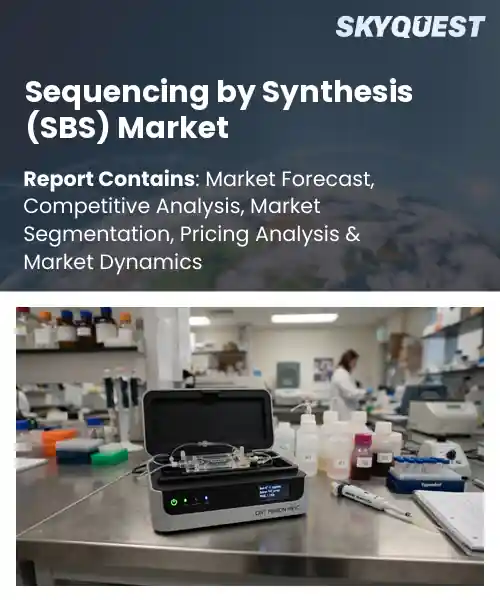
Sequencing by Synthesis (SBS) Market
Report ID: SQMIG35J2861
Report ID: SQMIG35J2861
[email protected]
USA +1 351-333-4748
Report ID:
SQMIG35J2861 |
Region:
Global |
Published Date: November, 2026
Pages:
157
|Tables:
94
|Figures:
76


Global Sequencing By Synthesis (Sbs) Market size was valued at USD 7.8 Billion in 2024 and is poised to grow from USD 8.91 Billion in 2025 to USD 25.77 Billion by 2033, growing at a CAGR of 14.2% during the forecast period (2026-2033).
The Sequencing‑by‑Synthesis (SBS) market encompasses platforms that decode DNA by repeatedly adding labeled nucleotides, a technology that underpins most next‑generation sequencers today. Its importance stems from the ability to generate high‑throughput, accurate reads at diminishing costs, fueling research, diagnostics, and personalized medicine. The primary driver has been the relentless price decline since Illumina’s 2006 launch of the Genome Analyzer, which reduced the cost per genome from $100 million to below $1 000 in a decade. Parallel advances in reagent chemistry, automation, and data analytics have broadened applications from oncology panels to large‑scale population studies, cementing SBS as the industry’s backbone global market. The next growth catalyst lies in the integration of SBS data into clinical decision‑making, where real‑time genomic insights reduce treatment latency and improve outcomes. As hospitals adopt liquid‑biopsy panels and pharmacogenomic tests, demand for rapid, high‑accuracy sequencers rises, prompting vendors to launch streamlined instruments with lower capital expense. This cause‑and‑effect chain spurs partnerships between biotech firms and cloud‑computing providers, exemplified by Illumina’s collaboration with Microsoft to accelerate AI‑driven variant interpretation. Consequently, emerging markets in Asia‑Pacific and Latin America experience accelerated adoption, unlocking new revenue streams while expanding the global SBS footprint across diverse therapeutic areas and research initiatives worldwide today.
How is AI-driven automation influencing growth in the Sequencing-by-Synthesis market?
AI driven automation is reshaping the Sequencing by Synthesis market by streamlining library preparation, run scheduling and data analysis. Machine learning models predict optimal reagent volumes, reduce cycle times and flag quality issues before they affect output. Laboratories now rely on integrated software that orchestrates instrument control and cloud based interpretation, freeing scientists to focus on experimental design. The result is higher throughput, lower hands on time and more consistent results, which encourages adoption across research, clinical and agricultural genomics. As vendors embed these capabilities into new sequencers the market experiences accelerated growth and broader accessibility.Illumina June 2024, introduced an AI powered workflow that automatically calibrates reagents and optimizes run parameters, cutting setup time and boosting data quality, which directly fuels market expansion. The system also streams results to cloud analytics, enabling real time decision making and reducing bottlenecks in high volume labs, further driving adoption of SBS platforms worldwide.
Market snapshot - (2026-2033)
Global Market Size
USD 7.8 Billion
Largest Segment
Instruments
Fastest Growth
Reagents & Consumables
Growth Rate
14.2% CAGR
To get more insights on this market click here to Request a Free Sample Report
Global sequencing by synthesis (sbs) market is segmented by component, application, end user and region. Based on component, the market is segmented into Instruments, Reagents & Consumables, Software & Data Analysis Solutions and Services. Based on application, the market is segmented into Whole-Genome Sequencing, Targeted Sequencing, Exome Sequencing, RNA Sequencing and Other Applications. Based on end user, the market is segmented into Academic & Research Institutions, Hospitals & Diagnostic Laboratories, Pharmaceutical & Biotechnology Companies and Contract Research Organizations. Based on region, the market is segmented into North America, Europe, Asia Pacific, Latin America and Middle East & Africa.
Instruments segment dominates because it provides the core hardware that enables high throughput, accurate base calling essential for SBS workflows. Manufacturers continuously integrate advanced optics, fluidics, and automation, which reduce turnaround time and improve data quality. This hardware reliability builds customer confidence, drives repeat purchases, and anchors the overall value proposition of SBS solutions, making instruments the indispensable foundation of the market for research, clinical, and commercial sequencing initiatives globally and sustainably.
However, Reagents & Consumables segment emerges as the fastest growing because novel chemistries and cost efficient kits are expanding accessibility of SBS across diverse labs. Continuous innovation reduces per sample expense, fuels adoption in emerging research programs, and creates new revenue streams, accelerating overall market expansion for both academic and commercial users.
RNA sequencing segment stands out because it unlocks transcriptomic insight critical for functional genomics and precision medicine. The ability to quantify gene expression and isoform diversity drives demand from researchers seeking dynamic cellular information. Continuous improvements in library preparation and multiplexing enhance sensitivity and reduce costs, positioning RNA seq as a strategic priority that elevates the relevance and adoption of SBS technologies across multiple disciplines in both basic science and therapeutic development.
Meanwhile, Targeted sequencing segment is witnessing the strongest growth momentum because it offers focused, cost effective panels that align with clinical diagnostics and companion test development. The push for rapid, actionable genetic information accelerates its uptake, and emerging multiplexed designs expand assay breadth, driving market penetration and opening opportunities for SBS providers.
To get detailed segments analysis, Request a Free Sample Report
North America leads the global Sequencing by Synthesis market because it combines deep research infrastructure with a mature biotech ecosystem. The United States hosts a concentration of leading academic institutions, venture‑backed start‑ups, and large genomics service providers that continuously push technological boundaries. Robust funding mechanisms, supportive regulatory pathways, and a well‑established supply chain for reagents and instrumentation accelerate product development and adoption. Canada contributes complementary strengths through strong public‑sector research programs, collaborative networks, and favorable policies encouraging genomics translation. The region’s focus on precision medicine, large clinical trial networks, and integration of genomics into healthcare delivery create sustained demand, reinforcing its leadership position worldwide.
Sequencing by Synthesis (SBS) Market in the United States is driven by a dense cluster of research universities, biotech incubators, and pharmaceutical giants that prioritize high‑throughput genomics. Strong public and private investment fuels continuous platform innovation, while a well‑developed logistics framework ensures rapid distribution of consumables. Close collaboration between academia and industry accelerates translational projects, and widespread adoption in clinical diagnostics reinforces market depth and resilience.
Sequencing by Synthesis (SBS) Market in Canada benefits from a collaborative research culture anchored by national genome initiatives and provincial funding programs. The presence of world‑renowned genomics centres and a growing number of specialized service providers nurtures ecosystem synergies. Favorable regulatory guidelines support clinical implementation, and strategic partnerships with international technology leaders expand access to cutting‑edge platforms, positioning Canada as a key contributor to the North American SBS landscape.
Europe’s rapid expansion in Sequencing by Synthesis is propelled by strong public research funding, a tradition of collaborative consortia, and accelerating adoption of genomics in healthcare systems. Policy frameworks that encourage data sharing and cross‑border partnerships enable efficient scaling of sequencing projects. The region’s focus on personalized medicine, coupled with a sophisticated network of biotech hubs, creates a fertile environment for platform upgrades and service diversification. Growing interest from pharmaceutical companies in integrating genomics into drug discovery further intensifies demand, while sustained investment in digital infrastructure supports seamless workflow integration across laboratories.
Sequencing by Synthesis (SBS) Market in Germany is anchored by a robust network of research institutes, industrial biotech clusters, and well‑funded national genome programs. The country’s emphasis on precision health drives adoption in clinical laboratories, while strong engineering expertise contributes to local instrument development. Collaborative frameworks between academia and industry accelerate technology transfer, and supportive regulatory pathways facilitate swift market entry for innovative SBS solutions.
Sequencing by Synthesis (SBS) Market in the United Kingdom is experiencing accelerated growth due to expansive government initiatives that prioritize genomics in public health. Leading university hospitals and biotech accelerators foster rapid technology uptake, while a vibrant venture capital scene funds emerging service providers. Integration of sequencing data into the national healthcare system creates a steady pipeline of clinical applications, and strong ties with European research networks enhance collaborative innovation and market momentum.
Sequencing by Synthesis (SBS) Market in France is emerging through strategic investments in genomic research infrastructure and a growing ecosystem of specialized start‑ups. National health agencies promote the incorporation of sequencing into diagnostic pathways, encouraging hospitals to adopt SBS platforms. Collaborative projects linking academic labs with biotech firms accelerate knowledge transfer, and recent policy incentives support scaling of production capacities, positioning France as an up‑and‑coming player in the European genomics arena.
Asia Pacific is strengthening its role in Sequencing by Synthesis by leveraging rapid technological adoption, expanding research capacities, and aligning genomics with national health priorities. Government programs that fund genomic initiatives, combined with a surge in private biotech investment, create a dynamic environment for platform development. The region’s emphasis on cost‑effective sequencing solutions caters to large‑scale population studies, while partnerships with global technology providers accelerate knowledge transfer. Growing integration of genomics into clinical practice and an increasing focus on agricultural and environmental applications further diversify demand, reinforcing Asia Pacific’s emerging influence on the global SBS market.
Sequencing by Synthesis (SBS) Market in Japan is propelled by world‑class research institutions and a strong emphasis on precision medicine within its healthcare system. Collaborative consortia between academic hospitals and major biotech firms facilitate rapid deployment of SBS platforms. Government incentives encourage domestic production of reagents, reducing reliance on imports, while a culture of meticulous quality control drives high adoption rates in clinical and research laboratories across the country.
Sequencing by Synthesis (SBS) Market in South Korea benefits from a highly digitized biotech sector and aggressive government support for genomics research. Leading universities and corporate research centers co‑develop innovative sequencing pipelines, fostering swift translation to market. Strategic partnerships with international equipment manufacturers enhance technology access, and national health initiatives promote integration of SBS into personalized therapy programs, positioning South Korea as a fast‑moving contributor to the regional SBS ecosystem.
To know more about the market opportunities by region and country, click here to
Buy The Complete Report
Expanding Clinical Application
Enhancements Improving Data Accuracy
High Capital Equipment Investment
Regulatory Uncertainty Across Regions
Request Free Customization of this report to help us to meet your business objectives.
The SBS market is shaped by intense rivalry among incumbents and emerging players, driving rapid innovation in sequencing chemistry, automation, and data analytics. Illumina’s acquisition of GRAIL accelerates its clinical diagnostics portfolio, while Thermo Fisher’s partnership with Roche expands joint development of high‑throughput platforms, and MGI’s European expansion intensifies competition on pricing and throughput, prompting continuous technology upgrades.
Top Player’s Company Profile
Recent Developments
SkyQuest’s ABIRAW (Advanced Business Intelligence, Research & Analysis Wing) is our Business Information Services team that Collects, Collates, Correlates, and Analyses the Data collected by means of Primary Exploratory Research backed by robust Secondary Desk research. As per SkyQuest analysis, the key driver is the expanding clinical application of SBS, while a second driver is AI‑driven automation that speeds up library preparation and data analysis. The main restraint remains the high capital cost of instruments. North America continues to dominate the market, supported by a dense research and biotech ecosystem, and the instruments segment remains the leading revenue generator. The integration of cloud‑based analytics further lowers turnaround times, making SBS more accessible to mid‑size labs. Overall, the competitive landscape and ongoing innovation sustain strong growth prospects, underpinning a projected CAGR of 14.2% through 2033 as the market expands from $8.9 billion in 2025 to $25.8 billion by 2033.
| Report Metric | Details |
|---|---|
| Market size value in 2024 | USD 7.8 Billion |
| Market size value in 2033 | USD 25.77 Billion |
| Growth Rate | 14.2% |
| Base year | 2024 |
| Forecast period | (2026-2033) |
| Forecast Unit (Value) | USD Billion |
| Segments covered |
|
| Regions covered | North America (US, Canada), Europe (Germany, France, United Kingdom, Italy, Spain, Rest of Europe), Asia Pacific (China, India, Japan, Rest of Asia-Pacific), Latin America (Brazil, Rest of Latin America), Middle East & Africa (South Africa, GCC Countries, Rest of MEA) |
| Companies covered |
|
| Customization scope | Free report customization with purchase. Customization includes:-
|
To get a free trial access to our platform which is a one stop solution for all your data requirements for quicker decision making. This platform allows you to compare markets, competitors who are prominent in the market, and mega trends that are influencing the dynamics in the market. Also, get access to detailed SkyQuest exclusive matrix.
Table Of Content
Executive Summary
Market overview
Parent Market Analysis
Market overview
Market size
KEY MARKET INSIGHTS
COVID IMPACT
MARKET DYNAMICS & OUTLOOK
Market Size by Region
KEY COMPANY PROFILES
Methodology
For the Sequencing by Synthesis (SBS) Market, our research methodology involved a mixture of primary and secondary data sources. Key steps involved in the research process are listed below:
1. Information Procurement: This stage involved the procurement of Market data or related information via primary and secondary sources. The various secondary sources used included various company websites, annual reports, trade databases, and paid databases such as Hoover's, Bloomberg Business, Factiva, and Avention. Our team did 45 primary interactions Globally which included several stakeholders such as manufacturers, customers, key opinion leaders, etc. Overall, information procurement was one of the most extensive stages in our research process.
2. Information Analysis: This step involved triangulation of data through bottom-up and top-down approaches to estimate and validate the total size and future estimate of the Sequencing by Synthesis (SBS) Market.
3. Report Formulation: The final step entailed the placement of data points in appropriate Market spaces in an attempt to deduce viable conclusions.
4. Validation & Publishing: Validation is the most important step in the process. Validation & re-validation via an intricately designed process helped us finalize data points to be used for final calculations. The final Market estimates and forecasts were then aligned and sent to our panel of industry experts for validation of data. Once the validation was done the report was sent to our Quality Assurance team to ensure adherence to style guides, consistency & design.
Analyst Support
Customization Options
With the given market data, our dedicated team of analysts can offer you the following customization options are available for the Sequencing by Synthesis (SBS) Market:
Product Analysis: Product matrix, which offers a detailed comparison of the product portfolio of companies.
Regional Analysis: Further analysis of the Sequencing by Synthesis (SBS) Market for additional countries.
Competitive Analysis: Detailed analysis and profiling of additional Market players & comparative analysis of competitive products.
Go to Market Strategy: Find the high-growth channels to invest your marketing efforts and increase your customer base.
Innovation Mapping: Identify racial solutions and innovation, connected to deep ecosystems of innovators, start-ups, academics, and strategic partners.
Category Intelligence: Customized intelligence that is relevant to their supply Markets will enable them to make smarter sourcing decisions and improve their category management.
Public Company Transcript Analysis: To improve the investment performance by generating new alpha and making better-informed decisions.
Social Media Listening: To analyze the conversations and trends happening not just around your brand, but around your industry as a whole, and use those insights to make better Marketing decisions.
REQUEST FOR SAMPLE
 REQUEST FREE CUSTOMIZATION


Want to customize this report? This report can be personalized according to your needs. Our analysts and industry experts will work directly with you to understand your requirements and provide you with customized data in a short amount of time. We offer $1000 worth of FREE customization at the time of purchase.
Feedback From Our Clients


 USA (+1) 351-333-4748

