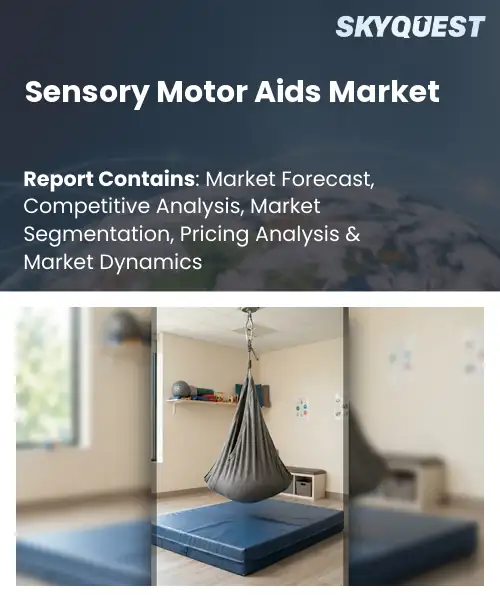
Sensory Motor Aids Market
Report ID: SQMIG35B2508
Report ID: SQMIG35B2508
[email protected]
USA +1 351-333-4748
Report ID:
SQMIG35B2508 |
Region:
Global |
Published Date: August, 2026
Pages:
157
|Tables:
121
|Figures:
77


Global Sensory Motor Aids Market size was valued at USD 2.94 Billion in 2024 and is poised to grow from USD 3.17 Billion in 2025 to USD 5.83 Billion by 2033, growing at a CAGR of 7.9% during the forecast period (2026-2033).
The global sensory motor aids market comprises devices and therapeutic tools that enhance proprioception, balance, and coordination for individuals with neurological or developmental disorders. Its importance stems from the rising prevalence of autism spectrum disorder, cerebral palsy, and age‑related motor decline, which drive demand for interventions that improve functional independence. Historically, the market emerged from simple orthotic braces in the 1970s, evolved through the introduction of vibration platforms in the 1990s, and accelerated with wearable haptic feedback systems after 2015. These innovations reflect a shift from passive support to active stimulation, positioning sensory motor aids as a cornerstone of rehabilitative care. Building on that evolution, the principal growth catalyst for the global sensory motor aids market is the integration of health platforms that enable data‑driven personalization. Analytics from embedded sensors allow clinicians to adjust stimulation parameters instantly, which improves therapeutic outcomes and shortens treatment cycles. For example, pediatric clinics in Scandinavia now pair wearable ankle‑assist devices with cloud‑based dashboards, reducing fall incidents by 30 % within six months. This convergence of IoT connectivity and reimbursement reforms that recognize remote monitoring creates a fertile environment for manufacturers to launch subscription‑based models, expanding market reach while delivering measurable value to patients and payers alike.
How is AI improving functionality and user experience in the sensory motor aids market?
AI is reshaping sensory motor aids by turning static devices into intelligent companions. Machine‑learning algorithms analyze user movement patterns and adjust assistance levels in real time, making prosthetic limbs feel more natural. Voice and gesture recognition let users control devices without manual input, while predictive maintenance alerts reduce downtime. Cloud‑based platforms collect anonymized data, enabling developers to refine designs across populations. This convergence of AI with ergonomic engineering creates products that respond to individual needs, boosting confidence and independence for people with sensory or motor impairments. As the market expands, these smart features become key differentiators that attract investors and healthcare providers.In July 2025 an AI‑enhanced adaptive glove entered the market, delivering precise tactile feedback and learning user preferences to streamline calibration, which shortens therapy sessions and improves daily usability. This innovation illustrates how intelligent sensing drives broader adoption and efficiency in the sensory motor aids sector.
Market snapshot - (2026-2033)
Global Market Size
USD 2.94 Billion
Largest Segment
Multi-Sensory Equipment
Fastest Growth
Vestibular Therapy Aids
Growth Rate
7.9% CAGR
To get more insights on this market click here to Request a Free Sample Report
Global sensory motor aids market is segmented by product type, application, age group, end user and region. Based on product type, the market is segmented into Balance & Coordination Aids, Tactile Stimulation Aids, Proprioceptive Aids, Vestibular Therapy Aids and Multi-Sensory Equipment. Based on application, the market is segmented into Occupational Therapy, Physical Therapy, Special Education and Home Therapy. Based on age group, the market is segmented into Children, Adults and Geriatric. Based on end user, the market is segmented into Hospitals & Rehabilitation Centers, Schools & Special Education Centers, Therapy Clinics and Home Care. Based on region, the market is segmented into North America, Europe, Asia Pacific, Latin America and Middle East & Africa.
Vestibular Therapy Aids segment dominates because practitioners recognize its essential contribution to stabilizing balance systems and mitigating sensory overload. Its therapeutic designs integrate motion based stimuli that directly engage the inner ear, fostering neural adaptation. Clinicians prioritize these tools for their proven efficacy in addressing core deficits across age groups, leading to sustained procurement by rehabilitation facilities. Consequently, demand remains robust, reinforcing its leadership within the sensory motor aids market.
Meanwhile, Proprioceptive Aids segment emerges as the most rapidly expanding area, driven by growing interest in tactile feedback devices that promote body awareness. Advances in wearable technology and integration with digital platforms stimulate adoption among therapists seeking customizable solutions, thereby accelerating market expansion and opening new avenues for product innovation.
Occupational Therapy segment dominates because it serves as the primary conduit for integrating sensory motor aids into daily functional activities. Therapists leverage these tools to address fine motor deficits, sensory processing challenges, and adaptive skill building, aligning closely with client centered goals. The interdisciplinary nature of occupational practice ensures continuous exposure to innovative equipment, prompting steady acquisition by clinics and schools that prioritize holistic development. This entrenched role sustains its preeminence in the market.
On the other hand, Home Therapy segment is witnessing strongest growth momentum, propelled by rising caregiver involvement and tele rehabilitation models. Portable, user friendly devices enable families to conduct therapeutic sessions outside clinical settings, increasing adherence and outcomes. This shift expands market reach and fuels demand for adaptable, home centric solutions.
To get detailed segments analysis, Request a Free Sample Report
North America leads the market through a combination of mature healthcare systems, extensive research and development ecosystems, and strong financial capacity among providers and patients. The region benefits from early adoption of innovative therapeutic technologies and a regulatory environment that encourages product approvals and clinical integration. Robust reimbursement frameworks and well‑established distribution networks further accelerate market penetration. Additionally, a high prevalence of neurological and musculoskeletal conditions drives sustained demand, while collaborations between academic institutions and industry foster continuous product improvement and customization for diverse patient needs.
Sensory Motor Aids Market in the United States thrives on a deep pool of clinical expertise and a culture of rapid technology adoption. Leading medical centers and research universities drive product innovation, while a sophisticated insurance landscape supports broad patient access. The market is reinforced by strong partnerships between device manufacturers and rehabilitation specialists, ensuring that emerging solutions are quickly integrated into therapeutic protocols. Consumer awareness and a focus on personalized care further stimulate demand across acute and chronic care settings.
Sensory Motor Aids Market in Canada is shaped by a publicly funded healthcare system that emphasizes equitable access to advanced therapies. Provincial health authorities prioritize evidence‑based interventions, encouraging the adoption of proven sensory motor technologies. Collaborative networks among hospitals, research institutes, and industry facilitate knowledge exchange and support the introduction of novel devices. A growing emphasis on community‑based rehabilitation and aging‑population care expands the market’s reach, while government initiatives promote local manufacturing and innovation to meet domestic demand.
Europe’s rapid expansion is propelled by strong governmental commitment to health innovation, comprehensive reimbursement schemes, and a highly integrated clinical research environment. The region’s emphasis on patient‑centered care and early intervention creates a fertile ground for advanced sensory motor solutions. Cross‑border collaboration among research institutions, industry clusters, and regulatory bodies accelerates product development and market entry. Moreover, a focus on sustainable healthcare delivery and the integration of digital health platforms enhances the effectiveness and accessibility of therapeutic devices across diverse patient populations.
Sensory Motor Aids Market in Germany benefits from a robust engineering tradition and a well‑structured healthcare system that supports cutting‑edge rehabilitation technologies. Strong ties between medical device manufacturers and leading research hospitals foster continuous product refinement. Reimbursement policies that reward functional outcomes encourage clinicians to adopt advanced sensory motor solutions. The market is further bolstered by a proactive regulatory framework that streamlines approval processes while maintaining high safety standards.
Sensory Motor Aids Market in the United Kingdom experiences accelerated growth through a dynamic NHS environment that prioritizes innovative care pathways. National health initiatives promote early adoption of evidence‑based sensory motor devices, while public‑private partnerships drive research and commercialization. The market is reinforced by a skilled workforce of therapists and clinicians who champion personalized rehabilitation strategies. Emerging digital health integrations also expand the reach and efficacy of sensory motor interventions across community and hospital settings.
Sensory Motor Aids Market in France is emerging as a vibrant segment supported by strong public health policies and a growing focus on neuro‑rehabilitation. Collaborative programs between academic centers and industry accelerate the translation of research into clinical practice. Reimbursement mechanisms that emphasize therapeutic outcomes facilitate broader patient access. The market is further energized by increasing awareness of the benefits of sensory motor technologies among healthcare providers and patients alike.
Asia Pacific is strengthening its position through rapid urbanization, rising healthcare expenditure, and a cultural shift toward proactive health management. The region’s expanding middle class drives demand for advanced rehabilitation solutions, while governments invest heavily in modernizing medical infrastructure. Strong manufacturing capabilities and a focus on cost‑effective innovation enable local producers to compete globally. Additionally, strategic partnerships between multinational firms and regional research institutions accelerate technology transfer and adaptation to local clinical needs, fostering a dynamic and increasingly sophisticated market landscape.
Sensory Motor Aids Market in Japan is characterized by a high level of clinical expertise and a strong emphasis on precision medicine. Government health programs support the integration of advanced sensory motor devices into standard rehabilitation protocols. Collaboration between leading universities and device manufacturers drives continuous innovation tailored to an aging population. The market benefits from a well‑established distribution network and a cultural acceptance of technology‑enabled therapeutic approaches.
Sensory Motor Aids Market in South Korea thrives on a vibrant biotech sector and aggressive adoption of digital health solutions. National health insurance policies encourage the use of evidence‑based sensory motor technologies, while government incentives promote research and development. Close cooperation between hospitals, research institutes, and technology firms accelerates the introduction of novel devices. The market is further propelled by a tech‑savvy population that readily embraces innovative rehabilitation tools.
To know more about the market opportunities by region and country, click here to
Buy The Complete Report
Rising Adoption Of Smart Wearables
Integration Of AI Powered Analytics
High Cost Of Advanced Devices
Regulatory Complexity Across Regions
Request Free Customization of this report to help us to meet your business objectives.
The competitive landscape of the global Sensory Motor Aids market is shaped by intense rivalry among technology firms pursuing strategic M&A, cross‑industry partnerships, and rapid product innovation. Recent examples include a major acquisition of a haptic‑feedback device maker by a leading medical‑equipment group, and a joint venture between a robotics company and a neuro‑rehabilitation specialist to co‑develop AI‑driven motor‑control platforms, accelerating time‑to‑market and expanding distribution networks.
Top Player’s Company Profile
Recent Developments
SkyQuest’s ABIRAW (Advanced Business Intelligence, Research & Analysis Wing) is our Business Information Services team that Collects, Collates, Correlates, and Analyses the Data collected by means of Primary Exploratory Research backed by robust Secondary Desk research. As per SkyQuest analysis the global sensory motor aids market is being propelled primarily by the rising adoption of smart wearable devices that deliver real‑time feedback and personalized therapy, while AI‑powered analytics integration serves as a second major driver by fine‑tuning assistance levels through machine‑learning insights. The market’s growth is tempered by the high cost of advanced devices, which limits accessibility in budget‑constrained settings. North America remains the dominant region, benefitting from mature healthcare systems, strong R&D and robust reimbursement frameworks. Within the product landscape the vestibular therapy aids segment leads the market, backed by clinicians’ preference for its proven efficacy in stabilising balance and reducing sensory overload.
| Report Metric | Details |
|---|---|
| Market size value in 2024 | USD 2.94 Billion |
| Market size value in 2033 | USD 5.83 Billion |
| Growth Rate | 7.9% |
| Base year | 2024 |
| Forecast period | (2026-2033) |
| Forecast Unit (Value) | USD Billion |
| Segments covered |
|
| Regions covered | North America (US, Canada), Europe (Germany, France, United Kingdom, Italy, Spain, Rest of Europe), Asia Pacific (China, India, Japan, Rest of Asia-Pacific), Latin America (Brazil, Rest of Latin America), Middle East & Africa (South Africa, GCC Countries, Rest of MEA) |
| Companies covered |
|
| Customization scope | Free report customization with purchase. Customization includes:-
|
To get a free trial access to our platform which is a one stop solution for all your data requirements for quicker decision making. This platform allows you to compare markets, competitors who are prominent in the market, and mega trends that are influencing the dynamics in the market. Also, get access to detailed SkyQuest exclusive matrix.
Table Of Content
Executive Summary
Market overview
Parent Market Analysis
Market overview
Market size
KEY MARKET INSIGHTS
COVID IMPACT
MARKET DYNAMICS & OUTLOOK
Market Size by Region
KEY COMPANY PROFILES
Methodology
For the Sensory Motor Aids Market, our research methodology involved a mixture of primary and secondary data sources. Key steps involved in the research process are listed below:
1. Information Procurement: This stage involved the procurement of Market data or related information via primary and secondary sources. The various secondary sources used included various company websites, annual reports, trade databases, and paid databases such as Hoover's, Bloomberg Business, Factiva, and Avention. Our team did 45 primary interactions Globally which included several stakeholders such as manufacturers, customers, key opinion leaders, etc. Overall, information procurement was one of the most extensive stages in our research process.
2. Information Analysis: This step involved triangulation of data through bottom-up and top-down approaches to estimate and validate the total size and future estimate of the Sensory Motor Aids Market.
3. Report Formulation: The final step entailed the placement of data points in appropriate Market spaces in an attempt to deduce viable conclusions.
4. Validation & Publishing: Validation is the most important step in the process. Validation & re-validation via an intricately designed process helped us finalize data points to be used for final calculations. The final Market estimates and forecasts were then aligned and sent to our panel of industry experts for validation of data. Once the validation was done the report was sent to our Quality Assurance team to ensure adherence to style guides, consistency & design.
Analyst Support
Customization Options
With the given market data, our dedicated team of analysts can offer you the following customization options are available for the Sensory Motor Aids Market:
Product Analysis: Product matrix, which offers a detailed comparison of the product portfolio of companies.
Regional Analysis: Further analysis of the Sensory Motor Aids Market for additional countries.
Competitive Analysis: Detailed analysis and profiling of additional Market players & comparative analysis of competitive products.
Go to Market Strategy: Find the high-growth channels to invest your marketing efforts and increase your customer base.
Innovation Mapping: Identify racial solutions and innovation, connected to deep ecosystems of innovators, start-ups, academics, and strategic partners.
Category Intelligence: Customized intelligence that is relevant to their supply Markets will enable them to make smarter sourcing decisions and improve their category management.
Public Company Transcript Analysis: To improve the investment performance by generating new alpha and making better-informed decisions.
Social Media Listening: To analyze the conversations and trends happening not just around your brand, but around your industry as a whole, and use those insights to make better Marketing decisions.
REQUEST FOR SAMPLE
 REQUEST FREE CUSTOMIZATION


Want to customize this report? This report can be personalized according to your needs. Our analysts and industry experts will work directly with you to understand your requirements and provide you with customized data in a short amount of time. We offer $1000 worth of FREE customization at the time of purchase.
Feedback From Our Clients


 USA (+1) 351-333-4748

