

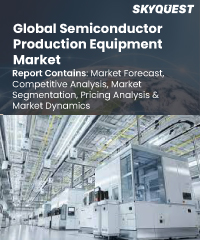
Semiconductor Production Equipment Market
Report ID: SQMIG45N2084
Skyquest Technology's expert advisors have carried out comprehensive research and identified these companies as industry leaders in the Semiconductor Production Equipment Market. This Analysis is based on comprehensive primary and secondary research on the corporate strategies, financial and operational performance, product portfolio, market share and brand analysis of all the leading Semiconductor Production Equipment industry players.


As demand for higher-performance semiconductors increases throughout various industries, this is the largest factor impacting the global semiconductor production equipment industry. Advancing technologies such as artificial intelligence (AI), 5G telecommunications, high-performance computing (HPC), as well as next-generation consumer electronics all require increasingly advanced and sophisticated production methodologies. As a result, manufacturers need to invest in production equipment that can support advanced process nodes and new materials; therefore, they are investing in cutting-edge production equipment designed to produce smaller, faster, higher-performance and lower-power semiconductors.
According to SkyQuest Technology “Semiconductor Production Equipment Market By Type (Front-End Equipment, Backend Equipment, and Others), By Products (Dicing Machine, Probing Machines, Sliced Wafer Demounting, Cleaning Machine, Wafer Edge Grinding Machine, Polish Grinders, and Others), By Region - Industry Forecast 2026-2033,” Global Semiconductor Production Equipment Market is projected to grow at a CAGR of over 8.5% by 2033, on account of urgent need for automating quantified data. Investments by the governments and large companies in North America, Europe, and Asia to promote local semiconductor manufacturing will also contribute significantly to the semiconductor production equipment market. Numerous countries are making substantial investments to develop and implement local semiconductor fabrication facilities to reduce reliance on foreign supply chains and to increase their capabilities for developing and implementing new technologies.
|
Company |
Est. Year |
Headquarters |
Revenue |
Key Services |
|
ASML |
1984 |
Veldhoven, Netherlands |
30.8 Billion USD |
Exclusive provider of EUV (Extreme Ultraviolet) lithography systems. |
|
Applied Materials |
1967 |
Santa Clara, USA |
27.2 Billion USD |
Materials engineering, deposition (CVD/PVD), and ion implantation. |
|
Lam Research |
1980 |
Fremont, USA |
17.5 Billion USD |
Market leader in etching and thin-film deposition (CVD/ALD). |
|
Tokyo Electron (TEL) |
1963 |
Tokyo, Japan |
14.8 Billion USD |
Photoresist coaters/developers and thermal processing tools. |
|
KLA Corporation |
1975 |
Milpitas, USA |
10.5 Billion USD |
Process control, metrology, and yield management (inspection). |
|
Naura Technology |
2001 |
Beijing, China |
5.5 Billion USD |
China’s leader in etching, deposition, and cleaning equipment. |
|
Screen Holdings |
1943 |
Kyoto, Japan |
4.2 Billion USD |
Global leader in single-wafer cleaning and track systems. |
|
Advantest |
1954 |
Tokyo, Japan |
4.0 Billion USD |
Dominant in Automated Test Equipment (ATE) for logic and memory. |
|
ASM International |
1968 |
Almere, Netherlands |
3.4 Billion USD |
Specialized leader in Atomic Layer Deposition (ALD) technology. |
|
Teradyne |
1960 |
North Reading, USA |
2.8 Billion USD |
High-precision semiconductor testing and industrial robotics. |
Beginning in 1984, ASML operates out of Veldhoven, Netherlands, and is the sole supplier of the Extreme Ultraviolet (EUV) lithography systems that are integral to constructing advanced semiconductor nodes. ASML provides cutting-edge lithography technology that allows chip manufacturers to reduce chip size and produce faster and more energy-efficient chips. This enables ASML to maintain its leadership position in the worldwide semiconductor equipment market.
Founded in 1967 in Santa Clara, California, Applied Materials is a global leader in developing materials engineering solutions as well as chemical vapor deposition (CVD), physical vapor deposition (PVD), and ion implantation equipment. They enable semiconductor fabrication across various semiconductor nodes and technologies, including developing high-performance and high-yield chips.
Establishing their headquarters in 1980, Lam Research is located in Fremont, California, and focuses on developing etching & thin-film deposition (CVD/ALD). Lam Research provides essential processing solutions for constructing advanced semiconductor nodes and is known for its innovative techniques for providing higher transistor density and improving performance.
Founded in 1963 in Tokyo, Japan, TEL is a major player in manufacturing photoresist coaters/developers, thermal processing equipment and various other front-end tools. TEL supports various types of semiconductor processing (logic, memory, advanced packaging) and is focused on providing high throughput, yield, and consistent processes.
KLA Corporation was established in 1975 and has been leading the world in process control and yield management for semiconductor manufacturing. KLA's metrology-based inspection tools support semiconductor manufacturers in monitoring defects in their products and by providing the means to optimize yields from their production.
Founded in Beijing in 2001, Naura Technology is the leader in China for the supply of cleaning, deposition, and etching equipment for semiconductor fabrication. Naura Technology also financially supports China’s domestic semiconductor manufacturing by providing advanced technology platforms supporting precision manufacturing tools used for the increasing demand of the next generation process nodes.
Established in 1943, Screen Holdings is headquartered in Kyoto, Japan. Screen Holdings is one of the world's leaders in single wafer cleaning and track systems that provide products to ensure contamination free processing of wafers during semiconductor production.
Advantest was founded in 1954 in Tokyo, Japan, and is the major provider of Automated Test Equipment (ATE) for logic and memory chips. Advantest's products provide the necessary feedback on the performance, reliability, and functionality of semiconductor devices made by semiconductor manufacturers before the devices are shipped to the consumer marketplace. With advances in testing systems developed by Advantest, both production and advanced semiconductor designs benefit.
ASM International (founded in Almere, Netherlands, in 1968) is a technological leader in Atomic Layer Deposition (ALD), a process that allows the deposition of layers of material such as silicon at the level of individual atoms. This process is critical to the fabrication of advanced semiconductor chips. ASM International is able to innovate and provide chip manufacturers with increased density, better performance, and improved efficiency in their semiconductor devices through its expertise in ALD.
Teradyne is a provider of high-accuracy semiconductor test equipment and robotic systems that ensure the functional verification and quality of semiconductor components in a variety of markets, including; memory, logic, automotive, and industrial. Teradyne's solutions help manufacturers worldwide achieve high yield and reliable chip performance.
The semiconductor manufacturing equipment market has the capability for viable opportunities in the future owing to the rising demand for high-tech semiconductors, the strategic investment in manufacturing locally and the transition to automation & intelligent manufacturing methods. When considering the changing international landscape of semiconductors, manufacturers are focused more on precision, performance and efficiency meaning that there will be a need for a continual supply of advanced manufacturing equipment. Although the changing global political climate and shifts in supply chains can create difficulties, it also provides the potential for manufacturing to expand into new regions and the opportunity for diversification of manufacturing capabilities. In general, this market will continue to thrive as more industries rely on semiconductors to develop innovation in digital infrastructure, mobile devices and consumer electronics.
REQUEST FOR SAMPLE
 REQUEST FREE CUSTOMIZATION
Semiconductor Production Equipment Market size was valued at USD 104.49 Billion in 2024 poised to grow from USD 113.37 Billion in 2025 to USD 217.73 Billion by 2033, growing at a CAGR of 8.5% in the forecast period (2026–2033).
The global semiconductor production equipment market outlook is highly competitive, dominated by key international players like Tokyo Electron, ASML, Lam Research, Applied Materials, and Screen Holdings. They place strong emphasis on innovation, strategic collaborations, and increased R&D capabilities to stay abreast of the market. For instance, ASML invests significantly in next-generation lithography technology, while Applied Materials places strong focus on acquisitions for augmenting its portfolio. Product customization and product efficiency enhancement also stem from collaboration with semiconductor manufacturers. 'ASML (Netherlands)', 'Tokyo Electron Limited (TEL) (Japan)', 'Applied Materials (USA)', 'Lam Research Corporation (USA)', 'SCREEN Holdings Co., Ltd. (Japan)', 'KLA Corporation (USA)', 'Hitachi High-Technologies Corporation (Japan)', 'Advantest Corporation (Japan)', 'Nikon Corporation (Japan)', 'Teradyne, Inc. (USA)', 'Canon Inc. (Japan)', 'ASM International (Netherlands)', 'Veeco Instruments Inc. (USA)', 'Ultra Clean Holdings, Inc. (USA)', 'SCREEN Semiconductor Solutions Co., Ltd. (Japan)'
The rising need for advanced semiconductor devices in smartphones, AI, and 5G technology drives demand for sophisticated production equipment. With rising chip complexity, companies need to have advanced equipment to ensure that precision is maintained and efficiency is ensured, driving the global semiconductor production equipment market growth.
Growing Focus on Sustainable and Energy-Efficient Equipment: Manufacturers increasingly prioritize sustainability by developing energy-efficient semiconductor production equipment. This trend is answering to green regulations and corporate responsibility aspirations, lowering carbon footprints and cost of operations. Sustainable technologies are becoming a necessity for long-term competitiveness and appealing to green stakeholders in the semiconductor arena.
How does Strong Manufacturing Capacity Boost the Region’s Market Share?
Want to customize this report? This report can be personalized according to your needs. Our analysts and industry experts will work directly with you to understand your requirements and provide you with customized data in a short amount of time. We offer $1000 worth of FREE customization at the time of purchase.
Feedback From Our Clients
Report ID: SQMIG45N2084
[email protected]
USA +1 351-333-4748
 USA (+1) 351-333-4748

