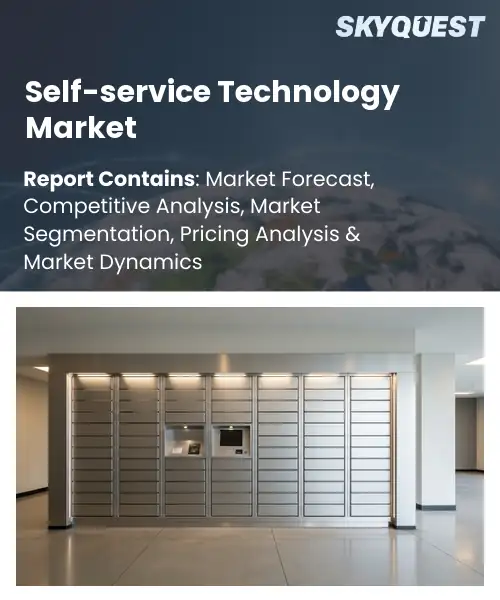
Self-service Technology Market
Report ID: SQMIG45J2565
Report ID: SQMIG45J2565
[email protected]
USA +1 351-333-4748
Report ID:
SQMIG45J2565 |
Region:
Global |
Published Date: June, 2026
Pages:
157
|Tables:
120
|Figures:
72


Global Self-Service Technology Market size was valued at USD 48.52 Billion in 2024 and is poised to grow from USD 53.28 Billion in 2025 to USD 112.85 Billion by 2033, growing at a CAGR of 9.82% during the forecast period (2026-2033).
As a research analyst, I view the self-service technology market as a suite of automated solutions that allow consumers and employees to complete tasks without assistance, a capability that constitutes its primary driver. The market matters because it reduces operational costs, increases speed of service, and enhances data capture for personalization. Over the past two decades, developments have progressed from simple kiosks in airports and fast food restaurants to sophisticated mobile apps, AI-driven chatbots, and biometric-enabled terminals in banking. For example, airport check-in kiosks evolved into mobile boarding passes while retail adopted self-checkout and automated returns to reshape customer flows.
Building on this shift toward automation, the key factor propelling global self-service technology growth is artificial intelligence which enables systems to learn from interactions and optimize user journeys. As AI improves accuracy and personalization, businesses see higher adoption because customer satisfaction rises and transaction times shorten. In retail, real-time analytics drive dynamic pricing and faster checkout, leading to higher basket values. In banking, conversational AI reduces call center volumes so institutions reinvest savings into product innovation. These cause-and-effect dynamics create opportunities for vendors to offer SaaS platforms, integrated biometrics, and managed services that scale quickly across regions with measurable ROI.
How is AI enabling personalization in the self-service technology market?
AI enables personalization in self service technology by uniting data driven customer profiles with real time context and adaptive interfaces. Key aspects are behavioral learning from transactions and sensors, natural language and visual recognition for contextual signals, and integration with loyalty and inventory systems. The current state shows kiosks and self checkout evolving from static terminals to intelligent touchpoints that surface tailored offers, streamline task flows, and adapt content for repeat users. This shift gives retailers and banks practical ways to make experiences more relevant, reduce friction, and deliver consistent service at scale.
Diebold Nixdorf May 2026, showcased AI driven visual recognition and modular self checkout that personalizes prompts and suggests relevant items. This development improves throughput and customer relevance while helping the self service market grow by making automated touchpoints more efficient and tailored.
Market snapshot - (2026-2033)
Global Market Size
USD 48.52 Billion
Largest Segment
Kiosks
Fastest Growth
Self-Checkout Systems
Growth Rate
9.82% CAGR
To get more insights on this market click here to Request a Free Sample Report
Global self-service technology market is segmented by product type, application, technology, end-user and region. Based on product type, the market is segmented into Kiosks, ATMs, Self-Checkout Systems and Vending Machines. Based on application, the market is segmented into Retail & Grocery, Banking & Financial Services, Hospitality, Healthcare and Transportation. Based on technology, the market is segmented into Touchscreen, Biometric and NFC & Contactless. Based on end-user, the market is segmented into Retail, Banks and Hospitality & Travel. Based on region, the market is segmented into North America, Europe, Asia Pacific, Latin America and Middle East & Africa.
Kiosks segment dominates because operators across retail, hospitality, and transport prioritize durable, multifunctional touchpoint devices that centralize transactions, information and service tasks. Their prominence arises from broad interoperability with payment systems, streamlined customer flows, and the ability to offload labor intensive tasks, which reduces operational bottlenecks and improves throughput. Demand for customizable interfaces and sturdy hardware encourages vendor investments, reinforcing kiosk deployment as the foundational self service infrastructure driving market standardization and enterprise adoption.
However, Self-Checkout Systems are the most rapidly expanding area, driven by consumer demand for frictionless, time saving purchase experiences and retailers' focus on labor optimization. Continuous software innovation, integration with loyalty and mobile payment ecosystems, and evolving store formats accelerate rollouts, creating avenues for third party services and analytics that expand the overall self service technology opportunity.
Biometric segment leads because it offers robust, user centric authentication that mitigates fraud and streamlines verification across unattended devices. Strong emphasis on secure identity verification and seamless user flow drives vendor prioritization of fingerprint, facial and iris capabilities, which in turn reduces transaction friction and chargeback exposure. Integration with backend identity management and compliance frameworks increases trust among enterprises, encouraging deployment in high security and high volume self service use cases.
Meanwhile, NFC & Contactless is emerging as the fastest growing area because rising demand for hygienic, tap and go interactions and mobile wallet integration simplifies payments and loyalty activation. Rapid innovation in reader chipset and tokenization, combined with expanding contactless acceptance across verticals, fuels adopter confidence and opens partnerships that broaden deployment footprints and service monetization.
To get detailed segments analysis, Request a Free Sample Report
North America leads due to an advanced technology ecosystem, strong vendor presence, and early enterprise adoption that together create a reinforcing innovation cycle. Robust investment in research and development, deep integration between software providers and hardware manufacturers, and mature retail and financial service networks support broad deployment of kiosks, terminals, and automated checkouts. High customer familiarity with digital interactions encourages provider experimentation and iterative improvements. A collaborative regulatory and standards environment enables interoperability and scalability across jurisdictions, while established channel partners and service firms accelerate implementation and maintenance. Emphasis on user experience, accessibility, and security has produced reliable solutions that are easier to scale. This combination of market sophistication, supply chain depth, and customer readiness sustains North America as the dominant region for self service technology development and commercialization.
Self-service Technology Market in United States benefits from a dense ecosystem of vendors, integrators, and enterprise adopters that drive continuous product refinement. High consumer acceptance of automation and strong partnerships between technology providers and service channels enable rapid pilots and broader rollouts. Emphasis on security, accessibility, and user experience supports premium deployments across retail, travel, and financial sectors, creating a rich environment for ongoing innovation and scale and operational resilience.
Self-service Technology Market in Canada leverages alignment with vendors and service providers to tailor solutions for dispersed populations and urban centers alike. Emphasis on accessibility, multilingual interfaces, and regulatory compliance shapes deployments. Collaborative pilot programs between public and private sectors foster trust and demonstrate value across retail, healthcare, and transportation use cases. A network of systems integrators and service firms supports sustainable implementation and localized customer experience refinement and resilience.
Asia Pacific expansion is driven by strong consumer receptivity to digital interfaces, rapid modernization of service industries, and concentrated technology investment across leading markets. Urbanization and high smartphone penetration foster mobile integration with kiosks and unattended terminals, enabling seamless omnichannel experiences. Regional vendors increasingly localize hardware and software to address language, cultural, and regulatory diversity, while strategic partnerships between global suppliers and domestic integrators accelerate deployment. Governments promoting digital public services and private sector adoption in retail, transportation, and hospitality create visible use cases that normalize automated interactions. The convergence of local market adaptability, evolving customer expectations, and a competitive supply base has produced a fertile environment for fast growth and sustained innovation across the region. Local service partners and flexible financing models help overcome deployment complexity and accelerate adoption.
Self-service Technology Market in Japan reflects a culture of precision engineering and focus on human centered design, producing refined hardware and intuitive interfaces. Providers prioritize compact, reliable kiosks and integrated payment solutions for dense urban settings and complex retail formats. Collaboration among manufacturers, retailers, and transport operators yields pilot programs that emphasize accessibility and seamless customer journeys. A mature supply chain and exacting quality standards support broad adoption and development.
Self-service Technology Market in South Korea is characterized by rapid integration of advanced display technologies, mobile payment systems, and AI driven customer interfaces. Strong consumer preference for convenience and high urban footfall encourages deployments across retail, QSR, and public transit environments. Domestic manufacturers and startups collaborate with system integrators to deliver localized solutions with multilingual support and connectivity. Emphasis on speed, personalization, and compact hardware design drives experimentation and refinement.
Europe is reinforcing its role through technology standardization, emphasis on privacy and accessibility, and a collaborative innovation ecosystem that connects vendors, research institutions, and service providers. Vendors focus on modular platforms and interoperability to address diverse language and regulatory requirements across national markets. Strong design traditions and user experience research guide development toward inclusive interfaces, while public procurement and pilot initiatives encourage real world validation in sectors such as retail, transportation, and public services. Growing competence among systems integrators and managed service firms enables more cost effective rollouts and lifecycle support. Collectively, these factors help Europe cultivate robust, adaptable solutions that reflect regional priorities and promote cross border adoption. Investment in AI enabled analytics and partnerships with telecommunications providers are advancing remote management, personalization, and connectivity for unattended systems.
Self-service Technology Market in Germany benefits from strong manufacturing capabilities, rigorous engineering standards, and a focus on quality that produce durable, hardware offerings. Vendors emphasize modular architectures and compliance with regulatory and safety requirements. Collaboration between suppliers and software firms yields solutions tailored to complex retail and transportation networks. A mature ecosystem of systems integrators and service providers supports lifecycle management and customization, enabling reliable deployments that meet operational expectations.
Self-service Technology Market in United Kingdom benefits from a vibrant fintech sector, a strong focus on user centered design, and retail innovation labs that foster iterative testing. Providers emphasize omnichannel experiences, secure payments, and inclusive interfaces to meet diverse consumer expectations. Collaboration between startups, retailers, and public transport authorities produces practical pilots that inform broader rollouts. A competitive services market for installation and maintenance supports deployments and customer experience improvements.
Self-service Technology Market in France blends strong design orientation with public sector support for digital access, leading to interfaces that prioritize usability and inclusion. Local vendors and integrators adapt solutions for multilingual and accessibility requirements, partnering with transport and retail operators to validate deployments. A network of service providers facilitates implementation and maintenance, while emphasis on aesthetics and regulatory compliance shapes product development and encourages user acceptance across urban settings.
To know more about the market opportunities by region and country, click here to
Buy The Complete Report
Rising Consumer Preference For Convenience
Advances In AI and IoT
High Initial Deployment Costs
Concerns Over Data Security and Privacy
Request Free Customization of this report to help us to meet your business objectives.
Competitive intensity in the global self service technology market is driven by retailers using acquisitions and partnerships to deploy cashierless and kiosk solutions for differentiation; for example Instacart acquired Caper AI to integrate smart cart and checkout tech, and Autonomo secured investment and a retailer partnership with Meyer part of EDEKA to scale autonomous stores.
Top Player’s Company Profile
Recent Developments
SkyQuest’s ABIRAW (Advanced Business Intelligence, Research & Analysis Wing) is our Business Information Services team that Collects, Collates, Correlates, and Analyses the Data collected by means of Primary Exploratory Research backed by robust Secondary Desk research. As per SkyQuest analysis, the global self-service technology market is driven primarily by rising consumer preference for convenience, which fuels deployments across retail, hospitality and transportation, while a second major driver is advances in AI and IoT that enable personalization, predictive maintenance and adaptive interfaces. The market is dominated by North America, where mature ecosystems and vendor presence accelerate scale, and kiosks remain the leading product segment due to interoperability and multifunction capability. A key restraint is high initial deployment costs that can limit adoption by smaller operators and extend procurement cycles. Overall vendors that combine hardware, software and managed services are best positioned to capture growth.
| Report Metric | Details |
|---|---|
| Market size value in 2024 | USD 48.52 Billion |
| Market size value in 2033 | USD 112.85 Billion |
| Growth Rate | 9.82% |
| Base year | 2024 |
| Forecast period | (2026-2033) |
| Forecast Unit (Value) | USD Billion |
| Segments covered |
|
| Regions covered | North America (US, Canada), Europe (Germany, France, United Kingdom, Italy, Spain, Rest of Europe), Asia Pacific (China, India, Japan, Rest of Asia-Pacific), Latin America (Brazil, Rest of Latin America), Middle East & Africa (South Africa, GCC Countries, Rest of MEA) |
| Companies covered |
|
| Customization scope | Free report customization with purchase. Customization includes:-
|
To get a free trial access to our platform which is a one stop solution for all your data requirements for quicker decision making. This platform allows you to compare markets, competitors who are prominent in the market, and mega trends that are influencing the dynamics in the market. Also, get access to detailed SkyQuest exclusive matrix.
Table Of Content
Executive Summary
Market overview
Parent Market Analysis
Market overview
Market size
KEY MARKET INSIGHTS
COVID IMPACT
MARKET DYNAMICS & OUTLOOK
Market Size by Region
KEY COMPANY PROFILES
Methodology
For the Self-service Technology Market, our research methodology involved a mixture of primary and secondary data sources. Key steps involved in the research process are listed below:
1. Information Procurement: This stage involved the procurement of Market data or related information via primary and secondary sources. The various secondary sources used included various company websites, annual reports, trade databases, and paid databases such as Hoover's, Bloomberg Business, Factiva, and Avention. Our team did 45 primary interactions Globally which included several stakeholders such as manufacturers, customers, key opinion leaders, etc. Overall, information procurement was one of the most extensive stages in our research process.
2. Information Analysis: This step involved triangulation of data through bottom-up and top-down approaches to estimate and validate the total size and future estimate of the Self-service Technology Market.
3. Report Formulation: The final step entailed the placement of data points in appropriate Market spaces in an attempt to deduce viable conclusions.
4. Validation & Publishing: Validation is the most important step in the process. Validation & re-validation via an intricately designed process helped us finalize data points to be used for final calculations. The final Market estimates and forecasts were then aligned and sent to our panel of industry experts for validation of data. Once the validation was done the report was sent to our Quality Assurance team to ensure adherence to style guides, consistency & design.
Analyst Support
Customization Options
With the given market data, our dedicated team of analysts can offer you the following customization options are available for the Self-service Technology Market:
Product Analysis: Product matrix, which offers a detailed comparison of the product portfolio of companies.
Regional Analysis: Further analysis of the Self-service Technology Market for additional countries.
Competitive Analysis: Detailed analysis and profiling of additional Market players & comparative analysis of competitive products.
Go to Market Strategy: Find the high-growth channels to invest your marketing efforts and increase your customer base.
Innovation Mapping: Identify racial solutions and innovation, connected to deep ecosystems of innovators, start-ups, academics, and strategic partners.
Category Intelligence: Customized intelligence that is relevant to their supply Markets will enable them to make smarter sourcing decisions and improve their category management.
Public Company Transcript Analysis: To improve the investment performance by generating new alpha and making better-informed decisions.
Social Media Listening: To analyze the conversations and trends happening not just around your brand, but around your industry as a whole, and use those insights to make better Marketing decisions.
REQUEST FOR SAMPLE
 REQUEST FREE CUSTOMIZATION
Global Self-Service Technology Market size was valued at USD 48.52 Billion in 2024 and is poised to grow from USD 53.28 Billion in 2025 to USD 112.85 Billion by 2033, growing at a CAGR of 9.82% during the forecast period (2026-2033).
Competitive intensity in the global self service technology market is driven by retailers using acquisitions and partnerships to deploy cashierless and kiosk solutions for differentiation; for example Instacart acquired Caper AI to integrate smart cart and checkout tech, and Autonomo secured investment and a retailer partnership with Meyer part of EDEKA to scale autonomous stores. 'NCR Corporation', 'Diebold Nixdorf', 'Fujitsu Ltd.', 'Crane Payment Innovations', 'KIOSK Information Systems', 'Glory Global Solutions', 'Nautilus Hyosung', 'GRGBanking', 'Olea Kiosks', 'Meridian Kiosks', 'Pyramid Computer GmbH', 'Inpas Group', 'Azkoyen Group', 'Sielaff GmbH', 'Wincor Nixdorf (Diebold)'
Rising consumer preference for quick, autonomous interactions and contactless service drives demand for self-service technologies across retail, hospitality, and transportation sectors. As customers seek efficient, personalized experiences, organizations invest in kiosks and digital interfaces to streamline ordering, check-in, and payment processes. This behavioral shift encourages vendors to develop user-friendly interfaces and integrations that improve throughput and reduce perceived friction, making self-service solutions a strategic tool for enhancing customer satisfaction and operational productivity, thereby supporting broader market adoption and sustained technology deployment.
Experience Driven Retail Automation: Self service technologies are increasingly deployed to shape seamless, personalized customer journeys across physical and digital touchpoints. Retailers leverage kiosks, interactive displays and intuitive checkout interfaces to reduce friction, enable product discovery and support differentiated service experiences. This shift prioritizes experience design, empowering consumers with choice while allowing staff to focus on advisory roles. The emphasis on consistent brand interaction and experiential differentiation drives adoption as organizations seek competitive advantage through enhanced satisfaction, loyalty and operational flexibility and sustained growth.
Why does North America Dominate the Global Self-service Technology Market? |@12


Want to customize this report? This report can be personalized according to your needs. Our analysts and industry experts will work directly with you to understand your requirements and provide you with customized data in a short amount of time. We offer $1000 worth of FREE customization at the time of purchase.
Feedback From Our Clients


 USA (+1) 351-333-4748

