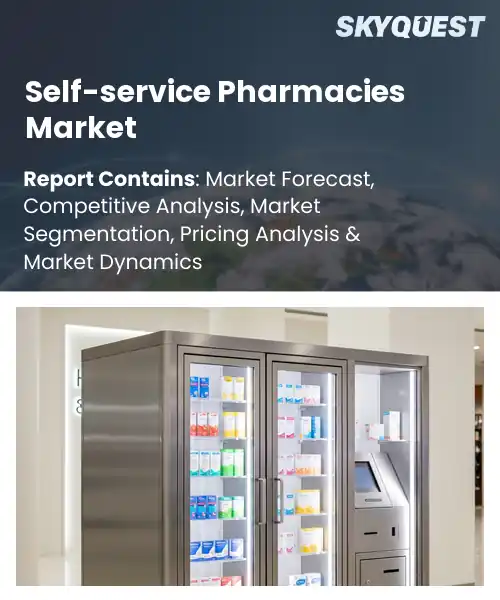
Self-service Pharmacies Market
Report ID: SQMIG30A2027
Report ID: SQMIG30A2027
[email protected]
USA +1 351-333-4748
Report ID:
SQMIG30A2027 |
Region:
Global |
Published Date: July, 2026
Pages:
157
|Tables:
117
|Figures:
77


Global Self-Service Pharmacies Market size was valued at USD 1.68 Billion in 2024 and is poised to grow from USD 1.81 Billion in 2025 to USD 3.3 Billion by 2033, growing at a CAGR of 7.8% during the forecast period (2026-2033).
Regulatory facilitation drives global self‑service pharmacy expansion because streamlined approvals shorten time‑to‑market and lower entry barriers. Countries such as Japan and the United Arab Emirates have issued clear safety and privacy guidelines, allowing operators to place kiosks in hospitals, workplaces and transit hubs. This certainty creates significant opportunities: pharmacy chains extend brand reach beyond physical stores, while tech firms monetize licensing of inventory‑management software that monitors stock and warns of dosage limits. As compliance costs fall, adoption spreads to emerging markets, where affordable dispensing robots mitigate pharmacist shortages and substantially improve access to essential medicines in remote rural healthcare communities. The self‑service pharmacy market comprises kiosks, vending machines and dispensers that allow consumers to obtain medicines and health supplies without staff assistance. Its relevance stems from rising demand for convenient, 24‑hour access to medication, especially in urban centers where traditional pharmacies face space constraints. The sector originated in Europe during the 2000s, where pilot kiosks in London and Berlin demonstrated reduced queue times and lower labor costs. Adoption followed as manufacturers integrated dispensing technology, enabling compliance with regulatory labeling while preserving product integrity. Consequently, the model expanded to North America and Asia, driven by pandemic‑induced shifts toward online digital retail.
How is AI-driven automation reshaping the self-service pharmacy market?
AI‑driven automation is redefining self‑service pharmacies by streamlining order entry, inventory control and dispensing. Machine‑learning algorithms predict demand, allowing kiosks to stock the right products and reduce out‑of‑stock events. Robotics handle pill counting and packaging, cutting human error and speeding up transactions. Real‑time data feeds let customers see pricing, insurance coverage and personalized recommendations on touchscreens, creating a seamless experience that mirrors online shopping while retaining the convenience of a physical location. These technologies also lower labor costs, enable 24‑hour access and generate actionable insights for operators, making the model more attractive to both retailers and health plans.Guardian Pharmacy Services, January 2026, announced the launch of AI‑enabled self‑service pharmacy kiosks, a move that accelerates checkout speed and improves inventory accuracy, reinforcing growth and efficiency in the market.
Market snapshot - (2026-2033)
Global Market Size
USD 1.68 Billion
Largest Segment
Automated Dispensing Pharmacies
Fastest Growth
Pharmacy Kiosks
Growth Rate
7.8% CAGR
To get more insights on this market click here to Request a Free Sample Report
Global self-service pharmacies market is segmented by pharmacy type, product category, technology, end user and region. Based on pharmacy type, the market is segmented into Automated Dispensing Pharmacies, Pharmacy Kiosks and Hybrid Self-service Pharmacies. Based on product category, the market is segmented into Prescription Medicines, Over-the-Counter Medicines and Health & Wellness Products. Based on technology, the market is segmented into AI-Enabled, IoT-Enabled and Conventional. Based on end user, the market is segmented into Hospitals, Retail Pharmacies and Clinics. Based on region, the market is segmented into North America, Europe, Asia Pacific, Latin America and Middle East & Africa.
Automated dispensing pharmacies segment dominates because they combine robotics with integrated software, delivering rapid, error‑free medication fulfillment that meets consumer demand for speed and safety. The seamless end‑to‑end workflow reduces labor costs, minimizes human error, and enhances compliance with regulatory standards, creating a compelling value proposition for operators seeking high throughput. This operational superiority fuels widespread adoption across various retail formats, cementing its leadership in the self‑service pharmacies market.
However, pharmacy kiosks are witnessing the strongest growth momentum as they provide low‑cost, space‑efficient points of sale that attract tech‑savvy shoppers. Their modular design enables rapid deployment in high‑traffic locations, while contactless interfaces address evolving hygiene expectations, accelerating market expansion and opening new revenue streams for operators.
AI‑enabled technology segment leads because its predictive analytics and personalized recommendation engines transform inventory management and patient interaction, delivering a hyper‑responsive experience that aligns with modern consumer expectations. Machine learning models anticipate demand spikes, reduce waste, and optimize stock levels, while chat‑based assistants guide users through medication selection, increasing adherence and satisfaction. This intelligence‑driven advantage positions AI as the core differentiator propelling the self‑service pharmacies market forward.
Meanwhile, IoT‑enabled solutions are emerging as the key high‑growth area, linking dispensing units, cold‑chain monitors, and patient wearables into a unified data ecosystem. Real‑time connectivity enables proactive maintenance, precise environmental control, and seamless refill triggers, driving heightened operational reliability and creating new service models that expand market potential
To get detailed segments analysis, Request a Free Sample Report
North America combines advanced technology adoption, robust regulatory frameworks that support automation, and consumer expectations for convenience. Healthcare providers and retail chains invest heavily in integrated digital platforms that enable seamless prescription verification and secure dispensing. A culture of early acceptance of innovative retail experiences fuels demand for unattended dispensing solutions. Strong supply chain networks ensure availability of high‑quality pharmaceutical products across wide geographic areas. Collaboration between technology firms and pharmacy operators accelerates the development of intuitive user interfaces, enhancing trust and acceptance. Additionally, a mature insurance landscape that reimburses medication costs through automated channels reduces friction for end users, solidifying the region’s leading position.
Self-service Pharmacies Market in United States thrives on a highly competitive retail environment where major chains prioritize digital transformation. Consumer preference for quick, contactless access drives deployment of sophisticated kiosks and mobile integration. Regulatory bodies provide clear guidance that fosters innovation while safeguarding patient safety. Partnerships between pharmacy networks and technology innovators create tailored solutions that address diverse demographic needs. The result is a landscape characterized by widespread adoption and continuous enhancement of unattended dispensing services.
Self-service Pharmacies Market in Canada benefits from a supportive health policy environment that encourages automation for efficiency and patient convenience. Consumer expectations for privacy and swift service align with the deployment of advanced dispensing units in both urban and remote locations. Collaboration between provincial health authorities and private operators ensures compliance and integration with electronic health records. Emphasis on user‑friendly design and multilingual interfaces broadens accessibility, fostering strong acceptance across diverse communities.
Europe experiences a confluence of progressive health policies, digital infrastructure investment, and consumer desire for personalized convenience. Regulatory frameworks across member states promote safe unattended dispensing while encouraging interoperability with national health systems. Strong emphasis on data privacy builds confidence in electronic prescription handling. Retail pharmacy chains leverage unified e‑commerce platforms to extend service reach, integrating multilingual support and localized product assortments. Emerging collaborations with fintech providers simplify payment processes, enhancing the overall user experience. Together these dynamics create an environment where self‑service solutions expand rapidly across both mature and developing markets within the region.
Self-service Pharmacies Market in Germany is anchored by a well‑established pharmaceutical distribution network that embraces automation for reliability. Stringent quality standards coupled with collaborative research initiatives drive continuous improvement of dispensing technologies. Consumers value the blend of efficiency and confidentiality offered by unattended units, especially in densely populated urban centers. Integration with national e‑prescription systems ensures seamless reimbursement, reinforcing trust and widespread adoption across the country.
Self-service Pharmacies Market in United Kingdom accelerates through a strong focus on digital health strategies and consumer‑centric service design. Public health campaigns promote the convenience of remote prescription fulfillment, encouraging adoption among time‑pressed demographics. Partnerships with technology start‑ups deliver innovative user interfaces that simplify medication retrieval. Alignment with national health service digital platforms ensures secure data exchange, while flexible payment options enhance accessibility. The resulting ecosystem supports rapid growth and broad acceptance throughout the nation.
Self-service Pharmacies Market in France gains momentum as regulatory bodies endorse pilot programs that showcase the benefits of unattended dispensing. Emphasis on patient empowerment drives interest in self‑service options that complement traditional pharmacy visits. Collaborative efforts between pharmacy chains and telecom providers enable robust connectivity for real‑time prescription verification. Tailored solutions that address language diversity and regional health priorities increase relevance, fostering an emerging market poised for expanded presence across the country.
Asia Pacific leverages rapid urbanization, high mobile penetration, and a cultural shift toward convenience-driven retail experiences to solidify its role in self‑service pharmacy evolution. Governments across the region introduce supportive policies that streamline approval processes for automated dispensing units while ensuring patient safety. Technology firms harness advancements in artificial intelligence and biometric verification to create intuitive, secure kiosks suited to diverse consumer habits. Collaborative ecosystems involving telecom operators, fintech innovators, and healthcare providers facilitate seamless integration of payment, authentication, and health record access. Growing consumer confidence in digital health solutions fuels broader acceptance, positioning the region as a dynamic hub for next‑generation pharmacy automation.
Self-service Pharmacies Market in Japan reflects a synergy of meticulous regulatory oversight and a tech‑savvy consumer base. High adoption of contactless payment methods and pervasive smartphone usage enable smooth interaction with unattended dispensing stations. Partnerships between pharmacy chains and electronics manufacturers produce sleek, space‑efficient kiosks that align with compact urban environments. Integration with national health insurance platforms ensures accurate reimbursement, while emphasis on privacy and quality builds trust. These factors collectively drive a steady increase in self‑service pharmacy utilization across the nation.
Self-service Pharmacies Market in South Korea thrives amid a culture that readily embraces innovative digital solutions. Extensive broadband coverage and widespread use of mobile authentication simplify user access to automated pharmacy points. Collaborative ventures between major retailers and biotech firms result in advanced dispensing units that support real‑time prescription validation. Government incentives encourage the rollout of unattended pharmacies in both metropolitan and underserved areas, enhancing equitable access to medication. The convergence of technology, policy support, and consumer openness propels rapid expansion of self‑service pharmacy offerings throughout the country
To know more about the market opportunities by region and country, click here to
Buy The Complete Report
Growing Consumer Preference For Convenience
Adopting Digital Health Technologies
Regulatory Compliance Challenges
Security Concerns Over Data Privacy
Request Free Customization of this report to help us to meet your business objectives.
The competitive landscape is shaped by large chains digitizing checkout with AI‑driven kiosks while nimble startups introduce autonomous dispensing and data‑rich health hubs; CVS leverages its extensive retail footprint to pilot self‑service stations, and newcomers accelerate market entry through strategic funding and tech partnerships, exemplified by SiteLabs’ seed investment to embed preventive‑care analytics in pharmacy kiosks and Evidenced’s $24 million Series A to launch a cloud‑based prescription fulfillment platform.
Top Player’s Company Profile
Recent Developments
SkyQuest’s ABIRAW (Advanced Business Intelligence, Research & Analysis Wing) is our Business Information Services team that Collects, Collates, Correlates, and Analyses the Data collected by means of Primary Exploratory Research backed by robust Secondary Desk research. As per SkyQuest analysis, the global self‑service pharmacies market is being propelled primarily by a rising consumer preference for convenient, 24‑hour medication access, which fuels rapid rollout of unattended kiosks and dispensers. A secondary engine is the integration of digital health technologies that link tele‑medicine, inventory and patient records, further streamlining the purchase journey. The market is led by North America, where advanced regulatory support and high tech adoption accelerate growth. Within the segment landscape, automated dispensing pharmacies dominate thanks to their robotic speed, accuracy and low labor cost. However, stringent regulatory compliance requirements remain a notable restraint, adding complexity and cost to new deployments.
| Report Metric | Details |
|---|---|
| Market size value in 2024 | USD 1.68 Billion |
| Market size value in 2033 | USD 3.3 Billion |
| Growth Rate | 7.8% |
| Base year | 2024 |
| Forecast period | (2026-2033) |
| Forecast Unit (Value) | USD Billion |
| Segments covered |
|
| Regions covered | North America (US, Canada), Europe (Germany, France, United Kingdom, Italy, Spain, Rest of Europe), Asia Pacific (China, India, Japan, Rest of Asia-Pacific), Latin America (Brazil, Rest of Latin America), Middle East & Africa (South Africa, GCC Countries, Rest of MEA) |
| Companies covered |
|
| Customization scope | Free report customization with purchase. Customization includes:-
|
To get a free trial access to our platform which is a one stop solution for all your data requirements for quicker decision making. This platform allows you to compare markets, competitors who are prominent in the market, and mega trends that are influencing the dynamics in the market. Also, get access to detailed SkyQuest exclusive matrix.
Table Of Content
Executive Summary
Market overview
Parent Market Analysis
Market overview
Market size
KEY MARKET INSIGHTS
COVID IMPACT
MARKET DYNAMICS & OUTLOOK
Market Size by Region
KEY COMPANY PROFILES
Methodology
For the Self-service Pharmacies Market, our research methodology involved a mixture of primary and secondary data sources. Key steps involved in the research process are listed below:
1. Information Procurement: This stage involved the procurement of Market data or related information via primary and secondary sources. The various secondary sources used included various company websites, annual reports, trade databases, and paid databases such as Hoover's, Bloomberg Business, Factiva, and Avention. Our team did 45 primary interactions Globally which included several stakeholders such as manufacturers, customers, key opinion leaders, etc. Overall, information procurement was one of the most extensive stages in our research process.
2. Information Analysis: This step involved triangulation of data through bottom-up and top-down approaches to estimate and validate the total size and future estimate of the Self-service Pharmacies Market.
3. Report Formulation: The final step entailed the placement of data points in appropriate Market spaces in an attempt to deduce viable conclusions.
4. Validation & Publishing: Validation is the most important step in the process. Validation & re-validation via an intricately designed process helped us finalize data points to be used for final calculations. The final Market estimates and forecasts were then aligned and sent to our panel of industry experts for validation of data. Once the validation was done the report was sent to our Quality Assurance team to ensure adherence to style guides, consistency & design.
Analyst Support
Customization Options
With the given market data, our dedicated team of analysts can offer you the following customization options are available for the Self-service Pharmacies Market:
Product Analysis: Product matrix, which offers a detailed comparison of the product portfolio of companies.
Regional Analysis: Further analysis of the Self-service Pharmacies Market for additional countries.
Competitive Analysis: Detailed analysis and profiling of additional Market players & comparative analysis of competitive products.
Go to Market Strategy: Find the high-growth channels to invest your marketing efforts and increase your customer base.
Innovation Mapping: Identify racial solutions and innovation, connected to deep ecosystems of innovators, start-ups, academics, and strategic partners.
Category Intelligence: Customized intelligence that is relevant to their supply Markets will enable them to make smarter sourcing decisions and improve their category management.
Public Company Transcript Analysis: To improve the investment performance by generating new alpha and making better-informed decisions.
Social Media Listening: To analyze the conversations and trends happening not just around your brand, but around your industry as a whole, and use those insights to make better Marketing decisions.
REQUEST FOR SAMPLE
 REQUEST FREE CUSTOMIZATION


Want to customize this report? This report can be personalized according to your needs. Our analysts and industry experts will work directly with you to understand your requirements and provide you with customized data in a short amount of time. We offer $1000 worth of FREE customization at the time of purchase.
Feedback From Our Clients


 USA (+1) 351-333-4748

