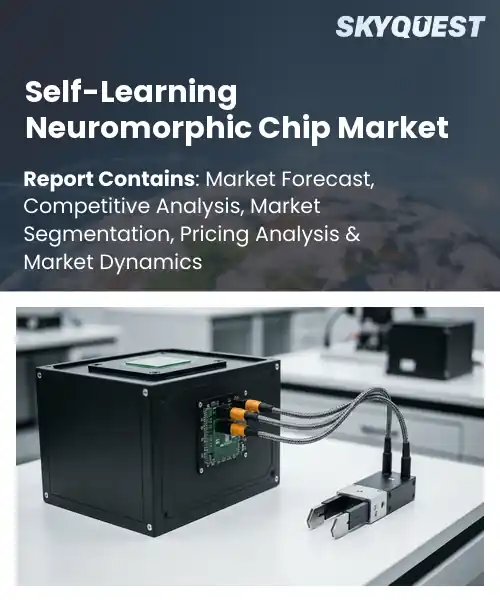
Self-Learning Neuromorphic Chip Market
Report ID: SQMIG45N2203
Report ID: SQMIG45N2203
[email protected]
USA +1 351-333-4748
Report ID:
SQMIG45N2203 |
Region:
Global |
Published Date: April, 2026
Pages:
157
|Tables:
66
|Figures:
75


Global Self-Learning Neuromorphic Chip Market size was valued at USD 0.8 Billion in 2024 and is poised to grow from USD 0.98 Billion in 2025 to USD 4.97 Billion by 2033, growing at a CAGR of 22.5% during the forecast period (2026-2033).
The primary driver of the self learning neuromorphic chip market is the need for energy efficient, low latency intelligence at the edge, where von Neumann designs struggle with power and bandwidth constraints. The market covers hardware and software that mimic neural computation to perform on chip learning, enabling adaptation without cloud dependence. It matters because such chips enable always on perception, privacy preserving inference and longer battery life for mobile and IoT devices. The field moved from academic prototypes and arrays into commercialization, illustrated by IBM TrueNorth, Intel Loihi and startups like BrainChip translating spike based learning into deployments.Building on commercialization trajectory, the dominant growth factor is the ability of neuromorphic chips to deliver on chip learning with orders of magnitude lower energy per inference, which directly unlocks new applications. Because sensors are producing ever more event driven data and edge systems require immediate decisions, designers adopt spike based processors to cut latency and bandwidth needs, so drones gain longer flight times and surveillance nodes operate without cloud connectivity. As real deployments validate robustness, enterprises and defense agencies fund further development, which lowers unit costs and accelerates integration into autonomous vehicles, industrial robotics and healthcare wearables and sensors.
How will AI-enabled self-learning neuromorphic chips transform edge IoT applications?
AI enabled self learning neuromorphic chips emulate brain like processing by using event driven spikes and local plasticity to learn at the device. Key aspects include continuous on device learning, ultra low power operation and temporal pattern recognition. The current state moves from research prototypes to commercial modules that target edge IoT needs such as adaptive sensors, autonomous drones and industrial monitoring. In the market interest is rising because these chips lower latency, preserve privacy and reduce cloud load. Examples from industry include Akida and Loihi which illustrate practical pathways to deployable edge intelligence and faster response in constrained devices.BrainChip March 2026, announced a collaboration to integrate Akida into heterogeneous ASIC and RF platforms which targets cognitive signal classification and adaptive edge processing. This development shows how self learning neuromorphic chips enable more efficient on device adaptation and lower power operation for complex IoT scenarios supporting faster deployment and operational resilience.
Market snapshot - (2026-2033)
Global Market Size
USD 0.8 Billion
Largest Segment
Data Processing
Fastest Growth
Data Processing
Growth Rate
22.5% CAGR
To get more insights on this market click here to Request a Free Sample Report
Global self-learning neuromorphic chip market is segmented by applications, verticals and region. Based on applications, the market is segmented into Data Processing. Based on verticals, the market is segmented into Healthcare, Automotive, Consumer Electronics, Media & Entertainment, Power & Energy, Aerospace, Defense and Smartphones. Based on region, the market is segmented into North America, Europe, Asia Pacific, Latin America and Middle East & Africa.
Healthcare segment dominates because its demand for continuous patient monitoring and adaptive diagnostics maps directly to the core advantages of self-learning neuromorphic chips. Energy-efficient on device learning enables persistent pattern recognition and anomaly detection in wearable and bedside devices, prompting medtech integration. Close collaboration between chip developers and clinical practitioners, combined with the need for low-latency, explainable inference in care pathways, drives procurement and design wins across medical device portfolios.
However, automotive is the most rapidly expanding area as manufacturers adopt adaptive, low power learning for real-time perception and edge decision making. Integration into driver assistance and sensor fusion stacks is driving investment and production-scale deployment, opening supplier partnerships and new mobility service opportunities that accelerate market expansion.
Automotive segment dominates because vehicles require deterministic, resilient intelligence for real-time perception, sensor fusion, and safety-critical inference that self-learning neuromorphic chips deliver. The mandate for low power use and predictable latency in on vehicle systems pushes OEMs toward neuromorphic architectures, fostering deep engineering collaboration with suppliers. These factors create robust design pipelines into control units and perception stacks, embedding neuromorphic approaches across mobility platforms.
Meanwhile, smartphones are emerging as the fastest growing area as manufacturers seek always-on, personalized AI that conserves battery through energy efficient learning hardware. Integration into camera pipelines, voice assistants, and sensor-driven personalization drives rapid adoption and spawns new app ecosystems and monetization pathways, stimulating chipset innovation and broader market opportunity.
To get detailed segments analysis, Request a Free Sample Report
North America dominates the global Self-Learning Neuromorphic Chip market through an integrated combination of advanced research capabilities, mature semiconductor manufacturing and a robust innovation ecosystem. The region benefits from deep collaborations among universities, national laboratories, defense research programs and commercial enterprises, enabling rapid translation from laboratory prototypes to scalable platforms. Strong venture and corporate funding channels, established supply chain networks, and protective intellectual property regimes further support commercialization. Cross sector demand from automotive, data center and edge computing customers creates compelling use cases that accelerate adoption. Collaborative public private initiatives and targeted procurement programs stimulate pilot projects and early deployments, while a mature service and systems integration industry enables end to end solution delivery across diverse verticals.
Self-Learning Neuromorphic Chip Market in United States is characterized by concentrated research ecosystems, semiconductor manufacturing capacity, and cross sector partnerships that accelerate technology maturation. Leading universities, research facilities and defense innovation programs collaborate with industry to pilot applications in edge intelligence and adaptive computing. A robust venture investment environment supports scale up while strong IP frameworks and supply chain integration reinforce commercialization pathways across consumer, automotive, broader sectors.
Self-Learning Neuromorphic Chip Market in Canada benefits from collaborative university networks, research bodies and a cluster of design talent focused on energy efficient architectures. Academic centers partner with domestic firms and international collaborators to prototype neuromorphic systems for edge sensing and autonomous platforms. A policy environment that emphasizes innovation and transfer, combined with access to fabrication partnerships and a skilled engineering workforce, fosters commercialization and integration into sector supply chains.
Asia Pacific is experiencing rapid expansion in the Self-Learning Neuromorphic Chip market due to concentrated investments in advanced semiconductor fabrication, dense clusters of design expertise, and proactive government initiatives that prioritize artificial intelligence and edge computing. Strong partnerships between large electronics manufacturers, specialized design firms and research institutions accelerate prototype development and industrialization. A vibrant consumer electronics ecosystem and growing demand for smart devices, robotics and autonomous systems create a broad base of real world use cases. Supply chain proximity to key component suppliers and flexible manufacturing capacity further enable scalable production. Local foundries and assembly partners work closely with designers to shorten time to production, while a competitive manufacturing environment supports cost efficiencies that attract global design activity.
Self-Learning Neuromorphic Chip Market in Japan leverages advanced materials expertise, precision manufacturing and institutional research in electronics and cognitive computing. Large conglomerates collaborate with university laboratories and specialized startups to develop energy efficient neuromorphic designs for robotics, automotive and automation. A culture of incremental engineering, combined with established supply chain relationships and focus on miniaturization, enables prototypes to progress toward integration. Public and corporate research centers support technology translation efforts.
Self-Learning Neuromorphic Chip Market in South Korea is supported by close integration between major semiconductor manufacturers, agile design houses and advanced research institutes. A focus on memory approaches, low power design and system level optimization aids development of neuromorphic architectures for mobile and edge applications. Industry consortia and innovation programs facilitate prototype validation, while competitive manufacturing capacity and export oriented supply chains support commercialization across regional markets and global engagement.
Europe is strengthening its position in the Self-Learning Neuromorphic Chip market by combining focused public research programs, collaborative industrial consortia and a growing base of specialized startups. National research centers and pan regional initiatives promote shared infrastructure, standards dialogue and cross border project work that bridge academic breakthroughs with industrial needs. Automotive, industrial automation and healthcare sectors drive demand for low power adaptive computing at the edge, encouraging applied R and D. Strategic partnerships between foundries, design houses and systems integrators facilitate pilot programs, while emphasis on regulatory compliance, data governance and interoperability supports broader deployment and investor confidence across the region. A network of boutique foundries and specialized contract manufacturers across multiple countries provides adaptable production pathways, while a resilient SME ecosystem and experienced systems integrators reduce time to market. Coordinated funding mechanisms and public private partnerships further lower commercialization barriers and attract talent.
Self-Learning Neuromorphic Chip Market in Germany builds on strong industrial automation expertise, semiconductor research and close ties between engineering universities and manufacturers. Firms focus on reliable neuromorphic solutions for factory automation, automotive safety and industrial IoT. Collaborative testbeds and competence centers enable rigorous validation, while systems integrators and design houses translate research outcomes into deployable modules. A reputation for engineering rigor and quality supports enterprise adoption and cross sector integration.
Self-Learning Neuromorphic Chip Market in United Kingdom is anchored by academic strengths in computational neuroscience, vibrant startup communities and partnerships with industry. Research in algorithm design and software toolchains complements hardware development to produce integrated solutions for edge analytics and smart infrastructure. Technology transfer offices and incubators help startups commercialize prototypes, while services firms and systems integrators assist scaling deployments across telecommunications, healthcare and urban mobility sectors and attract investment.
Self-Learning Neuromorphic Chip Market in France is supported by public research organizations, schools and a semiconductor design community focused on low power computing. Cross disciplinary collaborations link cognitive science, materials research and circuit design to create neuromorphic prototypes for healthcare, robotics and transport applications. Incubators and regional innovation clusters assist startups in scaling prototypes and forming industry partnerships, while national initiatives foster ecosystems that bridge laboratory innovation with commercial adoption.
To know more about the market opportunities by region and country, click here to
Buy The Complete Report
Energy Efficient Architectures
Edge AI Application Expansion
High Design Complexity
Limited Standardization Across Platforms
Request Free Customization of this report to help us to meet your business objectives.
Competitive landscape is fragmented with startups and incumbents pursuing IP led strategies, strategic acquisitions, and partner ecosystems to secure edge AI use cases. Recent M&A such as Snap's acquisition of GrAI Matter Labs in October 2023, platform partnerships like Neurobotx with Intel and Sony, and scale up of SpiNNaker2 by Spinncloud illustrate tactics, IP licensing, chiplet integration, and productization of neuromorphic processors to capture low power on device learning demand.
Top Player’s Company Profile
Recent Developments
SkyQuest’s ABIRAW (Advanced Business Intelligence, Research & Analysis Wing) is our Business Information Services team that Collects, Collates, Correlates, and Analyses the Data collected by means of Primary Exploratory Research backed by robust Secondary Desk research. As per SkyQuest analysis, the global self-learning neuromorphic chip market is poised for rapid expansion, with a key driver being the need for energy-efficient, low-latency on-device intelligence that enables edge autonomy and longer battery life. A restraint is the high design complexity and limited standardization that increase development time and integration risk. The dominating region is North America, supported by strong research, funding and manufacturing ecosystems. The dominating segment is healthcare, where continuous monitoring and adaptive diagnostics align with neuromorphic advantages. A second driver is the growth of edge AI applications demanding privacy preserving, real-time learning on constrained devices, which will further accelerate commercialization and deployment across industries.
| Report Metric | Details |
|---|---|
| Market size value in 2024 | USD 0.8 Billion |
| Market size value in 2033 | USD 4.97 Billion |
| Growth Rate | 22.5% |
| Base year | 2024 |
| Forecast period | (2026-2033) |
| Forecast Unit (Value) | USD Billion |
| Segments covered |
|
| Regions covered | North America (US, Canada), Europe (Germany, France, United Kingdom, Italy, Spain, Rest of Europe), Asia Pacific (China, India, Japan, Rest of Asia-Pacific), Latin America (Brazil, Rest of Latin America), Middle East & Africa (South Africa, GCC Countries, Rest of MEA) |
| Companies covered |
|
| Customization scope | Free report customization with purchase. Customization includes:-
|
To get a free trial access to our platform which is a one stop solution for all your data requirements for quicker decision making. This platform allows you to compare markets, competitors who are prominent in the market, and mega trends that are influencing the dynamics in the market. Also, get access to detailed SkyQuest exclusive matrix.
Table Of Content
Executive Summary
Market overview
Parent Market Analysis
Market overview
Market size
KEY MARKET INSIGHTS
COVID IMPACT
MARKET DYNAMICS & OUTLOOK
Market Size by Region
KEY COMPANY PROFILES
Methodology
For the Self-Learning Neuromorphic Chip Market, our research methodology involved a mixture of primary and secondary data sources. Key steps involved in the research process are listed below:
1. Information Procurement: This stage involved the procurement of Market data or related information via primary and secondary sources. The various secondary sources used included various company websites, annual reports, trade databases, and paid databases such as Hoover's, Bloomberg Business, Factiva, and Avention. Our team did 45 primary interactions Globally which included several stakeholders such as manufacturers, customers, key opinion leaders, etc. Overall, information procurement was one of the most extensive stages in our research process.
2. Information Analysis: This step involved triangulation of data through bottom-up and top-down approaches to estimate and validate the total size and future estimate of the Self-Learning Neuromorphic Chip Market.
3. Report Formulation: The final step entailed the placement of data points in appropriate Market spaces in an attempt to deduce viable conclusions.
4. Validation & Publishing: Validation is the most important step in the process. Validation & re-validation via an intricately designed process helped us finalize data points to be used for final calculations. The final Market estimates and forecasts were then aligned and sent to our panel of industry experts for validation of data. Once the validation was done the report was sent to our Quality Assurance team to ensure adherence to style guides, consistency & design.
Analyst Support
Customization Options
With the given market data, our dedicated team of analysts can offer you the following customization options are available for the Self-Learning Neuromorphic Chip Market:
Product Analysis: Product matrix, which offers a detailed comparison of the product portfolio of companies.
Regional Analysis: Further analysis of the Self-Learning Neuromorphic Chip Market for additional countries.
Competitive Analysis: Detailed analysis and profiling of additional Market players & comparative analysis of competitive products.
Go to Market Strategy: Find the high-growth channels to invest your marketing efforts and increase your customer base.
Innovation Mapping: Identify racial solutions and innovation, connected to deep ecosystems of innovators, start-ups, academics, and strategic partners.
Category Intelligence: Customized intelligence that is relevant to their supply Markets will enable them to make smarter sourcing decisions and improve their category management.
Public Company Transcript Analysis: To improve the investment performance by generating new alpha and making better-informed decisions.
Social Media Listening: To analyze the conversations and trends happening not just around your brand, but around your industry as a whole, and use those insights to make better Marketing decisions.
REQUEST FOR SAMPLE
 REQUEST FREE CUSTOMIZATION


Want to customize this report? This report can be personalized according to your needs. Our analysts and industry experts will work directly with you to understand your requirements and provide you with customized data in a short amount of time. We offer $1000 worth of FREE customization at the time of purchase.
Feedback From Our Clients


 USA (+1) 351-333-4748

