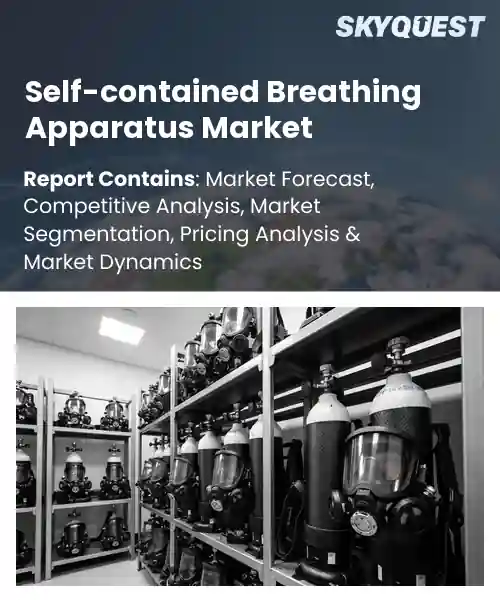
Self-contained Breathing Apparatus Market
Report ID: SQMIG35A3797
Report ID: SQMIG35A3797
[email protected]
USA +1 351-333-4748
Report ID:
SQMIG35A3797 |
Region:
Global |
Published Date: June, 2026
Pages:
157
|Tables:
156
|Figures:
78


Global Self-Contained Breathing Apparatus Market size was valued at USD 1.7 Billion in 2024 and is poised to grow from USD 1.82 Billion in 2025 to USD 3.15 Billion by 2033, growing at a CAGR of 7.1% during the forecast period (2026-2033).
The main driver for the global self contained breathing apparatus market growth is the tighter safety regulations, plus a stronger awareness of occupational respiratory risks. The market basically covers portable respiratory protection systems that provide breathable air to people working in fires, confined spaces , chemical incidents and industrial settings and it matters because if something fails it can get catastrophic for human life and also mess up business continuity. Over time the demand has drifted from basic passive masks toward more advanced positive pressure modular systems , with influence coming from NFPA guidelines, OSHA enforcement, and those high profile events like city fires and industrial accidents seen around the world.
Furthermore, building on that regulatory pressure and the constant upgrades the real propelling factor for market growth is mandatory compliance through replacement programs, turning safety rules into recurring procurement. When standards ask for air cylinder recertification and the retirement of older units, manufacturers and service providers get steadier demand, while end users tend to prefer modular platforms to reduce training time and maintenance headaches. For instance municipal fire services that swap open circuit gear for positive pressure setups can improve firefighter survival and limit liability, while petrochemical plants that invest in escape and rescue ensembles often cut downtime after leaks. these patterns also open up opportunities in maintenance software and sensor enabled air management approaches.
Internet of Things technology is helping monitoring and maintenance in the self-contained breathing apparatus market by pairing onboard sensors with wireless telemetry and cloud analytics. Key pieces include continuous pressure monitoring, environmental sensing, automated event logs, and remote health checks for devices. Right now the market leans toward condition based maintenance instead of waiting for reactive repairs, which helps keep readiness higher and reduces downtime. Manufacturers and service providers then use connected data to tidy up inspection workflows and to support compliance requirements. In actual use firefighters can find particular units faster, get maintenance alerts after incidents, and even run diagnostics remotely, so fleets become more dependable and easier to manage.
Market snapshot - (2026-2033)
Global Market Size
USD 1.7 Billion
Largest Segment
Open-Circuit SCBA
Fastest Growth
Closed-Circuit SCBA
Growth Rate
7.1% CAGR
To get more insights on this market click here to Request a Free Sample Report
The global self-contained breathing apparatus market is segmented by type, component, cylinder type, application, end user and region. Based on type, the market is segmented into Open-Circuit SCBA and Closed-Circuit SCBA. Based on component, the market is segmented into Face Mask, Cylinder & Cylinder Valve, Harness & Backplate, Pressure Reducer, Breathing Regulator, PASS Device and Others. Based on cylinder type, the market is segmented into Steel Cylinders, Aluminum Cylinders and Composite Cylinders. Based on application, the market is segmented into Firefighting, Industrial Safety, Oil & Gas, Mining, Chemical & Petrochemical, Marine, Law Enforcement & Defense and Emergency Rescue. Based on end user, the market is segmented into Fire Service Departments, Industrial Enterprises, Defense Organizations, Mining Companies, Oil & Gas Companies, Chemical Processing Facilities and Others. Based on region, the market is segmented into North America, Europe, Asia Pacific, Latin America and Middle East & Africa.
As per the self-contained breathing apparatus market analysis, the Open-Circuit SCBA segment dominates because it has, for a long time been the default configuration in emergency and industrial breathing protection. It offers proven reliability, easier upkeep, and it just fits with established training and buying routines. The whole simpler architecture lowers operational complexity, and that makes servicing less of a burden, so institutions tend to adopt it. Procurement cycles, supplier focus, and regulatory alignment also keep pushing continued investment into open system variants, plus their incremental improvements, even if they don’t always look flashy.
Whereas Closed-Circuit SCBA is also getting the most noticeable growth momentum. The rebreather design can extend operational duration and reduce resupply needs, which makes it attractive for prolonged rescue scenarios and confined space work. As improvements keep happening—like scrubber chemistry, electronic monitoring, and ergonomics—along with a rising demand for extended mission capability, adoption is speeding up. So, it’s creating new procurement pathways and retrofit opportunities, especially for harsher use cases where time matters a lot.
According to the self-contained breathing apparatus market forecast, the Face Mask segment drives the market mainly because the mask is the real user interface that shapes seal integrity, visibility, and wearer comfort. That in turn directly affects how well respiratory protection performs in hazardous environments. Procurement and training folks prioritize facepiece designs that are already proven, partly to limit contaminant ingress, keep communication clarity steady, and manage fit variability. Because of that, manufacturers invest in durable materials, better optics and sealing systems, to meet operational and regulatory expectations.
Meanwhile, PASS Device is emerging as the fastest expanding area, largely because it’s being integrated with electronic monitoring and wireless telemetry. This helps with downed firefighter detection and it improves remote situational awareness. There’s also more regulatory attention on personnel tracking, and the tech is getting smaller plus better battery life, so procurement of advanced PASS units is accelerating. That, in turn, is opening up retrofit projects and OEM opportunities, all aimed at stronger incident management.
To get detailed segments analysis, Request a Free Sample Report
As per the self-contained breathing apparatus market regional forecast, North America stays up front because a mix of solid regulatory expectations, fairly mature emergency response setups, and a crowded network of manufacturers plus service providers who care about safety innovation, even if they sometimes phrase it differently. Procurement teams tend to push for long run reliability and interoperability, so they favor advanced breathing apparatus features and training schedules that are baked in not bolted on later. Public agencies and private industry keep collaborating, which helps product iterations keep moving along and also keeps aftermarket services from falling behind. Even with all the activity, industrial diversification—like energy and heavy manufacturing—keeps pulling demand for specialized equipment and helps align standards, reinforcing that regional lead.
United States Self-contained Breathing Apparatus Market
In the United States, the Self-contained Breathing Apparatus sector is shaped by institutional procurement cycles, strict compliance requirements, and a strong, well established web of original equipment manufacturers plus distributors. Demand usually comes from public safety bodies, industrial safety programs, and operators tied to critical infrastructure, who want proven performance and lifecycle support. Training focus matters a lot, along with interoperability between different units and suppliers, and that supplier accountability ends up influencing purchasing decisions. Aftermarket service capacity and end user feedback also encourage incremental product improvements across the market, over and over.
Canada Self-contained Breathing Apparatus Market
In Canada, the Self-contained Breathing Apparatus industry reflects a clear attention to responder safety and day to day operational readiness across public and industrial areas. Procurement often leans toward gear that holds up well while still being simple to maintain, and it’s supported by regional service networks and specialized training providers. Federal and provincial agencies collaborate to help standardize specifications and support mutual aid compatibility. Long term reliability plus environmental resilience are treated like real selection criteria, not just buzzwords, and that pushes suppliers to match expectations. Domestic service capability and industry partnerships then help manage the equipment lifecycle smoothly.
Europe is seeing rapid self-contained breathing apparatus market penetration from harmonized safety standards, more urgency around emergency preparedness, and higher requirements for advanced personal protective equipment across both public and private environments. There’s also a concentration of specialized manufacturers, which nudges innovation in ergonomics, filtration technology, and system integration, together rather than separately. Procurement modernization among fire services and industrial operators speeds up adoption, and cross border cooperation plus standardization work helps interoperability and reduces friction when qualifying suppliers. Growth is further supported by investment in training infrastructure, and by a competitive supplier environment that highlights aftermarket service quality plus technical support capabilities, not just the hardware.
Germany Self-contained Breathing Apparatus Market
In Germany, the Self-contained Breathing Apparatus Market is influenced by strong industrial demand and a culture that values technical precision in equipment specifications. End users commonly prioritize high performance, durability, and compliance with both national and European standards that aren’t optional. There’s also a dense network of engineering oriented suppliers, so customization for industrial uses and emergency services stays realistic. Comprehensive training and maintenance networks support operational readiness, and procurement decisions are guided by lifecycle considerations, supplier technical competence, and how well systems integrate into wider safety frameworks.
United Kingdom Self-contained Breathing Apparatus Market
In the United Kingdom, the Self-contained Breathing Apparatus Market is shifting as emergency services modernize and industrial safety upgrades get more attention. Buyers increasingly look for equipment with better comfort, user friendly maintenance, and smooth integration with communication plus monitoring systems. The supplier landscape is competitive, so value added offerings like training and calibration become part of the buying conversation. Regulatory guidance and interagency collaboration also push specification convergence. Overall, market movement tends to favor vendors that combine product improvements with quick local support.
France Self-contained Breathing Apparatus Market
In France, the Self-contained Breathing Apparatus Market is showing faster adoption that’s tied to proactive safety policies and investments in emergency response capacity. There is a strong inclination toward modernized equipment, including improved ergonomics, advanced filtering solutions, and sturdier maintenance frameworks. National programs that support standardization and interoperability help procurement across municipal and industrial operators keep moving. Suppliers offering complete service packages, including training and technical support are especially positioned, as the market keeps expanding under focused public and private sector initiatives.
Asia Pacific keeps pushing its market position a lot , mostly by putting concentrated money into manufacturing capability, shifting product development closer to local needs,and also widening how fast these systems get taken up in both industrial and urban safety areas. At the same time , regional suppliers are trying to sync their products with international standards , but they still tweak features so they fit local operating conditions more naturally. There’s also a growing focus on responder training, aftermarket support, and public private partnerships, which makes the whole market feel more mature over time. When global manufacturers team up with regional distributors, the technology handoff moves faster and market access improves, so modern breathing apparatus solutions can be deployed more broadly,and that further strengthens the region as a real contributor to global supply and innovation.
Japan Self-contained Breathing Apparatus Market
The Self-contained Breathing Apparatus market in Japan leans hard on precision engineering , very high reliability, and close integration with safety management frameworks. End users want gear that hits strict performance expectations, and they also expect organized maintenance and training services to come along with it. Domestic manufacturers and specialized suppliers put a lot of attention into ergonomic design plus robust materials, so the equipment stays dependable across many different operational situations. Purchases are guided by long term serviceability and also by compatibility with the existing emergency response protocols, which helps the solution capabilities advance steadily.
South Korea Self-contained Breathing Apparatus Market
The Self-contained Breathing Apparatus market in South Korea shows up as fast modernization of industrial safety programs, plus a proactive attitude toward advanced protective technology. Local makers and international suppliers compete by offering solutions that mix technical novelty with cost effective lifecycle support. A key thread here is the integration with digital monitoring and training platforms, which improves day to day operational effectiveness. Strong collaboration between government and industry also supports standardization and capacity building for emergency teams and industrial responders, even as adoption keeps expanding.
To know more about the market opportunities by region and country, click here to
Buy The Complete Report
Enhanced Respiratory Protection Standards
Rising Industrial Safety Investments
High Initial Equipment Costs
Maintenance Complexity And Downtime
Request Free Customization of this report to help us to meet your business objectives.
The competitive landscape is getting tougher, like incumbents are going after M and A, big procurement wins, plus partnership stuff, all while newer startups try to stand out with differentiated technology. A bunch of major players already did deals such as CSE’s 2020 acquisition of Biomarine, and they kept chasing procurement awards, meanwhile vendors started collaboration initiatives like Dräger’s AirBoss partnership meant to help field NFPA compliant SCBA. New entrants are also forcing the older firms to speed up product approvals, and to work in SCBA telemetry alongside hybrid rebreather concepts, and it’s not exactly subtle.
Top Player’s Company Profile
Recent Developments in the Self-Contained Breathing Apparatus Market
SkyQuest’s ABIRAW (Advanced Business Intelligence, Research & Analysis Wing) is our Business Information Services team that Collects, Collates, Correlates, and Analyses the Data collected by means of Primary Exploratory Research backed by robust Secondary Desk research.
As per SkyQuest analysis, in the global self-contained breathing apparatus market , growth is mostly being driven by tighter safety regulations that turn standards into recurring procurement. A second big driver is the expanding IoT enabled connectivity, since it supports improved monitoring, maintenance and fleet readiness. One notable restraint still lingers: the high initial equipment cost, which can slow down replacements for smaller organizations and volunteer services. North America remains the dominating region, mainly because of mature regulatory frameworks , entrenched procurement cycles and a strong manufacturer and service ecosystem. Open-circuit SCBA is the dominating segment because of proven reliability, simpler maintenance, and broad institutional adoption. At the same time, ongoing innovation in telemetry and rebreather designs should influence future growth, steadily.
| Report Metric | Details |
|---|---|
| Market size value in 2024 | USD 1.7 Billion |
| Market size value in 2033 | USD 3.15 Billion |
| Growth Rate | 7.1% |
| Base year | 2024 |
| Forecast period | (2026-2033) |
| Forecast Unit (Value) | USD Billion |
| Segments covered |
|
| Regions covered | North America (US, Canada), Europe (Germany, France, United Kingdom, Italy, Spain, Rest of Europe), Asia Pacific (China, India, Japan, Rest of Asia-Pacific), Latin America (Brazil, Rest of Latin America), Middle East & Africa (South Africa, GCC Countries, Rest of MEA) |
| Companies covered |
|
| Customization scope | Free report customization with purchase. Customization includes:-
|
To get a free trial access to our platform which is a one stop solution for all your data requirements for quicker decision making. This platform allows you to compare markets, competitors who are prominent in the market, and mega trends that are influencing the dynamics in the market. Also, get access to detailed SkyQuest exclusive matrix.
Table Of Content
Executive Summary
Market overview
Parent Market Analysis
Market overview
Market size
KEY MARKET INSIGHTS
COVID IMPACT
MARKET DYNAMICS & OUTLOOK
Market Size by Region
KEY COMPANY PROFILES
Methodology
For the Self-contained Breathing Apparatus Market, our research methodology involved a mixture of primary and secondary data sources. Key steps involved in the research process are listed below:
1. Information Procurement: This stage involved the procurement of Market data or related information via primary and secondary sources. The various secondary sources used included various company websites, annual reports, trade databases, and paid databases such as Hoover's, Bloomberg Business, Factiva, and Avention. Our team did 45 primary interactions Globally which included several stakeholders such as manufacturers, customers, key opinion leaders, etc. Overall, information procurement was one of the most extensive stages in our research process.
2. Information Analysis: This step involved triangulation of data through bottom-up and top-down approaches to estimate and validate the total size and future estimate of the Self-contained Breathing Apparatus Market.
3. Report Formulation: The final step entailed the placement of data points in appropriate Market spaces in an attempt to deduce viable conclusions.
4. Validation & Publishing: Validation is the most important step in the process. Validation & re-validation via an intricately designed process helped us finalize data points to be used for final calculations. The final Market estimates and forecasts were then aligned and sent to our panel of industry experts for validation of data. Once the validation was done the report was sent to our Quality Assurance team to ensure adherence to style guides, consistency & design.
Analyst Support
Customization Options
With the given market data, our dedicated team of analysts can offer you the following customization options are available for the Self-contained Breathing Apparatus Market:
Product Analysis: Product matrix, which offers a detailed comparison of the product portfolio of companies.
Regional Analysis: Further analysis of the Self-contained Breathing Apparatus Market for additional countries.
Competitive Analysis: Detailed analysis and profiling of additional Market players & comparative analysis of competitive products.
Go to Market Strategy: Find the high-growth channels to invest your marketing efforts and increase your customer base.
Innovation Mapping: Identify racial solutions and innovation, connected to deep ecosystems of innovators, start-ups, academics, and strategic partners.
Category Intelligence: Customized intelligence that is relevant to their supply Markets will enable them to make smarter sourcing decisions and improve their category management.
Public Company Transcript Analysis: To improve the investment performance by generating new alpha and making better-informed decisions.
Social Media Listening: To analyze the conversations and trends happening not just around your brand, but around your industry as a whole, and use those insights to make better Marketing decisions.
REQUEST FOR SAMPLE
 REQUEST FREE CUSTOMIZATION
Global Self-Contained Breathing Apparatus Market size was valued at USD 1.7 Billion in 2024 and is poised to grow from USD 1.82 Billion in 2025 to USD 3.15 Billion by 2033, growing at a CAGR of 7.1% during the forecast period (2026-2033).
The competitive landscape is intensifying as incumbents pursue M and A, large procurement wins, and partnership programs while startups push differentiated technology. Major firms executed deals such as CSE’s 2020 acquisition of Biomarine and pursued procurement awards, and vendors launched collaboration programs like Dräger’s AirBoss partnership to field NFPA compliant SCBA. New entrants force incumbents to accelerate product approvals and integrate SCBA telemetry and hybrid rebreather designs. 'MSA Safety Incorporated', 'Drägerwerk AG & Co. KGaA', 'Honeywell International Inc.', 'Avon Protection plc', '3M Company', 'Lakeland Industries, Inc.', 'Gentex Corporation', 'Interspiro AB', 'Survitec Group Limited', 'Shigematsu Works Co., Ltd.', 'Teijin Limited', 'Bullard', 'Kimberly-Clark Corporation', 'Ansell Limited', 'Delta Plus Group', 'Alpha Pro Tech, Ltd.', 'COFRA Holding AG', 'RPB Safety LLC', 'Matisec', 'Mine Safety Appliances Company LLC'
Regulatory enhancements that mandate higher levels of respiratory protection for emergency responders and industrial workers have encouraged organizations to prioritize self-contained breathing apparatus procurement and replacement. Clearer compliance expectations prompt safety managers to upgrade equipment to meet certification requirements, while procurement policies favor devices that reduce liability and improve operational readiness. Manufacturers respond by emphasizing certified performance and training support, and this reciprocal dynamic strengthens buyer confidence, leading to broader specification in contracts and more consistent demand across public safety and industrial sectors.
Integrated Connectivity And Iot: Adoption of sensor integration, wireless monitoring and connected maintenance platforms is reshaping product value propositions and aftersales services. Manufacturers are prioritizing real time condition awareness, predictive alerts and secure data exchange to improve user safety, operational readiness and asset lifecycle management. Interoperability with incident management systems and mobile devices enhances situational awareness for first responders and industrial teams. This trend drives partnerships across technology providers, fuels modular design thinking, and elevates expectations for service ecosystems that extend beyond equipment supply.
Why does North America Dominate the Global Self-contained Breathing Apparatus Market? |@12


Want to customize this report? This report can be personalized according to your needs. Our analysts and industry experts will work directly with you to understand your requirements and provide you with customized data in a short amount of time. We offer $1000 worth of FREE customization at the time of purchase.
Feedback From Our Clients


 USA (+1) 351-333-4748

