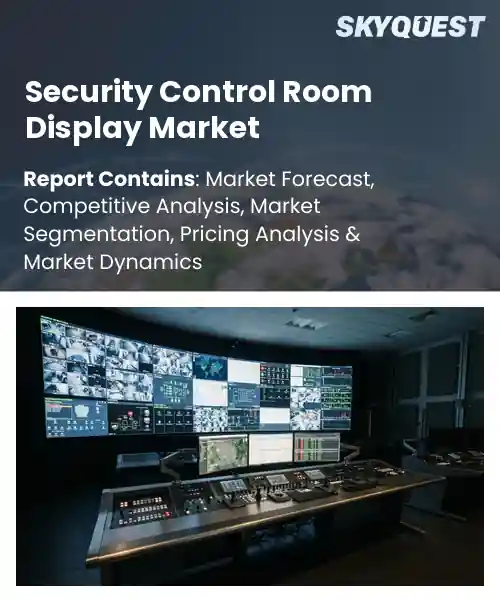
Security Control Room Display Market
Report ID: SQMIG45J2829
Report ID: SQMIG45J2829
[email protected]
USA +1 351-333-4748
Report ID:
SQMIG45J2829 |
Region:
Global |
Published Date: August, 2026
Pages:
157
|Tables:
128
|Figures:
77


Global Security Control Room Display Market size was valued at USD 4.26 Billion in 2024 and is poised to grow from USD 4.58 Billion in 2025 to USD 8.1 Billion by 2033, growing at a CAGR of 7.4% during the forecast period (2026-2033).
The global security control room display market comprises the design, production, and integration of visual interfaces that enable monitoring centers to coordinate emergency response, protect critical infrastructure, and manage safety. Its importance stems from the growing need for situational awareness in sectors such as transportation, utilities, and government. Historically, the market evolved from bulky cathode‑ray tube consoles in the 1980s to modular LED walls and immersive video walls driven by advances in graphic processing and network bandwidth. Airports now rely on 4K video walls that fuse radar, CCTV, and threat‑intelligence feeds into a panoramic view, illustrating how convergence reshapes workflows. Proliferation of AI analytics that fuse sensor streams into a feed is a catalyst driving expansion of control room display market. AI models identify anomalies such as unauthorized vehicle movement, instantly flagging them on the screen; operators then dispatch teams, shortening response time and lowering incident severity. This cause‑and‑effect dynamic creates demand for video walls capable of overlaying data. A metropolitan police department exemplifies the trend, having integrated facial‑recognition feeds into a 12‑panel LED wall, which enabled suspect identification and thwarted a robbery. Manufacturers respond by offering modular, scalable panels and bundled AI software, unlocking revenue and reinforcing market growth.
How is AI enhancing real-time analytics in the security control room display market?
AI is reshaping real‑time analytics in security control rooms by fusing video streams, sensor data and threat intelligence into a single, instantly interpretable view. Machine‑learning models flag unusual patterns, prioritize alerts and suggest corrective actions, allowing operators to focus on genuine incidents. Edge computing reduces latency, so insights appear on displays the moment an anomaly is detected. Integrated dashboards combine facial‑recognition results with access‑control logs, creating a holistic picture that speeds decision‑making. As operators demand faster situational awareness, AI‑driven analytics become the backbone of modern control‑room workflows, turning raw data into actionable intelligence without overwhelming staff.In July 2024 a leading security display manufacturer launched an AI‑enhanced wall that automatically aggregates and visualizes live feeds, boosting operational efficiency and supporting the market’s shift toward smarter, faster response capabilities.
Market snapshot - (2026-2033)
Global Market Size
USD 4.26 Billion
Largest Segment
LCD Displays
Fastest Growth
OLED Displays
Growth Rate
7.4% CAGR
To get more insights on this market click here to Request a Free Sample Report
Global security control room display market is segmented by display type, display configuration, application, end user and region. Based on display type, the market is segmented into LCD Displays, LED Displays, OLED Displays, Video Walls, Interactive Displays and Others. Based on display configuration, the market is segmented into Single Display, Multi-Display Systems and Video Wall Systems. Based on application, the market is segmented into Surveillance & Monitoring, Emergency & Incident Management, Access Control Monitoring, Transportation Security, Critical Infrastructure Monitoring and Others. Based on end user, the market is segmented into Government & Defense, Transportation, BFSI, Energy & Utilities, Manufacturing, Healthcare, Commercial & Enterprise and Others. Based on region, the market is segmented into North America, Europe, Asia Pacific, Latin America and Middle East & Africa.
Video walls segment dominates because they deliver expansive, high resolution canvases that enable operators to monitor numerous camera feeds simultaneously without visual fragmentation. Their tiling and uniform brightness allow critical incidents to be identified instantly, supporting rapid decision making. Integration with analytics platforms further amplifies situational awareness, making video walls the preferred choice for mission critical control rooms where clarity and scale directly impact response effectiveness and improve overall operational resilience significantly.
Meanwhile, interactive displays segment emerges as the fastest growing because touch enabled surfaces foster collaborative incident analysis and enable real time annotation of video streams. Their ability to integrate with command software accelerates information sharing among operators, prompting adoption in control rooms seeking agile, user centric interfaces that enhance response coordination and training efficiency.
Surveillance & Monitoring segment dominates because it forms the core data source for every security control room, supplying continuous video feeds that demand high definition, low latency displays. Operators rely on crisp imagery to detect anomalies, verify identities, and maintain situational awareness across expansive premises. The perpetual need for reliable, real time visual insight drives investment in displays that can sustain 24/7 operation, ensuring uninterrupted vigilance in protecting assets and personnel.
On the other hand, Emergency & Incident Management segment is witnessing the strongest growth because emerging standards require rapid visual dissemination of alerts and coordinated response workflows. Displays equipped with dynamic content overlays and real time mapping enable swift decision making during crises. This heightened emphasis on agile incident handling spurs adoption of adaptable display solutions, expanding market opportunities as control rooms evolve to manage increasingly complex emergency scenarios.
To get detailed segments analysis, Request a Free Sample Report
North America benefits from a mature ecosystem of technology developers, system integrators and end users that creates a seamless pipeline for advanced display solutions. The region’s extensive critical infrastructure network drives continuous investment in high‑performance visualization tools, while stringent safety regulations and proactive government programs encourage early adoption. Strong procurement practices across public safety, transportation and energy sectors reinforce demand, and the presence of leading display manufacturers supports rapid innovation cycles. This combination of sophisticated infrastructure, regulatory encouragement and deep industry expertise consolidates North America’s position at the forefront of the market.
Security Control Room Display Market in the United States is propelled by sophisticated command‑center designs that integrate real‑time analytics, video streams and geographic information systems. Public safety agencies prioritize interoperable display platforms that enhance situational awareness, while private sector operators in logistics and utilities seek resilient visual solutions for continuous monitoring. The culture of early technology adoption, coupled with robust funding mechanisms for critical‑infrastructure upgrades, sustains a high level of demand for cutting‑edge display architectures across diverse operational environments.
Security Control Room Display Market in Canada is shaped by a strong emphasis on public safety and a collaborative approach between government bodies and technology providers. National initiatives focus on modernizing emergency response centers with high‑resolution, multi‑screen environments that support real‑time data fusion. The energy and transportation sectors also drive adoption, seeking reliable visual platforms to monitor extensive networks. A proactive regulatory landscape and investment in resilient infrastructure underpin steady growth of sophisticated display solutions throughout the country.
Europe’s expansion is anchored by rigorous safety standards and a coordinated push toward digital transformation across public and private domains. Unified regulatory frameworks promote standardized display technologies that enhance cross‑border emergency coordination. Significant funding for smart‑city projects and critical‑infrastructure upgrades fuels demand for immersive visual environments, while a strong emphasis on sustainability encourages the adoption of energy‑efficient display solutions. Collaborative research initiatives among leading technology hubs further accelerate innovation, positioning Europe as a dynamic market for advanced security control room displays.
Security Control Room Display Market in Germany benefits from a robust industrial base that integrates high‑precision engineering with advanced visualization. Federal and state authorities prioritize resilient command centres for transport, energy and public safety, fostering demand for highly reliable, modular display architectures. Close cooperation between manufacturers and research institutes drives continuous improvement in display performance, while strict compliance requirements ensure that solutions meet exacting operational standards across diverse sectors.
Security Control Room Display Market in the United Kingdom is experiencing swift growth as agencies modernize emergency response facilities with integrated, high‑definition visual platforms. Emphasis on real‑time data analytics and multi‑agency coordination drives procurement of flexible, scalable display systems. Investment in smart‑city infrastructure and a proactive approach to cyber‑resilience amplify the need for secure, interoperable visual solutions that support rapid decision‑making across public safety and critical‑infrastructure environments.
Security Control Room Display Market in France is emerging as a focal point for public‑sector modernization initiatives that target enhanced situational awareness. National programs encourage the deployment of advanced display walls in transportation hubs, energy networks and law‑enforcement command centres. Collaborative efforts between technology vendors and research entities stimulate the introduction of innovative, energy‑efficient display technologies, positioning France as an increasingly important contributor to the broader European market landscape.
Asia Pacific is reinforcing its market role through accelerating urbanization and heightened focus on safeguarding expansive critical‑infrastructure networks. Government‑driven smart‑city agendas prioritize sophisticated command‑center environments that integrate high‑resolution displays with real‑time monitoring capabilities. Strong manufacturing capabilities across the region enable rapid production of cost‑effective, high‑performance visual solutions, while strategic partnerships with global technology firms foster the transfer of cutting‑edge display innovations. This blend of demand growth, production capacity and collaborative development propels the region toward a more prominent global standing.
Security Control Room Display Market in Japan is driven by a commitment to technological excellence and resilient infrastructure management. Public safety agencies and disaster‑response organizations adopt advanced visual systems to coordinate complex emergency operations, while transportation and energy sectors seek integrated display solutions for continuous network oversight. The country’s focus on reliability and precision engineering ensures that display technologies meet rigorous performance criteria, supporting a sophisticated and dependable command‑center environment.
Security Control Room Display Market in South Korea is shaped by vigorous investment in smart‑city projects and a strong emphasis on digital innovation. Government initiatives encourage the deployment of immersive display walls in public‑security command centres and critical‑infrastructure monitoring hubs. Collaboration between local manufacturers and international technology partners accelerates the introduction of high‑definition, interactive display solutions, reinforcing the nation’s capability to manage complex operational scenarios with enhanced visual intelligence.
To know more about the market opportunities by region and country, click here to
Buy The Complete Report
Increasing Demand For Real‑Time Situational Awareness
Integration Of AI‑Enabled Analytics
High Initial Capital Investment
Complexity Of System Interoperability
Request Free Customization of this report to help us to meet your business objectives.
The competitive landscape of the security control room display market is shaped by intense rivalry among hardware manufacturers, software integrators, and system integrators, each leveraging strategic M&A, joint ventures, and technology innovation to capture market share. Recent examples include large display manufacturers acquiring niche visualization firms to broaden product portfolios, while software providers partner with cloud‑based analytics companies to embed AI‑driven situational awareness directly into control room interfaces. These moves intensify competition and drive rapid advancement of high‑resolution, interoperable display solutions tailored for critical operations.
Top Player’s Company Profile
Recent Developments
SkyQuest’s ABIRAW (Advanced Business Intelligence, Research & Analysis Wing) is our Business Information Services team that Collects, Collates, Correlates, and Analyses the Data collected by means of Primary Exploratory Research backed by robust Secondary Desk research. As per SkyQuest analysis the global security control‑room display market is projected to rise to $8.1 billion by 2033, driven primarily by the growing need for real‑time situational awareness that pushes operators toward larger, higher‑resolution screens, while AI‑enabled analytics serve as a second catalyst by turning raw sensor feeds into actionable visual cues. The video‑wall segment leads the market because its expansive, seamless canvases deliver the clarity required for swift decision‑making, and North America remains the dominant region thanks to its mature technology ecosystem and strong public‑safety investments. However, the high initial capital outlay needed for advanced display hardware and integration remains a notable restraint on faster adoption.
| Report Metric | Details |
|---|---|
| Market size value in 2024 | USD 4.26 Billion |
| Market size value in 2033 | USD 8.1 Billion |
| Growth Rate | 7.4% |
| Base year | 2024 |
| Forecast period | (2026-2033) |
| Forecast Unit (Value) | USD Billion |
| Segments covered |
|
| Regions covered | North America (US, Canada), Europe (Germany, France, United Kingdom, Italy, Spain, Rest of Europe), Asia Pacific (China, India, Japan, Rest of Asia-Pacific), Latin America (Brazil, Rest of Latin America), Middle East & Africa (South Africa, GCC Countries, Rest of MEA) |
| Companies covered |
|
| Customization scope | Free report customization with purchase. Customization includes:-
|
To get a free trial access to our platform which is a one stop solution for all your data requirements for quicker decision making. This platform allows you to compare markets, competitors who are prominent in the market, and mega trends that are influencing the dynamics in the market. Also, get access to detailed SkyQuest exclusive matrix.
Table Of Content
Executive Summary
Market overview
Parent Market Analysis
Market overview
Market size
KEY MARKET INSIGHTS
COVID IMPACT
MARKET DYNAMICS & OUTLOOK
Market Size by Region
KEY COMPANY PROFILES
Methodology
For the Security Control Room Display Market, our research methodology involved a mixture of primary and secondary data sources. Key steps involved in the research process are listed below:
1. Information Procurement: This stage involved the procurement of Market data or related information via primary and secondary sources. The various secondary sources used included various company websites, annual reports, trade databases, and paid databases such as Hoover's, Bloomberg Business, Factiva, and Avention. Our team did 45 primary interactions Globally which included several stakeholders such as manufacturers, customers, key opinion leaders, etc. Overall, information procurement was one of the most extensive stages in our research process.
2. Information Analysis: This step involved triangulation of data through bottom-up and top-down approaches to estimate and validate the total size and future estimate of the Security Control Room Display Market.
3. Report Formulation: The final step entailed the placement of data points in appropriate Market spaces in an attempt to deduce viable conclusions.
4. Validation & Publishing: Validation is the most important step in the process. Validation & re-validation via an intricately designed process helped us finalize data points to be used for final calculations. The final Market estimates and forecasts were then aligned and sent to our panel of industry experts for validation of data. Once the validation was done the report was sent to our Quality Assurance team to ensure adherence to style guides, consistency & design.
Analyst Support
Customization Options
With the given market data, our dedicated team of analysts can offer you the following customization options are available for the Security Control Room Display Market:
Product Analysis: Product matrix, which offers a detailed comparison of the product portfolio of companies.
Regional Analysis: Further analysis of the Security Control Room Display Market for additional countries.
Competitive Analysis: Detailed analysis and profiling of additional Market players & comparative analysis of competitive products.
Go to Market Strategy: Find the high-growth channels to invest your marketing efforts and increase your customer base.
Innovation Mapping: Identify racial solutions and innovation, connected to deep ecosystems of innovators, start-ups, academics, and strategic partners.
Category Intelligence: Customized intelligence that is relevant to their supply Markets will enable them to make smarter sourcing decisions and improve their category management.
Public Company Transcript Analysis: To improve the investment performance by generating new alpha and making better-informed decisions.
Social Media Listening: To analyze the conversations and trends happening not just around your brand, but around your industry as a whole, and use those insights to make better Marketing decisions.
REQUEST FOR SAMPLE
 REQUEST FREE CUSTOMIZATION


Want to customize this report? This report can be personalized according to your needs. Our analysts and industry experts will work directly with you to understand your requirements and provide you with customized data in a short amount of time. We offer $1000 worth of FREE customization at the time of purchase.
Feedback From Our Clients


 USA (+1) 351-333-4748

