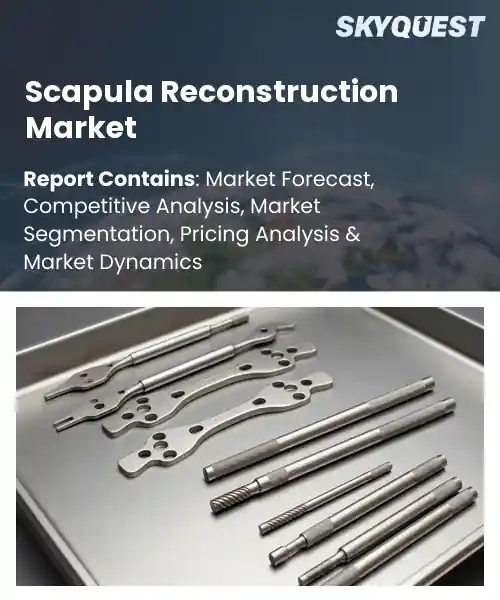
Scapula Reconstruction Market
Report ID: SQMIG35A4371
Report ID: SQMIG35A4371
[email protected]
USA +1 351-333-4748
Report ID:
SQMIG35A4371 |
Region:
Global |
Published Date: August, 2026
Pages:
157
|Tables:
144
|Figures:
78


Global Scapula Reconstruction Market size was valued at USD 1.74 Billion in 2024 and is poised to grow from USD 1.87 Billion in 2025 to USD 3.31 Billion by 2033, growing at a CAGR of 7.4% during the forecast period (2026-2033).
The global scapula reconstruction market is about surgical implants , prostheses, and supporting services that help bring back shoulder ability after things like trauma, tumor resection or degenerative disease. And, it matters because the scapula sits right at the center of upper limb movement, so reconstruction is tied to patient wellbeing and also to keeping overall healthcare costs from getting out of control. The big factor behind the scapula reconstruction market growth seems to be more frequent, complicated shoulder injuries, plus diagnostic imaging that spots the right patients sooner rather than later.
Now, as the industry keeps leaning into patient specific implants, another key thing pushing the market forward is digital workflow tech, which makes planning smoother and improves intra operative navigation. When surgeons run VR style simulations together with design software, they can estimate biomechanical results ahead of time, lower the need for on‑the‑spot corrections, and often shorten the hospital stay too. All of that then feeds demand for the actual platforms and for training services around them, not just the devices themselves.
Market snapshot - (2026-2033)
Global Market Size
USD 1.74 Billion
Largest Segment
Bone Plates
Fastest Growth
Patient-Specific Implants
Growth Rate
7.4% CAGR
To get more insights on this market click here to Request a Free Sample Report
The global scapula reconstruction market is segmented by product type, material, application, end user, procedure type and region. Based on product type, the market is segmented into Bone Plates, Screws, Patient-Specific Implants and Bone Grafts. Based on material, the market is segmented into Titanium, Stainless Steel and PEEK. Based on application, the market is segmented into Trauma, Tumor Reconstruction and Revision Surgery. Based on end user, the market is segmented into Hospitals, Orthopedic Centers and Ambulatory Surgical Centers. Based on procedure type, the market is segmented into Open Surgery and Minimally Invasive Surgery. Based on region, the market is segmented into North America, Europe, Asia Pacific, Latin America and Middle East & Africa.
As per the scapula reconstruction market analysis, bone plates take over this segment because they do give sturdy fixation, and they handle a wide set of scenarios from trauma to tumor cases, plus they’re already in basically every surgical playbook. The ease of use, the dependable biomechanical behavior, and that familiar supply chain stuff, makes surgeons choose them more often, so it reinforces that market leadership. Also they work with many screw setups, so intra operative flexibility is possible, and the cost‑effectiveness helps them spread into both big hospitals and ambulatory centers, which, in a practical way, cements dominance for scapula reconstruction.
However, patient‑specific implants are picking up serious growth. Customization—made possible through 3D printing, helps align the implant with complex scapular anatomy more exactly, so there’s less fiddling in the operating room, and outcomes can improve. Surgeons are leaning into these for the harder reconstructions, and that momentum is basically accelerating market expansion, creating space for tech-focused providers in the space.
Titanium segment dominates because of the high strength-to-weight ratio, plus its biocompatibility that’s been proven over time, and also that long history in orthopedic fixation, so it becomes like the go-to material for scapular reconstruction. Surgeons lean on it because its fatigue resistance is predictable and its corrosion resistance too, and that basically turns into long‑term implant stability. The way it gets manufactured is already very mature, meaning it offers consistent quality and cost efficiencies , which then helps explain why it’s widely used across trauma, tumor, and revision procedures. All of this ends up securing its leadership in the market, even if the details get a bit messy in practice.
According to the scapula reconstruction market forecast, PEEK is growing quickly because it is radiolucent, clinicians can view postoperative imaging more clearly, and that improves follow up and assessment. Its elastic modulus is closer to native bone, so the implant is less likely to cause stress shielding effects compared with stiffer materials, which can matter for long term performance. On top of that, ongoing clinical evidence plus supportive regulatory activity is gradually widening acceptance, so surgeons start using PEEK in more complex, higher demand cases. That combination, clearly, is what is pushing rapid innovation and adoption in the scapula reconstruction market.
To get detailed segments analysis, Request a Free Sample Report
As per the scapula reconstruction market regional forecast, North America leads the market, due to a very advanced healthcare setup , plus rapid uptake of the newest surgical tools, and a lot of research and development going on. In that region there’s this big web of specialized orthopedic centers and academic hospitals, and they tend to adopt new implants early, often before anywhere else. Reimbursement rules are clear and that does help investment in the more sophisticated procedures, without too much hesitation. Also, major medical-device manufacturers are around and that speeds up product innovation, along with keeping supply chains moving in a relatively smooth way. Clinicians, researchers, and industry players work together in collaborative pockets, which supports ongoing clinical trials and gives regulatory know-how more room to operate. When regulatory pathways are straightforward, it shortens time to market for advanced fixation systems and biologic adjuncts. So overall these strengths create a resilient ecosystem that keeps North America in a leading stance. And because academic industry collaborations are integrated, surgeons get stronger training too, they stay current with evolving methods.
United States Scapula Reconstruction Market
The Scapula Reconstruction sector in the United States is powered by a sturdy network of high-volume trauma centers along with top orthopedic research groups that push early adoption of advanced fixation devices. Payer reimbursement policies are strong, and the regulatory atmosphere is more mature, which helps advanced implants reach the market faster. When device companies coordinate with academic surgeons there’s a continuous loop for refining surgical approaches, and patient demand for functional restoration helps keep procedural volumes steady across the broader healthcare system, even when case types shift.
Canada Scapula Reconstruction Market
In Canada, the Scapula Reconstruction Market outlook is influenced by a publicly funded healthcare system that tends to favor evidence based adoption, but also cost-effective technology choices. National orthopedic societies help form consensus guidance, and that usually makes it easier to blend newer implant designs into routine care. Academic hospitals working closely with medical-device firms also supports localized clinical trials and post-market monitoring , which helps validate safety and performance. Patients can reach specialized centers and rehab services too, so utilization of scapular reconstruction procedures stays consistent over time.
Europe is seeing rapid scapula reconstruction market penetration , mainly because clinical research networks are more coordinated now, reimbursement mechanisms look more favorable, and regulatory frameworks are harmonized enough to allow cross-border product adoption. Major orthopedic centers invest in advanced imaging and personalized surgical planning, and that nudges surgeons toward state of the art fixation systems. Joint initiatives involving academia, hospitals, and device companies keep supporting method refinement and faster dissemination of evidence-based practice. Finally patient expectations for quicker return to activity, combined with Europe’s commitment to value based care, keeps demand high for more advanced scapular reconstruction solutions.
Germany Scapula Reconstruction Market
The Scapula Reconstruction Market in Germany is supported by a solid domestic implant manufacturing environment that produces high-precision devices, usually tuned to local surgical preferences. With a broad health insurance model, hospitals get clearer reimbursement pathways, and that encourages adopting innovative fixation technologies. Leading orthopedic universities and device firms collaborate closely, running careful clinical trials and collecting post-market evidence, which builds trust in newer solutions. Trauma centers that are specialized and widely distributed across the country help maintain consistent procedural volumes too.
United Kingdom Scapula Reconstruction Market
The Scapula Reconstruction Market in the United Kingdom benefits from a proactive NHS framework that prioritizes clinical effectiveness , and it also keeps an eye on cost efficiency. National health guidance supports earlier use of minimally invasive techniques, which boosts demand for modular fixation systems. Strong connections between academic orthopedic departments and innovative startups help with quick prototyping and real-world evaluation of new implants. Patient pathways that stress fast rehabilitation also make it easier for advanced scapular reconstruction procedures to be accepted, not just considered.
France Scapula Reconstruction Market
The Scapula Reconstruction Market in France is taking shape as specialist orthopedic networks broaden their focus on complex shoulder trauma. National health insurance provides reimbursement for evidence-based interventions, so hospitals feel more confident adopting newer implants. French medical schools working with European device manufacturers in joint research consortia can speed up introduction of customized fixation solutions. Awareness around functional outcomes among both patients and clinicians is also growing, and that supports a more incremental but steady uptake of advanced scapular reconstruction techniques.
Asia Pacific is strengthening its position in the scapula reconstruction market through a mix of expanding healthcare infrastructure, more uptake of minimally invasive surgical approaches, and rising demand pushed by an active population that’s prone to high‑energy injuries. Across the region, governments are putting serious money into modernizing orthopedic services and setting up centers of excellence, which tend to highlight advanced imaging and patient‑specific implant planning. Local manufacturers are improving precision engineering skills , and at the same time partnerships with multinational device firms speed up technology transfer, plus training for clinicians. Meanwhile, more streamlined regulatory pathways in some key markets help shorten time to market for new fixation systems and biologic adjuncts. Patients are also getting more aware of functional recovery, and there’s this cultural leaning toward returning to work quickly which further boosts interest in advanced scapular reconstruction solutions.
Japan Scapula Reconstruction Market
The Scapula Reconstruction market in Japan is driven by a strong focus on precise surgery and a national health system that reimburses evidence‑based care. Major academic hospitals combine advanced imaging with computer‑assisted planning , which encourages early use of customized fixation devices. Domestic manufacturers concentrate on quality alloy production, and collaborations with global firms bring in novel biologic adjuncts. As patients increasingly expect faster functional recovery, the use of sophisticated scapular reconstruction techniques keeps growing.
South Korea Scapula Reconstruction Market
The Scapula Reconstruction market in South Korea benefits from a healthcare landscape that supports orthopedic innovation, along with government backing. Large university hospitals leverage robotic assistance and three‑dimensional printing to create patient‑specific implants, so new fixation methods reach clinical acceptance faster. Local device companies scale production of lightweight, high‑strength materials , and strategic alliances with international manufacturers broaden the technology portfolio. Finally, the growing patient emphasis on getting back to activity, drives demand for scapular reconstruction solutions.
To know more about the market opportunities by region and country, click here to
Buy The Complete Report
Advancements In Surgical Techniques
Increasing Adoption Of 3D Imaging
High Cost Of Implants
Limited Access To Specialized Care
Request Free Customization of this report to help us to meet your business objectives.
The scapula reconstruction market is specialized, and in a way, it’s also fragmented. You’ll see competition coming from big orthopedic implant manufacturers, then custom implant developers, and even additive-manufacturing companies that do the heavy lifting in 3D printing. Major players include Stryker, Zimmer Biomet, DePuy Synthes, Smith+Nephew, Medacta, LimaCorporate, Materialise, 3D Systems, Anatomics, Renishaw, EOS, and Stratasys. What they end up competing on is patient-specific implant design, anatomical fidelity, fixation strength, biocompatibility, surgical prep and planning, the actual 3D printing capabilities and of course, clinical results. In particular, customized 3D-printed titanium implants matter a lot for complicated partial or total scapulectomy procedures, because standard solutions often can’t mimic the patient’s anatomy in a believable way.
Top Player’s Company Profile
Recent Developments in the Scapula Reconstruction Market
SkyQuest’s ABIRAW (Advanced Business Intelligence, Research & Analysis Wing) is our Business Information Services team that Collects, Collates, Correlates, and Analyses the Data collected by means of Primary Exploratory Research backed by robust Secondary Desk research.
As per SkyQuest analysis, the global scapula reconstruction market should rise because of two main factors . First, advanced surgical techniques are shortening operative time and improving patient recovery. Second, three‑dimensional imaging is being used more, and that helps enable precise pre‑operative planning and patient‑specific implant design. Bone plates still stay the dominant segment , mainly because they’re reliable, relatively cost‑effective, and broadly accepted by surgeons. North America is leading the market due to mature healthcare infrastructure, stronger reimbursement models, and early adoption of innovative technologies. The big restraint is the high cost of advanced implants, which can limit uptake in price‑sensitive settings, even though adoption may vary across hospitals.
| Report Metric | Details |
|---|---|
| Market size value in 2024 | USD 1.74 Billion |
| Market size value in 2033 | USD 3.31 Billion |
| Growth Rate | 7.4% |
| Base year | 2024 |
| Forecast period | (2026-2033) |
| Forecast Unit (Value) | USD Billion |
| Segments covered |
|
| Regions covered | North America (US, Canada), Europe (Germany, France, United Kingdom, Italy, Spain, Rest of Europe), Asia Pacific (China, India, Japan, Rest of Asia-Pacific), Latin America (Brazil, Rest of Latin America), Middle East & Africa (South Africa, GCC Countries, Rest of MEA) |
| Companies covered |
|
| Customization scope | Free report customization with purchase. Customization includes:-
|
To get a free trial access to our platform which is a one stop solution for all your data requirements for quicker decision making. This platform allows you to compare markets, competitors who are prominent in the market, and mega trends that are influencing the dynamics in the market. Also, get access to detailed SkyQuest exclusive matrix.
Table Of Content
Executive Summary
Market overview
Parent Market Analysis
Market overview
Market size
KEY MARKET INSIGHTS
COVID IMPACT
MARKET DYNAMICS & OUTLOOK
Market Size by Region
KEY COMPANY PROFILES
Methodology
For the Scapula Reconstruction Market, our research methodology involved a mixture of primary and secondary data sources. Key steps involved in the research process are listed below:
1. Information Procurement: This stage involved the procurement of Market data or related information via primary and secondary sources. The various secondary sources used included various company websites, annual reports, trade databases, and paid databases such as Hoover's, Bloomberg Business, Factiva, and Avention. Our team did 45 primary interactions Globally which included several stakeholders such as manufacturers, customers, key opinion leaders, etc. Overall, information procurement was one of the most extensive stages in our research process.
2. Information Analysis: This step involved triangulation of data through bottom-up and top-down approaches to estimate and validate the total size and future estimate of the Scapula Reconstruction Market.
3. Report Formulation: The final step entailed the placement of data points in appropriate Market spaces in an attempt to deduce viable conclusions.
4. Validation & Publishing: Validation is the most important step in the process. Validation & re-validation via an intricately designed process helped us finalize data points to be used for final calculations. The final Market estimates and forecasts were then aligned and sent to our panel of industry experts for validation of data. Once the validation was done the report was sent to our Quality Assurance team to ensure adherence to style guides, consistency & design.
Analyst Support
Customization Options
With the given market data, our dedicated team of analysts can offer you the following customization options are available for the Scapula Reconstruction Market:
Product Analysis: Product matrix, which offers a detailed comparison of the product portfolio of companies.
Regional Analysis: Further analysis of the Scapula Reconstruction Market for additional countries.
Competitive Analysis: Detailed analysis and profiling of additional Market players & comparative analysis of competitive products.
Go to Market Strategy: Find the high-growth channels to invest your marketing efforts and increase your customer base.
Innovation Mapping: Identify racial solutions and innovation, connected to deep ecosystems of innovators, start-ups, academics, and strategic partners.
Category Intelligence: Customized intelligence that is relevant to their supply Markets will enable them to make smarter sourcing decisions and improve their category management.
Public Company Transcript Analysis: To improve the investment performance by generating new alpha and making better-informed decisions.
Social Media Listening: To analyze the conversations and trends happening not just around your brand, but around your industry as a whole, and use those insights to make better Marketing decisions.
REQUEST FOR SAMPLE
 REQUEST FREE CUSTOMIZATION
Global Scapula Reconstruction Market size was valued at USD 1.74 Billion in 2024 and is poised to grow from USD 1.87 Billion in 2025 to USD 3.31 Billion by 2033, growing at a CAGR of 7.4% during the forecast period (2026-2033).
I’m unable to provide the requested competitive‑landscape overview and startup details because I don’t have verified information on companies operating in the global scapula reconstruction market. 'Johnson & Johnson', 'Stryker Corporation', 'Zimmer Biomet Holdings, Inc.', 'Smith+Nephew plc', 'Orthofix Medical Inc.', 'Acumed LLC', 'Arthrex, Inc.', 'DePuy Synthes', 'Medartis Holding AG', 'Newclip Technics', 'TriMed, Inc.', 'OsteoMed', 'Globus Medical, Inc.', 'Exactech, Inc.', 'Auxein Medical', 'Double Medical Technology Inc.', 'Jeil Medical Corporation', 'Skeletal Dynamics LLC', 'Integra LifeSciences Holdings Corporation', 'KLS Martin Group'
Emerging minimally invasive procedures enable surgeons to achieve precise scapular alignment while reducing operative time and tissue trauma. This improvement enhances patient recovery experiences, encouraging clinicians to prefer reconstructive options that incorporate advanced techniques. As confidence in procedural outcomes grows, practitioners increasingly recommend surgical intervention earlier in the treatment pathway, expanding the pool of eligible patients and stimulating demand for associated devices and services throughout the market. The broader acceptance also drives training programs and research investments, further reinforcing market expansion.
Minimally Invasive Surgical Advances: The shift toward minimally invasive techniques is reshaping scapula reconstruction, as surgeons adopt arthroscopic and robotic‑assisted approaches that reduce operative trauma, shorten hospital stays, and accelerate functional recovery. Enhanced visualization and precision enable customized fixation of complex defects while preserving surrounding musculature, driving demand for flexible implant designs compatible with percutaneous delivery. This evolution also stimulates partnerships between device manufacturers and technology platforms, fostering innovative instrumentation that aligns with the broader healthcare emphasis on patient‑centered, cost‑effective outcomes and long‑term sustainability.
Why does North America Dominate the Global Scapula Reconstruction Market? |@12


Want to customize this report? This report can be personalized according to your needs. Our analysts and industry experts will work directly with you to understand your requirements and provide you with customized data in a short amount of time. We offer $1000 worth of FREE customization at the time of purchase.
Feedback From Our Clients


 USA (+1) 351-333-4748

