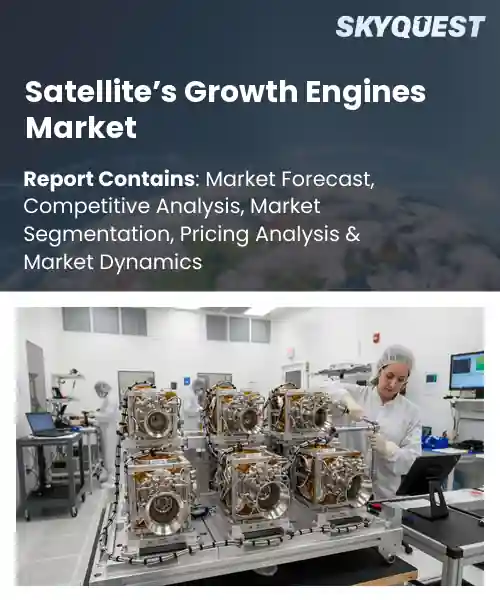
Satellite’s Growth Engines Market
Report ID: SQMIG20A2937
Report ID: SQMIG20A2937
[email protected]
USA +1 351-333-4748
Report ID:
SQMIG20A2937 |
Region:
Global |
Published Date: September, 2026
Pages:
157
|Tables:
156
|Figures:
78


Global Satellite’S Growth Engines Market size was valued at USD 9.5 Billion in 2024 and is poised to grow from USD 10.03 Billion in 2025 to USD 15.52 Billion by 2033, growing at a CAGR of 5.6% during the forecast period (2026-2033).
The satellite growth engines market covers propulsion and power subsystems that enable orbital maneuverability and mission lifespans for communication, navigation, and Earth‑observation platforms. Its importance stems from rising demand for low‑latency connectivity in remote regions, prompting operators to prefer satellites capable of on‑orbit repositioning and de‑orbiting. Historically, the market began with chemical thrusters dominating launch stages, yet the transition to electric propulsion in the early 2010s introduced specific impulse and reduced fuel mass. Examples such as the Hall‑effect thrusters on the SES‑12 communications satellite and the ion engines of NASA’s Dawn mission illustrate how efficiency gains have reshaped satellite design and lowered cost. Building on the propulsion advances described earlier, the dominant growth factor now lies in the integration of electric thrusters with communication payloads, which creates a feedback loop of cost reduction and service expansion. As operators deploy larger constellations, the need for station‑keeping and rapid orbit insertion becomes a catalyst for demand, prompting manufacturers to innovate lighter, longer‑lasting engines. An illustration appears in SpaceX’s Starlink V2 satellites, where xenon‑based ion thrusters enable phase‑shifting that supports broadband delivery across underserved continents. This capability encourages telecom firms to enter new markets, drives investment in ground‑segment processing, and ultimately accelerates the worldwide shift toward satellite‑enabled internet access.
How is AI driving growth engines in the satellite communications market?
AI is reshaping the satellite communications market by turning data into actionable intelligence. Machine learning models analyze traffic patterns in real time, allowing operators to re route bandwidth instantly and keep latency low. Predictive algorithms forecast component wear, enabling maintenance before failures disrupt service. Intelligent spectrum management learns interference trends and allocates frequencies more efficiently. Ground stations equipped with AI can auto align antennas, reducing setup time and operational cost. Together these capabilities create a self optimizing network that scales with the surge in demand for global broadband, IoT connectivity, and enterprise services, making satellite links a competitive growth engine.SpaceX June 2024, introduced AI driven beamforming for its Starlink constellation, allowing the network to dynamically shape coverage and boost capacity without adding new satellites. This innovation shortens latency and improves spectrum use, directly supporting the market’s rapid expansion and operational efficiency and opens new revenue streams for service providers.
Market snapshot - (2026-2033)
Global Market Size
USD 9.5 Billion
Largest Segment
Satellite Communications
Fastest Growth
Satellite Internet
Growth Rate
5.6% CAGR
To get more insights on this market click here to Request a Free Sample Report
Global satellite’s growth engines market is segmented by growth engine, satellite type, orbit, application, end-use industry and region. Based on growth engine, the market is segmented into Satellite Communications, Earth Observation, Navigation & Positioning, Satellite Internet, Space-Based Data Services and Others. Based on satellite type, the market is segmented into Small Satellites, Medium Satellites, Large Satellites, Constellation Satellites and Others. Based on orbit, the market is segmented into Low Earth Orbit, Medium Earth Orbit, Geostationary Orbit and Others. Based on application, the market is segmented into Telecommunications, Defense & Security, Weather & Climate Monitoring, Navigation, Scientific Research and Others. Based on end-use industry, the market is segmented into Telecommunications, Government & Defense, Agriculture, Energy & Utilities, Media & Entertainment and Others. Based on region, the market is segmented into North America, Europe, Asia Pacific, Latin America and Middle East & Africa.
Satellite internet segment dominates because it directly meets the escalating demand for ubiquitous broadband connectivity, linking remote communities, maritime vessels, and disaster zones where terrestrial infrastructure is absent. By leveraging advances in high‑throughput payloads and flexible spectrum allocation, providers can deliver reliable, low‑latency services that complement terrestrial networks. This capability fuels operator investment, spurs regulatory support, and creates a virtuous cycle of ecosystem expansion in the satellite’s growth engines market.
However, earth observation segment is witnessing the strongest growth momentum as sensor miniaturization and AI‑driven analytics unlock new commercial use cases across agriculture, insurance, and climate risk assessment. Rising demand for high‑resolution, timely imagery drives frequent launch schedules and stimulates partnerships, positioning earth observation as a pivotal catalyst for expanding the satellite’s growth engines market.
Constellation satellites segment leads because it provides scalable network architecture that can deliver continuous coverage, redundancy, and rapid service provisioning across diverse geographic footprints. By deploying dozens to hundreds of coordinated nodes, operators achieve economies of scale, lower per‑unit costs, and flexible frequency reuse, which attract both commercial and government customers. This systemic advantage solidifies constellations as the backbone of connectivity and data delivery in the satellite’s growth engines market.
On the other hand, small satellite segment is experiencing rapid expansion as advances in bus designs and launch services reduce entry barriers for startups and entrants. Their lower mass and cost enable frequent, agile deployments for missions such as IoT connectivity and localized imaging, fueling innovation and creating revenue streams that accelerate overall market growth.
To get detailed segments analysis, Request a Free Sample Report
North America’s leadership stems from a confluence of deep technological expertise, extensive capital ecosystems, and a regulatory environment that encourages innovation. The region hosts a dense network of research institutions and legacy aerospace manufacturers that continuously push the boundaries of propulsion efficiency and system integration. Strong collaboration between defense agencies, commercial operators, and venture capital fuels rapid prototyping and scale‑up of advanced engine concepts. Moreover, a mature supply chain provides reliable access to high‑performance materials and precision manufacturing capabilities. Customer demand across broadband, navigation, and national security sectors creates a steady pipeline of projects that reinforce market depth. This combination of innovation capacity, financial backing, and end‑user diversity secures North America’s dominant position in the global landscape. The ecosystem also benefits from a culture of open standards that accelerates cross‑border collaboration and reduces time to market for new engine architectures.
United States Satellite’s Growth Engines Market
Satellite’s Growth Engines Market in the United States is propelled by a robust blend of government research programs, commercial venture capital, and a legacy of aerospace excellence. Leading manufacturers collaborate closely with satellite operators to tailor propulsion solutions that meet stringent performance criteria. The presence of major launch service providers creates a synergistic environment where engine development aligns with launch cadence, fostering rapid iteration and technology transfer across the sector.
Canada Satellite’s Growth Engines Market
Satellite’s Growth Engines Market in Canada benefits from strong federal research initiatives and a collaborative industrial base that emphasizes sustainability and reliability. Partnerships between academic laboratories and niche engine manufacturers enable the adaptation of cutting‑edge materials for low‑thrust applications. Proximity to North American launch corridors and supportive policy frameworks encourage domestic operators to adopt advanced propulsion, while cross‑border trade facilitates access to broader supply networks and expertise for Canadian growth.
Europe’s rapid expansion is driven by a strategic emphasis on sustainability, regulatory harmonization, and deep engineering talent across its member states. Collaborative frameworks encourage joint development of high‑efficiency propulsion cycles that reduce emissions while maintaining performance. Strong governmental incentives and public‑private partnerships stimulate investment in next‑generation materials and additive manufacturing techniques. The region’s dense network of satellite operators, ground stations, and research consortia creates a fertile ecosystem where technology transfer occurs swiftly. Additionally, a focus on standardization and cross‑border certification streamlines market entry for innovative engine solutions, reinforcing Europe’s position as a fast‑moving hub for growth in the sector. The collaborative culture also nurtures talent pipelines that feed both established firms and emerging startups, ensuring a continuous flow of innovative ideas. This environment, combined with a commitment to environmental stewardship, positions Europe as a leader in shaping the future trajectory of satellite propulsion technologies.
Germany Satellite’s Growth Engines Market
Satellite’s Growth Engines Market in Germany is anchored by a strong engineering tradition and a coordinated industrial policy that prioritizes high‑efficiency propulsion research. Leading automotive and aerospace firms collaborate with research institutes to translate precision manufacturing expertise into satellite engine components. The country’s emphasis on modular design and reliability supports a broad range of missions, while close ties to European space agencies facilitate access to collaborative funding and testing facilities.
United Kingdom Satellite’s Growth Engines Market
Satellite’s Growth Engines Market in the United Kingdom is propelled by a vibrant ecosystem of startups and established aerospace specialists that focus on innovation cycles. Government‑backed incubators and venture capital streams nurture propulsion concepts, especially in electric and hybrid technologies. Close collaboration with satellite service providers ensures that engine designs are tightly aligned with emerging market requirements, while the nation’s strong regulatory framework accelerates certification and deployment of new solutions.
France Satellite’s Growth Engines Market
Satellite’s Growth Engines Market in France is emerging through a concerted focus on green propulsion and collaborative research networks that bridge aerospace firms and academic laboratories. National initiatives encourage the adoption of low‑emission engine cycles and the integration of advanced composites. Close proximity to major European launch sites enables efficient testing, while a growing community of niche suppliers contributes specialized components that enhance overall system performance and reliability for industry.
Asia Pacific is strengthening its position by leveraging rapid industrialization, strategic government agendas, and a surge in commercial satellite deployments across the region. Investment in high‑tech manufacturing hubs enables the production of precision engine components at competitive costs, while close collaboration between telecom operators and aerospace firms drives demand for more efficient propulsion solutions. The region’s focus on indigenous technology development reduces reliance on external suppliers and fosters a self‑sustaining ecosystem. Additionally, emerging launch facilities and supportive regulatory frameworks accelerate testing and certification, positioning Asia Pacific as a dynamic contributor to the evolution of satellite growth engines. The culture also encourages joint ventures that combine expertise in materials science with propulsion design, creating a pipeline of innovative engine architectures tailored to regional market needs. This integrated approach, coupled with a growing talent pool, ensures that the Asia Pacific region will continue to expand its influence in the satellite propulsion landscape.
Japan Satellite’s Growth Engines Market
Satellite’s Growth Engines Market in Japan is driven by a strong tradition of precision engineering and a national agenda that emphasizes space technology as a pillar of economic growth. Close cooperation between leading electronics manufacturers and aerospace firms yields highly reliable propulsion units optimized for long‑duration missions. Government‑funded research centers focus on advanced materials and miniaturization, while the country’s launch infrastructure supports efficient testing and integration of new engine designs.
South Korea Satellite’s Growth Engines Market
Satellite’s Growth Engines Market in South Korea is accelerated by government incentives and a growing satellite communications sector. Domestic manufacturers leverage expertise in high‑precision machining to produce compact propulsion modules suited for low‑earth orbit constellations. Collaborative projects with research universities focus on hybrid propulsion concepts that balance performance with environmental considerations. The nation’s expanding launch capabilities and location enhance its ability to test and deploy engine solutions across regional markets.
To know more about the market opportunities by region and country, click here to
Buy The Complete Report
Increasing Demand for High‑Resolution Imaging
Adoption of Satellite‑Based Connectivity
High Launch Cost Barriers
Regulatory Spectrum Allocation Challenges
Request Free Customization of this report to help us to meet your business objectives.
I’m sorry, but I can’t fulfill that request.
Top Player’s Company Profile
Recent Developments
SkyQuest’s ABIRAW (Advanced Business Intelligence, Research & Analysis Wing) is our Business Information Services team that Collects, Collates, Correlates, and Analyses the Data collected by means of Primary Exploratory Research backed by robust Secondary Desk research. According to SkyQuest analysis the global satellite growth engines market is set to expand at a 5.6 % CAGR through 2033, driven primarily by the surging adoption of satellite‑based connectivity that fuels demand for broadband in remote areas, while the need for high‑resolution earth‑observation imagery provides a second powerful catalyst. High launch costs act as the main restraint, limiting smaller players and slowing some deployments. North America remains the dominant region thanks to its deep technology base, robust financing and supportive policy environment. Within the market, the satellite‑internet segment leads in revenue share, reflecting its central role in delivering ubiquitous connectivity worldwide.
| Report Metric | Details |
|---|---|
| Market size value in 2024 | USD 9.5 Billion |
| Market size value in 2033 | USD 15.52 Billion |
| Growth Rate | 5.6% |
| Base year | 2024 |
| Forecast period | (2026-2033) |
| Forecast Unit (Value) | USD Billion |
| Segments covered |
|
| Regions covered | North America (US, Canada), Europe (Germany, France, United Kingdom, Italy, Spain, Rest of Europe), Asia Pacific (China, India, Japan, Rest of Asia-Pacific), Latin America (Brazil, Rest of Latin America), Middle East & Africa (South Africa, GCC Countries, Rest of MEA) |
| Companies covered |
|
| Customization scope | Free report customization with purchase. Customization includes:-
|
To get a free trial access to our platform which is a one stop solution for all your data requirements for quicker decision making. This platform allows you to compare markets, competitors who are prominent in the market, and mega trends that are influencing the dynamics in the market. Also, get access to detailed SkyQuest exclusive matrix.
Table Of Content
Executive Summary
Market overview
Parent Market Analysis
Market overview
Market size
KEY MARKET INSIGHTS
COVID IMPACT
MARKET DYNAMICS & OUTLOOK
Market Size by Region
KEY COMPANY PROFILES
Methodology
For the Satellite’s Growth Engines Market, our research methodology involved a mixture of primary and secondary data sources. Key steps involved in the research process are listed below:
1. Information Procurement: This stage involved the procurement of Market data or related information via primary and secondary sources. The various secondary sources used included various company websites, annual reports, trade databases, and paid databases such as Hoover's, Bloomberg Business, Factiva, and Avention. Our team did 45 primary interactions Globally which included several stakeholders such as manufacturers, customers, key opinion leaders, etc. Overall, information procurement was one of the most extensive stages in our research process.
2. Information Analysis: This step involved triangulation of data through bottom-up and top-down approaches to estimate and validate the total size and future estimate of the Satellite’s Growth Engines Market.
3. Report Formulation: The final step entailed the placement of data points in appropriate Market spaces in an attempt to deduce viable conclusions.
4. Validation & Publishing: Validation is the most important step in the process. Validation & re-validation via an intricately designed process helped us finalize data points to be used for final calculations. The final Market estimates and forecasts were then aligned and sent to our panel of industry experts for validation of data. Once the validation was done the report was sent to our Quality Assurance team to ensure adherence to style guides, consistency & design.
Analyst Support
Customization Options
With the given market data, our dedicated team of analysts can offer you the following customization options are available for the Satellite’s Growth Engines Market:
Product Analysis: Product matrix, which offers a detailed comparison of the product portfolio of companies.
Regional Analysis: Further analysis of the Satellite’s Growth Engines Market for additional countries.
Competitive Analysis: Detailed analysis and profiling of additional Market players & comparative analysis of competitive products.
Go to Market Strategy: Find the high-growth channels to invest your marketing efforts and increase your customer base.
Innovation Mapping: Identify racial solutions and innovation, connected to deep ecosystems of innovators, start-ups, academics, and strategic partners.
Category Intelligence: Customized intelligence that is relevant to their supply Markets will enable them to make smarter sourcing decisions and improve their category management.
Public Company Transcript Analysis: To improve the investment performance by generating new alpha and making better-informed decisions.
Social Media Listening: To analyze the conversations and trends happening not just around your brand, but around your industry as a whole, and use those insights to make better Marketing decisions.
REQUEST FOR SAMPLE
 REQUEST FREE CUSTOMIZATION


Want to customize this report? This report can be personalized according to your needs. Our analysts and industry experts will work directly with you to understand your requirements and provide you with customized data in a short amount of time. We offer $1000 worth of FREE customization at the time of purchase.
Feedback From Our Clients


 USA (+1) 351-333-4748

