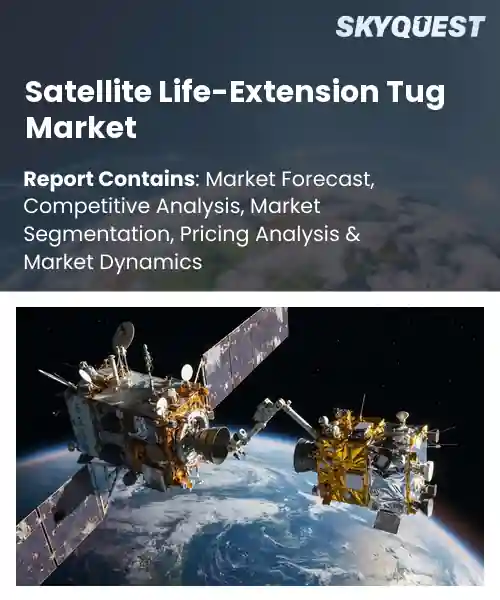
Satellite Life-Extension Tug Market
Report ID: SQMIG20A2908
Report ID: SQMIG20A2908
[email protected]
USA +1 351-333-4748
Report ID:
SQMIG20A2908 |
Region:
Global |
Published Date: August, 2026
Pages:
157
|Tables:
120
|Figures:
77


Global Satellite Life-Extension Tug Market size was valued at USD 428.0 Million in 2024 and is poised to grow from USD 528.58 Million in 2025 to USD 2860.53 Million by 2033, growing at a CAGR of 23.5% during the forecast period (2026-2033).
The satellite life‑extension tug market focuses on services that attach to aging orbiting satellites to raise them to a slot, boost remaining fuel, or provide propulsion for orbital adjustments. This capability matters because replacing a satellite can cost hundreds of millions, while many payloads retain communications or imaging hardware beyond their original fuel limits. The market emerged as operators faced congestion in GEO and regulatory pressure to limit space debris. The 2017 Mission Extension Vehicle by Northrop Grumman proved that a tug could extend a satellite’s service life by up to five years, prompting a significant cascade of government contracts.
Rising demand for broadband constellations and aging first‑generation GEO assets drives the tug market, because operators seek to preserve revenue without launching replacements. When a satellite exhausts propellant, a tug can rendezvous, attach, and raise the platform to a disposal orbit or deliver fresh propellant, converting a potential loss into an extended asset. The 2022 on‑orbit refueling of a communications satellite by SpaceX’s Refuel‑tug service proved that one mission can service multiple customers and reduce launch cadence. This capability lowers insurance premiums, attracts investment, and spurs collaboration between tug manufacturers and constellation builders, creating a virtuous loop of ongoing demand.
How is AI-driven automation influencing the satellite life‑extension tug market?
AI driven automation is reshaping the satellite life extension tug market by enabling smarter navigation, predictive maintenance and autonomous docking. Machine learning models analyze orbital decay patterns and fuel consumption, allowing tugs to plan optimal thrust sequences without human input. This reduces mission risk and shortens preparation time, making tug services more attractive to operators seeking to prolong GEO assets. Vendors are integrating AI into guidance, navigation and control suites, while ground stations use AI to monitor health of both tug and client satellite in real time. The result is a more efficient workflow that lowers cost and supports the growing demand for extending satellite lifespans.
Market snapshot - (2026-2033)
Global Market Size
USD 428.0 Million
Largest Segment
Station Keeping
Fastest Growth
Life Extension Missions
Growth Rate
23.5% CAGR
To get more insights on this market click here to Request a Free Sample Report
Global satellite life-extension tug market is segmented by service type, propulsion type, orbit, end user and region. Based on service type, the market is segmented into Orbit Raising, Orbit Relocation, Station Keeping, End-of-Life Disposal and Life Extension Missions. Based on propulsion type, the market is segmented into Chemical Propulsion, Electric Propulsion and Hybrid Propulsion. Based on orbit, the market is segmented into Low Earth Orbit (LEO), Medium Earth Orbit (MEO), Geostationary Orbit (GEO) and Cislunar & Deep Space. Based on end user, the market is segmented into Commercial Satellite Operators, Government & Defense Agencies and Space Agencies. Based on region, the market is segmented into North America, Europe, Asia Pacific, Latin America and Middle East & Africa.
Life Extension Missions segment dominates because operators prioritize preserving existing assets to defer costly replacements, and tugs provide a cost effective means to replenish fuel and adjust orbital parameters. The market values the ability to extend revenue streams, reduce launch demand, and meet sustainability mandates. Consequently, demand for dedicated tug services that can perform precise docking, refueling, and attitude control drives this dominance. These capabilities also align with regulatory pressure for responsible space stewardship, reinforcing operator commitment.
However, Orbit Relocation segment emerges as the fastest growing because emerging constellations require frequent repositioning to optimize coverage and avoid interference. Innovative tug designs enable rapid low thrust maneuvers, attracting operators seeking flexible fleet management. This growth fuels broader market expansion and creates new service revenue streams.
Electric Propulsion segment dominates because it offers high specific impulse, enabling tugs to perform long duration maneuvers with minimal propellant mass. This efficiency translates into lower launch costs and greater payload capacity for ancillary services such as refueling or debris removal. Operators value the ability to sustain multiple missions from a single tug, enhancing asset utilization and supporting sustainability goals across the orbital environment. The quiet thrust profile also reduces collision risk, further appealing to risk averse stakeholders.
Meanwhile, Hybrid Propulsion segment is witnessing the strongest growth momentum because it combines the thrust of chemical systems with the efficiency of electric engines, delivering versatile performance for diverse tug missions. This dual capability attracts customers needing rapid orbit changes alongside long duration station keeping, expanding market appeal and prompting increased investment in hybrid technology development.
To get detailed segments analysis, Request a Free Sample Report
The United States and Canada together provide a robust ecosystem of aerospace expertise, mature launch infrastructure, and advanced research institutions. Strong governmental support for space exploration and commercial satellite operations fuels investment in innovative tug technologies. A dense network of satellite manufacturers, operators, and service providers creates synergies that accelerate development cycles. The region also benefits from a culture of private‑sector entrepreneurship that rapidly translates concepts into operational services, reinforcing its leadership position and attracting multinational collaborations.
Satellite Life-Extension Tug Market in United States thrives on a convergence of high‑tech talent, extensive launch sites, and a thriving venture capital scene. Collaborative programs between federal agencies and commercial firms encourage early adoption of tug services, while the presence of major satellite constellations generates consistent demand. Industry clusters around leading aerospace hubs foster knowledge exchange, enabling rapid iteration of propulsion, navigation, and autonomous docking technologies that underpin the market’s momentum.
Satellite Life-Extension Tug Market in Canada is shaped by a strong focus on sustainable space operations and a growing aerospace supply chain. Government initiatives promote research into low‑emission propulsion and debris mitigation, aligning with the region’s environmental priorities. Close ties with United States programs provide access to cross‑border expertise, while emerging domestic manufacturers expand the portfolio of tug components, positioning Canada as an influential partner in the North American value chain.
Europe leverages deep-rooted aerospace heritage, coordinated policy frameworks, and a collaborative industrial base to accelerate market growth. The European Union’s emphasis on responsible space stewardship and the establishment of shared regulatory standards encourage investment in tug services. Robust research ecosystems across member states generate cutting‑edge propulsion and autonomous navigation solutions. Strong demand from regional satellite operators, combined with a strategic shift toward extending satellite lifespans, fuels a dynamic environment where innovative tug concepts transition swiftly from laboratory to orbit.
Satellite Life-Extension Tug Market in Germany is propelled by a vibrant research landscape and a tradition of precision engineering. Collaborative ventures between universities, research institutes, and industrial partners focus on high‑efficiency electric propulsion and sophisticated guidance systems. The country’s commitment to sustainable space practices drives exploration of reusable tug architectures, while emerging start‑ups contribute fresh approaches that enrich the broader European ecosystem.
Satellite Life-Extension Tug Market in United Kingdom experiences rapid acceleration through strong government incentives and an energetic start‑up culture. Investment in orbital logistics and autonomous rendezvous technology positions the UK as a hub for next‑generation tug solutions. Partnerships between defense agencies and commercial enterprises enhance capability development, and a skilled workforce in aerospace software and systems engineering fuels ongoing innovation.
Satellite Life-Extension Tug Market in France benefits from a long‑standing aerospace legacy and comprehensive national space programs. Coordination between the national space agency and leading industrial groups prioritizes the integration of tug services into satellite lifecycle management. Emphasis on modular design and advanced propulsion research supports a dominant market presence, while collaborative European projects reinforce France’s role as a central driver of regional growth.
Asia Pacific combines a burgeoning satellite constellation market with ambitious national space agendas, creating fertile ground for tug technology adoption. Nations in the region invest heavily in homegrown launch capabilities and autonomous spacecraft systems, fostering a self‑reliant ecosystem. The convergence of rapid manufacturing advances, strategic partnerships with global suppliers, and a focus on cost‑effective orbital maintenance solutions accelerates the deployment of life‑extension tugs. This collaborative momentum positions the region as an emerging powerhouse in sustainable satellite operations.
Satellite Life-Extension Tug Market in Japan is driven by a strong emphasis on precision robotics and high‑reliability engineering. Integration of advanced AI for autonomous docking and innovative electric propulsion aligns with national priorities for efficient orbital asset management. Collaboration between governmental space agencies and private firms accelerates technology transfer, while a mature satellite manufacturing base ensures steady demand for tug services in maintaining long‑duration missions.
Satellite Life-Extension Tug Market in South Korea leverages rapid growth in domestic satellite deployments and a forward‑looking national space strategy. Investment in miniaturized propulsion modules and smart navigation algorithms reflects a commitment to extending satellite lifespans cost‑effectively. Partnerships with international technology providers and a vibrant start‑up ecosystem drive the development of scalable tug solutions, reinforcing the country’s emerging role within the broader regional market.
To know more about the market opportunities by region and country, click here to
Buy The Complete Report
Increasing Demand for Satellite Longevity
Advancements in Autonomous Docking Technology
High Development and Certification Costs
Limited Ground Infrastructure for Tug Operations
Request Free Customization of this report to help us to meet your business objectives.
Intense rivalry among emerging tug providers is accelerating technology adoption and service diversification in the satellite life‑extension market. Recent funding rounds for Starfish Space, Infinite Orbits and Aule Space illustrate a race to secure proprietary grappling mechanisms, modular propulsion and dedicated endurance platforms. Companies are leveraging strategic partnerships with launch firms and pursuing rapid prototype deployments to outpace incumbents and capture market share.
Top Player’s Company Profile
SkyQuest’s ABIRAW (Advanced Business Intelligence, Research & Analysis Wing) is our Business Information Services team that Collects, Collates, Correlates, and Analyses the Data collected by means of Primary Exploratory Research backed by robust Secondary Desk research.
As per SkyQuest analysis, the market is propelled primarily by the growing need to extend the operational life of costly communications and Earth‑observation satellites, which drives operators to seek tug services for refueling and orbital adjustments. A second catalyst is the rapid progress in autonomous docking and AI‑driven navigation that lowers mission risk and costs, making on‑orbit servicing more attractive. North America leads the market due to its deep aerospace talent, launch infrastructure and strong private‑sector momentum, while life‑extension missions dominate the service mix as customers prioritize preserving revenue streams. However, the high development and certification expenses required for tug hardware and safety compliance act as a notable restraint on broader adoption.
| Report Metric | Details |
|---|---|
| Market size value in 2024 | USD 428.0 Million |
| Market size value in 2033 | USD 2860.53 Million |
| Growth Rate | 23.5% |
| Base year | 2024 |
| Forecast period | (2026-2033) |
| Forecast Unit (Value) | USD Million |
| Segments covered |
|
| Regions covered | North America (US, Canada), Europe (Germany, France, United Kingdom, Italy, Spain, Rest of Europe), Asia Pacific (China, India, Japan, Rest of Asia-Pacific), Latin America (Brazil, Rest of Latin America), Middle East & Africa (South Africa, GCC Countries, Rest of MEA) |
| Companies covered |
|
| Customization scope | Free report customization with purchase. Customization includes:-
|
To get a free trial access to our platform which is a one stop solution for all your data requirements for quicker decision making. This platform allows you to compare markets, competitors who are prominent in the market, and mega trends that are influencing the dynamics in the market. Also, get access to detailed SkyQuest exclusive matrix.
Table Of Content
Executive Summary
Market overview
Parent Market Analysis
Market overview
Market size
KEY MARKET INSIGHTS
COVID IMPACT
MARKET DYNAMICS & OUTLOOK
Market Size by Region
KEY COMPANY PROFILES
Methodology
For the Satellite Life-Extension Tug Market, our research methodology involved a mixture of primary and secondary data sources. Key steps involved in the research process are listed below:
1. Information Procurement: This stage involved the procurement of Market data or related information via primary and secondary sources. The various secondary sources used included various company websites, annual reports, trade databases, and paid databases such as Hoover's, Bloomberg Business, Factiva, and Avention. Our team did 45 primary interactions Globally which included several stakeholders such as manufacturers, customers, key opinion leaders, etc. Overall, information procurement was one of the most extensive stages in our research process.
2. Information Analysis: This step involved triangulation of data through bottom-up and top-down approaches to estimate and validate the total size and future estimate of the Satellite Life-Extension Tug Market.
3. Report Formulation: The final step entailed the placement of data points in appropriate Market spaces in an attempt to deduce viable conclusions.
4. Validation & Publishing: Validation is the most important step in the process. Validation & re-validation via an intricately designed process helped us finalize data points to be used for final calculations. The final Market estimates and forecasts were then aligned and sent to our panel of industry experts for validation of data. Once the validation was done the report was sent to our Quality Assurance team to ensure adherence to style guides, consistency & design.
Analyst Support
Customization Options
With the given market data, our dedicated team of analysts can offer you the following customization options are available for the Satellite Life-Extension Tug Market:
Product Analysis: Product matrix, which offers a detailed comparison of the product portfolio of companies.
Regional Analysis: Further analysis of the Satellite Life-Extension Tug Market for additional countries.
Competitive Analysis: Detailed analysis and profiling of additional Market players & comparative analysis of competitive products.
Go to Market Strategy: Find the high-growth channels to invest your marketing efforts and increase your customer base.
Innovation Mapping: Identify racial solutions and innovation, connected to deep ecosystems of innovators, start-ups, academics, and strategic partners.
Category Intelligence: Customized intelligence that is relevant to their supply Markets will enable them to make smarter sourcing decisions and improve their category management.
Public Company Transcript Analysis: To improve the investment performance by generating new alpha and making better-informed decisions.
Social Media Listening: To analyze the conversations and trends happening not just around your brand, but around your industry as a whole, and use those insights to make better Marketing decisions.
REQUEST FOR SAMPLE
 REQUEST FREE CUSTOMIZATION
Global Satellite Life-Extension Tug Market size was valued at USD 428.0 Million in 2024 and is poised to grow from USD 528.58 Million in 2025 to USD 2860.53 Million by 2033, growing at a CAGR of 23.5% during the forecast period (2026-2033).
Intense rivalry among emerging tug providers is accelerating technology adoption and service diversification in the satellite life‑extension market. Recent funding rounds for Starfish Space, Infinite Orbits and Aule Space illustrate a race to secure proprietary grappling mechanisms, modular propulsion and dedicated endurance platforms. Companies are leveraging strategic partnerships with launch firms and pursuing rapid prototype deployments to outpace incumbents and capture market share. 'Northrop Grumman Corporation', 'Lockheed Martin Corporation', 'Airbus SE', 'Thales S.A.', 'Rocket Lab Corporation', 'Astroscale Holdings Inc.', 'Momentus Inc.', 'D-Orbit S.p.A.', 'ClearSpace SA', 'Starfish Space, Inc.', 'Impulse Space, Inc.', 'Orbit Fab, Inc.', 'Infinite Orbits SAS', 'Exotrail SA', 'Rogue Space Systems Corporation', 'Katalyst Space Technologies', 'Atomos Space Operations, Inc.', 'PIAP Space Sp. z o.o.', 'Kurs Orbital Ltd.', 'Blue Origin, LLC'
The growing need to maintain operational capability of costly communications and Earth‑observation platforms drives interest in life‑extension tug services. Satellite owners view refueling and orbital maneuvering as a means to preserve revenue streams while avoiding replacement launches. Industry are encouraging the development of tug architectures that can attach to legacy satellites, thereby extending life. This shift supports market growth by creating service contracts and fostering confidence in asset management. Moreover, operators are prioritizing sustainability goals, viewing tug interventions as a responsible approach to space resource utilization.
On‑Orbit Servicing Ecosystem Expansion: Satellite operators are increasingly viewing on‑orbit servicing as a strategic capability rather than a one‑off repair option. The emergence of dedicated service platforms, standardized docking interfaces, and collaborative agreements among manufacturers is fostering a shared ecosystem where tugs can reposition, refuel, or attach life‑extension modules to aging assets. This collaborative mindset reduces the need for costly replacements, extends revenue streams, and aligns with sustainability goals, driving demand for versatile tug solutions that can operate across multiple platforms and mission profiles.
Why does North America Dominate the Global Satellite Life-Extension Tug Market? |@12


Want to customize this report? This report can be personalized according to your needs. Our analysts and industry experts will work directly with you to understand your requirements and provide you with customized data in a short amount of time. We offer $1000 worth of FREE customization at the time of purchase.
Feedback From Our Clients


 USA (+1) 351-333-4748

