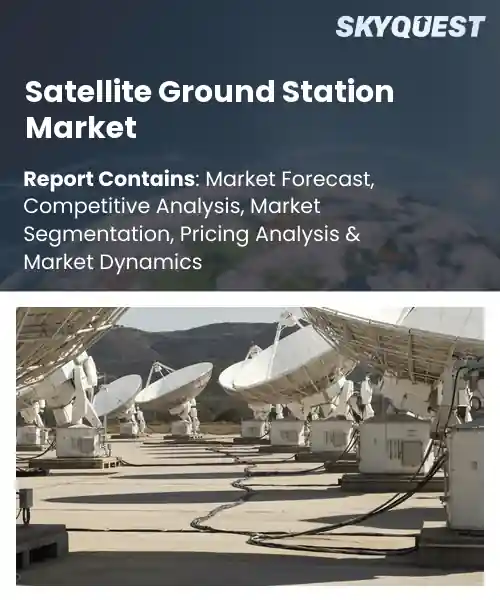
Satellite Ground Station Market
Report ID: SQMIG20A2589
Report ID: SQMIG20A2589
[email protected]
USA +1 351-333-4748
Report ID:
SQMIG20A2589 |
Region:
Global |
Published Date: May, 2026
Pages:
157
|Tables:
120
|Figures:
77


Global Satellite Ground Station Market size was valued at USD 52.52 Billion in 2024 and is poised to grow from USD 57.15 Billion in 2025 to USD 112.85 Billion by 2033, growing at a CAGR of 8.82% during the forecast period (2026-2033).
The primary driver of the satellite ground station market growth is the rapid proliferation of satellites, especially small low-earth-orbit constellations, which has transformed a niche infrastructure sector into a critical global communications layer. Ground stations receive, command, and process telemetry and payload data, so the market matters because it converts orbital assets into actionable services for broadband, Earth observation, and national security. Historically the industry evolved from large, government-run complexes to distributed commercial networks as launch costs fell and satellite capabilities expanded; for example, Planet’s daily imagery and SpaceX’s Starlink demand have forced operators to scale ground footprints and automate scheduling.
As that expansion continues, a key factor shaping market growth is the shift to cloud-integrated, software-defined ground stations that lower entry barriers and enable ground station-as-a-service propositions. Because operators can virtualize antenna control and lease access globally, satellite firms avoid building costly physical sites, which accelerates time-to-market and attracts commercial use cases such as real-time disaster mapping, maritime surveillance, and low-latency IoT telemetry. Regulatory progress on spectrum and cross-border data flows further amplifies deployment, prompting telecommunications players to partner with satellite providers and create hybrid terrestrial-satellite networks that expand coverage while generating recurring revenue streams and improving operational resilience globally.
How is AI improving operational efficiency in the satellite ground station market?
The satellite ground station market trend is witnessing an increase in efficiency as a result of the automation of routine tasks and the enhancement of operational decision-making through the use of AI. AI will play an important role in activities such as intelligently scheduling time for antenna usage, implementing automatic classification of signals, and predicting when radio frequency (RF) equipment will need to be serviced. Additionally, AI will enable the efficient routing of data to be routed closer to the time they are ingested into systems. Currently, the market has a growing need for more frequent satellite passes and faster availability of "mission-ready" products to its customers. By reducing the amount of manual work required to schedule tasks; speeding up the process of detecting problems with satellites and ground stations; and allowing for faster conversion of raw data streams into usable output; AI will enable ground station operators to operate more efficiently. Other examples of the impact of AI on the ground station market include the use of AI to integrate various cloud-based applications and the establishment of partner programs that integrate machine learning into mission operations, thereby creating more responsive and scalable ground networks.
Also, Kongsberg Satellite Services in April 2026 announced that it has formed a strategic partnership with cloud service providers to provide cloud-based processing and automation to support ground operations. By using AI to intelligently schedule & task operations, Kongsberg is able to improve the operational efficiency of its mission operations. This will facilitate faster and more flexible missions while reducing latency and operational overhead.
Market snapshot - (2026-2033)
Global Market Size
USD 52.52 Billion
Largest Segment
Antenna Systems
Fastest Growth
Software & Control Systems
Growth Rate
8.82% CAGR
To get more insights on this market click here to Request a Free Sample Report
Global satellite ground station market is segmented by component, frequency band, application, end-user and region. Based on component, the market is segmented into Antenna Systems, RF Equipment, Modems & Modulation Equipment and Software & Control Systems. Based on frequency band, the market is segmented into L-Band, S-Band, C-Band, Ku-Band and Ka-Band. Based on application, the market is segmented into Military & Defense, Commercial Satellite and Weather Monitoring. Based on end-user, the market is segmented into Government Agencies, Commercial Operators and Telecom Companies. Based on region, the market is segmented into North America, Europe, Asia Pacific, Latin America and Middle East & Africa.
Antenna systems segment dominates with large global satellite ground station market share because antenna hardware is the physical gateway for satellite links, providing critical pointing accuracy, gain and polarization control that determine link quality. High-performance antennas enable multi-mission operations, interoperability across frequency bands and long lifecycle value that attracts infrastructure investment. System integrators and operators prioritize proven antenna designs to ensure availability and resilience, driving procurement and maintenance ecosystems around antenna platforms and simplify ground station scalability.
As per global satellite ground station market forecast, software & control systems segment is the most rapidly expanding area, driven by automation, cloud-native ground station architectures, AI-enabled scheduling and remote orchestration which accelerate capacity utilization and lower operational costs. This innovation broadens service offerings and enables ground station-as-a-service models that create new commercial opportunities and faster deployment cycles.
As per global satellite ground station market analysis, C-band segment dominates because its propagation characteristics and legacy adoption make it the workhorse for reliable links, especially for wide-area and high-reliability services. Established ecosystem of ground station infrastructure, compatible RF equipment and regulatory familiarity reduce deployment friction and operational risk. Operators favor C-Band for consistent performance in varied conditions, prompting sustained investment in antennas, RF chains and maintenance frameworks that anchor ground station portfolios and support scalable network architectures.
As per global satellite ground station market outlook, Ka-band is the most rapidly expanding frequency band, propelled by demand for higher throughput and compact high-gain terminals that enable high-capacity services. Innovations in high-speed modulation, flat-panel antennas and spectrum access policies drive adoption. Growth in Ka-Band fuels new service models, accelerates ground station upgrades and creates opportunities for high-throughput connectivity and innovative commercial offerings.
To get detailed segments analysis, Request a Free Sample Report
As per global satellite ground station market regional outlook, North America leads the market with a coherent combination of technological advantage, concentrated infrastructure, and a well-established commercial policy framework that favors private sector funding. Established aerospace companies, new startups, and specialized service providers partner with research institutes and government agencies to provide end-to-end capabilities in ground segment design, operations, and data analytics. A mature procurement ecosystem and advanced telecommunications networks allow for rapid deployment of ground stations and value-added services. Ongoing capability upgrades are underpinned by strong access to funding, deep engineering talent pools and an active defense and civil space industry. This combination of commercial agility, regulatory clarity and deep technical understanding provides a robust ecosystem that attracts clients looking for reliable global connections and complicated mission support. Industry collaboration helps to deepen the market.
As per global satellite ground station market regional forecast, U.S. benefits from a dense network of commercial operators, research facilities, and defense installations that encourage the growth of advanced ground segment services and innovation. A strong base of engineering talent and access to financial sources drive growth across antenna systems, cloud integration and mission operations. Public-private partnerships benefit from accelerated technology transfer and operational readiness that enables providers to meet the needs of national and international customers with scalable, secure ground infrastructure.
As per global satellite ground station industry analysis, Canada is concentrating on coastal and remote connectivity solutions, with an emphasis on specialist operators and research institutes to ensure resilient coverage for various user groups. By focusing on modular, transportable ground systems, and working with multinational providers, we are able to supply services flexibly in problematic geographies. Investment in secure communications and data processing skills underpins specialist solutions, and working with North American networks promotes interoperability and access to mission support capabilities.
Asia Pacific market can be attributed to the growing need for data connection, the development of regional satellite programs and the strengthening of commercial ecosystems focused on low latency and high throughput ground services. Ground infrastructure is being modernized by national and private sector investments, and strategic alliances with global ground network providers are enhancing capacity and geographic reach. Rapid urbanization and maritime activity provide diverse use cases for resilient coastal and island ground assets. Local engineering talent and increasing manufacturing capabilities minimize time to market for antenna and ground systems enabling providers to offer tailored cost-conscious solutions. Regulatory changes and better spectrum coordination are making cross-border service models possible and adding market depth throughout the area. Academic-industry relationships that increase innovation and operational reliability.
Japan market leverages the country’s expertise in precision engineering and modern electronics to provide reliable ground segment components and services. Innovation in antenna design, signal processing and integration with terrestrial networks is driven by collaboration between industry incumbents, SMEs and academic research institutions. The focus on disaster monitoring, marine surveillance and high-reliability applications is driving demand for resilient coastal and inland ground assets. International reach is extended via export partnerships and service agreements.
South Korea is characterized by strong electronics manufacturing and a startup ecosystem that is driving technology integration. Telecommunications operators, system integrators and research institutes join forces to provide enhanced antennas, edge processing and provide a seamless connectivity with terrestrial networks. Their focus on scalable commercial services, secure mission operations and solutions makes them competitive regional partners. Focused innovation and operational reliability capabilities are supported by talent concentration and public-private initiatives.
Europe is boosting its position in the market by concerted efforts combining industrial experience, cross-border collaboration and an emphasis on secure standards-based ground services. Established aerospace manufacturers, specialist ground operators, research institutions and cloud service providers are teaming up to develop interoperable ground networks to serve multi-mission needs. Harmonized regulations and coordination of spectrum use between countries eliminate operational frictions and enable pan-European service delivery. They focus on cybersecurity, resilient infrastructure for all climates, and modular ground designs that enable flexible deployment for commercial and institutionally backed missions. They also support cooperative procurement , and public-private partnerships , which help drive investment for next generation ground segment capabilities and create a competitive supplier ecosystem. Stakeholders are exploring cleaner, energy-efficient station designs to lower the operational footprint, with specialized ground technology being incubated in research hubs across many nations. The integration with pan-European cloud and telecom networks allows for advanced data management and service orchestration, providing differentiated commercial and scientific support.
Germany has a solid industrial background and engineering standards on which the ground segment solutions are based. System integrators, technology SMEs and research organizations are working together to develop safe, modular station architectures and enhanced signal processing. Customers get the benefit of integration with national digital infrastructure and focus on cybersecurity. European network export partnerships offer service scalability and contribute to a supplier environment focused on dependability and regulatory compliance and innovation.
United Kingdom is anchored by a strong commercial ecosystem of satellite operators, ground network providers, and data center operators that enable advanced service orchestration. Expertise in systems integration, cloud-native operations, and secure data handling supports commercial and governmental missions. Collaboration with international partners and flexible licensing frameworks facilitate deployment of coastal and inland ground assets. Innovation hubs and networks sustain solution development and export growth.
France is supported by a strong aerospace sector and public research institutions that drive capability development across ground architectures and mission operations. Partnerships between national agencies, defense stakeholders, and innovators focus on secure, mission-critical services and advanced signal processing. Integration with European networks and cloud platforms enhances data distribution. Testbeds and industry clusters promote modular deployments and further reinforce export competitiveness for specialized ground solutions.
To know more about the market opportunities by region and country, click here to
Buy The Complete Report
Growing Demand For Low Latency Services
Expansion Of Small Satellite Constellations
Spectrum Allocation and Interference Challenges
High Capital Expenditure Requirements
Request Free Customization of this report to help us to meet your business objectives.
The competitive landscape is shaped by cloud providers and specialist GSaaS firms executing targeted mergers and partnerships to secure antenna networks and cloud pipelines, for example York Space acquisition of Atlas and Microsoft Azure Orbital co location deals with SES. Rising Earth observation data volumes and LEO constellation growth drive demand for higher throughput and cloud integrated ground stations and optical links, prompting hardware and software innovation.
SkyQuest’s ABIRAW (Advanced Business Intelligence, Research & Analysis Wing) is our Business Information Services team that Collects, Collates, Correlates, and Analyses the Data collected by means of Primary Exploratory Research backed by robust Secondary Desk research.
As per SkyQuest analysis, the global satellite ground station market trend is being propelled the rapid proliferation of small low-earth-orbit satellite constellations that increase demand for frequent, flexible ground contacts. A second driver is the shift toward cloud-integrated, software-defined ground stations and AI-driven automation that lower entry barriers and enable ground station-as-a-service models. A restraint is persistent spectrum allocation and interference challenges that complicate deployments and slow site expansion. The dominating region is North America due to its mature commercial ecosystem and concentrated infrastructure. The dominating segment remains Antenna Systems as high-performance antennas are essential to link quality, scalability and mission resilience.
| Report Metric | Details |
|---|---|
| Market size value in 2024 | USD 52.52 Billion |
| Market size value in 2033 | USD 112.85 Billion |
| Growth Rate | 8.82% |
| Base year | 2024 |
| Forecast period | (2026-2033) |
| Forecast Unit (Value) | USD Billion |
| Segments covered |
|
| Regions covered | North America (US, Canada), Europe (Germany, France, United Kingdom, Italy, Spain, Rest of Europe), Asia Pacific (China, India, Japan, Rest of Asia-Pacific), Latin America (Brazil, Rest of Latin America), Middle East & Africa (South Africa, GCC Countries, Rest of MEA) |
| Companies covered |
|
| Customization scope | Free report customization with purchase. Customization includes:-
|
To get a free trial access to our platform which is a one stop solution for all your data requirements for quicker decision making. This platform allows you to compare markets, competitors who are prominent in the market, and mega trends that are influencing the dynamics in the market. Also, get access to detailed SkyQuest exclusive matrix.
Table Of Content
Executive Summary
Market overview
Parent Market Analysis
Market overview
Market size
KEY MARKET INSIGHTS
COVID IMPACT
MARKET DYNAMICS & OUTLOOK
Market Size by Region
KEY COMPANY PROFILES
Methodology
For the Satellite Ground Station Market, our research methodology involved a mixture of primary and secondary data sources. Key steps involved in the research process are listed below:
1. Information Procurement: This stage involved the procurement of Market data or related information via primary and secondary sources. The various secondary sources used included various company websites, annual reports, trade databases, and paid databases such as Hoover's, Bloomberg Business, Factiva, and Avention. Our team did 45 primary interactions Globally which included several stakeholders such as manufacturers, customers, key opinion leaders, etc. Overall, information procurement was one of the most extensive stages in our research process.
2. Information Analysis: This step involved triangulation of data through bottom-up and top-down approaches to estimate and validate the total size and future estimate of the Satellite Ground Station Market.
3. Report Formulation: The final step entailed the placement of data points in appropriate Market spaces in an attempt to deduce viable conclusions.
4. Validation & Publishing: Validation is the most important step in the process. Validation & re-validation via an intricately designed process helped us finalize data points to be used for final calculations. The final Market estimates and forecasts were then aligned and sent to our panel of industry experts for validation of data. Once the validation was done the report was sent to our Quality Assurance team to ensure adherence to style guides, consistency & design.
Analyst Support
Customization Options
With the given market data, our dedicated team of analysts can offer you the following customization options are available for the Satellite Ground Station Market:
Product Analysis: Product matrix, which offers a detailed comparison of the product portfolio of companies.
Regional Analysis: Further analysis of the Satellite Ground Station Market for additional countries.
Competitive Analysis: Detailed analysis and profiling of additional Market players & comparative analysis of competitive products.
Go to Market Strategy: Find the high-growth channels to invest your marketing efforts and increase your customer base.
Innovation Mapping: Identify racial solutions and innovation, connected to deep ecosystems of innovators, start-ups, academics, and strategic partners.
Category Intelligence: Customized intelligence that is relevant to their supply Markets will enable them to make smarter sourcing decisions and improve their category management.
Public Company Transcript Analysis: To improve the investment performance by generating new alpha and making better-informed decisions.
Social Media Listening: To analyze the conversations and trends happening not just around your brand, but around your industry as a whole, and use those insights to make better Marketing decisions.
REQUEST FOR SAMPLE
 REQUEST FREE CUSTOMIZATION
Global Satellite Ground Station Market size was valued at USD 52.52 Billion in 2024 and is poised to grow from USD 57.15 Billion in 2025 to USD 112.85 Billion by 2033, growing at a CAGR of 8.82% during the forecast period (2026-2033).
The competitive landscape is shaped by cloud providers and specialist GSaaS firms executing targeted mergers and partnerships to secure antenna networks and cloud pipelines, for example York Space acquisition of Atlas and Microsoft Azure Orbital co location deals with SES. Rising Earth observation data volumes and LEO constellation growth drive demand for higher throughput and cloud integrated ground stations and optical links, prompting hardware and software innovation. 'Viasat Inc.', 'Hughes Network Systems (EchoStar)', 'Inmarsat (VEON)', 'SES SA', 'Eutelsat Communications', 'Kratos Defense & Security', 'L3Harris Technologies', 'General Dynamics Mission Systems', 'Norsat International', 'Comtech EF Data', 'Spacepath Communications', 'iDirect (ST Engineering)', 'Orbital Sciences (Northrop)', 'ViaSat Inc.', 'Satcom Direct', 'Globecomm Systems', 'Telefonica', 'Gilat Satellite Networks', 'Intelsat', 'O3b Networks (SES)'
Ground stations play a central role in enabling low latency satellite communications by providing localized access, routing, and data downlink capabilities. As demand for responsive services increases across industries, operators prioritize deployment and upgrades of ground infrastructure to reduce transmission delay and improve user experience. Investment in geographically distributed ground stations supports service availability and allows satellite operators to offer differentiated low latency offerings. This direct link between user expectations for immediacy and the need for terrestrial access points sustains demand for ground station capacity and related services.
Edge To Cloud Integration: Ground stations increasingly function as distributed, software-defined nodes tightly coupled with cloud and edge processing ecosystems, enabling seamless ingestion, routing and near-real-time processing of payload data. Operators prioritize virtualization, API-driven orchestration and containerized workflows to support rapid tasking, multi-mission flexibility and scalable service delivery. Strategic partnerships with cloud providers and systems integrators facilitate managed services and modular deployments, shifting value toward data products and operations rather than hardware ownership, and accelerating adoption of ground station-as-a-service and hybrid edge-cloud operational models.
Why does North America Dominate the Global Satellite Ground Station Market? |@12


Want to customize this report? This report can be personalized according to your needs. Our analysts and industry experts will work directly with you to understand your requirements and provide you with customized data in a short amount of time. We offer $1000 worth of FREE customization at the time of purchase.
Feedback From Our Clients


 USA (+1) 351-333-4748

