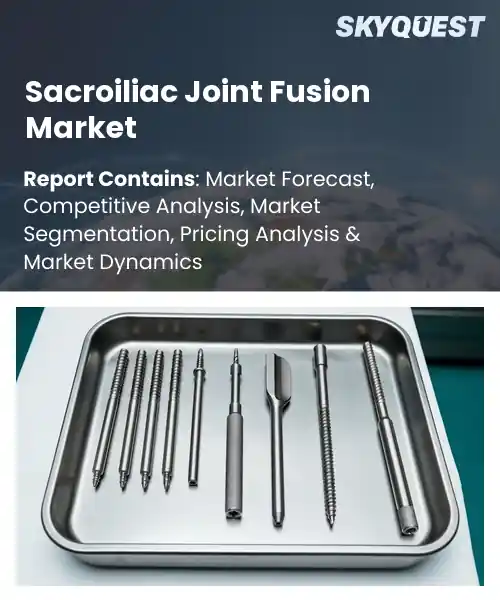
Sacroiliac Joint Fusion Market
Report ID: SQMIG35A3679
Report ID: SQMIG35A3679
[email protected]
USA +1 351-333-4748
Report ID:
SQMIG35A3679 |
Region:
Global |
Published Date: June, 2026
Pages:
157
|Tables:
141
|Figures:
78


Global Sacroiliac Joint Fusion Market size was valued at USD 482.50 Million in 2024 and is poised to grow from USD 522.16 Million in 2025 to USD 985.40 Million by 2033, growing at a CAGR of 8.22% during the forecast period (2026-2033).
Sacroiliac joint fusion market growth is a surgical and minimally invasive procedure that stabilizes the sacroiliac joint between the sacrum and ilium bones. Chronic SI joint dysfunction results in significant pain, disability, and healthcare utilization, and promotes clinicians to look for durable solutions beyond conservative care. Over the decade the field changed from open fusion techniques to percutaneous image guided systems and implantable devices that reduce recovery time and complication rates. Examples include lateral transiliac implants and posterior approaches supported by randomized and registry data, which have driven adoption among spine surgeons and interventional pain specialists worldwide and referrals.
Building on growing clinical adoption and evidence, reimbursement expansion and technological innovation are the key growth factor shaping the global sacroiliac joint fusion market trends. As payers see long-term cost savings from reduced opioid use, fewer repeat procedures and faster return to work, coverage policies expand, incentivizing hospitals to invest in implants and training. Tertiary centres have demonstrated reduced length of stay and improved outcomes through integrated care pathways, leading to fusion in community practices. Modular implants, navigation-enabled systems and underserved markets with aging populations and higher rates of diagnosis are providing opportunities for device manufacturers.
How is AI Enhancing Surgical Outcomes in the Sacroiliac Joint Fusion Market?
AI is improving sacroiliac joint fusion through preoperative planning intraoperative navigation and postoperative assessment. Key aspects include image driven planning to help identify safe implant trajectories, AI assisted registration to speed setup and reduce radiation and navigation to support precise implant placement and consistent technique. The market is shifting away from fluoroscopy-heavy workflows, to integrated navigation and robotic platforms that reduce variability and shorten learning curves. Examples include AI-enabled registration software and autopilot-style systems that incorporate planning, tracking, and execution to make procedures safer and more efficient for surgeons and patients.
SurGenTec March 2026 added navigation instruments for its TiLink SI fusion system and expanded intraoperative guidance with compatible navigation platforms. This evolution brings AI enabled planning and registration to more reliable implant placement and smoother workflow that supports broader adoption and improved procedural efficiency.
Market snapshot - (2026-2033)
Global Market Size
USD 482.5 Million
Largest Segment
Minimally Invasive SIJ Fusion Implants
Fastest Growth
Minimally Invasive SIJ Fusion Implants
Growth Rate
8.22% CAGR
To get more insights on this market click here to Request a Free Sample Report
Global sacroiliac joint fusion market is segmented by product type, material, procedure, end-user, distribution and region. Based on product type, the market is segmented into minimally invasive SIJ fusion implants and open SIJ fusion implants. Based on material, the market is segmented into titanium, PEEK and stainless steel. Based on procedure, the market is segmented into minimally invasive surgery (MIS) and open surgery. Based on end-user, the market is segmented into hospitals, ambulatory surgical centers and spine specialty clinics. Based on distribution, the market is segmented into direct sales and distributors. Based on region, the market is segmented into North America, Europe, Asia Pacific, Latin America and Middle East & Africa.
On the basis of product type, the minimally invasive SIJ fusion implants segment is anticipated to hold the largest share of the market during the forecast period. The percutaneous design of these implants helps in reducing tissue disruption and accelerating patient recovery, which drives the preference of surgeons for these implants as well as the adoption of these implants in hospitals. Better implant geometries and navigation compatibility minimize complication risk and procedure time, resulting in favorable reimbursement dynamics and supply chain prioritization. Manufacturers concentrate research and development and marketing efforts on these platforms, which in turn supports clinician training pathways and referral patterns, leading to sustained demand across care settings.
The strongest growth momentum is being seen in open SIJ fusion implants, which cater to complex anatomy and revision cases that need strong fixation. The procedure mix expands as device improvements, surgeon comfort with traditional approaches and broader clinical indications evolve. This results in investments in training and facility capabilities that open new opportunities for product differentiation and market penetration.
The titanium segment dominates due to a favorable strength to weight ratio and proven osseointegration profiles, making it the material of choice for durable sacroiliac fusion constructs. Surgeons trust and procurement preference is driven by clinical familiarity and long established regulatory clearances. Surface treatments improve bone ongrowth which reduces failure risk. This close correlation of mechanical reliability and clinical acceptance motivates manufacturers to focus on titanium designs in product pipelines and clinical support programs.
However, PEEK is the fastest growing material due to radiolucency that improves postoperative imaging and a modulus more similar to bone that may reduce stress shielding. Advances in materials and surface treatments continue to improve biological compatibility and have driven manufacturers to develop PEEK based implants to meet clinician demands for visibility, handling and alternative material options.
To get detailed segments analysis, Request a Free Sample Report
North America is the largest sacroiliac joint fusion market in the world owing to the advanced clinical infrastructure, specialized expertise concentrated in the region and an innovation friendly commercial environment that drives adoption of new technologies. Well-established networks of spine surgeons and interventional pain specialists help refine procedures and disseminate best practices. A well-established medtech industry and engaged local manufacturers ensure ongoing product development and dependable supply. Predictable regulatory pathways and rigorous post market surveillance, engenders clinician and payer confidence. Integrated hospital systems and outpatient surgical platforms enable streamlined patient access, and targeted investment in training, professional education and real world evidence generation sustains leadership and broad commercial reach.
Sacroiliac joint fusion market share in United States is characterized by concentrated centers of excellence, extensive specialist networks and active involvement of domestic device manufacturers driving iterative product development. The adoption across hospital and outpatient settings is supported by well-established reimbursement pathways and strong procedural familiarity among surgeons and interventionalists. Concentration on clinician training, referral pathways, clinical evidence generation maintains market depth, while distribution and support services allow for the deployment of implants and instrumentation.
Sacroiliac joint fusion market forecast in Canada is characterized by a centralized healthcare delivery model influencing procurement patterns, with clinical adoption being led by academic hospitals and regional spine centers. Uptake is guided by health technology assessment and institutional protocols based on clinical effectiveness and value. Targeted training and evidence generation supported by collaborative partnerships between clinicians and manufacturers, and expansion of outpatient procedural pathways and targeted education of referring physicians further improves patient access and procedural consistency across provinces.
A confluence of clinical, regulatory and commercial factors that reduce barriers to adoption and standardise care pathways is fuelling the rapid expansion in Europe. Specialized spine centers and clinical champions drive device innovation that encourages adoption of the procedure, while evolving reimbursement approaches and clinical guidance are opening clearer pathways to access. Cross national collaboration on training, registry development and real world evidence improves clinician confidence and supports market penetration. Market structures vary by level of development, with some leading countries quickly assimilating global technologies while others take a phased approach. This leads to a diversified regional profile driven by provider networks, medical education initiatives and targeted commercialization by local and international manufacturers. Payer engagement is underpinned by investment in clinical research and country specific evidence generation to support wider clinical adoption.
Sacroiliac joint fusion market outlook in Germany benefits from a network of specialized spine centers and a strong industry base promoting device innovation. Hospital care pathways & clinical leadership help adoption and evidence generation. Reimbursement and acceptance by health system are encouraging integration of minimally invasive approaches and professional societies and surgical training programs are disseminating best practice. Registry activity and collaborative studies build market maturity and clinician confidence.
Sacroiliac joint fusion market regional outlook in United Kingdom is driven by active clinician leadership, agile private and public provider pathways and targeted pilots validating minimally invasive approaches. Procedural uptake across hospital settings and referral constancy is underpinned by an emphasis on multidisciplinary referral and targeted training. Engagement between manufacturers and clinician networks provides real world evidence and surgical education, with evolving commissioning pathways and professional society endorsements further promoting integration into standardised care pathways.
Sacroiliac joint fusion market analysis in France is gaining traction with measured adoption by regional spine centers and hospitals focusing on clinical value. Uptake is affected by institutional procurement and health technology appraisal, leading to targeted pilot collaborations and local training by manufacturers. More clinician engagement and increasing real world evidence support a slow expansion into wider care pathways. Measurement of outcomes and demonstration of value are key to shaping adoption strategies and further alignment with payer priorities.
The Asia Pacific region is also building its position by targeting its investment on clinical capability, regulatory alignment and closer collaboration with global device innovators to tailor technologies to regional practice. Local manufacturers and distributors are customizing their offerings to the clinical preferences, while centers of excellence in the region and forward looking hospitals are adopting minimally invasive techniques. Improved regulatory pathways and increased focus on real world evidence have increased market readiness, while expanded clinician training programs speed procedural competency. Cross border collaborations, involvement in international registries, and customized commercialization strategies by multi-national companies increase geographic reach and patient access. Increased public and private payer engagement helps facilitate pathways for broader innovation adoption and access.
Sacroiliac joint fusion market regional forecast in Japan is supported by high clinical standards, strong hospital infrastructure and active collaboration between domestic manufacturers and global partners to localize technologies to local practice. Well-defined regulatory and reimbursement pathways facilitate access and leading Orthopedic and Spine centers drive clinical research and training. Prioritize procedural refinement and real world evidence supports measured expansion of broader access across specialized care settings and clinician confidence.
Sacroiliac joint fusion industry in South Korea has progressive healthcare ecosystem with hospitals adopting minimally invasive solutions. The localization of implants and instrumentation is fast-tracked by collaboration between domestic device companies and international companies. Procedural adoption is supported by supportive regulatory pathways and focused training programs for spine specialists, local evidence is strengthened by active clinical research and registry participation. Clinician networks and distribution channels are an effective way of scaling access across metropolitan care centers.
To know more about the market opportunities by region and country, click here to
Buy The Complete Report
Advancements In Implant Technology
Increased Clinician Awareness
Reimbursement and Coverage Limitations
Limited Long Term Clinical Evidence
Request Free Customization of this report to help us to meet your business objectives.
Competitive landscape in the global sacroiliac joint fusion market is characterized by clinical differentiation and channel expansion. Incumbents and challengers are capitalizing on M&A, partnerships and device innovation to win surgeon preference. Examples include Tenon Medical’s acquisitions to build its sacropelvic portfolio and SpineGuard’s FDA clearance of a dedicated SIJ drilling device in tandem with an Omnia Medical partnership. New entrants are focusing on percutaneous threaded implants and ASC-centric training to accelerate adoption.
Top Player’s Company Profile
Recent Developments in the Sacroiliac Joint Fusion Market
SkyQuest’s ABIRAW (Advanced Business Intelligence, Research & Analysis Wing) is our Business Information Services team that Collects, Collates, Correlates, and Analyses the Data collected by means of Primary Exploratory Research backed by robust Secondary Desk research. As per SkyQuest analysis, the global growth trajectory for the sacroiliac joint fusion market, driven by technological advancements and clinical adoption. Key drivers include advances in implant technology that improve safety and procedural efficiency, and second, increased clinician awareness that expands referrals and uptake. One limitation is that restrictions on reimbursement and coverage may limit institutional uptake and patient access. North America dominates the region, supported by robust clinical infrastructure, mature reimbursement pathways and a strong manufacturer presence. Minimally Invasive SIJ Fusion Implants dominates segment due to faster recovery, lower complication rates and alignment with outpatient surgical trends, driving manufacturer R&D and training investments.
| Report Metric | Details |
|---|---|
| Market size value in 2024 | USD 482.5 Million |
| Market size value in 2033 | USD 985.4 Million |
| Growth Rate | 8.22% |
| Base year | 2024 |
| Forecast period | (2026-2033) |
| Forecast Unit (Value) | USD Million |
| Segments covered |
|
| Regions covered | North America (US, Canada), Europe (Germany, France, United Kingdom, Italy, Spain, Rest of Europe), Asia Pacific (China, India, Japan, Rest of Asia-Pacific), Latin America (Brazil, Rest of Latin America), Middle East & Africa (South Africa, GCC Countries, Rest of MEA) |
| Companies covered |
|
| Customization scope | Free report customization with purchase. Customization includes:-
|
To get a free trial access to our platform which is a one stop solution for all your data requirements for quicker decision making. This platform allows you to compare markets, competitors who are prominent in the market, and mega trends that are influencing the dynamics in the market. Also, get access to detailed SkyQuest exclusive matrix.
Table Of Content
Executive Summary
Market overview
Parent Market Analysis
Market overview
Market size
KEY MARKET INSIGHTS
COVID IMPACT
MARKET DYNAMICS & OUTLOOK
Market Size by Region
KEY COMPANY PROFILES
Methodology
For the Sacroiliac Joint Fusion Market, our research methodology involved a mixture of primary and secondary data sources. Key steps involved in the research process are listed below:
1. Information Procurement: This stage involved the procurement of Market data or related information via primary and secondary sources. The various secondary sources used included various company websites, annual reports, trade databases, and paid databases such as Hoover's, Bloomberg Business, Factiva, and Avention. Our team did 45 primary interactions Globally which included several stakeholders such as manufacturers, customers, key opinion leaders, etc. Overall, information procurement was one of the most extensive stages in our research process.
2. Information Analysis: This step involved triangulation of data through bottom-up and top-down approaches to estimate and validate the total size and future estimate of the Sacroiliac Joint Fusion Market.
3. Report Formulation: The final step entailed the placement of data points in appropriate Market spaces in an attempt to deduce viable conclusions.
4. Validation & Publishing: Validation is the most important step in the process. Validation & re-validation via an intricately designed process helped us finalize data points to be used for final calculations. The final Market estimates and forecasts were then aligned and sent to our panel of industry experts for validation of data. Once the validation was done the report was sent to our Quality Assurance team to ensure adherence to style guides, consistency & design.
Analyst Support
Customization Options
With the given market data, our dedicated team of analysts can offer you the following customization options are available for the Sacroiliac Joint Fusion Market:
Product Analysis: Product matrix, which offers a detailed comparison of the product portfolio of companies.
Regional Analysis: Further analysis of the Sacroiliac Joint Fusion Market for additional countries.
Competitive Analysis: Detailed analysis and profiling of additional Market players & comparative analysis of competitive products.
Go to Market Strategy: Find the high-growth channels to invest your marketing efforts and increase your customer base.
Innovation Mapping: Identify racial solutions and innovation, connected to deep ecosystems of innovators, start-ups, academics, and strategic partners.
Category Intelligence: Customized intelligence that is relevant to their supply Markets will enable them to make smarter sourcing decisions and improve their category management.
Public Company Transcript Analysis: To improve the investment performance by generating new alpha and making better-informed decisions.
Social Media Listening: To analyze the conversations and trends happening not just around your brand, but around your industry as a whole, and use those insights to make better Marketing decisions.
REQUEST FOR SAMPLE
 REQUEST FREE CUSTOMIZATION
Global Sacroiliac Joint Fusion Market size was valued at USD 482.5 Million in 2024 and is poised to grow from USD 522.16 Million in 2025 to USD 985.4 Million by 2033, growing at a CAGR of 8.22% during the forecast period (2026-2033).
Competition in the global sacroiliac joint fusion market hinges on clinical differentiation and channel expansion, with incumbents and challengers using M&A, partnerships and device innovation to capture surgeon preference. Examples include Tenon Medical’s acquisitions to broaden its sacropelvic portfolio and SpineGuard’s FDA clearance for a dedicated SIJ drilling device alongside an Omnia Medical partnership. New entrants emphasize percutaneous threaded implants and ASC focused training to accelerate adoption. 'SI-BONE Inc. (iFuse)', 'Globus Medical', 'Zyga Technology (RTI Surgical)', 'NuVasive Inc.', 'Medtronic plc', 'Stryker Corporation', 'RTI Surgical', 'Orthofix Medical', 'CoreLink LLC', 'Innovasis Inc.', 'Reva Medical', 'Amendia Inc.', 'IsoRay Inc.', 'SiO2 Medical Products', 'Surgio Healthcare', 'Anika Therapeutics', 'TranS1 (Baxano)', 'Trident Medical', 'Vertiflex Inc.', 'IntriCon Corporation'
Advancements in implant design and materials have improved the safety, reliability, and surgeon confidence associated with sacroiliac joint fusion procedures. Innovations such as enhanced fixation features, precontoured geometries, and biocompatible surfaces reduce intraoperative complexity and support predictable postoperative healing. These improvements encourage procedural adoption by reducing perceived risk and broadening clinician acceptance across specialties, while enabling device makers to position offerings as differentiated technology solutions. As a result, hospitals and surgical centers are more inclined to integrate fusion options into treatment pathways, supporting market expansion.
Device Design Convergence: Manufacturers are integrating minimally invasive delivery systems, customized implants, advanced biomaterials, and navigation-compatible architectures to create unified sacroiliac fusion solutions that streamline operative workflows. This convergence prioritizes ease of implantation, reduced tissue disruption, and compatibility with adjunct technologies, encouraging partnerships across device, software, and materials firms. The trend supports faster procedural adoption, enhances surgeon preference through practical refinements, and fosters competition based on integrated system performance and comprehensive perioperative experience rather than isolated implant features, sustaining clinical and economic value.
Why does North America Dominate the Global Sacroiliac Joint Fusion Market? |@12


Want to customize this report? This report can be personalized according to your needs. Our analysts and industry experts will work directly with you to understand your requirements and provide you with customized data in a short amount of time. We offer $1000 worth of FREE customization at the time of purchase.
Feedback From Our Clients


 USA (+1) 351-333-4748

