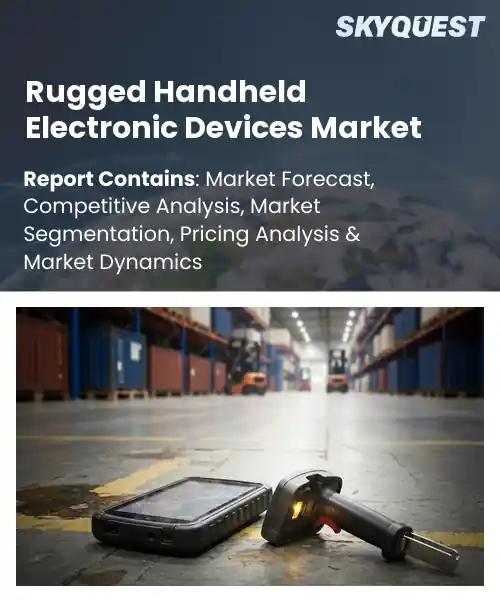
Rugged Handheld Electronic Devices Market
Report ID: SQMIG45I2419
Report ID: SQMIG45I2419
[email protected]
USA +1 351-333-4748
Report ID:
SQMIG45I2419 |
Region:
Global |
Published Date: June, 2026
Pages:
157
|Tables:
118
|Figures:
77


Global Rugged Handheld Electronic Devices Market size was valued at USD 8.52 Billion in 2024 and is poised to grow from USD 9.06 Billion in 2025 to USD 14.85 Billion by 2033, growing at a CAGR of 6.32% during the forecast period (2026-2033).
Rugged handheld electronic devices, designed for temperature, vibration, dust and water, form a segment of technology market. Their primary driver is need for dependable field data capture in construction, logistics and safety work, where ordinary smartphones rapidly deteriorate. In last decade manufacturers have shifted from bulky military‑grade units to slimmer Android models that retain sealed housings and reinforced frames. This shift appears in move from early 2010s Panasonic Toughpad series to today’s Samsung Galaxy XCover line, which blends ruggedization with performance. By guaranteeing operation under harsh conditions, these devices cut downtime, lower replacement costs and enable decisions, solidifying their role. Internet‑of‑Things connectivity fuels growth because it turns rugged handhelds from collectors into networked nodes pushing sensor streams to cloud platforms. This ability lets utilities dispatch technicians with devices that log transformer health, preventing outages and lowering maintenance budgets. Emergency services use rugged units with built‑in LTE and location services to map disaster zones, shortening response times and improving allocation. As 5G matures, bandwidth‑heavy tasks such as AI‑assisted visual inspection become feasible, prompting manufacturers to embed processors. Consequently, OEMs see demand from enterprises seeking compliance‑ready hardware that reduces downtime while delivering insights, opening contracts in regulated sectors like oil‑gas and transportation.
How are AI and IoT integration reshaping the rugged handheld electronic devices market?
AI and IoT are merging to turn rugged handhelds from simple data collectors into intelligent edge platforms. Sensors now feed live streams to cloud‑based analytics while on‑device AI filters noise and flags anomalies before they reach the user. This enables predictive maintenance, real‑time asset tracking and adaptive user interfaces that adjust to harsh environments. Manufacturers embed low‑power processors that run machine‑learning models locally, reducing latency and dependence on intermittent networks. As a result field technicians receive actionable insights instantly, extending device uptime and lowering total cost of ownership across industries such as logistics, utilities and public safety.In December 2025, Zebra announced an AI‑driven IoT analytics suite for its rugged handheld line, enabling devices to predict equipment failures and optimize workflow without constant cloud connectivity, thereby boosting operational efficiency and supporting the market’s shift toward smarter, more autonomous field solutions.
Market snapshot - (2026-2033)
Global Market Size
USD 8.52 Billion
Largest Segment
Rugged Smartphones
Fastest Growth
Handheld Barcode Scanners
Growth Rate
6.32% CAGR
To get more insights on this market click here to Request a Free Sample Report
Global rugged handheld electronic devices market is segmented by product type, end-use industry, operating system, distribution and region. Based on product type, the market is segmented into Rugged Smartphones, Rugged Tablets, Rugged Laptops and Handheld Barcode Scanners. Based on end-use industry, the market is segmented into Military & Defense, Field Services & Utilities, Logistics & Warehousing and Healthcare. Based on operating system, the market is segmented into Android and Windows. Based on distribution, the market is segmented into Direct, Value-Added Resellers and Online. Based on region, the market is segmented into North America, Europe, Asia Pacific, Latin America and Middle East & Africa.
Rugged smartphones segment dominates because they blend full mobile connectivity, high durability, and a familiar touch interface, making them the first choice for field personnel. Their capacity to run native applications, provide instant data transmission, and survive extreme temperatures, moisture, and drops creates a compelling value proposition that aligns with the core demands of rugged handheld deployments. Consequently, organizations prioritize them when seeking versatile yet robust handheld solutions.
However, rugged tablets are witnessing the strongest growth momentum as larger display sizes enable complex data visualization, multi touch operations, and advanced analytics on site. Emerging use cases in field diagnostics, remote surveying, and interactive training drive adoption, expanding the market’s functional scope and creating new opportunities for integrated rugged solutions.
Android segment dominates because its open architecture encourages rapid customization, broad device compatibility, and cost effective development for rugged applications. Manufacturers can tailor firmware, integrate specialized sensors, and leverage a vast app ecosystem, which accelerates time to market and reduces total ownership cost. This flexibility resonates with enterprises seeking scalable, secure, and interchangeable solutions across diverse field environments, reinforcing Android’s preeminence in rugged handheld deployments throughout the device lifecycle and continued support.
Meanwhile, Windows is emerging as the key high growth area because legacy enterprise software migration and the need for full desktop class capabilities on the go are prompting adoption. Its compatibility with established line of business tools accelerates field digitization, unlocking new use cases and expanding market reach for rugged devices.
To get detailed segments analysis, Request a Free Sample Report
Asia Pacific leverages a combination of advanced manufacturing ecosystems, deep engineering talent pools, and robust demand from sectors such as logistics, construction, and field services. The region benefits from long‑standing expertise in semiconductor and component production, enabling rapid prototyping and cost‑effective scaling. Strong collaboration between original equipment manufacturers and technology innovators accelerates feature integration, while governmental support for industrial digitalization fuels adoption. Moreover, the presence of major multinational corporations establishes extensive distribution networks, reinforcing market leadership and reinforcing the region’s reputation as a hub for durable, high‑performance handheld solutions.
Japan Rugged Handheld Electronic Devices Market
Rugged Handheld Electronic Devices Market in Japan is driven by a culture of precision engineering and a commitment to reliability across automotive, railway, and disaster‑response applications. Domestic manufacturers prioritize ruggedization standards that align with stringent safety protocols, fostering trust among enterprise customers. The integration of sophisticated sensor technologies and seamless connectivity solutions further enhances device utility in complex operational environments. Collaborative research initiatives between industry and academic institutions continue to push the envelope of durability and functionality, solidifying Japan’s role as a benchmark for quality in the handheld sector.
South Korea Rugged Handheld Electronic Devices Market
Rugged Handheld Electronic Devices Market in South Korea thrives on its rapid adoption of cutting‑edge mobile technologies and strong focus on smart factory solutions. Local firms emphasize rugged designs that meet the rigorous demands of manufacturing, shipping, and field engineering sectors. The nation’s advanced semiconductor capabilities enable compact yet powerful device architectures, while strategic partnerships with global distributors expand market reach. Emphasis on user‑centric interfaces and robust connectivity drives preference among enterprises seeking resilient handheld tools for real‑time data capture and analysis.
North America experiences accelerated growth due to heightened emphasis on operational safety, increasing reliance on field data collection, and expanding adoption of Internet of Things integration across industrial workflows. Enterprises prioritize rugged devices that can withstand harsh environments while delivering real‑time analytics, prompting investment in advanced sensor suites and secure communication protocols. Regulatory frameworks encouraging workplace safety and asset protection further stimulate demand. Additionally, a vibrant ecosystem of specialized distributors and a strong culture of innovation enable rapid deployment of customized solutions, reinforcing the region’s position as a leading market for durable handheld technology.
United States Rugged Handheld Electronic Devices Market
Rugged Handheld Electronic Devices Market in United States is shaped by a vast network of logistics, energy, and construction enterprises that require dependable field tools. Domestic manufacturers focus on integrating rugged hardware with cloud‑based platforms, enhancing remote monitoring and predictive maintenance capabilities. The emphasis on interoperability with existing enterprise resource planning systems drives demand for versatile devices. Collaborative initiatives between technology providers and sector leaders foster continuous improvement, ensuring that rugged handheld solutions remain aligned with evolving operational challenges across the nation.
Canada Rugged Handheld Electronic Devices Market
Rugged Handheld Electronic Devices Market in Canada benefits from a natural resource‑intensive economy where reliability in remote and extreme conditions is paramount. Companies prioritize devices that can endure low temperatures and rugged terrain while delivering accurate data for mining, forestry, and oil operations. Partnerships with local research institutes encourage adaptation of rugged technology to meet specific environmental standards. The focus on safety compliance and efficient field communication further propels adoption, positioning Canada as a key market for resilient handheld solutions.
Europe advances its role by leveraging strong regulatory frameworks that promote occupational safety and environmental sustainability, encouraging enterprises to adopt rugged handheld technologies. The region’s emphasis on standardization ensures compatibility across diverse industrial sectors, while collaborative innovation hubs integrate advanced materials and IoT capabilities into device designs. Mature supply chains and a focus on high‑quality engineering foster confidence among users in sectors such as transportation, utilities, and manufacturing. Continued investment in research and cross‑border partnerships bolsters Europe’s ability to deliver durable, intelligent handheld solutions that meet stringent European market expectations.
Germany Rugged Handheld Electronic Devices Market
Rugged Handheld Electronic Devices Market in Germany is anchored by a tradition of engineering excellence and a robust automotive and manufacturing base. Domestic providers emphasize precision durability and seamless integration with machine‑level data systems, supporting predictive maintenance initiatives. Collaborative projects between industry and research institutes drive the incorporation of advanced sensor arrays and secure connectivity, enhancing device performance in demanding production environments. The focus on compliance with stringent European safety standards strengthens confidence among German enterprises seeking reliable handheld solutions.
United Kingdom Rugged Handheld Electronic Devices Market
Rugged Handheld Electronic Devices Market in United Kingdom reflects a growing demand across construction, utilities, and public safety sectors that require resilient field equipment. Companies prioritize ruggedization that aligns with strict regulatory requirements and facilitates real‑time data sharing across dispersed teams. Integration of cloud‑native platforms and robust cybersecurity features ensures that handheld devices can operate securely in critical infrastructure contexts. Partnerships with technology innovators support continuous evolution of device capabilities, reinforcing the United Kingdom’s commitment to durable handheld technology.
France Rugged Handheld Electronic Devices Market
Rugged Handheld Electronic Devices Market in France is driven by a diversified industrial landscape, encompassing aerospace, energy, and transportation domains that rely on dependable field tools. French manufacturers focus on creating rugged devices that meet high durability standards while offering intuitive user experiences. Emphasis on seamless connectivity with national digital infrastructure enables efficient data capture and analysis across field operations. Collaborative efforts with research institutions promote the adoption of emerging technologies, ensuring that France remains at the forefront of resilient handheld device development.
To know more about the market opportunities by region and country, click here to
Buy The Complete Report
Improved Durability Demands
Expanding IoT Integration
High Development Cost Barriers
Limited Battery Performance
Request Free Customization of this report to help us to meet your business objectives.
The competitive landscape is shaped by intense rivalry as manufacturers accelerate M&A activity, forge strategic partnerships with component suppliers, and invest in AI‑driven durability enhancements; recent examples include a major acquisition of a sensor‑technology firm by a leading handheld producer and a joint venture between a rugged device maker and a cloud‑service provider to embed real‑time analytics in field units. Startups:
Top Player’s Company Profile
Recent Developments
SkyQuest’s ABIRAW (Advanced Business Intelligence, Research & Analysis Wing) is our Business Information Services team that Collects, Collates, Correlates, and Analyses the Data collected by means of Primary Exploratory Research backed by robust Secondary Desk research. As per SkyQuest analysis, the market is propelled primarily by the growing demand for improved durability, which pushes manufacturers to create devices that survive extreme temperatures, vibration and dust, while the expanding IoT integration acts as a second catalyst by turning handhelds into connected edge nodes that feed real‑time data to cloud platforms. The dominant segment is rugged smartphones, favored for their familiar interface and full mobile connectivity, and Asia‑Pacific leads the market thanks to its strong manufacturing base and intense field‑service demand. A notable restraint is the high development cost, as ruggedization requires specialized materials and extensive testing, which can deter price‑sensitive buyers.
| Report Metric | Details |
|---|---|
| Market size value in 2024 | USD 8.52 Billion |
| Market size value in 2033 | USD 14.85 Billion |
| Growth Rate | 6.32% |
| Base year | 2024 |
| Forecast period | (2026-2033) |
| Forecast Unit (Value) | USD Billion |
| Segments covered |
|
| Regions covered | North America (US, Canada), Europe (Germany, France, United Kingdom, Italy, Spain, Rest of Europe), Asia Pacific (China, India, Japan, Rest of Asia-Pacific), Latin America (Brazil, Rest of Latin America), Middle East & Africa (South Africa, GCC Countries, Rest of MEA) |
| Companies covered |
|
| Customization scope | Free report customization with purchase. Customization includes:-
|
To get a free trial access to our platform which is a one stop solution for all your data requirements for quicker decision making. This platform allows you to compare markets, competitors who are prominent in the market, and mega trends that are influencing the dynamics in the market. Also, get access to detailed SkyQuest exclusive matrix.
Table Of Content
Executive Summary
Market overview
Parent Market Analysis
Market overview
Market size
KEY MARKET INSIGHTS
COVID IMPACT
MARKET DYNAMICS & OUTLOOK
Market Size by Region
KEY COMPANY PROFILES
Methodology
For the Rugged Handheld Electronic Devices Market, our research methodology involved a mixture of primary and secondary data sources. Key steps involved in the research process are listed below:
1. Information Procurement: This stage involved the procurement of Market data or related information via primary and secondary sources. The various secondary sources used included various company websites, annual reports, trade databases, and paid databases such as Hoover's, Bloomberg Business, Factiva, and Avention. Our team did 45 primary interactions Globally which included several stakeholders such as manufacturers, customers, key opinion leaders, etc. Overall, information procurement was one of the most extensive stages in our research process.
2. Information Analysis: This step involved triangulation of data through bottom-up and top-down approaches to estimate and validate the total size and future estimate of the Rugged Handheld Electronic Devices Market.
3. Report Formulation: The final step entailed the placement of data points in appropriate Market spaces in an attempt to deduce viable conclusions.
4. Validation & Publishing: Validation is the most important step in the process. Validation & re-validation via an intricately designed process helped us finalize data points to be used for final calculations. The final Market estimates and forecasts were then aligned and sent to our panel of industry experts for validation of data. Once the validation was done the report was sent to our Quality Assurance team to ensure adherence to style guides, consistency & design.
Analyst Support
Customization Options
With the given market data, our dedicated team of analysts can offer you the following customization options are available for the Rugged Handheld Electronic Devices Market:
Product Analysis: Product matrix, which offers a detailed comparison of the product portfolio of companies.
Regional Analysis: Further analysis of the Rugged Handheld Electronic Devices Market for additional countries.
Competitive Analysis: Detailed analysis and profiling of additional Market players & comparative analysis of competitive products.
Go to Market Strategy: Find the high-growth channels to invest your marketing efforts and increase your customer base.
Innovation Mapping: Identify racial solutions and innovation, connected to deep ecosystems of innovators, start-ups, academics, and strategic partners.
Category Intelligence: Customized intelligence that is relevant to their supply Markets will enable them to make smarter sourcing decisions and improve their category management.
Public Company Transcript Analysis: To improve the investment performance by generating new alpha and making better-informed decisions.
Social Media Listening: To analyze the conversations and trends happening not just around your brand, but around your industry as a whole, and use those insights to make better Marketing decisions.
REQUEST FOR SAMPLE
 REQUEST FREE CUSTOMIZATION


Want to customize this report? This report can be personalized according to your needs. Our analysts and industry experts will work directly with you to understand your requirements and provide you with customized data in a short amount of time. We offer $1000 worth of FREE customization at the time of purchase.
Feedback From Our Clients


 USA (+1) 351-333-4748

