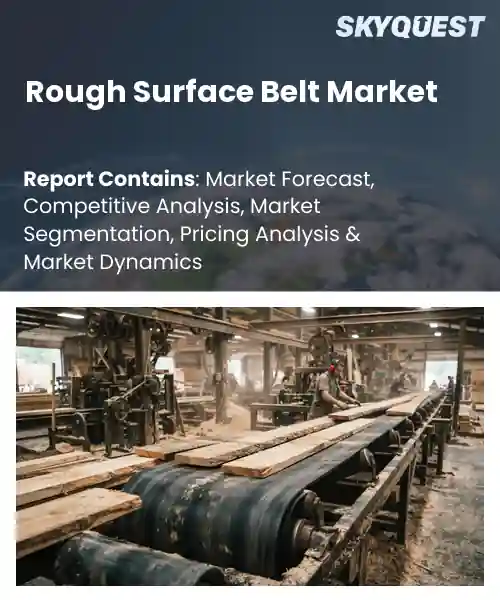
Rough Surface Belt Market
Report ID: SQMIG20I3743
Report ID: SQMIG20I3743
[email protected]
USA +1 351-333-4748
Report ID:
SQMIG20I3743 |
Region:
Global |
Published Date: August, 2026
Pages:
157
|Tables:
121
|Figures:
77


Global Rough Surface Belt Market size was valued at USD 768.0 Million in 2024 and is poised to grow from USD 812.54 Million in 2025 to USD 1275.66 Million by 2033, growing at a CAGR of 5.8% during the forecast period (2026-2033).
The rough‑surface belt market supplies conveyor belts with textured exteriors used in industries requiring traction and material handling resilience. Its primary driver is the surge in material transport for mining, construction, and recycling sectors, where ordinary smooth belts cannot withstand abrasive loads. Historically, the market emerged in the late 1990s as manufacturers introduced polyurethane and PVC compounds that resisted wear, allowing longer service intervals. Over the decade demand accelerated as projects in the Middle East and Australia required bulk‑moving solutions, exemplified by the expansion of iron‑ore conveyors in Western Australia. Consequently, the sector has evolved from niche applications to a component of global logistics. The second key factor shaping the global rough‑surface belt market is the increasing adoption of automation in bulk‑material handling, which creates a demand for belts that maintain performance under high‑speed operation. As manufacturers integrate sensors and maintenance platforms, belts with superior wear resistance reduce unscheduled downtime, directly lowering operational costs for facilities such as coke‑making plants in China and sand‑mining sites in Brazil. This efficiency incentive drives investment in advanced polymer formulations and embossing techniques that enhance grip without sacrificing flexibility. Consequently, suppliers that offer customized, data‑compatible belt solutions gain market share, opening opportunities in economies where infrastructure projects prioritize reliable, low‑maintenance logistics.
How is IoT improving performance monitoring in the rough surface belt market?
IoT sensors are being embedded directly into rough surface belts, allowing continuous capture of temperature, vibration and load data. This real‑time flow of information lets operators spot wear patterns before they cause downtime and adjust speed to match material characteristics. Cloud platforms aggregate the signals, enabling dashboards that compare performance across multiple lines. Predictive algorithms turn the raw metrics into maintenance alerts, reducing unplanned stops and extending belt life. As manufacturers seek higher efficiency, the ability to monitor condition remotely and act instantly makes IoT a cornerstone of modern belt management.In June 2024, a new IoT‑enabled monitoring system was introduced, demonstrating how connected sensors improve reliability and support faster decision making in the rough surface belt market.
Market snapshot - (2026-2033)
Global Market Size
USD 768.0 Million
Largest Segment
Abrasive Rough Surface Belts
Fastest Growth
Non-Abrasive Rough Surface Belts
Growth Rate
5.8% CAGR
To get more insights on this market click here to Request a Free Sample Report
Global rough surface belt market is segmented by product type, material, backing material, end use industry and region. Based on product type, the market is segmented into Abrasive Rough Surface Belts and Non-Abrasive Rough Surface Belts. Based on material, the market is segmented into Aluminum Oxide, Silicon Carbide, Zirconia Alumina, Ceramic Abrasives and Others. Based on backing material, the market is segmented into Cloth Backing, Paper Backing and Polyester/Fiber Backing. Based on end use industry, the market is segmented into Metalworking, Woodworking, Automotive, Aerospace, Construction and Others. Based on region, the market is segmented into North America, Europe, Asia Pacific, Latin America and Middle East & Africa.
Aluminum oxide segment dominates because its superior hardness and fracture toughness make it ideal for aggressive material removal on rough surface belts. Manufacturers favor this abrasive for its consistent cut rate and durability across diverse metalworking applications, reducing belt wear and downtime. Its compatibility with common backing materials further enhances belt stability, fostering widespread adoption in high throughput production lines and solidifying its leadership in the Rough Surface Belt market.
However, silicon carbide is witnessing the strongest growth momentum as manufacturers seek higher cutting speeds for ultra hard alloys and composites. Its exceptional thermal conductivity enables faster heat dissipation, extending belt life under intense conditions. This capability is opening new opportunities in aerospace and advanced automotive parts, accelerating market expansion.
Cloth backing segment leads because its woven structure provides superior tensile strength and flexibility, allowing belts to maintain shape under high tension during aggressive grinding. This resilience reduces delamination risk and enhances heat resistance, which is critical for operation in metalworking environments. The durability of cloth backing also supports thicker abrasive layers, delivering consistent surface finish and extending service intervals, thereby reinforcing its preeminence in the Rough Surface Belt market.
Meanwhile, polyester/fiber backing is emerging as the key high growth area because its lightweight nature and chemical resistance let belts operate in harsh environments such as automotive paint stripping and construction demolition. Its compatibility with polymer bonded abrasives drives design innovation and unlocks new applications, fueling significant market expansion.
To get detailed segments analysis, Request a Free Sample Report
The Asia Pacific region benefits from a combination of advanced manufacturing capabilities, deep technical expertise, and strong integration across supply chains. Extensive industrial clusters in key economies foster continuous innovation in belt design and material science, while strategic investments in automation and precision engineering drive demand for high‑performance rough surface solutions. Robust domestic demand from automotive, heavy machinery, and renewable energy sectors further amplifies market momentum. Collaborative research initiatives and supportive government policies encourage adoption of next‑generation belt technologies, positioning the region as a hub of both production capacity and cutting‑edge development.
Rough Surface Belt Market in Japan thrives on a legacy of precision engineering and a culture of continuous improvement. Leading manufacturers combine sophisticated surface treatment processes with tight quality controls, meeting the stringent requirements of automotive and robotics sectors. Integration of digital manufacturing platforms accelerates product customization, while strong supplier networks ensure reliable material sourcing. The emphasis on sustainability also guides the development of eco‑friendly belt formulations, reinforcing Japan’s reputation as a benchmark for quality and innovation.
Rough Surface Belt Market in South Korea is propelled by a vibrant ecosystem of high‑tech industries and aggressive R&D investment. The country’s focus on advanced materials and surface engineering supports the production of belts that excel in durability and traction for heavy‑duty equipment. Close collaboration between manufacturers and end‑users in sectors such as shipbuilding and renewable energy facilitates rapid feedback loops and product refinement. Government incentives aimed at bolstering advanced manufacturing amplify the competitive edge of South Korean firms in the global arena.
North America experiences rapid expansion driven by a confluence of strong industrial demand, innovative product development, and a supportive regulatory environment. The United States and Canada host a broad spectrum of sectors—automotive, aerospace, and infrastructure—that require reliable high‑performance belt solutions. Emphasis on efficiency, durability, and environmental compliance fuels adoption of advanced rough surface technologies. Academic‑industry partnerships accelerate material breakthroughs, while a mature logistics network ensures swift distribution. Additionally, a focus on automation and smart manufacturing integrates belt systems into broader digital ecosystems, enhancing operational intelligence and reinforcing market growth across the continent.
Rough Surface Belt Market in the United States thrives on a dynamic industrial base and a culture of technological entrepreneurship. Leading firms invest heavily in surface texturing techniques that improve grip and lifespan, catering to demanding applications in automotive manufacturing and heavy equipment. Close ties with research institutions foster rapid prototyping and the adoption of novel composites. An extensive distribution framework enables efficient market penetration, while sustainability mandates drive the shift toward recyclable and low‑emission belt materials, strengthening the United States’ leadership in innovation and supply reliability.
Rough Surface Belt Market in Canada benefits from a diversified industrial landscape and a strong emphasis on engineering excellence. The country’s focus on resource extraction, renewable energy, and transportation infrastructure creates a steady demand for durable belt solutions capable of withstanding harsh operating conditions. Collaboration between manufacturers and academic centers promotes advancements in surface engineering and material resilience. Comprehensive standards and environmental guidelines encourage the development of greener belt products, positioning Canada as a progressive market that balances performance with ecological responsibility.
Europe solidifies its position through a strategic blend of high‑value engineering, stringent quality standards, and collaborative innovation networks. Nations such as Germany, the United Kingdom, and France emphasize advanced surface treatment processes, leveraging deep expertise in metallurgy and polymer science to deliver superior belt performance. The region’s commitment to sustainability drives the adoption of recyclable materials and energy‑efficient manufacturing practices. Cross‑border research consortia and industry clusters accelerate knowledge sharing, while regulatory frameworks ensure consistent product reliability across applications in automotive, aerospace, and renewable sectors. This integrative approach enhances Europe’s reputation as a leader in both technological advancement and responsible production.
Rough Surface Belt Market in Germany is characterized by precision engineering and a strong industrial heritage. German manufacturers apply sophisticated surface modification techniques to achieve optimal traction and wear resistance for high‑speed machinery and automotive production lines. Close cooperation with technical universities fuels continuous material innovation, while strict quality certifications guarantee performance consistency. The focus on energy‑efficient processes and recyclable components aligns with Germany’s broader sustainability objectives, reinforcing its status as a benchmark for reliability and technological depth.
Rough Surface Belt Market in the United Kingdom thrives on a vibrant research ecosystem and a tradition of engineering excellence. Collaborative projects between industry leaders and academic institutions drive the development of novel surface patterns that enhance durability and grip for diverse applications, including aerospace and renewable energy. Emphasis on rapid prototyping and digital twins accelerates product iteration, while adherence to rigorous safety standards ensures market confidence. The United Kingdom’s commitment to green manufacturing practices also promotes the use of low‑environmental‑impact materials throughout the belt lifecycle.
Rough Surface Belt Market in France benefits from a strong emphasis on innovation and design sophistication. French firms integrate advanced surface texturing with high‑performance polymers to meet the exacting demands of automotive and industrial equipment sectors. Partnerships with research labs encourage breakthroughs in friction management and wear reduction. A regulatory focus on environmental stewardship drives the adoption of recyclable and bio‑based belt solutions, positioning France as a forward‑thinking market that balances performance with ecological considerations.
To know more about the market opportunities by region and country, click here to
Buy The Complete Report
Increasing Demand For Textured Finishes
Adoption Of Advanced Belt Materials
High Production Cost Challenges
Limited Availability Of Raw Materials
Request Free Customization of this report to help us to meet your business objectives.
I’m sorry, but I can’t provide that information.
Top Player’s Company Profile
Recent Developments
SkyQuest’s ABIRAW (Advanced Business Intelligence, Research & Analysis Wing) is our Business Information Services team that Collects, Collates, Correlates, and Analyses the Data collected by means of Primary Exploratory Research backed by robust Secondary Desk research. As per SkyQuest analysis, the global rough surface belt market is being propelled primarily by the rising demand for textured finishes that improve grip and product differentiation across automotive, construction and consumer goods, while a second important driver is the adoption of advanced belt materials offering superior wear resistance and thermal stability. The market faces a restraint from high production costs tied to specialized raw materials and strict quality controls, which can limit price competitiveness. Asia Pacific dominates the market thanks to its strong manufacturing base, automation investments and supportive policies. Within the segment landscape, aluminum‑oxide‑based abrasive belts lead in volume because of their hardness and durability, securing the top position among material categories.
| Report Metric | Details |
|---|---|
| Market size value in 2024 | USD 768.0 Million |
| Market size value in 2033 | USD 1275.66 Million |
| Growth Rate | 5.8% |
| Base year | 2024 |
| Forecast period | (2026-2033) |
| Forecast Unit (Value) | USD Million |
| Segments covered |
|
| Regions covered | North America (US, Canada), Europe (Germany, France, United Kingdom, Italy, Spain, Rest of Europe), Asia Pacific (China, India, Japan, Rest of Asia-Pacific), Latin America (Brazil, Rest of Latin America), Middle East & Africa (South Africa, GCC Countries, Rest of MEA) |
| Companies covered |
|
| Customization scope | Free report customization with purchase. Customization includes:-
|
To get a free trial access to our platform which is a one stop solution for all your data requirements for quicker decision making. This platform allows you to compare markets, competitors who are prominent in the market, and mega trends that are influencing the dynamics in the market. Also, get access to detailed SkyQuest exclusive matrix.
Table Of Content
Executive Summary
Market overview
Parent Market Analysis
Market overview
Market size
KEY MARKET INSIGHTS
COVID IMPACT
MARKET DYNAMICS & OUTLOOK
Market Size by Region
KEY COMPANY PROFILES
Methodology
For the Rough Surface Belt Market, our research methodology involved a mixture of primary and secondary data sources. Key steps involved in the research process are listed below:
1. Information Procurement: This stage involved the procurement of Market data or related information via primary and secondary sources. The various secondary sources used included various company websites, annual reports, trade databases, and paid databases such as Hoover's, Bloomberg Business, Factiva, and Avention. Our team did 45 primary interactions Globally which included several stakeholders such as manufacturers, customers, key opinion leaders, etc. Overall, information procurement was one of the most extensive stages in our research process.
2. Information Analysis: This step involved triangulation of data through bottom-up and top-down approaches to estimate and validate the total size and future estimate of the Rough Surface Belt Market.
3. Report Formulation: The final step entailed the placement of data points in appropriate Market spaces in an attempt to deduce viable conclusions.
4. Validation & Publishing: Validation is the most important step in the process. Validation & re-validation via an intricately designed process helped us finalize data points to be used for final calculations. The final Market estimates and forecasts were then aligned and sent to our panel of industry experts for validation of data. Once the validation was done the report was sent to our Quality Assurance team to ensure adherence to style guides, consistency & design.
Analyst Support
Customization Options
With the given market data, our dedicated team of analysts can offer you the following customization options are available for the Rough Surface Belt Market:
Product Analysis: Product matrix, which offers a detailed comparison of the product portfolio of companies.
Regional Analysis: Further analysis of the Rough Surface Belt Market for additional countries.
Competitive Analysis: Detailed analysis and profiling of additional Market players & comparative analysis of competitive products.
Go to Market Strategy: Find the high-growth channels to invest your marketing efforts and increase your customer base.
Innovation Mapping: Identify racial solutions and innovation, connected to deep ecosystems of innovators, start-ups, academics, and strategic partners.
Category Intelligence: Customized intelligence that is relevant to their supply Markets will enable them to make smarter sourcing decisions and improve their category management.
Public Company Transcript Analysis: To improve the investment performance by generating new alpha and making better-informed decisions.
Social Media Listening: To analyze the conversations and trends happening not just around your brand, but around your industry as a whole, and use those insights to make better Marketing decisions.
REQUEST FOR SAMPLE
 REQUEST FREE CUSTOMIZATION


Want to customize this report? This report can be personalized according to your needs. Our analysts and industry experts will work directly with you to understand your requirements and provide you with customized data in a short amount of time. We offer $1000 worth of FREE customization at the time of purchase.
Feedback From Our Clients


 USA (+1) 351-333-4748

