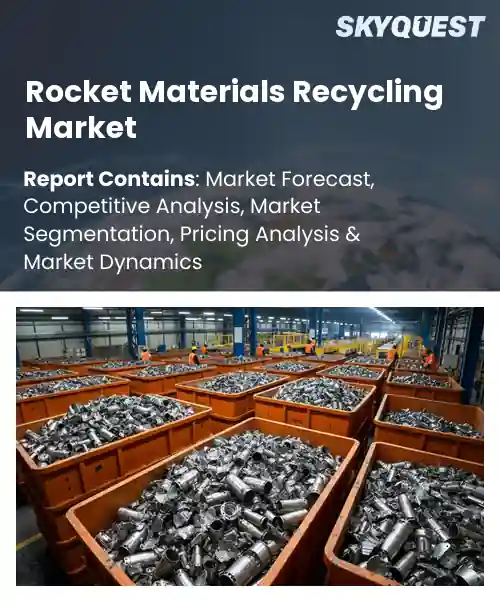
Rocket Materials Recycling Market
Report ID: SQMIG20A2823
Report ID: SQMIG20A2823
[email protected]
USA +1 351-333-4748
Report ID:
SQMIG20A2823 |
Region:
Global |
Published Date: August, 2026
Pages:
157
|Tables:
118
|Figures:
77


Global Rocket Materials Recycling Market size was valued at USD 528.6 Million in 2024 and is poised to grow from USD 620.58 Million in 2025 to USD 2239.44 Million by 2033, growing at a CAGR of 17.4% during the forecast period (2026-2033).
The global rocket materials recycling market trends has become a niche within the aerospace sustainability ecosystem. The primary driver is the need to reduce the cost of launch while complying with regulations governing activities in the United States, Europe and countries. In the past, waste aluminum alloys, carbon fiber composites, and titanium scraps from launch vehicle stages were landfilled or sold as scrap, providing little financial return. Over the last decade, programs like NASA’s Sustainable Launch Program and the European Space Agency’s economy pilots have demonstrated that recovered materials can meet specifications, prompting manufacturers to embed recycling loops into critical design and procurement cycles.
The rocket materials recycling market growth of closed-loop supply chains between launch providers and satellite makers and component refurbishers is another important growth driver. When companies realize that reclaimed aluminum and carbon-fibre meet the same tolerances as virgin material, cost savings feed back into value chain, prompting investment in recycling plants. SpaceX’s Starship program has partnered with a metallurgical startup to recycle shielding panels from spent stages into feedstock for new booster cores, for example. This cause-effect cycle reduces production costs, reduces the cost of reusable launch vehicles, thereby significantly propels the broader global future market demand for recycling services.
How is AI Improving Efficiency and Cost-effectiveness in the Rocket Materials Recycling Market?
AI is making rocket materials recycling market share easier by automating sorting, defect detection, and process optimization. Machine-learning models analyze sensor data from dismantling lines to instantly classify alloys, composites and propellant residues, reducing manual handling and contamination. Predictive analytics can predict wear on equipment. This allows maintenance to be done before downtime occurs and extends the life of expensive machinery. Tuning temperature and chemical cycles in real-time saves energy without compromising material integrity. The capabilities turn a once labor-intensive and costly operation into a faster, more reliable service, encouraging launch providers to recycle components instead of discarding them and supporting the sector’s growing role in sustainable spaceflight.
Space Exploration Technologies, August 2025, featured an AI-powered refurbishment platform that speeds up component reuse, directly lowers recycling costs, and increases market momentum.
Market snapshot - (2026-2033)
Global Market Size
USD 528.6 Million
Largest Segment
Metal Alloys
Fastest Growth
Composite Materials
Growth Rate
17.4% CAGR
To get more insights on this market click here to Request a Free Sample Report
Global rocket materials recycling market is segmented by material type, recycling process, application, end user and region. Based on material type, the market is segmented into metal alloys, composite materials, thermal protection materials and electronic components. Based on recycling process, the market is segmented into mechanical recycling, chemical recycling and thermal recovery. Based on application, the market is segmented into launch vehicles, rocket engines and spacecraft components. Based on end user, the market is segmented into space agencies, aerospace manufacturers and recycling companies. Based on region, the market is segmented into North America, Europe, Asia Pacific, Latin America and Middle East & Africa.
Metal alloys segment dominates because its high structural relevance in launch systems creates a steady supply of recyclable material, prompting focused recovery initiatives. The intrinsic value of alloys such as aluminum lithium and titanium drives investment in specialized reclaim processes, ensuring material integrity after multiple cycles. Consequently, stakeholders prioritize alloy recovery to secure performance standards, reduce raw material costs, and align with sustainability mandates, reinforcing its leading market position.
However, composite materials segment is witnessing the strongest growth momentum because additive manufacturing advances enable efficient recovery of carbon fiber and polymer blends, expanding recycling feasibility. Emerging demand for lightweight structures in new launch vehicles fuels innovative separation techniques, accelerating market expansion and creating fresh value streams for recyclers.
Chemical recycling segment dominates because it transforms complex alloy and composite waste into high purity feedstock, addressing the core challenge of material degradation. Advanced solvent and catalytic methods preserve alloy chemistry, enabling closed loop manufacturing and reducing dependence on virgin extraction. This capability aligns with industry pressure for greener supply chains, positioning chemical routes as the preferred recovery pathway.
Meanwhile, mechanical recycling segment is emerging as the key high growth area because simple shredding and sorting technologies have become increasingly cost effective for bulk metal alloy streams. The low capital intensity and rapid processing time attract new entrants, expanding capacity and fostering broader adoption across launch vehicle manufacturers, thereby driving market expansion.
To get detailed segments analysis, Request a Free Sample Report
North America benefits from a unique combination of cutting-edge aerospace infrastructure, a strong venture capital ecosystem and a proactive government focused on sustainable operations in space. The region has leading launch service providers and a dense network of research institutions that promote innovation in material recovery and reuse. The demand pipeline for high-performance recycled components is created through close cooperation between private manufacturers and defense agencies. The market’s leadership position is underpinned by entrenched supply chains for specialty alloys and a culture of responsibility for the environment.
Rocket materials recycling market outlook in the United States is propelled by a mature commercial launch sector that continuously seeks cost‑effective alternatives to virgin materials. The country’s emphasis on public‑private partnerships accelerates technology transfer from defense research to commercial applications. A sophisticated regulatory environment encourages the certification of recycled components, while a vibrant ecosystem of startups specializes in advanced separation and remanufacturing processes, reinforcing the United States as a hub of innovation and scale.
Rocket materials recycling market forecast in Canada leverages strong governmental incentives for green technologies and a thriving aerospace cluster concentrated in key provinces. Collaborative research initiatives between universities and industry accelerate the development of low‑temperature recycling techniques suitable for composite structures. The nation’s expertise in cryogenic processing and clean energy integration supports the creation of high‑purity recycled alloys, positioning Canada as a strategic partner for cross‑border supply chains and a catalyst for regional sustainability efforts.
Europe’s growth is underpinned by a single regulatory framework enforcing circular economy principles in the aerospace sector and large public funding for green propulsion research. Its concentration of legacy aerospace manufacturers and new launch companies makes the region a perfect place for recycling technologies to grow. European research institutes have developed collaborative networks to promote standardization of recycling processes and there is increasing consumer and political pressure for low‑carbon launch solutions encouraging the adoption of new methods. The emphasis on supply chain resilience is also encouraging the adoption of recycled materials in new vehicle designs, helping to position Europe as a future-facing market.
Rocket materials recycling market regional forecast in Germany is anchored by a deep industrial heritage in high‑precision engineering and alloy production. The country’s extensive network of research laboratories focuses on developing efficient thermomechanical recycling methods for titanium and composite materials. Strategic collaborations between automotive, aerospace, and energy sectors enable knowledge transfer that speeds up process optimization, while government‑backed innovation programs provide the necessary resources to scale up pilot facilities, solidifying Germany’s dominant status in Europe.
Rocket materials recycling market regional outlook in the United Kingdom is experiencing rapid growth driven by a vibrant startup ecosystem and proactive policy incentives aimed at decarbonizing launch operations. The nation’s world‑class universities contribute cutting‑edge research on chemical recovery of composite fibers, while newly established industry clusters foster close cooperation between manufacturers and recyclers. A strong focus on certification pathways for recycled components accelerates market acceptance, positioning the United Kingdom as the fastest‑growing hub for sustainable space materials in Europe.
Rocket materials recycling market analysis in France is emerging through focused investments in renewable propulsion and material circularity initiatives. French aerospace agencies are actively supporting pilot projects that demonstrate the feasibility of reprocessing high‑strength composites for reuse in launch vehicles. Partnerships with marine and automotive sectors introduce novel recycling technologies that enhance material quality. This emerging momentum, combined with a growing talent pool in advanced manufacturing, signals France’s rising influence within the European recycling landscape.
Asia Pacific is ramping up its share by capitalizing on a burgeoning launch industry and strategic focus on resource efficiency. The region’s growing private launch providers are looking to use recycled materials from domestic sources, to cut dependence on imports and bring overall program costs down. Strong links between government space agencies and industrial clusters encourage joint research on low energy recycling methods suitable for the mixes of material in the region. Moreover, cultural emphasis on innovation combined with an increasing pool of engineering talent accelerates the commercialization of recycling solutions, enhancing Asia Pacific’s ascendant role on the global stage.
Rocket materials recycling market penetration in Japan benefits from a longstanding tradition of precision manufacturing and strong governmental support for sustainable technologies. Cross‑sector collaborations between the nation’s leading electronics firms and aerospace manufacturers drive the adaptation of micro‑filtration and plasma‑based recycling processes. Emphasis on high‑quality output ensures that recycled alloys meet stringent aerospace standards, while research institutions focus on extending the lifecycle of composite structures. These efforts collectively enhance Japan’s contribution to the regional recycling ecosystem.
Rocket materials recycling industry in South Korea is propelled by aggressive investment in advanced materials science and a rapidly growing commercial launch sector. The country’s leading semiconductor and automotive industries provide expertise in nanostructured material recovery, which is being repurposed for aerospace applications. Government incentives encourage the establishment of dedicated recycling facilities near major launch sites, fostering a streamlined supply chain. This synergy of high‑tech capability and strategic location strengthens South Korea’s position as a key player in the Asia Pacific recycling arena.
To know more about the market opportunities by region and country, click here to
Buy The Complete Report
Rising Demand For Sustainable Launches
Policy Incentives Supporting Recycling
High Cost Of Recycling Processes
Limited Availability Of Specialized Facilities
Request Free Customization of this report to help us to meet your business objectives.
The global rocket materials recycling market is an emerging segment at the intersection of aerospace manufacturing, launch-vehicle reusability, advanced materials recovery, and circular-economy technologies. Competition is currently driven less by dedicated rocket recyclers and more by aerospace manufacturers, launch companies, materials specialists, and recycling technology developers seeking to recover high-value metals, carbon-fiber composites, and other advanced materials from manufacturing scrap and retired aerospace components. Companies are increasingly exploring closed-loop manufacturing, reusable launch architectures, composite recycling, and recovery of aerospace-grade materials to reduce material costs, manufacturing waste, and dependence on virgin feedstocks. As commercial launch activity expands and governments place greater emphasis on sustainable space operations, partnerships between aerospace companies, materials researchers, and specialized recycling firms are expected to become increasingly important.
Top Player’s Company Profile
Recent Developments in the Rocket Materials Recycling Market
SkyQuest’s ABIRAW (Advanced Business Intelligence, Research & Analysis Wing) is our Business Information Services team that Collects, Collates, Correlates, and Analyses the Data collected by means of Primary Exploratory Research backed by robust Secondary Desk research. As per SkyQuest analysis the global rocket materials recycling market is expanding rapidly, driven primarily by the rising demand for sustainable launches that push manufacturers to adopt closed‑loop material loops, while AI‑enhanced sorting and process optimisation serves as a second catalyst by cutting costs and improving reliability. The metal alloys segment leads the market because of its abundant feedstock and high value, and North America dominates thanks to its advanced aerospace ecosystem, strong venture capital support and proactive regulations. However, the high cost of specialized recycling processes remains a significant restraint, limiting wider adoption especially where dedicated facilities are scarce.
| Report Metric | Details |
|---|---|
| Market size value in 2024 | USD 528.6 Million |
| Market size value in 2033 | USD 2239.44 Million |
| Growth Rate | 17.4% |
| Base year | 2024 |
| Forecast period | (2026-2033) |
| Forecast Unit (Value) | USD Million |
| Segments covered |
|
| Regions covered | North America (US, Canada), Europe (Germany, France, United Kingdom, Italy, Spain, Rest of Europe), Asia Pacific (China, India, Japan, Rest of Asia-Pacific), Latin America (Brazil, Rest of Latin America), Middle East & Africa (South Africa, GCC Countries, Rest of MEA) |
| Companies covered |
|
| Customization scope | Free report customization with purchase. Customization includes:-
|
To get a free trial access to our platform which is a one stop solution for all your data requirements for quicker decision making. This platform allows you to compare markets, competitors who are prominent in the market, and mega trends that are influencing the dynamics in the market. Also, get access to detailed SkyQuest exclusive matrix.
Table Of Content
Executive Summary
Market overview
Parent Market Analysis
Market overview
Market size
KEY MARKET INSIGHTS
COVID IMPACT
MARKET DYNAMICS & OUTLOOK
Market Size by Region
KEY COMPANY PROFILES
Methodology
For the Rocket Materials Recycling Market, our research methodology involved a mixture of primary and secondary data sources. Key steps involved in the research process are listed below:
1. Information Procurement: This stage involved the procurement of Market data or related information via primary and secondary sources. The various secondary sources used included various company websites, annual reports, trade databases, and paid databases such as Hoover's, Bloomberg Business, Factiva, and Avention. Our team did 45 primary interactions Globally which included several stakeholders such as manufacturers, customers, key opinion leaders, etc. Overall, information procurement was one of the most extensive stages in our research process.
2. Information Analysis: This step involved triangulation of data through bottom-up and top-down approaches to estimate and validate the total size and future estimate of the Rocket Materials Recycling Market.
3. Report Formulation: The final step entailed the placement of data points in appropriate Market spaces in an attempt to deduce viable conclusions.
4. Validation & Publishing: Validation is the most important step in the process. Validation & re-validation via an intricately designed process helped us finalize data points to be used for final calculations. The final Market estimates and forecasts were then aligned and sent to our panel of industry experts for validation of data. Once the validation was done the report was sent to our Quality Assurance team to ensure adherence to style guides, consistency & design.
Analyst Support
Customization Options
With the given market data, our dedicated team of analysts can offer you the following customization options are available for the Rocket Materials Recycling Market:
Product Analysis: Product matrix, which offers a detailed comparison of the product portfolio of companies.
Regional Analysis: Further analysis of the Rocket Materials Recycling Market for additional countries.
Competitive Analysis: Detailed analysis and profiling of additional Market players & comparative analysis of competitive products.
Go to Market Strategy: Find the high-growth channels to invest your marketing efforts and increase your customer base.
Innovation Mapping: Identify racial solutions and innovation, connected to deep ecosystems of innovators, start-ups, academics, and strategic partners.
Category Intelligence: Customized intelligence that is relevant to their supply Markets will enable them to make smarter sourcing decisions and improve their category management.
Public Company Transcript Analysis: To improve the investment performance by generating new alpha and making better-informed decisions.
Social Media Listening: To analyze the conversations and trends happening not just around your brand, but around your industry as a whole, and use those insights to make better Marketing decisions.
REQUEST FOR SAMPLE
 REQUEST FREE CUSTOMIZATION
Global Rocket Materials Recycling Market size was valued at USD 528.6 Million in 2024 and is poised to grow from USD 620.58 Million in 2025 to USD 2239.44 Million by 2033, growing at a CAGR of 17.4% during the forecast period (2026-2033).
The competitive landscape of the global rocket materials recycling market is shaped by intense rivalry among emerging recyclers and established aerospace suppliers, each leveraging strategic M&A, joint ventures, and proprietary pyro‑chemical processes to secure feedstock and expand capacity. Recent partnerships between aerospace component manufacturers and specialized recycling firms aim to close material loops, while acquisitions of niche technology startups accelerate the deployment of high‑temperature depolymerization and metal recovery solutions. 'SpaceX', 'Blue Origin, LLC', 'Northrop Grumman Corporation', 'L3Harris Technologies, Inc.', 'Lockheed Martin Corporation', 'RTX Corporation', 'ArianeGroup', 'Avio S.p.A.', 'Rocket Lab USA, Inc.', 'Firefly Aerospace, Inc.', 'Relativity Space, Inc.', 'PLD Space', 'Skyrora Ltd.', 'Orbex Space Ltd.', 'Agnikul Cosmos Private Limited', 'Skyroot Aerospace Private Limited', 'ISAR Aerospace Technologies GmbH', 'Exolaunch GmbH', 'The Exploration Company', 'D-Orbit S.p.A.'
The aerospace sector is increasingly prioritizing environmentally responsible launch operations, prompting aircraft manufacturers and launch service providers to seek materials that can be recovered and reused. This shift creates a strong demand for recycling solutions that can restore alloy performance, reduce raw material consumption, and align with corporate sustainability goals. As a result, companies invest in developing closed‑loop supply chains, fostering collaborations with recyclers, and integrating recycled components into new rocket designs, thereby accelerating market expansion across multiple market segments and fostering broader adoption.
Sustainable Propellant Recovery: The industry is shifting toward capturing and reprocessing residual fuels and oxidizers from decommissioned stages, driven by environmental regulations and corporate ESG commitments. Companies are integrating closed‑loop systems that separate propellant residues, cleanse contaminants, and produce certified recycled fuel blends for test launches. This approach reduces reliance on virgin chemicals, lowers hazardous waste handling costs, and positions recyclers as strategic partners in launch service ecosystems, fostering supplier relationships and reinforcing sustainability narratives across the aerospace value chain.
Why does North America Dominate the Global Rocket Materials Recycling Market? |@12


Want to customize this report? This report can be personalized according to your needs. Our analysts and industry experts will work directly with you to understand your requirements and provide you with customized data in a short amount of time. We offer $1000 worth of FREE customization at the time of purchase.
Feedback From Our Clients


 USA (+1) 351-333-4748

