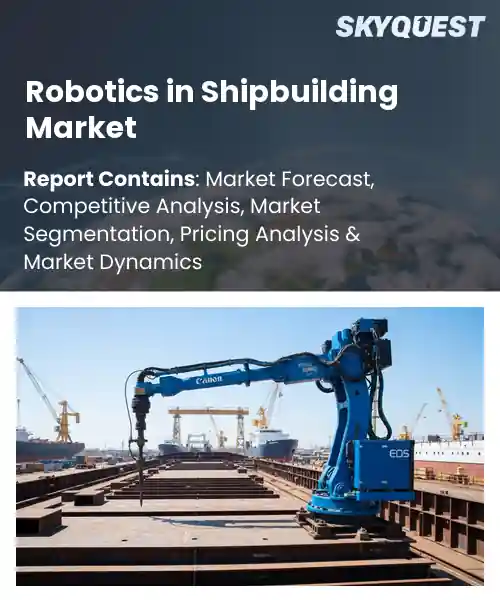
Robotics in Shipbuilding Market
Report ID: SQMIG20I2989
Report ID: SQMIG20I2989
[email protected]
USA +1 351-333-4748
Report ID:
SQMIG20I2989 |
Region:
Global |
Published Date: May, 2026
Pages:
157
|Tables:
179
|Figures:
79


Global Robotics In Shipbuilding Market size was valued at USD 2.7 Billion in 2024 and is poised to grow from USD 3.0 Billion in 2025 to USD 7.02 Billion by 2033, growing at a CAGR of 11.2% during the forecast period (2026-2033).
The driving factor behind the adoption of robotics within shipbuilding is the immediate requirement to increase productivity while lowering the risk of humans performing dangerous jobs. The shipbuilding robotics market includes robots used for applications like welding, painting, cutting, handling, and non-destructive testing integrated into the design and manufacturing processes. The reason for its significance lies in the need to cut down time spent building ships, manage labor costs and increase safety standards in order to be more competitive. During the last twenty years, the robotics market transitioned from inflexible systems to smart and adaptable manipulators and inspection drones, implemented successfully by some major yards like Hyundai Heavy Industries and Fincantieri. Building upon this progress, an important element driving adoption is the integration of sensing, AI-based process control, and modular production.
As a result of early detection of defects through sensors and machine vision, robotics used for welding and NDT decrease rework and improve component longevity, which allows for timely assembly of prefabricated blocks using the slipway method. This makes it possible for yards to adopt mixed products with small volumes through the use of robotic painting systems, which produce less pollution. Examples include the use of robotic abrasive blasting and automated ultrasonic testing in ship repair yards.
How is AI and IoT-enabled Robotics Automation Transforming Shipbuilding Efficiency?
The integration of AI and IoT in Robotics Automation creates changes in the shipbuilding industry through intelligent control and sensing networks to transfer heavy fabrication work from manual to robotic cells. Major elements include autonomous welding, inspections, planning with digital twin, and logistics which will minimize errors and make operations safer. As yards have to deal with complicated hull structures and the lack of skilled labor, shipyards will leverage robotics automation as it helps cut down building times and ensure production uniformity. Real-world implementations include robotic arc welding and robotic material handling using sensors to help ship builders keep to their schedule and enhance visibility on their supply chain. Fincantieri's announcement on its collaboration in February 2026 aims at the development of a humanoid robot capable of welding, indicating the potential applications of robots and how real-time welding and sensor data can be used for faster assembly and planning in shipyards through digital twins.
Market snapshot - (2026-2033)
Global Market Size
USD 2.7 Billion
Largest Segment
Articulated Robots
Fastest Growth
Collaborative Robots
Growth Rate
11.2% CAGR
To get more insights on this market click here to Request a Free Sample Report
Global robotics in shipbuilding market is segmented by robot type, solution, ship type, technology, application, end user and region. Based on robot type, the market is segmented into Articulated Robots, Collaborative Robots, Cartesian Robots and Autonomous Mobile Robots. Based on solution, the market is segmented into Shipbuilding and Inspection, Repair & Maintenance. Based on ship type, the market is segmented into Cargo Ships, Military & Naval Ships, Offshore Vessels and Recreational Boats. Based on technology, the market is segmented into AI-Enabled Robotics, Vision-Guided Robotics, IoT-Integrated Robotics and Digital Twin-Integrated Systems. Based on application, the market is segmented into Welding, Cutting, Painting & Coating, Assembly, Material Handling, Inspection & Maintenance and Others. Based on end user, the market is segmented into Commercial Shipyards, Naval Shipyards, Offshore Engineering Companies and Others. Based on region, the market is segmented into North America, Europe, Asia Pacific, Latin America and Middle East & Africa.
Collaborative Robots take first position since collaboration between humans and robots helps carry out safe and productive work in assembling and finishing operations, where skilled technicians can concentrate on more critical processes than robots who perform repetitive work or jobs which might cause strain for humans. All of these help in improving productivity through efficiency and better material movement throughout the process of production.
On the contrary, Autonomous Mobile Robots stand as the fastest-growing segment as they help in automating logistics and flow of materials within the vast yards, and therefore eliminating delays due to manual material transfers, and achieving delivery of materials just in time to different workstations.
The AI-Enabled Robotics segment is the dominating segment, supported by factors such as artificial intelligence, robots can detect anomalies, process multi-sensor data, and make decisions based on risks that are assessed through contextual analysis, thus minimizing downtime and ensuring efficient maintenance of equipment. Such solutions improve inspection procedures, allow for flexible decision-making while repairing and maintaining ships, and incorporate machine learning algorithms, which increase the efficiency of the whole process.
On the other side, the digital twin-integrated systems have the highest growth rate since digital twins help validate robot activity, predict scenarios, and troubleshoot remotely prior to actual implementation of robotics. The ability to simulate operations of the ship assembly and maintenance process accelerates the launch of automation and fosters collaboration between engineers and operations managers, which creates further growth opportunities.
To get detailed segments analysis, Request a Free Sample Report
Dominance by the Asia Pacific countries is attributed to having key shipyards and complete maritime value chains where automated systems help in handling intricate constructions as well as large production volumes. The best performing markets in the area have combined their rich history in shipbuilding with fast embracing of modern manufacturing techniques and collaboration between robotics providers and shipyards. Key advantages within the region include availability of a huge labor force with the skills required for robot implementation, innovation in custom designing robots as well as industry support for the same. In addition, there is a lot of investment in development of welding, assembly, and materials handling robots and application in both commercial and military sectors. There are well developed R&D infrastructure and industrial participation in promoting customized robotics. Academic institutions provide the manpower required through collaboration with shipyard companies.
Market of Robotics in Shipbuilding in Japan is highly influenced by the long history of precision-based manufacturing practices. Prioritizing automation processes associated with welding, surface treatment, and assembling of components, manufacturers and suppliers are able to improve the quality and increase efficiency. Cooperation between industries and science institutions contributes to rapid development, and an established supplier sector allows customizing the solution, thus providing for both retrofits and construction with advanced automated technologies.
Robots in Shipbuilding Industry in South Korea makes good use of the established relationships between shipbuilding groups and automation suppliers within the country to facilitate large-scale adoption of robots. Focus on automation within the dockyard, movement and management of modules, and exacting assembly contributes to efficiency and safety goals. Engineering expertise along with industrial policies within the country make it possible for prototypes and robots to be implemented and optimized.
There have been many instances of European countries undergoing growth thanks to a variety of factors, including the modernization of shipyards, engineering proficiency, and environmental and occupational health policies. This is made possible by strong system integrators and specialized manufacturers of robotic devices that fit into the needs of each process or application within the shipbuilding industry. Cooperation between various industry clusters and research organizations fast-tracks the validation process, as increased demand for high-end ships spurs more interest in adopting automation solutions for precision applications. Workforce development programs make way for favorable working conditions, and an active support network provides opportunities for implementation beyond the flagship shipyards.
Robotics in Shipbuilding Market in Germany leverages industrial automation knowledge and tight collaboration between shipyards and robotics producers. Emphasis on modular fabrication, quality control, and accuracy encourages the use of robots for welding, painting, and assembly processes. Well-established networks of robot builders, system integrators, and vocational education systems provide support, facilitating both new constructions and retrofits, and meeting various needs without sacrificing craftsmanship in shipbuilding.
The Robotics in Shipbuilding Market in the United Kingdom is defined by innovation ecosystems, where naval shipyards, innovative start-ups, and research centered on robotics in ship fitting and modular assembly come together. Key areas of interest are increasing the level of operational flexibility, addressing defense and offshore vessels, and ensuring safety via automation. Pilots and integration specialists drive uptake, with training and retrofit programs helping yards automate processes of welding, painting, and material handling.
Robotic Applications in Shipbuilding Industry in France is distinguished through usage within naval and commercial shipyards through initiatives aimed at updating technology and cooperation with other stakeholders. Focus on robotized outfitting, precise welding and the use of robots for assembling structures ensures competitiveness and minimization of manual processes. Collaboration between systems providers, shipbuilders and institutions specializing in research ensures custom-built applications and pilot projects. After-market services and skills development facilitate the spread of robotics in shipbuildingindustry.
North America can increase its competitive stance by focusing on concentration in innovation, transfer of technology among different industries, and cooperation between yards, military manufacturers, and robotics companies. Safety issues, worker enhancement, and resilience inspire investments in robotization for welding, inspections, and assembly procedures. High-level universities and the startup community expedite research in specialized robotics and the integration of these machines. Programmes related to retrofits, and servicing make it easier for established yards to robotize their operations, while cooperation within the maritime, aerospace, and industrial automation fields facilitate rapid prototyping and scaling up. These combined factors increase potential to supply both national and export customers with unique robotics systems. Efforts regarding skill development and local supply chain programs enhance the prospects for implementation in the long term.
US Robotics for Ship Building Industry is backed by efficient research facilities and integrators, suppliers, and defence contractors concentrated on automation technologies for naval and commercial shipbuilding processes. Robotic inspection, machine technology, and automatic material handling are highly valued, which is reflected in pilot projects, among other things. Retrofits, skilled labour force, and effective after-sales service will contribute to converting prototype technologies into real products.
Robotics in Shipbuilding Market in Canada highlights targeted utilization by repair yards, local builders, and shipyards catering to offshore and fisheries segments. Key concerns involve automation in safe assembly, hull machining, and inspection in the marine domain. Cooperation between industrial and academic research centers facilitates robotics application and safety improvements. Retrofit initiatives and vendor alliances enable implementation in scattered shipyards, thus aiding in upgrading operations yet retaining flexibility for diverse vessels.
To know more about the market opportunities by region and country, click here to
Buy The Complete Report
Automation of Repetitive Shipyard Tasks
Shipyard automation through repetitive tasks helps drive market growth by facilitating the constant operation of critical functions like welding, painting, and handling of parts. By automating these dull and dangerous activities, the shipyards will be able to assign their skilled employees to more valuable jobs like supervising and designing, making the operation process more efficient. With constant quality results and decreased instances of rework, the shipyards become more confident about automation, leading to more investments.
Advances in Perception and Control
Improvements in sensing and control techniques have broadened the scope of robotic capabilities, allowing the machines to work effectively within the challenging environment of shipyards. Sensing advancements and intuitive motion control enable robots to detect changes in geometry and surface, making robots less dependent on fixed structures and extensive pre-programming. Such improvements make it easier for shipyards to deploy robotic systems for a wide range of vessel types, automating many procedures that would otherwise require expensive customization.
High Capital Investment Requirements
The high capital investment costs involved limit the market development process, posing a considerable challenge to early adoption by many yards since the cost involved is usually very high when compared to other capital investments required in the modernization process. Limited availability of capital among smaller shipyards will force such shipyards to delay or completely avoid investment, hence limiting the market penetration of robotics. Financial risks and complications that are associated with funding customized robotic systems make early adoption less attractive.
Skilled Workforce and Training Needs
The lack of trained staff and substantial need for training act as a constraint on the rapid adoption of robotics due to the logistical and labor problems involved. Robotics needs trained personnel that can program and control the robot; however, such skills are not prevalent throughout the industry. The need for time and effort to train personnel, coupled with a drop in efficiency while in the process of doing so, discourages quick adoption.
Request Free Customization of this report to help us to meet your business objectives.
The competitive dynamic within shipbuilding robotics has moved towards leveraging technology collaborations, selective acquisitions, and quick pilot deployments as companies work to establish yard-level implementation capabilities. The competition is fueled by the necessity to find replacements for highly skilled welders and reduce exposure in yards, leading to initiatives like supplier collaborations and pilot programs in factories. Some examples include Samsung Heavy Industries’ piloting of KAIST spin-off robots, Path Robotics’ collaboration with an autonomous vessel builder, and pre-seed investment rounds for a marine automation startup.
Digital Twin Integration: The implementation of highly realistic digital models of the ships and shipbuilding processes allows for seamless simulation, virtual commissioning, and feedback of information to the robotic systems throughout the entire building process. Models allow stakeholders to confirm the effectiveness of assembly processes, improve logistics and foresee future maintenance requirements, without changing the initial idea of the vessel. Integration of such models enhances cooperation between design, engineering and production departments, decreases physical redesigns, speeds up planning of the retrofit and opens possibilities of remote diagnostics based on real-world data.
Collaborative Robotics Ecosystems: The increased use of collaborative robotic cells and wearable technology will lead to changes in the shipyard workflow because of collaboration between people and robots in order to carry out assembly operations, as well as treatment and testing operations. The collaborative ecosystem includes robots that are flexible enough, visual perception equipment, and end-effectors which can be used for various hull designs and retrofits. The focus on safety issues, easy programming and operator enhancement will increase acceptance and contribute to gradual automation paths.
SkyQuest’s ABIRAW (Advanced Business Intelligence, Research & Analysis Wing) is our Business Information Services team that Collects, Collates, Correlates, and Analyses the Data collected by means ofPrimary Exploratory Research backed by robust Secondary Desk research.
As per SkyQuest analysis, the robotics in shipbuilding market is driven mainly by the critical need for increasing efficiency and safeguarding the health of workers exposed to dangerous activities. On the other side, stringent investments in capital equipment form an important restriction hampering market growth. The leading region within the market is Asia Pacific owing to the presence of a large number of shipyard facilities. Collaborative robotics dominate the market because of the ability to ensure safety and cooperation between human beings and robots for carrying out various assembling and finishing activities. Another factor driving the market is AI-based solutions and sensors along with IoT systems, which allow for automation of shipbuilding processes.
| Report Metric | Details |
|---|---|
| Market size value in 2024 | USD 2.7 Billion |
| Market size value in 2033 | USD 7.02 Billion |
| Growth Rate | 11.2% |
| Base year | 2024 |
| Forecast period | (2026-2033) |
| Forecast Unit (Value) | USD Billion |
| Segments covered |
|
| Regions covered | North America (US, Canada), Europe (Germany, France, United Kingdom, Italy, Spain, Rest of Europe), Asia Pacific (China, India, Japan, Rest of Asia-Pacific), Latin America (Brazil, Rest of Latin America), Middle East & Africa (South Africa, GCC Countries, Rest of MEA) |
| Companies covered |
|
| Customization scope | Free report customization with purchase. Customization includes:-
|
To get a free trial access to our platform which is a one stop solution for all your data requirements for quicker decision making. This platform allows you to compare markets, competitors who are prominent in the market, and mega trends that are influencing the dynamics in the market. Also, get access to detailed SkyQuest exclusive matrix.
Table Of Content
Executive Summary
Market overview
Parent Market Analysis
Market overview
Market size
KEY MARKET INSIGHTS
COVID IMPACT
MARKET DYNAMICS & OUTLOOK
Market Size by Region
KEY COMPANY PROFILES
Methodology
For the Robotics in Shipbuilding Market, our research methodology involved a mixture of primary and secondary data sources. Key steps involved in the research process are listed below:
1. Information Procurement: This stage involved the procurement of Market data or related information via primary and secondary sources. The various secondary sources used included various company websites, annual reports, trade databases, and paid databases such as Hoover's, Bloomberg Business, Factiva, and Avention. Our team did 45 primary interactions Globally which included several stakeholders such as manufacturers, customers, key opinion leaders, etc. Overall, information procurement was one of the most extensive stages in our research process.
2. Information Analysis: This step involved triangulation of data through bottom-up and top-down approaches to estimate and validate the total size and future estimate of the Robotics in Shipbuilding Market.
3. Report Formulation: The final step entailed the placement of data points in appropriate Market spaces in an attempt to deduce viable conclusions.
4. Validation & Publishing: Validation is the most important step in the process. Validation & re-validation via an intricately designed process helped us finalize data points to be used for final calculations. The final Market estimates and forecasts were then aligned and sent to our panel of industry experts for validation of data. Once the validation was done the report was sent to our Quality Assurance team to ensure adherence to style guides, consistency & design.
Analyst Support
Customization Options
With the given market data, our dedicated team of analysts can offer you the following customization options are available for the Robotics in Shipbuilding Market:
Product Analysis: Product matrix, which offers a detailed comparison of the product portfolio of companies.
Regional Analysis: Further analysis of the Robotics in Shipbuilding Market for additional countries.
Competitive Analysis: Detailed analysis and profiling of additional Market players & comparative analysis of competitive products.
Go to Market Strategy: Find the high-growth channels to invest your marketing efforts and increase your customer base.
Innovation Mapping: Identify racial solutions and innovation, connected to deep ecosystems of innovators, start-ups, academics, and strategic partners.
Category Intelligence: Customized intelligence that is relevant to their supply Markets will enable them to make smarter sourcing decisions and improve their category management.
Public Company Transcript Analysis: To improve the investment performance by generating new alpha and making better-informed decisions.
Social Media Listening: To analyze the conversations and trends happening not just around your brand, but around your industry as a whole, and use those insights to make better Marketing decisions.
REQUEST FOR SAMPLE
 REQUEST FREE CUSTOMIZATION
Global Robotics In Shipbuilding Market size was valued at USD 2.7 Billion in 2024 and is poised to grow from USD 3.0 Billion in 2025 to USD 7.02 Billion by 2033, growing at a CAGR of 11.2% during the forecast period (2026-2033).
Competitive dynamics in shipbuilding robotics have shifted toward technology-driven partnerships, targeted acquisitions, and rapid pilot rollouts as firms race to prove yard-level deployability and integration. Competition is driven by the need to replace skilled welders and reduce in-yard exposure, prompting concrete strategies such as supplier alliances and factory pilots. Examples include Samsung Heavy Industries testing a KAIST spinoff robot, Path Robotics partnering with an autonomous-vessel builder, and a recent pre-seed funding round for a maritime autonomy startup. 'ABB', 'KUKA', 'FANUC Corporation', 'Kawasaki Heavy Industries', 'Yaskawa Electric Corporation', 'Hyundai Heavy Industries', 'Mitsubishi Heavy Industries', 'Siemens', 'Wärtsilä', 'Thyssenkrupp Marine Systems', 'General Dynamics', 'Lockheed Martin', 'Thales Group', 'ST Engineering', 'Samsung Heavy Industries', 'Daewoo Shipbuilding & Marine Engineering', 'Panasonic Holdings', 'Universal Robots', 'Nachi-Fujikoshi', 'Kongsberg Gruppen'
Automation of repetitive shipyard tasks drives market growth by enabling continuous, reliable operation of core processes such as welding, painting, and component handling. By transferring monotonous and hazardous activities to robotic systems, shipbuilders can allocate skilled personnel to higher value engineering and supervisory roles, improving overall efficiency. Consistent quality outcomes and reduced rework foster confidence in automated solutions, encouraging further investment. The visible improvements in safety and workflow predictability support broader adoption across yards seeking to modernize operations and reduce reliance on manual labor.
Digital Twin Integration: The adoption of high fidelity digital replicas of vessels and shipyard processes enables seamless simulation, virtual commissioning and continuous feedback to robotic systems across the build lifecycle. Stakeholders leverage synchronized models to validate assembly sequences, optimize resource flows and forecast maintenance needs while preserving design intent. Integrated twins improve collaboration among design, engineering and production teams, reduce physical rework, accelerate retrofit planning and unlock remote diagnostics and iterative improvement driven by real world operational data and robotics performance insights today.
Why does Asia Pacific Dominate the Global Robotics in Shipbuilding Market? |@12


Want to customize this report? This report can be personalized according to your needs. Our analysts and industry experts will work directly with you to understand your requirements and provide you with customized data in a short amount of time. We offer $1000 worth of FREE customization at the time of purchase.
Feedback From Our Clients


 USA (+1) 351-333-4748

