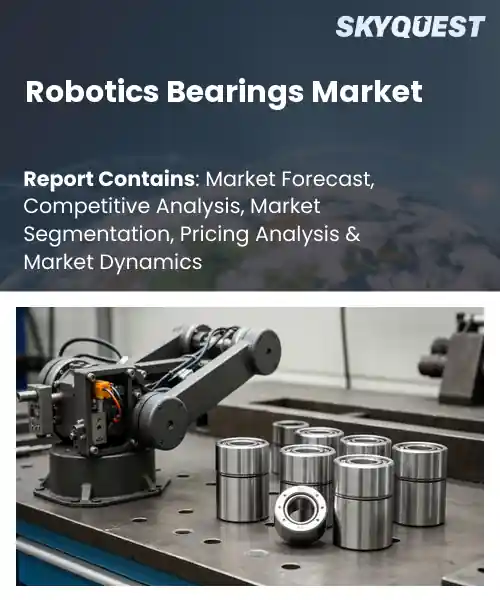
Robotics Bearings Market
Report ID: SQMIG20I2971
Report ID: SQMIG20I2971
[email protected]
USA +1 351-333-4748
Report ID:
SQMIG20I2971 |
Region:
Global |
Published Date: April, 2026
Pages:
157
|Tables:
113
|Figures:
77


Global Robotics Bearings Market size was valued at USD 985.6 Million in 2024 and is poised to grow from USD 1086.13 Million in 2025 to USD 994.6 Million by 2033, growing at a CAGR of 10.2% during the forecast period (2026-2033).
Rapid adoption of industrial and service robots is the primary driver propelling the robotics bearings market as manufacturers demand components that meet stricter precision, speed and durability requirements. The market comprises rotary and linear bearings for articulated arms, Cartesian systems and mobile platforms, and it matters because bearing quality governs accuracy, energy use and equipment lifespan. Over two decades the sector shifted from standard steel balls toward hybrid ceramic materials, crossed roller designs and sealed low-friction assemblies. For example, automotive welding lines employ high-torque slewing rings while surgical robots depend on miniature ceramic bearings to deliver sterilizable, high-repeatability motion reliably.Building on material and design advances, the pivotal growth factor now is integrating sensors into bearings, which creates operational benefits and commercial opportunities. When bearings include vibration, temperature and torque sensors, operators can predict failures and schedule maintenance, causing substantial reductions in unplanned downtime and spare-part costs. That effect translates into faster deployment cycles for e-commerce warehouses and higher uptime for AGVs, prompting OEMs to specify smart bearings as standard. Simultaneously, lighter coatings and low-friction geometries reduce energy draw on battery-powered platforms, expanding mobile service robot applications and enabling bearing-as-a-service business models. OEMs can monetize diagnostics through subscription retrofit services.
How is AI improving predictive maintenance for robotics bearings?
AI improves predictive maintenance for robotics bearings by turning sensor signals into actionable insights. Key aspects include vibration and temperature sensing, acoustic monitoring, edge computing and machine learning models trained to spot early failure patterns and estimate remaining life. Today’s market is moving toward sensor integrated bearings and platform based analytics that let robot operators shift from calendar based servicing to condition based care. In practice this reduces unexpected stoppages and simplifies spare parts planning. Examples appear across collaborative robots and assembly line manipulators where AI alerts prompt targeted inspections before damage progresses.SKF February 2026, showcased a scalable condition monitoring package with AI analytics at Maintenance Fair 2026, showing how embedded sensors and cloud based models translate vibration and temperature data into early fault alerts which supports robotics bearings market efficiency by reducing unexpected downtime and simplifying maintenance planning.
Market snapshot - (2026-2033)
Global Market Size
USD 985.6 Million
Largest Segment
High-Efficiency Dynamic Separators
Fastest Growth
High-Efficiency Dynamic Separators
Growth Rate
10.2% CAGR
To get more insights on this market click here to Request a Free Sample Report
Global robotics bearings market is segmented by technology generation, system configuration, capacity range, application phase and region. Based on technology generation, the market is segmented into High-Efficiency Dynamic Separators and Mechanical/Cyclone Separators. Based on system configuration, the market is segmented into Closed-Circuit Grinding Systems and Vertical Roller Mill (VRM) Integrated Separators. Based on capacity range, the market is segmented into Low to Medium Throughput and High Throughput Industrial Units. Based on application phase, the market is segmented into Raw Material Grinding and Finished Cement Grinding. Based on region, the market is segmented into North America, Europe, Asia Pacific, Latin America and Middle East & Africa.
High-Efficiency Dynamic Separators segment dominates because robotics designs prioritize precision rotational components that match the low-vibration, high-speed demands of advanced separators. This drives preference for bearings offering tight tolerances, superior load distribution, and minimal thermal growth, which in turn encourages suppliers to optimize materials and lubrication systems for long operational life. The cause-and-effect between separator performance goals and bearing engineering consolidates demand around advanced precision bearing solutions within the market.
However, Mechanical/Cyclone Separators are the most rapidly expanding area as industries seek rugged, cost-effective separator systems that demand heavy-duty, resilient bearings. Rising retrofit activity and emphasis on maintenance simplicity drive innovation in sealed, shock-tolerant bearing designs, accelerating adoption in industrial robotics modules and creating aftermarket opportunities for bearing specialists.
Closed-Circuit Grinding Systems segment stands out because their control-centric design demands bearings that ensure consistent rotational stability and long uninterrupted operation in automated grinding loops. Robotics elements used for feed control and classifier adjustments impose stringent requirements for low friction, contamination resistance and predictable life, prompting bearing makers to prioritize advanced sealing, specialized lubricants and precision engineering. These factors collectively elevate demand for tailored bearing solutions in the market.
Conversely, Vertical Roller Mill (VRM) Integrated Separators are the fastest growing area as mill designs favor compact integrated units with embedded robotics. Need for bearings that handle combined axial and radial stresses while supporting sensor integration accelerates development of smart, maintenance-friendly bearing systems, creating fresh opportunities for automation and lifecycle services.
To get detailed segments analysis, Request a Free Sample Report
Asia Pacific dominates the global robotics bearings market through a combination of concentrated manufacturing ecosystems, extensive component supply chains, and sustained demand across multiple high intensity industries. Regional industrial clusters enable close collaboration between original equipment manufacturers and precision bearing suppliers, fostering rapid iteration and tailored solutions. Strengths in electronics, automotive, and semiconductor assembly drive continuous need for high precision motion components. Investment in research and development and skilled technical talent support innovation in lightweight, high durability bearing designs. Proximity to large contract manufacturers and system integrators reduces lead times and enhances cost efficiency. Policy environments and industrial strategies that prioritize automation further bolster market leadership, while pervasive deployment of collaborative and factory floor robotics sustains consistent component consumption across diverse sectors.
Robotics Bearings Market in Japan benefits from a legacy of precision engineering and close integration between system designers and component manufacturers. Established OEMs and specialized suppliers prioritize high reliability and stringent quality control, driving demand for advanced bearing solutions. Emphasis on miniaturization and endurance in industrial and service robotics encourages innovation. Strong domestic expertise in materials science and manufacturing processes supports development of bearings tailored to demanding motion control applications.
Robotics Bearings Market in South Korea is driven by strong demand from precision electronics and semiconductor assembly sectors and automation initiatives. Local bearing manufacturers collaborate with system integrators to produce compact high speed solutions optimized for dense production environments. Emphasis on rapid prototyping and customization supports niche bearing variants. A culture of quality alignment and agile supply chain practices enables swift responses to evolving specifications across industrial and service robotics.
Rapid expansion of the robotics bearings market in Europe is propelled by industrial modernization, a strong engineering talent base, and rising adoption among both large manufacturers and agile small and medium enterprises. Emphasis on smart factories and interoperability compels system integrators to source reliable, standards compliant bearing solutions that enable precise motion control. Automotive electrification and high value manufacturing increase demand for specialized, durable components. Regional manufacturers prioritize customization, aftermarket services, and close collaboration with integrators to meet demanding performance and longevity requirements. Policy frameworks that encourage automation and investments in skills development further support growth, while focus on supply chain resilience and quality assurance enhances competitive positioning for regional suppliers. Cross border collaboration amplifies innovation capacity.
Robotics Bearings Market in Germany is anchored by robust automotive and industrial automation sectors. Bearing manufacturers and system integrators work closely with OEMs to deliver reliable, standards compliant solutions for demanding production environments. Focus on durability and integration with complex control systems drives preference for premium components. Deep engineering expertise and rigorous process optimization support ongoing refinement of bearing technology to satisfy intensive motion control and heavy duty application needs.
Robotics Bearings Market in United Kingdom is emerging as a hub for agile innovation and niche application development. Strong academic and technology clusters support collaboration between startups, integrators, and component suppliers to create tailored bearing solutions for aerospace, life science, and precision manufacturing. Emphasis on flexible production and modular robotics platforms favors compact, service friendly bearings. Growing focus on aftermarket support and customization helps accelerate adoption across diverse industrial deployments.
Robotics Bearings Market in France is gaining strong momentum from vibrant robotics research and innovative manufacturers serving aerospace, food processing, and service robotics sectors. Local suppliers emphasize precision and tailored solutions that meet strict quality standards. Collaborative initiatives linking research institutions and industry enable faster commercialization of bearing technologies. Agile manufacturing and design driven differentiation foster swift adoption of advanced bearings across a wide range of industrial and commercial applications.
North America is strengthening its position in the robotics bearings market through a blend of deep research capabilities, diverse end user demand across logistics, healthcare, and advanced manufacturing, and a dynamic supplier landscape that pairs established manufacturers with innovative startups. Integration of sensors, predictive maintenance, and intelligent motion control increases demand for bearings that perform reliably under variable loads and environmental conditions. Strategic partnerships between component suppliers and system integrators accelerate validation and deployment of specialized bearing solutions. Policy emphasis on industrial competitiveness and investments in workforce skills support adoption, while growing focus on localized production and supply chain diversification enhances regional resilience and supplier responsiveness to bespoke application needs. Robust aftermarket support networks and emphasis on standards and testing infrastructure reinforce trust in high performance bearings and enable wider uptake across commercial and defense robotics platforms.
Robotics Bearings Market in United States is propelled by demand across logistics, manufacturing, healthcare automation, and defense sectors. An ecosystem of established suppliers and innovative startups delivers bearing solutions emphasizing durability, sensor integration, and serviceability for complex robotic systems. Research institutions and engineering talent support rapid prototyping and validation. Focus on aftermarket services and close collaboration with integrators enables tailored designs and faster deployment in diverse commercial and industrial applications.
Robotics Bearings Market in Canada is shaped by adoption in resource processing, food, logistics automation, and emerging service robotics. Local suppliers and integrators focus on ruggedized bearing designs suited to harsh environments and on compact solutions for constrained spaces. Cooperation with academic research centers fosters innovation in materials and lubrication. Emphasis on reliability, maintenance friendliness, and after sales support drives acceptance across industrial customers and regional export opportunities for suppliers.
To know more about the market opportunities by region and country, click here to
Buy The Complete Report
Increasing Automation In Manufacturing
Advancements In Bearing Materials
High Initial Capital Investment
Technical Complexity and Maintenance
Request Free Customization of this report to help us to meet your business objectives.
Competitive rivalry in the global robotics bearings market is intensifying as incumbents pursue M&A and system level acquisitions to lock OEM relationships while specialists advance integrated motion modules. Examples include Timken acquiring precision gear and drive businesses to add actuator and gearbox capabilities and Schaeffler showcasing ultrahigh precision recirculating roller and drive systems. Strategic partnerships and component consolidation are driving faster tech integration and supplier consolidation.
Top Player’s Company Profile
Recent Developments
SkyQuest’s ABIRAW (Advanced Business Intelligence, Research & Analysis Wing) is our Business Information Services team that Collects, Collates, Correlates, and Analyses the Data collected by means of Primary Exploratory Research backed by robust Secondary Desk research. As per SkyQuest analysis, the global robotics bearings market is being driven primarily by rapid adoption of industrial and service robots, which demand higher precision, speed and durability from motion components. Growth is also supported by integration of sensors into bearings that enable predictive maintenance and lower lifecycle costs. However high initial capital investment limits adoption among smaller firms and slows deployment cycles. Asia Pacific remains the dominant region thanks to dense manufacturing ecosystems, strong supply chains and broad automation uptake. Within the product mix, high-efficiency dynamic separators lead demand due to their need for low-vibration, high-precision rotating components, creating sustained opportunities for specialized bearing suppliers.
| Report Metric | Details |
|---|---|
| Market size value in 2024 | USD 985.6 Million |
| Market size value in 2033 | USD 994.6 Million |
| Growth Rate | 10.2% |
| Base year | 2024 |
| Forecast period | (2026-2033) |
| Forecast Unit (Value) | USD Million |
| Segments covered |
|
| Regions covered | North America (US, Canada), Europe (Germany, France, United Kingdom, Italy, Spain, Rest of Europe), Asia Pacific (China, India, Japan, Rest of Asia-Pacific), Latin America (Brazil, Rest of Latin America), Middle East & Africa (South Africa, GCC Countries, Rest of MEA) |
| Companies covered |
|
| Customization scope | Free report customization with purchase. Customization includes:-
|
To get a free trial access to our platform which is a one stop solution for all your data requirements for quicker decision making. This platform allows you to compare markets, competitors who are prominent in the market, and mega trends that are influencing the dynamics in the market. Also, get access to detailed SkyQuest exclusive matrix.
Table Of Content
Executive Summary
Market overview
Parent Market Analysis
Market overview
Market size
KEY MARKET INSIGHTS
COVID IMPACT
MARKET DYNAMICS & OUTLOOK
Market Size by Region
KEY COMPANY PROFILES
Methodology
For the Robotics Bearings Market, our research methodology involved a mixture of primary and secondary data sources. Key steps involved in the research process are listed below:
1. Information Procurement: This stage involved the procurement of Market data or related information via primary and secondary sources. The various secondary sources used included various company websites, annual reports, trade databases, and paid databases such as Hoover's, Bloomberg Business, Factiva, and Avention. Our team did 45 primary interactions Globally which included several stakeholders such as manufacturers, customers, key opinion leaders, etc. Overall, information procurement was one of the most extensive stages in our research process.
2. Information Analysis: This step involved triangulation of data through bottom-up and top-down approaches to estimate and validate the total size and future estimate of the Robotics Bearings Market.
3. Report Formulation: The final step entailed the placement of data points in appropriate Market spaces in an attempt to deduce viable conclusions.
4. Validation & Publishing: Validation is the most important step in the process. Validation & re-validation via an intricately designed process helped us finalize data points to be used for final calculations. The final Market estimates and forecasts were then aligned and sent to our panel of industry experts for validation of data. Once the validation was done the report was sent to our Quality Assurance team to ensure adherence to style guides, consistency & design.
Analyst Support
Customization Options
With the given market data, our dedicated team of analysts can offer you the following customization options are available for the Robotics Bearings Market:
Product Analysis: Product matrix, which offers a detailed comparison of the product portfolio of companies.
Regional Analysis: Further analysis of the Robotics Bearings Market for additional countries.
Competitive Analysis: Detailed analysis and profiling of additional Market players & comparative analysis of competitive products.
Go to Market Strategy: Find the high-growth channels to invest your marketing efforts and increase your customer base.
Innovation Mapping: Identify racial solutions and innovation, connected to deep ecosystems of innovators, start-ups, academics, and strategic partners.
Category Intelligence: Customized intelligence that is relevant to their supply Markets will enable them to make smarter sourcing decisions and improve their category management.
Public Company Transcript Analysis: To improve the investment performance by generating new alpha and making better-informed decisions.
Social Media Listening: To analyze the conversations and trends happening not just around your brand, but around your industry as a whole, and use those insights to make better Marketing decisions.
REQUEST FOR SAMPLE
 REQUEST FREE CUSTOMIZATION


Want to customize this report? This report can be personalized according to your needs. Our analysts and industry experts will work directly with you to understand your requirements and provide you with customized data in a short amount of time. We offer $1000 worth of FREE customization at the time of purchase.
Feedback From Our Clients


 USA (+1) 351-333-4748

