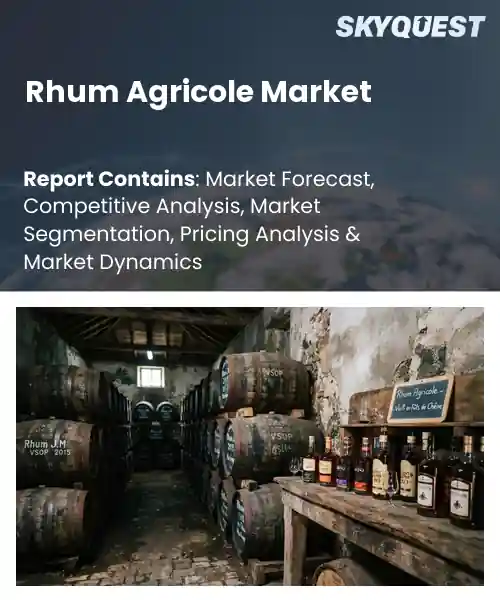
Rhum Agricole Market
Report ID: SQMIG30F2078
Report ID: SQMIG30F2078
[email protected]
USA +1 351-333-4748
Report ID:
SQMIG30F2078 |
Region:
Global |
Published Date: August, 2026
Pages:
157
|Tables:
95
|Figures:
76


Global Rhum Agricole Market size was valued at USD 487.3 Million in 2024 and is poised to grow from USD 522.39 Million in 2025 to USD 911.07 Million by 2033, growing at a CAGR of 7.2% during the forecast period (2026-2033).
The global rhum agricole market revolves around a spirit produced from sugarcane juice rather than molasses, a distinction that defines its aromatic profile and terroir‑driven identity. Its primary driver is consumer preference for terroir‑expressive beverages, a trend intensified by the rise of cocktail culture in cities such as Paris and New York. Historically, the market emerged from French Caribbean islands where colonial legislation mandated juice‑based distillation, and over the past two decades it has expanded beyond Martinique to include producers in Guadeloupe, Réunion, and mainland France. This evolution matters because it links heritage with positioning, attracting connoisseurs and hospitality sector. The surge in tourism has become the catalyst propelling the global rhum agricole market, because visitors to Caribbean destinations seek authentic experiences that showcase craftsmanship. Distilleries respond by offering tours, barrel‑aging workshops, and limited‑edition releases that turn cultural narratives into products, thereby boosting sales and brand loyalty. This tourism‑driven exposure also encourages European and Asian retailers to allocate shelf space to agricole expressions, expanding distribution and prompting investment in sustainable farming that guarantees juice quality. Consequently, new export agreements with the United States and China materialize, unlocking revenue for small‑scale producers while reinforcing the spirit’s reputation as a luxury commodity.
How is AI-driven consumer analytics reshaping the Rhum agricole market?
AI driven consumer analytics is reshaping the Rhum agricole market by turning vast streams of purchase data, social chatter and tasting notes into actionable insights. Brands now map consumer preferences for terroir driven flavors, predict emerging trends and tailor marketing messages to niche audiences. Real time sentiment analysis helps distilleries adjust product positioning while predictive demand models guide inventory and distribution decisions. The technology also enables personalized recommendations on e commerce platforms, turning casual buyers into loyal enthusiasts. As premiumization fuels interest in authentic farm origin spirits, AI equips producers with the precision needed to capture and retain this growing segment.Campari, July 2026, announced the divestiture of its agricole rum portfolio after AI driven consumer insights highlighted stronger demand for its apéritif brands, prompting a strategic shift that reallocates capital toward higher growth segments and refines its brand mix to better match evolving consumer preferences and strengthens market positioning in the premium
Market snapshot - (2026-2033)
Global Market Size
USD 487.3 Million
Largest Segment
Services
Fastest Growth
Software
Growth Rate
7.2% CAGR
To get more insights on this market click here to Request a Free Sample Report
Global rhum agricole market is segmented by product type, application, distribution channel and region. Based on product type, the market is segmented into Rhum Blanc, Rhum Ambre/Paille, Rhum Vieux and Rhum Arrange. Based on application, the market is segmented into Beverages, Culinary, Pharmaceuticals and Others. Based on distribution channel, the market is segmented into HoReCa, Supermarkets/Hypermarkets, Specialty liquor stores, Duty Free Stores, Online Retail and Others. Based on region, the market is segmented into North America, Europe, Asia Pacific, Latin America and Middle East & Africa.
Rhum Vieux segment dominates because it embodies the heritage and complexity that connoisseurs associate with high end rhum agricole, driving strong brand positioning and price premiums. Its extended aging in oak barrels creates nuanced flavor profiles that appeal to discerning consumers, encouraging repeat purchases and loyalty. Distillers invest heavily in maturation processes, and retailers highlight its exclusivity, reinforcing its status as the flagship offering within the product portfolio for the industry.
However, Rhum Blanc segment is witnessing the strongest growth momentum as mixologists and craft cocktail bars increasingly favor its fresh, vegetal character for innovative drink creations. The rise of experiential drinking and demand for transparent, terroir‑driven spirits fuels its adoption, opening avenues for brand differentiation and expanding the market footprint.
Beverages segment dominates because rhum agricole is primarily consumed as a standalone spirit or cocktail base, anchoring its cultural relevance and driving consistent demand across bars and home settings. Its distinctive terroir and aromatic profile differentiate it from other rums, encouraging brand storytelling and experiential marketing. Producers focus on flavor integrity, while distributors prioritize shelf visibility, reinforcing its central role in the overall consumption ecosystem for the industry.
On the other hand, Culinary application is emerging as the key high growth area as chefs integrate rhum agricole into sauces, desserts, and marinades to impart island flavors. The trend toward gourmet fusion and food experiences drives its adoption, creating revenue streams and expanding the spirit’s relevance beyond drinking occasions.
To get detailed segments analysis, Request a Free Sample Report
The dominance of North America in the global Rhum Agricole market stems from a confluence of sophisticated consumer preferences, extensive distribution channels, and robust hospitality ecosystems. Enthusiastic cocktail culture and a growing appetite for terroir‑driven spirits have positioned Rhum Agricole as a premium choice among mixologists and discerning drinkers. Retail networks across the United States and Canada provide deep shelf presence, while import specialists ensure consistent quality and traceability. Educational initiatives, tasting events, and collaborations with culinary institutions further elevate brand awareness. Moreover, supportive trade policies and a well‑established e‑commerce infrastructure enable rapid market penetration and sustained consumer engagement, reinforcing North America’s leadership position. Innovative packaging and limited‑edition releases attract collectors, while travel‑inspired tourism programs introduce the spirit to new audiences. The combined effect of these dynamics creates a self‑reinforcing cycle of demand and supply that solidifies the region’s preeminence.
Rhum Agricole Market in the United States benefits from a vibrant cocktail renaissance that prizes authentic, agricultural spirits. Premium bars and speakeasies showcase the spirit in classic and contemporary recipes, driving consumer curiosity. Importers focus on provenance storytelling, aligning the product with farm‑to‑glass narratives that resonate with upscale diners. Educational masterclasses and collaborations with culinary schools reinforce expertise, while upscale retail environments ensure visibility among affluent patrons through targeted marketing initiatives.
Rhum Agricole Market in Canada is propelled by a strong appreciation for craft beverages and a diverse consumer base that values terroir expression. Boutique distilleries and specialty retailers champion the spirit, emphasizing its island origins and sustainable farming practices. Culinary festivals integrate the product into regional pairings, enhancing its profile among food enthusiasts. Collaborations with United States importers expand distribution, while provincial liquor boards support limited releases that maintain perception.
The rapid expansion of the Rhum Agricole market in Europe is fueled by a confluence of heritage appreciation, sophisticated palate development, and evolving hospitality trends. Consumers across the continent increasingly seek authentic, terroir‑driven spirits that reflect agricultural origins, positioning Rhum Agricole alongside traditional European eau‑de‑vie and gin in premium bars. Culinary auteurs incorporate the spirit into regional menus, highlighting its versatility in both classic and avant‑garde pairings. Trade agreements and streamlined import logistics enable a steady flow of high‑quality product, while sustainability narratives resonate with environmentally conscious buyers. Collaborative events between distillers and mixologists generate buzz, and targeted storytelling in media amplifies brand visibility. Together, these dynamics create a fertile environment for sustained growth and market deepening. The collective enthusiasm also encourages new entrants to explore innovative expressions of the spirit.
Rhum Agricole Market in Germany is anchored by a discerning consumer segment that equates provenance with premium value. Bars and establishments feature the spirit in curated tasting menus, reinforcing its status as a luxury. Import distributors emphasize rigorous quality standards, aligning the product with the country’s reputation for precision. Culinary collaborations showcase the spirit alongside local ingredients, while sustainability messaging resonates with patrons, consolidating Germany’s position as a dominant market.
Rhum Agricole Market in the United Kingdom is experiencing adoption driven by a cocktail culture and curiosity for Caribbean heritage spirits. Trend‑setting bars experiment with the spirit in innovative concoctions, attracting a younger, experiential audience. Import agents focus on storytelling that highlights sustainable sugarcane cultivation, aligning with the market’s ethical consumption trends. Food festivals integrate Rhum Agricole into British gastronomy, reinforcing its versatility and accelerating its rapid significant growth trajectory.
Rhum Agricole Market in France is emerging as consumers seek authentic, terroir‑focused experiences that complement the country’s celebrated wine and spirit traditions. Boutique retailers position the spirit alongside premium cognac, emphasizing its agricultural origins. Culinary artisans experiment with Rhum Agricole in dessert pairings and sauce reductions, highlighting its aromatic complexity. Educational tastings hosted by French sommeliers foster appreciation, while import strategies ensure the product aligns with the palate of connoisseurs.
The Asia Pacific region is progressively strengthening its position in the Rhum Agricole market by leveraging a blend of cultural curiosity, premium‑spirit expertise, and innovative hospitality concepts. Consumers in key economies display a growing fascination with Caribbean agricultural spirits, associating them with exotic flavor narratives and sophisticated cocktail experiences. Local bartenders integrate Rhum Agricole into meticulously crafted drinks that emphasize balance and harmony, aligning with regional palate preferences. Strategic partnerships with established import houses facilitate consistent supply chains, while exclusive tasting events and culinary collaborations raise awareness among discerning diners. Moreover, sustainability messaging resonates strongly in markets attuned to environmental stewardship, enhancing brand credibility. This confluence of experiential marketing, craftsmanship appreciation, and supply‑chain reliability collectively elevates the region’s foothold in the global landscape.
Rhum Agricole Market in Japan thrives on an appreciation for craftsmanship and nuanced flavor profiles that align with the nation’s refined palate. Cocktail bars and izakayas experiment with the spirit, pairing it with ingredients to create libations. Import specialists highlight the agricultural heritage of the spirit, resonating with Japanese consumers’ respect for provenance. Collaborative events with sushi chefs and sake sommeliers showcase versatility, while narratives reinforce alignment with Japan’s expectations.
Rhum Agricole Market in South Korea is gaining traction as consumers seek premium spirits that complement the nation’s dining scene. Bars integrate the spirit into fusion cocktails, blending Korean ingredients with Caribbean notes for a palate experience. Import partners emphasize the sugarcane origins, resonating with Korean millennials. Collaborative tastings with chefs highlight the spirit’s versatility, while curated marketing campaigns amplify its status as an alternative within the competitive spirits landscape.
To know more about the market opportunities by region and country, click here to
Buy The Complete Report
Rising Consumer Interest in Authentic Spirits
Expansion of Premium Cocktail Menus
Limited Availability of Sugarcane Juice
Stringent Geographic Indication Regulations
Request Free Customization of this report to help us to meet your business objectives.
The competitive landscape of the global Rhum Agricole market is shaped by intense rivalry among premium spirit producers, who are leveraging strategic acquisitions, cross‑brand collaborations, and innovative fermentation technologies to differentiate their offerings. Recent M&A activity includes larger distilleries absorbing boutique brands to expand geographic reach, while partnerships with luxury hospitality groups enable exclusive tasting experiences. Investment in advanced distillation equipment and sustainable sugarcane sourcing further intensifies competition, driving product differentiation and market share gains.
Top Player’s Company Profile
Recent Developments
SkyQuest’s ABIRAW (Advanced Business Intelligence, Research & Analysis Wing) is our Business Information Services team that Collects, Collates, Correlates, and Analyses the Data collected by means of Primary Exploratory Research backed by robust Secondary Desk research. As per SkyQuest analysis, the global rhum agricole market is being propelled by rising consumer interest in authentic, terroir‑driven spirits, which fuels demand across specialty bars and upscale restaurants, while the expansion of premium cocktail menus further amplifies brand visibility and justifies higher price points. The market’s growth is tempered by the limited availability of fresh sugarcane juice, a seasonal constraint that restricts production capacity and raises costs. North America currently dominates the market, driven by sophisticated cocktail culture and extensive distribution networks, and within the product mix the Rhum Vieux segment leads, offering aged complexity that appeals to connoisseurs. Together these forces shape the market trajectory.
| Report Metric | Details |
|---|---|
| Market size value in 2024 | USD 487.3 Million |
| Market size value in 2033 | USD 911.07 Million |
| Growth Rate | 7.2% |
| Base year | 2024 |
| Forecast period | (2026-2033) |
| Forecast Unit (Value) | USD Million |
| Segments covered |
|
| Regions covered | North America (US, Canada), Europe (Germany, France, United Kingdom, Italy, Spain, Rest of Europe), Asia Pacific (China, India, Japan, Rest of Asia-Pacific), Latin America (Brazil, Rest of Latin America), Middle East & Africa (South Africa, GCC Countries, Rest of MEA) |
| Companies covered |
|
| Customization scope | Free report customization with purchase. Customization includes:-
|
To get a free trial access to our platform which is a one stop solution for all your data requirements for quicker decision making. This platform allows you to compare markets, competitors who are prominent in the market, and mega trends that are influencing the dynamics in the market. Also, get access to detailed SkyQuest exclusive matrix.
Table Of Content
Executive Summary
Market overview
Parent Market Analysis
Market overview
Market size
KEY MARKET INSIGHTS
COVID IMPACT
MARKET DYNAMICS & OUTLOOK
Market Size by Region
KEY COMPANY PROFILES
Methodology
For the Rhum Agricole Market, our research methodology involved a mixture of primary and secondary data sources. Key steps involved in the research process are listed below:
1. Information Procurement: This stage involved the procurement of Market data or related information via primary and secondary sources. The various secondary sources used included various company websites, annual reports, trade databases, and paid databases such as Hoover's, Bloomberg Business, Factiva, and Avention. Our team did 45 primary interactions Globally which included several stakeholders such as manufacturers, customers, key opinion leaders, etc. Overall, information procurement was one of the most extensive stages in our research process.
2. Information Analysis: This step involved triangulation of data through bottom-up and top-down approaches to estimate and validate the total size and future estimate of the Rhum Agricole Market.
3. Report Formulation: The final step entailed the placement of data points in appropriate Market spaces in an attempt to deduce viable conclusions.
4. Validation & Publishing: Validation is the most important step in the process. Validation & re-validation via an intricately designed process helped us finalize data points to be used for final calculations. The final Market estimates and forecasts were then aligned and sent to our panel of industry experts for validation of data. Once the validation was done the report was sent to our Quality Assurance team to ensure adherence to style guides, consistency & design.
Analyst Support
Customization Options
With the given market data, our dedicated team of analysts can offer you the following customization options are available for the Rhum Agricole Market:
Product Analysis: Product matrix, which offers a detailed comparison of the product portfolio of companies.
Regional Analysis: Further analysis of the Rhum Agricole Market for additional countries.
Competitive Analysis: Detailed analysis and profiling of additional Market players & comparative analysis of competitive products.
Go to Market Strategy: Find the high-growth channels to invest your marketing efforts and increase your customer base.
Innovation Mapping: Identify racial solutions and innovation, connected to deep ecosystems of innovators, start-ups, academics, and strategic partners.
Category Intelligence: Customized intelligence that is relevant to their supply Markets will enable them to make smarter sourcing decisions and improve their category management.
Public Company Transcript Analysis: To improve the investment performance by generating new alpha and making better-informed decisions.
Social Media Listening: To analyze the conversations and trends happening not just around your brand, but around your industry as a whole, and use those insights to make better Marketing decisions.
REQUEST FOR SAMPLE
 REQUEST FREE CUSTOMIZATION


Want to customize this report? This report can be personalized according to your needs. Our analysts and industry experts will work directly with you to understand your requirements and provide you with customized data in a short amount of time. We offer $1000 worth of FREE customization at the time of purchase.
Feedback From Our Clients


 USA (+1) 351-333-4748

